The Bottom Line on Workhorse Electric Vehicles
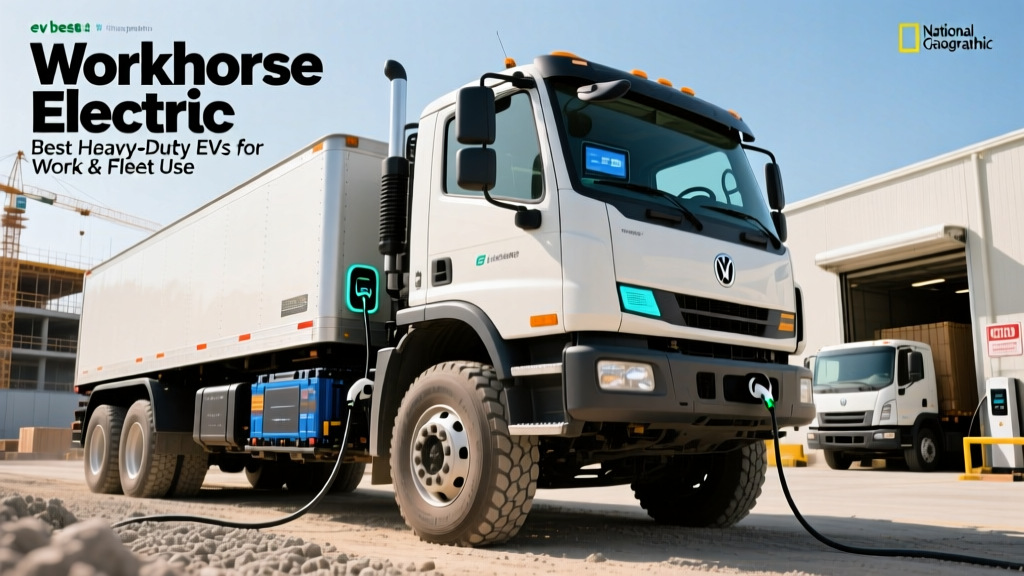
Workhorse electric vehicles — heavy-duty pickups and commercial vans designed for towing, hauling, and jobsite use — have matured into viable alternatives to gas and diesel trucks for many contractors and fleet operators. The top contenders in 2026 include the Ford F-150 Lightning (EPA range up to 320 miles, 10,000-lb towing), Rivian R1T Tri Motor (up to 420 miles, 11,000-lb towing), Chevrolet Silverado EV (up to 492 miles, 12,500-lb towing), and commercial vans like the Ford E-Transit (126-mile range, targeted at last-mile fleets). Real-world range under load drops 25–40% when towing at capacity. Purchase prices start around $55,000 for base Lightnings and climb past $100,000 for fully loaded Silverado EVs. The federal §30D tax credit of up to $7,500 applies to qualifying models, subject to MSRP caps ($80,000 for trucks/vans), buyer income limits, and battery-sourcing requirements. For buyers with home Level 2 charging and predictable daily routes under 200 miles, the total cost of ownership can undercut diesel by $0.12–$0.18 per mile over five years.
Top Workhorse Electric Vehicles Compared
The workhorse EV segment spans half-ton pickups, heavy-duty commercial vans, and the emerging class of medium-duty chassis cabs. Here is how the leading models stack up on the specifications that matter for jobsite and fleet duty.
| Model (2026) | Battery (kWh usable) | EPA Range | Max Tow | Max Payload | Peak DC Charge | 10–80% Time | 0–60 mph | Base MSRP |
|---|---|---|---|---|---|---|---|---|
| Ford F-150 Lightning (Ext. Range) | 131 kWh (NMC) | 320 mi | 10,000 lb | 2,235 lb | 150 kW | ~41 min | 3.8 sec | $59,990 |
| Chevrolet Silverado EV 4WT | 200 kWh (NMC) | 492 mi | 12,500 lb | 1,800 lb | 350 kW | ~20 min | 4.5 sec | $74,900 |
| Rivian R1T Tri Motor | 149 kWh (NMC) | 420 mi | 11,000 lb | 1,764 lb | 220 kW | ~30 min | 3.0 sec | $99,900 |
| Ford E-Transit (Commercial Van) | 68 kWh (NMC) | 126 mi | N/A (cargo van) | 3,880 lb | 115 kW | ~45 min | N/A | $55,895 |
| GMC Sierra EV Denali | 200 kWh (NMC) | 440 mi | 12,000 lb | 1,800 lb | 350 kW | ~20 min | 4.3 sec | $99,495 |
Sources: EPA / fueleconomy.gov, manufacturer specification sheets. Real-world range when towing at max capacity typically drops 25–40%. Cold-weather range reduction (below 32°F) adds another 15–30% loss.
Workhorse EVs vs. Gas and Diesel Trucks: The Real Cost Breakdown
For fleet managers and owner-operators, the purchase price is only the opening move. The five-year total cost of ownership (TCO) is where electric workhorse vehicles make or break the business case. Below is a comparison of a Ford F-150 Lightning (Extended Range, ~$60K) against a comparably equipped gas F-150 3.5L EcoBoost (~$55K) over 5 years and 100,000 miles.
| Cost Category | F-150 Lightning (EV) | F-150 EcoBoost (Gas) |
|---|---|---|
| Purchase Price (MSRP) | $59,990 | $55,000 |
| Federal Tax Credit (§30D) | −$7,500 (if eligible) | $0 |
| Effective Purchase | $52,490 | $55,000 |
| Fuel / Energy (100K mi) | $5,400 (home L2, $0.14/kWh avg) | $14,000 (gas $3.50/gal, 18 MPG avg) |
| Maintenance (5 yr) | $1,800 | $4,500 |
| Insurance (5 yr avg) | $11,500 | $9,000 |
| Estimated Depreciation | $22,000 | $18,000 |
| 5-Year TCO | $93,190 | $90,500 |
| Cost Per Mile | $0.93 | $0.91 |
The EV breaks even or pulls ahead for operators who can charge primarily at home or at a depot on Level 2 power (roughly $0.10–$0.18/kWh) and who drive under 200 miles per day. Public DC fast charging at $0.35–$0.55/kWh erodes savings quickly. Fleet operators installing depot Level 2 chargers should budget $2,500–$6,000 per stall for equipment and electrical work, with potential panel upgrades adding $3,000–$8,000.
Towing, Payload, and the Range-Under-Load Reality
This is where workhorse electric vehicles diverge most sharply from their EPA stickers. The Silverado EV's 492-mile EPA rating is impressive on paper, but towing a 10,000-lb enclosed trailer at highway speeds in real-world testing yields 180–250 miles of effective range. The physics are unforgiving: aerodynamic drag scales with the square of speed, and rolling resistance climbs with weight.
Real-World Range Under Workload
Unloaded, 70-mph highway: Expect 80–90% of EPA range (e.g., F-150 Lightning Ext. Range: ~260–290 miles).
Towing at max capacity, 65 mph: Expect 45–60% of EPA range (e.g., Silverado EV: ~220–295 miles).
Cold weather (below 20°F), unloaded: Expect 65–75% of EPA range due to battery internal resistance and cabin heating demands.
Cold weather + towing: Combined losses can reduce range to 35–50% of EPA. Plan routes around charger availability.
For contractors running predictable local routes — a plumber doing 80 miles of service calls, a landscaper hauling 2,000 lbs of equipment 40 miles each way — the range is more than sufficient. For long-haul towing through rural corridors with sparse charging infrastructure, a diesel truck remains the pragmatic choice in 2026.
Charging Infrastructure: Depot, Home, and Jobsite
A workhorse EV is only as useful as its charging plan. Fleet buyers need to think in terms of kW, not just kWh. Here is the charging-speed landscape:
| Charging Level | Power (kW) | Miles Added/Hour | Typical Use Case | Install Cost |
|---|---|---|---|---|
| Level 1 (120V) | 1.4 kW | 3–5 mi/hr | Emergency / overnight top-off | $0 (existing outlet) |
| Level 2 (240V, 48A) | 11.5 kW | 25–35 mi/hr | Home garage / depot overnight | $1,500–$4,000 |
| Level 2 (240V, 80A) | 19.2 kW | 40–55 mi/hr | Fleet depot / heavy daily use | $3,000–$7,000 |
| DC Fast (150 kW) | 150 kW | ~350 mi/hr (peak) | Public / route charging | N/A (pay per use) |
| DC Fast (350 kW) | 350 kW | ~700 mi/hr (peak) | Silverado/Sierra EV capable | N/A (pay per use) |
Critical note on kW vs. kWh: kW measures power (how fast energy flows into the battery); kWh measures energy (the battery's total capacity). A 131 kWh battery charged at 150 kW does not fill in 52 minutes — the charge curve tapers significantly above 80% State of Charge to protect cell longevity. Expect the final 20% to take as long as the first 60%.
For fleet depots, installing 80A Level 2 circuits on a 200A service panel can support 2–3 trucks charging simultaneously overnight. Larger fleets may require a utility service upgrade ($10,000–$30,000+). Consult a licensed electrician and your utility about commercial EV charging rates and demand-charge structures before committing.
Tax Credits and Incentives for Commercial EV Buyers
The IRS §30D federal tax credit provides up to $7,500 for qualifying new EVs purchased for personal use, but commercial fleet buyers may instead qualify under the §45W Commercial Clean Vehicle Credit, which offers up to $7,500 for vehicles under 14,000 lbs GVWR and up to $40,000 for heavier vehicles. Key eligibility factors:
- MSRP cap (§30D personal use): Trucks, vans, and SUVs must be under $80,000 MSRP. The Silverado EV 4WT at $74,900 qualifies; the GMC Sierra EV Denali at $99,495 does not under §30D.
- Buyer income cap (§30D): Modified AGI must not exceed $150,000 (single) / $300,000 (joint).
- Battery sourcing: Critical minerals and battery components must meet phased-in domestic-sourcing thresholds that tighten annually through 2029.
- Point-of-sale transfer: Eligible buyers can transfer the credit to the dealer at purchase, reducing the out-of-pocket price immediately rather than waiting for tax filing.
- §45W (commercial): No income cap or MSRP cap, but the vehicle must be used primarily for business. Consult a tax professional for entity-structure implications.
State and local incentives vary widely — California's HVIP program, for example, offers substantial vouchers for commercial fleet electrification. Check your state energy office or the AFDC incentive database for current programs.
Common Misconceptions About Workhorse EVs
| Myth | Fact |
|---|---|
| "EVs can't tow anything useful." | The Silverado EV tows 12,500 lbs — competitive with many gas three-quarter-tons. The limitation is range under load, not capability. |
| "Batteries won't last in a work truck." | Manufacturer warranties cover 8 years/100,000 miles (Ford, GM) with a minimum 70% capacity retention threshold. Real-world degradation data from early F-150 Lightnings shows ~5–7% loss over 60,000 miles with normal charging habits. |
| "You'll be stranded on the jobsite." | The F-150 Lightning's Pro Power Onboard provides up to 9.6 kW of 240V output — enough to run power tools, job-site lighting, or a welder. The truck becomes a mobile generator, eliminating the need for a separate gas generator. |
| "EVs cost more to insure." | Partially true. EV insurance premiums run 10–25% higher on average due to higher repair costs for battery packs and aluminum-intensive structures. Shop multiple carriers — some now offer EV-specific policies. |
| "Cold weather makes them useless." | Cold reduces range 15–30%, but preconditioning (warming the battery while plugged in) recovers much of the charging-speed penalty. Heated seats and steering wheels use far less energy than cabin air heating. |
Decision Framework: Is a Workhorse EV Right for You?
Choose a Workhorse EV If:
- Your daily driving is under 200 miles (loaded) and you can charge overnight at home or a depot.
- You tow under 7,000 lbs for most jobs and need max towing only occasionally.
- You value Pro Power Onboard / V2L capability for running tools on-site without a generator.
- You qualify for the §30D or §45W tax credit, bringing effective purchase price near or below a gas equivalent.
- You operate in an area with reliable public DC fast charging for the occasional longer haul.
Stick With Gas or Diesel If:
- You regularly tow 8,000+ lbs over 200+ miles in a single day through areas with sparse charging.
- You operate in extreme cold (sustained below 0°F) with high daily mileage demands.
- You lack access to home or depot Level 2 charging and cannot install it (rented property, street parking, incompatible electrical panel).
- Your work requires PTO (power take-off) for hydraulic equipment that current EV platforms don't support.
Consider a PHEV or Hybrid If:
- You want electric-only commuting (30–50 miles) but need unlimited range for long towing days. The hybrid truck segment is still emerging — watch for upcoming PHEV half-ton offerings.
Frequently Asked Questions
What is the best workhorse electric vehicle for towing in 2026?
The Chevrolet Silverado EV leads with a 12,500-lb max tow rating and 492-mile EPA range (unloaded). However, real-world range while towing at capacity drops to roughly 220–295 miles. For shorter daily tows under 150 miles round-trip, the Ford F-150 Lightning offers a more accessible price point at ~$60K with 10,000-lb towing.
Can I use a workhorse EV as a mobile power source on the jobsite?
Yes. The F-150 Lightning's Pro Power Onboard delivers up to 9.6 kW through 240V and 120V outlets in the bed and cabin. The Silverado EV offers similar V2L (vehicle-to-load) capability. This can replace a 7,000–9,000W portable gas generator for most power-tool and lighting needs.
How long do EV truck batteries last, and what does replacement cost?
Ford, GM, and Rivian warrant their battery packs for 8 years / 100,000 miles, guaranteeing at least 70% capacity retention. Out-of-warranty replacement for a 131–200 kWh pack currently ranges from $18,000 to $35,000+ depending on the model. However, real-world data from high-mileage EVs suggests most packs retain 85–90% capacity at 150,000 miles with proper charging habits (avoiding frequent 100% charges and DC fast charging exclusively).
Do workhorse electric vehicles qualify for the $7,500 tax credit?
It depends on the model, your income, and battery-sourcing compliance. Under §30D for personal use, the truck must be under $80,000 MSRP and the buyer under income thresholds ($300K joint / $150K single). The F-150 Lightning and Silverado EV 4WT qualify on price; higher trims may not. For commercial use, the §45W credit has no MSRP or income cap. Always verify current eligibility on IRS.gov and consult a tax professional.
What charging setup do I need for a work truck EV at home?
A 240V / 48A Level 2 home charger (11.5 kW) adds roughly 25–35 miles per hour of charging and can fully replenish an F-150 Lightning's 131 kWh battery in about 12–14 hours — sufficient for overnight turnaround. Budget $1,500–$4,000 for equipment and electrician labor. If your home has a 100A electrical panel, a $2,000–$5,000 panel upgrade to 200A may be necessary. Always get a site assessment from a licensed electrician before purchasing equipment.