Can You Drive for Uber with an Electric Car?
Yes — and in most markets, driving for Uber with an electric car is significantly more profitable than using a gas vehicle, provided you have reliable access to affordable charging. A typical full-time rideshare driver covering 40,000 miles per year can save $3,000–$5,500 annually on energy alone by switching from a 30 MPG gas sedan to a modern EV. Add in Uber's Zero Emissions incentive (an extra $1 per trip, capped at $4,000/year in eligible markets) and dramatically lower maintenance costs, and the math favors EVs — but only if your daily route, charging access, and climate align. Below, we break down every number you need to decide.
The Economics: EV vs. Gas for Rideshare Driving
Rideshare driving is a high-mileage, cost-sensitive business. Your vehicle is a revenue tool, and every dollar spent on fuel, maintenance, and depreciation comes directly out of your earnings. Let's compare the real operating costs of a popular EV (the 2026 Tesla Model 3 Rear-Wheel Drive) against the rideshare-favorite gas sedan (the 2026 Toyota Camry LE) over a realistic 40,000-mile driving year.
| Cost Category | 2026 Tesla Model 3 RWD (EV) | 2026 Toyota Camry LE (Gas) |
|---|---|---|
| Base MSRP | $38,990 | $28,400 |
| Est. price after §30D credit & incentives | ~$31,490 (if eligible) | $28,400 |
| Energy/fuel cost per mile | $0.04–$0.06 (home L2) / $0.10–$0.15 (public DCFC) | $0.12–$0.16 (at $3.50/gal, 32 MPG combined) |
| Annual energy cost (40k mi) | $1,600–$2,800 | $4,375–$5,000 |
| Annual maintenance | $300–$500 | $1,200–$1,800 |
| Uber Zero Emissions bonus | Up to $4,000/year | $0 |
| 5-year total operating cost (energy + maint.) | $9,500–$16,500 | $27,875–$34,000 |
| Estimated 5-yr depreciation | ~$16,000–$19,000 | ~$11,000–$13,000 |
The takeaway: Even accounting for higher upfront cost and steeper depreciation, the EV saves a full-time rideshare driver roughly $12,000–$18,000 over five years in combined energy and maintenance savings, plus up to $20,000 in Uber EV bonuses. The breakeven point typically arrives within 18–24 months of full-time driving.
Best Electric Cars for Uber in 2026
Not every EV is suited for rideshare. You need a combination of rear-seat space, cargo room, real-world range above 250 miles, fast DC charging, and a price that keeps your per-mile cost low. Here are the top contenders based on current model-year specs:
| Vehicle | EPA Range | Battery (kWh) | DC Fast Charge (peak kW) | 10–80% Time | Base MSRP | Uber Tier Eligibility |
|---|---|---|---|---|---|---|
| 2026 Tesla Model 3 RWD | 341 mi | 60 (LFP) | 170 kW | ~25 min | $38,990 | UberX, Comfort (varies) |
| 2026 Tesla Model Y LR AWD | 320 mi | 78 (NMC) | 250 kW | ~18 min | $44,990 | UberX, Comfort, XL (some markets) |
| 2026 Hyundai Ioniq 6 SEL | 361 mi | 77.4 (NMC) | 240 kW | ~18 min | $42,200 | UberX, Comfort |
| 2026 Chevrolet Equinox EV LT | 319 mi | 85 (NMC) | 150 kW | ~30 min | $34,900 | UberX |
| 2026 Kia EV6 Wind RWD | 310 mi | 77.4 (NMC) | 240 kW | ~18 min | $43,500 | UberX, Comfort |
Our pick for most rideshare drivers: The Tesla Model Y Long Range. Its Supercharger network access remains the most reliable public charging ecosystem in the U.S., the 320-mile EPA range translates to roughly 260–280 real-world highway miles, and the crossover body fits luggage for airport runs. The Model 3 is the budget play — lower cost, LFP battery chemistry that tolerates daily 100% charging without accelerated degradation, and sufficient rear-seat space for UberX.
Important real-world range note: EPA range is measured under ideal conditions. For rideshare driving — which involves stop-and-go city traffic, HVAC use, frequent door openings, and passenger weight — expect to achieve 80–90% of EPA range in moderate weather and 65–75% in freezing temperatures. A 341-mile EPA Model 3 might deliver 240 miles of usable range on a cold January day in Chicago. Plan your charging around that reality.
Charging Logistics: The Make-or-Break Factor
The single biggest variable in whether an EV works for Uber is your charging situation. Here's the honest breakdown:
Home Charging (Level 2) — The Ideal Scenario
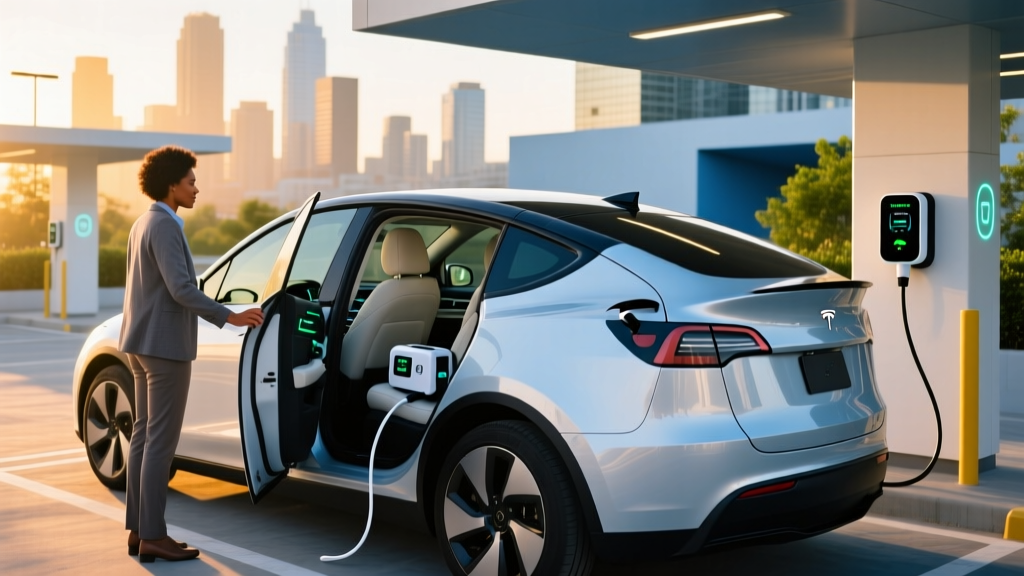
Installing a 240V Level 2 home charger (48A, ~11.5 kW) lets you wake up to a full battery every morning. For a 60 kWh battery (Model 3 RWD), a full charge takes roughly 5–6 hours. A 78 kWh battery (Model Y LR) takes 7–8 hours. Overnight charging at residential electricity rates ($0.10–$0.18/kWh national average) keeps your per-mile energy cost at $0.03–$0.06 — a fraction of gas.
Home installation cost: Expect $800–$2,500 for a professional Level 2 install if your electrical panel has capacity. If you need a panel upgrade (100A to 200A), add $1,500–$3,500. Check with a licensed electrician for your specific situation. Many utilities offer rebates of $250–$750 for charger installation.
Public DC Fast Charging — The Road- warrior Reality
If you don't have home charging, you'll rely on public DC fast chargers. Here's what that looks like in practice:
| Charging Level | Power (kW) | Miles Added per Hour | Cost per kWh | Cost per Mile |
|---|---|---|---|---|
| Level 1 (120V household) | 1.4 kW | 3–5 mi/hr | $0.10–$0.18 | $0.03–$0.05 |
| Level 2 (240V home/public) | 7.7–11.5 kW | 25–44 mi/hr | $0.10–$0.30 | $0.03–$0.09 |
| DC Fast (50–150 kW) | 50–150 kW | 150–400 mi/hr | $0.30–$0.55 | $0.09–$0.16 |
| DC Ultra-Fast (250–350 kW) | 250–350 kW | 600–1,000+ mi/hr | $0.35–$0.60 | $0.10–$0.18 |
Critical note on charge curves: No EV sustains its peak charge rate for an entire session. A vehicle rated at 250 kW peak might only hold that rate from 10–30% State of Charge (SoC), then taper to 150 kW, then drop further above 60%. That's why manufacturers quote 10–80% times rather than 0–100%. For rideshare, plan to charge from 15–20% up to 80% during meal breaks — that's your most time-efficient window.
Exclusive-reliance warning: If you DC fast charge exclusively at $0.40/kWh average, your per-mile cost rises to $0.12–$0.15 — approaching gas-car territory. The EV economics only fully work with regular access to Level 2 charging at home, at a depot, or at subsidized public stations. Many cities now offer discounted EV charging for rideshare drivers; check with your local Uber Green hub or municipal transit authority.
Real Costs and Savings: A Full-Time Driver's Year
Let's model a realistic year for a full-time Uber driver in a mid-cost metro area (think Atlanta, Phoenix, or Denver), driving 40,000 miles annually with a mix of 70% home charging and 30% public DC fast charging.
| Line Item | EV (Model 3 RWD) | Gas (Camry LE) |
|---|---|---|
| Vehicle purchase (after credits) | $31,490 | $28,400 |
| Year 1 energy/fuel | $2,200 | $4,700 |
| Year 1 maintenance | $350 | $1,400 |
| Year 1 insurance (rideshare endorsement) | $2,800 | $2,400 |
| Uber EV bonus earned | –$3,800 | $0 |
| Year 1 tire replacement (EVs wear tires faster) | $900 | $600 |
| Year 1 net operating cost | $2,450 | $9,100 |
| Year 1 net advantage (EV) | +$6,650 saved | |
Maintenance reality: EVs eliminate oil changes, transmission fluid, spark plugs, and exhaust repairs. Brake wear is dramatically reduced thanks to regenerative braking (many EV owners report original brake pads at 80,000+ miles). The main consumables are tires (EVs are heavier and deliver instant torque, wearing tires 20–30% faster), cabin air filters, windshield washer fluid, and wiper blades.
Insurance note: EV insurance premiums for rideshare tend to run 10–25% higher than equivalent gas vehicles due to higher repair costs after collisions (specialized parts, battery safety protocols). Get quotes before purchasing — the difference varies significantly by state and insurer.
Federal Tax Credits and Incentives for Rideshare EVs
The IRS §30D Clean Vehicle Credit can reduce your effective purchase price by up to $7,500, but eligibility has strict requirements as of 2026:
- MSRP cap: Sedans must be under $55,000; SUVs/trucks/vans under $80,000
- Buyer income cap: Modified AGI must not exceed $150,000 (single) / $300,000 (joint)
- Battery sourcing: Increasing percentages of critical minerals and battery components must be sourced from the U.S. or free-trade-agreement countries — this requirement tightens annually and disqualifies some models
- Point-of-sale transfer: You can transfer the credit to the dealer at purchase for an immediate price reduction, or claim it on your tax return
- Commercial use note: If you purchase the vehicle primarily for business (rideshare), you may alternatively qualify under the §45W Commercial Clean Vehicle Credit, which has different rules — consult a tax professional
Additionally, many states and utilities offer stacked incentives: California's CARB programs, Colorado's state EV credit, and utility-company rebates can bring total incentives to $10,000–$15,000 in favorable jurisdictions. Always verify current rules on irs.gov and your state's energy office before purchasing.
Common Misconceptions About Uber with an Electric Car
| Myth | Fact |
|---|---|
| "The battery will die before I pay off the car." | Modern EV batteries (especially LFP chemistry) retain 85–92% capacity at 150,000 miles. Federal warranty mandate requires 8 years/100,000 miles minimum battery coverage. Tesla, Hyundai, and Kia offer 8yr/100k–150k warranties. Rideshare drivers report 200,000+ miles on original batteries. |
| "I'll spend hours charging during shifts." | With planning, most drivers charge once during a meal break: 15–25 minutes at a DC fast charger adds 150–200 miles. Home charging happens overnight while you sleep — zero shift time lost. |
| "EVs can't handle winter." | Cold weather reduces range 20–35%, but preconditioning (warming the battery while plugged in) mitigates this significantly. Drivers in Minneapolis and Boston run EVs year-round — they just plan for shorter effective range and charge more frequently in winter. |
| "Passengers won't want to ride in an EV." | Uber data and driver reports consistently show neutral-to-positive rider feedback. Many passengers specifically appreciate the quiet, smooth ride. EVs qualify for Uber Green, which can attract eco-conscious riders willing to pay a small premium. |
| "Charging costs more than gas." | At home on Level 2: $0.03–$0.06/mile vs. $0.12–$0.16/mile for gas. Only exclusive reliance on premium-priced DC fast chargers ($0.50+/kWh) approaches gas costs. Most drivers mix home and public charging. |
Decision Framework: Should You Drive for Uber with an EV?
Choose an EV for Uber IF:
- You have (or can install) Level 2 home charging — this is the single most important factor
- You drive in a metro area with decent public charging infrastructure (Tesla Superchargers, Electrify America, EVgo, ChargePoint)
- Your typical daily mileage is under 250 miles (leaving a buffer for range loss)
- You plan to drive full-time or near-full-time (high mileage maximizes fuel savings)
- You qualify for the §30D tax credit or state incentives that narrow the upfront price gap
- You're in a market where Uber's Zero Emissions bonus ($1/trip) is active
Stick with gas or hybrid IF:
- You live in an apartment or street-park with zero access to home or depot charging
- You regularly drive 300+ miles per day in rural or charging-desert areas
- You live in an extreme cold climate and can't accommodate the 25–35% winter range reduction in your schedule
- Your budget can't accommodate the higher upfront cost even after incentives
- You need maximum vehicle flexibility for towing, off-road, or long rural trips beyond rideshare
Consider a PHEV (plug-in hybrid) as a middle ground IF:
- You have home charging but want gas backup for long trips
- A vehicle like the 2026 Toyota Prius Prime (44 mi electric-only, 52 MPG combined on gas) lets you do short city trips on electricity while retaining unlimited range
- You're not ready to commit to full electric but want partial savings
Frequently Asked Questions
Does Uber require a specific EV model or year?
Uber's vehicle requirements vary by city, but generally any 4-door EV that is 10 model years old or newer, seats at least 4 passengers plus the driver, and passes a vehicle inspection is eligible for UberX. For Uber Comfort, you typically need a mid-size or larger vehicle with extra legroom. Check your local Uber market's approved vehicle list for specifics.
How does Uber's EV bonus work?
Uber's Zero Emissions program adds $1 per completed trip for drivers using a fully electric vehicle, capped at $4,000 per year in eligible markets. Some cities also offer Uber Green, where riders opt in and pay a small surcharge that goes partly to the driver. Availability varies — check the Uber driver app in your market.
Will fast charging every day destroy my EV battery?
Modern battery management systems handle daily DC fast charging well, but exclusive reliance on DCFC does accelerate degradation slightly. Data from fleet operators shows batteries charged primarily via DCFC retain roughly 85–88% capacity at 100,000 miles vs. 90–93% for primarily Level 2 charging. LFP batteries (in the Model 3 RWD) are particularly resilient to frequent charging. The practical impact is modest — you might lose 15–20 miles of range over 100,000 miles of heavy DCFC use.
What happens if I run out of charge mid-shift?
Plan proactively: set your app to go offline at 20% SoC and navigate to a charger. Most EV navigation systems (Tesla, Hyundai, Kia) route through chargers automatically and precondition the battery for faster charging. If you do run out, roadside assistance can provide a flatbed tow to the nearest charger — EVs cannot be towed with wheels on the ground without drivetrain damage. AAA and many insurance policies now include EV-specific roadside assistance.
Is a used EV a good option for rideshare?
A used EV can work well, but check three things: (1) battery State of Health (SoH) — request a diagnostic showing remaining capacity percentage; (2) remaining warranty — the battery warranty must have at least 2–3 years of coverage left for rideshare viability; (3) model-year vehicle eligibility — Uber typically requires vehicles within 10 model years. The federal used-EV credit (§25E) offers up to $4,000 (30% of sale price, capped) on EVs priced under $25,000 from a dealer, with buyer income caps of $75,000 single / $150,000 joint.
Do EVs qualify for Uber Black or Uber SUV?
Yes, in many markets. The Tesla Model S, Model X, BMW iX, Mercedes EQS, and Lucid Air qualify for Uber Black in most cities. The Tesla Model Y and Hyundai Ioniq 5 may qualify for Uber SUV depending on the market. Higher-tier services pay better per mile, but the vehicle cost is substantially higher. Run the numbers for your specific market before committing to a luxury EV for rideshare.