The Short Answer on Tiny Electric Vehicles
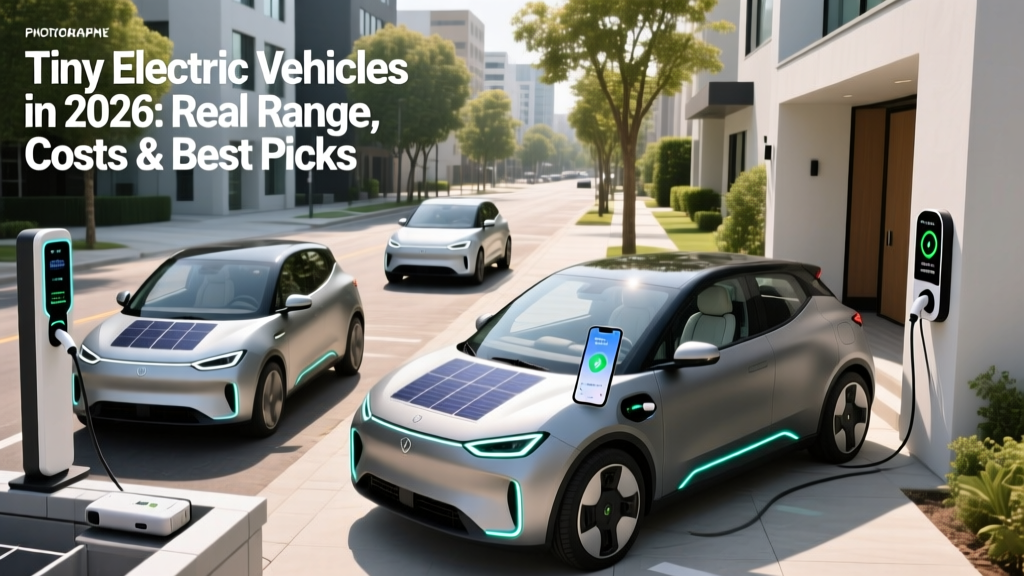
Tiny electric vehicles (micro-EVs and subcompact EVs) in 2026 offer 100–250 miles of EPA range, starting between $28,000 and $38,000 before incentives. They cost roughly $0.04–$0.06 per mile to charge at home versus $0.12–$0.16 per mile for a comparable gas car, but their small batteries (40–65 kWh) mean DC fast charging typically peaks at 75–150 kW, adding 10–80% in 25–40 minutes. They work best for urban commuters with Level 2 home charging and daily drives under 60 miles.
What Counts as a Tiny Electric Vehicle in 2026?
The term "tiny electric vehicles" covers two distinct categories that buyers frequently conflate. Understanding the difference matters for safety, highway legality, and real-world usability.
Subcompact EVs are full-featured, federally legal, crash-tested passenger vehicles. Examples include the Chevrolet Equinox EV (base LT trim), Nissan Leaf, Mini Cooper Electric, and Fiat 500e. They carry 40–65 kWh battery packs, qualify for standard registration and insurance, and meet NHTSA crash standards.
Neighborhood Electric Vehicles (NEVs) or Low-Speed Vehicles (LSVs) are federally limited to 25 mph top speed, lack airbags and modern crash structures, and are restricted to roads with speed limits of 35 mph or less in most jurisdictions. Brands like GEM, Arcimoto, and various Chinese-market imports fall here. They are not substitutes for a primary vehicle.
This guide focuses on subcompact, highway-capable EVs—the vehicles buyers actually cross-shop against gas-powered compacts like the Honda Civic or Toyota Corolla.
Spec Snapshot: Leading Tiny EVs Compared
| Model (2025–2026) | EPA Range | Battery (kWh) | Peak DC kW | 10–80% Time | 0–60 mph | Base MSRP |
|---|---|---|---|---|---|---|
| Chevrolet Equinox EV LT | 315 mi | 85 kWh (NMC) | 150 kW | ~30 min | 8.0 sec | $33,600 |
| Nissan Leaf S | 149 mi | 40 kWh (LMO/NMC) | 50 kW | ~40 min | 7.9 sec | $28,140 |
| Mini Cooper Electric SE | 114 mi | 54.2 kWh (NMC) | 95 kW | ~28 min | 7.3 sec | $30,900 |
| Fiat 500e | 149 mi | 42 kWh (NMC) | 85 kW | ~35 min | 9.0 sec | $32,500 |
| Hyundai Kona Electric SE | 261 mi | 64.8 kWh (NMC) | 100 kW | ~41 min | 7.8 sec | $32,975 |
Sources: fueleconomy.gov, manufacturer press sites. EPA range is the combined cycle sticker; real-world highway and cold-weather results will be lower (see below).
Tiny EVs vs Gas Compacts: Cost & Efficiency Data
Buyers evaluating tiny electric vehicles usually cross-shop against gas compacts in the $24,000–$30,000 range. Here is how a typical subcompact EV stacks up against a 30-MPG gas compact over five years and 60,000 miles.
| Category | Tiny EV (e.g., Kona Electric) | Gas Compact (30 MPG combined) |
|---|---|---|
| Purchase price (avg.) | $33,000 | $27,000 |
| Federal §30D credit (if eligible) | Up to $7,500 | $0 |
| Effective purchase price | ~$25,500 | $27,000 |
| Fuel/energy cost (60k mi) | $2,100 (home L2 @ $0.14/kWh) | $7,000 ($3.50/gal) |
| Maintenance (60k mi) | ~$600 | ~$2,400 |
| 5-year insurance (avg.) | $8,500 | $7,200 |
| Estimated 5-year total cost | ~$36,700 | ~$43,600 |
The EV wins on operating cost by a wide margin, but two caveats apply. First, EV insurance premiums run 15–25% higher on average due to battery repair costs. Second, the federal §30D credit has income caps ($150K single / $300K joint), MSRP caps ($55K for cars), and battery-sourcing requirements that change annually. Always verify current-year eligibility at IRS.gov or confirm point-of-sale transfer with your dealer before signing.
Real-World Range Reality Check
The EPA sticker is a combined-cycle estimate. In real-world testing, expect:
- Highway driving (70+ mph): subtract 15–20% from the EPA number.
- Cold weather (below 32°F): subtract 20–35%, especially in EVs without a heat pump.
- Combined highway + cold: a 149-mile Leaf can realistically deliver 85–100 miles before requiring a charge.
If your daily round-trip commute is 60 miles, a 150-mile EPA vehicle leaves slim margin in winter. A 250+ mile EPA vehicle is the safer minimum for drivers without reliable midday charging.
Real Ownership Costs: Charging, Maintenance, and the Home-Install Factor
| Cost Item | Typical Range | Notes |
|---|---|---|
| Level 2 home charger (hardware) | $400–$750 | 40-amp / 9.6 kW units from ChargePoint, Emporia, Wallbox |
| Electrician install (240V/50A circuit) | $600–$2,000 | Depends on panel proximity; panel upgrade adds $1,500–$3,500 |
| Electricity cost (home, national avg.) | $0.14–$0.18/kWh | Varies widely; California ~$0.30, Washington ~$0.10 |
| Public DC fast charging | $0.35–$0.55/kWh | Electrify America, EVgo, Tesla Supercharger rates |
| Tire replacement (every 30–40k mi) | $600–$1,000 | EVs wear tires faster due to instant torque and weight |
| Battery out-of-warranty replacement | $8,000–$18,000 | Rare before 150k mi; federal warranty mandate is 8 yr / 100k mi |
Home charging access is the single biggest predictor of EV satisfaction. If you can install a Level 2 charger, a 40 kWh Leaf replenishes fully in about 5 hours overnight. Without home charging, relying on public DC fast chargers at $0.45/kWh roughly doubles your per-mile cost and adds 30–40 minutes of waiting per session. Renters and apartment dwellers should investigate workplace charging, municipal Level 2 stations, and NACs/CCS adapter needs before purchasing.
Common Misconceptions About Tiny EVs
| Myth | Fact |
|---|---|
| "Tiny EVs are unsafe." | Modern subcompact EVs undergo full NHTSA and IIHS crash testing. The Kona Electric earned IIHS Top Safety Pick status. NEVs/LSVs are a different (unsafe) category entirely. |
| "The battery will need replacement in 5 years." | Lithium-ion packs in liquid-cooled EVs typically retain 85–92% capacity at 100,000 miles. Federal law mandates 8-year/100,000-mile battery warranty coverage. |
| "Tiny EVs save no money." | At national-average electricity and gas prices, a 250-mile subcompact EV saves $4,000–$6,000 in fuel and maintenance over 5 years—often enough to offset the higher purchase price even without the tax credit. |
| "I can use any public charger." | Connector compatibility varies. Nissan Leaf uses CHAdeMO (declining network support). Most 2025+ models use CCS1 or NACS (Tesla standard). Verify your vehicle's connector and the dominant networks in your area. |
| "All tiny EVs qualify for the $7,500 credit." | §30D eligibility requires the buyer to meet income caps, the vehicle to be under the MSRP cap, and the battery to meet critical-mineral and component sourcing thresholds. Several subcompact EVs qualify for only $3,750 or $0 in 2026. |
Decision Framework: Should You Buy a Tiny Electric Vehicle?
If-Then Buying Guide
- IF your daily round-trip is under 50 miles AND you can install Level 2 home charging → THEN a 150-mile EPA subcompact (Leaf, Fiat 500e) is a strong, affordable choice.
- IF your commute is 50–100 miles OR you face cold winters → THEN choose a 250+ mile EPA model (Kona Electric, Equinox EV) with a heat pump to preserve range.
- IF you lack home charging AND have no workplace charger → THEN a tiny EV will likely frustrate you. Consider a PHEV (Toyota Prius Prime, 44 mi electric range) instead.
- IF you regularly drive 300+ miles on weekends → THEN a tiny EV's 75–150 kW DC charge rate means 30–45 minute stops every 150–200 miles. A larger-battery EV (Hyundai Ioniq 5, 240 kW peak) or a PHEV is more practical.
- IF you need a second car for neighborhood errands only, on low-speed roads → THEN a NEV/LSV may work, but understand its crash-safety and speed limitations.
First-Time Tiny EV Buyer Checklist
- Verify your electrical panel.A 50-amp circuit for Level 2 charging requires spare panel capacity. Have a licensed electrician assess before committing.
- Check §30D eligibility now.Income, MSRP, and battery-sourcing rules change annually. Use the IRS clean-vehicle credit page and confirm point-of-sale transfer availability with the dealer.
- Identify your connector.NACS (Tesla), CCS1 (most brands), or CHAdeMO (Nissan Leaf). Download the relevant network apps (Tesla, Electrify America, EVgo) and map chargers on your common routes.
- Test cold-weather range.If you live north of the 37th parallel, request a winter test drive or consult owner forums for real SoC data in your climate.
- Get insurance quotes before buying.EV premiums vary by model; a Leaf may cost 10% more to insure than a Corolla, while a Kona Electric may cost 20% more.
- Read the battery warranty fine print.Federal mandate is 8 years/100,000 miles with capacity retention typically guaranteed above 70% of original kWh.
Are tiny electric vehicles good for long road trips?
Generally no. A 150-mile EPA subcompact EV requires DC fast charging every 100–120 real-world miles, and at 50–100 kW peak rates, each stop takes 30–45 minutes. Occasional road trips are feasible with planning; frequent long-distance drivers should look at 300+ mile EVs or a PHEV.
Do tiny EVs qualify for the federal tax credit?
Some do, but eligibility depends on the buyer's income (under $150K single / $300K joint), the vehicle's MSRP (under $55K for cars), and battery-sourcing compliance. The Nissan Leaf and certain trims of the Equinox EV have qualified for the full $7,500 in recent years, but rules tighten annually. Confirm at IRS.gov for the current tax year.
What happens if the battery degrades?
Modern liquid-cooled NMC packs lose roughly 1–2% capacity per year under normal use. After 8 years, expect 85–92% of original capacity. If degradation exceeds the warranty threshold (typically 70%), the manufacturer must repair or replace the pack at no cost.
Can I charge a tiny EV on a standard 120V outlet?
Yes, but Level 1 charging delivers only 1.0–1.4 kW—about 3–5 miles of range per hour. A 40 kWh Leaf takes roughly 30 hours from empty on a standard outlet. Level 1 works as a supplement for low-mileage drivers but is inadequate as a primary charging method.
How do tiny EVs handle in snow and cold?
Cold reduces battery efficiency by 20–35% below freezing, primarily due to cabin heating demands. Models equipped with a heat pump (Equinox EV, Kona Electric) lose less range than those using resistive heating (older Leaf trims). Winter tires are strongly recommended; EVs are heavier than gas equivalents, which aids traction but increases braking distance.