The Short Answer on Tiny Electric Trucks
If you want a compact, city-friendly electric pickup, your best current option is the Hyundai Santa Cruz EV (announced for late 2026) or converting your expectations toward the Ford Maverick Hybrid until more dedicated tiny electric trucks reach dealers. The compact truck segment remains largely gas and hybrid in 2026, but upcoming battery-electric entries promise 250+ miles of EPA range, ~150 kW DC fast charging, and starting prices in the $30,000–$38,000 range. For now, the closest you can get to a tiny electric truck experience is a used Rivian R1T (which is midsize, not tiny) or waiting for Hyundai's unibody electric pickup built on the e-IM platform.
What Counts as a Tiny Electric Truck in 2026?
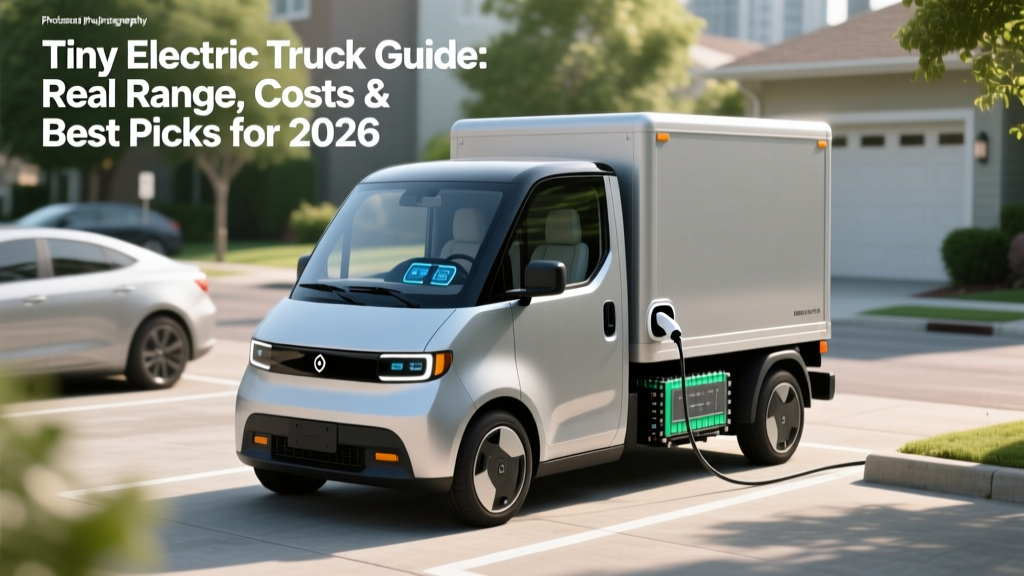
The term "tiny electric truck" typically refers to a compact or subcompact pickup with a bed under 5 feet, a footprint shorter than 190 inches, and a curb weight under 4,500 lbs. Think of the dimensions of a Ford Maverick or Hyundai Santa Cruz, but with a battery-electric powertrain instead of a turbocharged four-cylinder or hybrid system.
As of early 2026, no mass-market automaker sells a brand-new tiny electric truck in the United States. Here's what exists and what's coming:
| Model | Status | Powertrain | EPA Range | Base MSRP |
|---|---|---|---|---|
| Ford Maverick | On sale | Hybrid / Gas | N/A (42 MPG combined hybrid) | $28,145 |
| Hyundai Santa Cruz | On sale | Gas / Turbo | N/A (23 MPG combined) | $28,425 |
| Hyundai Santa Cruz EV | Announced (late 2026) | BEV (e-IM platform) | ~250 mi (est.) | ~$35,000 (est.) |
| Rivian R1T | On sale | BEV | 270–420 mi | $69,900 |
| Tesla Cybertruck | On sale | BEV | 250–340 mi | $79,990 |
The Maverick and Santa Cruz are tiny trucks, but neither is electric yet. The R1T and Cybertruck are electric, but neither is tiny — they're midsize to full-size pickups weighing 7,000+ lbs. The gap in the market is exactly what makes the tiny electric truck search volume grow: buyers want Maverick dimensions with EV running costs.
EV Compact Truck vs Gas and Hybrid: The Real Numbers
Until a dedicated tiny electric truck ships, the most useful comparison is between the Ford Maverick Hybrid (the current efficiency king of compact trucks) and what a battery-electric equivalent would deliver based on current EV powertrain benchmarks.
| Metric | Ford Maverick Hybrid (2026) | Estimated Tiny Electric Truck (2026–2027) |
|---|---|---|
| Powertrain | 2.5L 4-cyl + electric motor | Dual-motor BEV, ~75 kWh NMC |
| Combined Efficiency | 42 MPG | ~105 MPGe / 32 kWh/100mi |
| Range | ~500 mi (16.5-gal tank) | ~250 mi (EPA est.) |
| 0–60 mph | ~7.8 sec | ~5.5 sec (est.) |
| Fuel/Energy Cost per Mile | ~$0.11 (at $3.30/gal) | ~$0.04 (home charging, $0.13/kWh) |
| Annual Fuel/Energy (12k mi) | ~$1,320 | ~$480 |
| Maintenance (annual avg) | ~$450 | ~$150 |
| Base MSRP | $28,145 | ~$35,000 (est.) |
The hybrid Maverick wins on total range and upfront cost. The theoretical tiny electric truck wins on per-mile energy cost, acceleration, and maintenance — saving roughly $1,140/year in combined fuel and maintenance. Over a 5-year ownership period, that's $5,700 in operational savings, partially offsetting the higher purchase price.
Charging Reality: What a Tiny EV Truck Owner Needs
Assuming a 75 kWh battery pack and typical compact-EV charging architecture, here's what charging looks like for a future tiny electric truck:
| Charging Level | Power (kW) | Miles Added per Hour | Use Case |
|---|---|---|---|
| Level 1 (120V outlet) | 1.4 kW | ~4 mi/hr | Overnight trickle; adds ~50 mi in 12 hrs |
| Level 2 (240V, 32A) | 7.7 kW | ~24 mi/hr | Home daily charging; full charge in ~10 hrs |
| Level 2 (240V, 48A) | 11.5 kW | ~36 mi/hr | Faster home charging; full charge in ~7 hrs |
| DC Fast Charge | ~150 kW peak | N/A | 10–80% in ~25 min; tapers above 80% |
Real-world charging note: Peak DC fast-charge rates of 150 kW are not sustained across the entire session. Expect the charge curve to taper significantly above 80% State of Charge (SoC), meaning a 10–80% session takes roughly 25 minutes, but pushing from 80–100% can add another 20+ minutes. For road trips, plan stops around the 10–80% window for efficiency.
Home charging access is the make-or-break factor. If you have a garage or driveway with access to a 240V circuit (or can install one), daily charging is seamless — plug in overnight, wake up to a full battery. A Level 2 home charger installation typically costs $800–$2,200 including equipment and electrician labor, depending on panel capacity and run length. If you rely solely on public charging, your per-mile cost rises to $0.10–$0.15/mi (comparable to the hybrid Maverick), and convenience drops sharply. Apartment dwellers without charging access should strongly consider the Maverick Hybrid instead.
Ownership Costs: 5-Year Breakdown
| Cost Category | Ford Maverick Hybrid | Est. Tiny Electric Truck |
|---|---|---|
| Purchase Price (base) | $28,145 | $35,000 |
| Federal Tax Credit (§30D) | $0 | Up to $7,500* |
| Effective Purchase Price | $28,145 | $27,500 |
| Home Charger Install | $0 | $1,200 (avg) |
| Energy/Fuel (5 yrs, 60k mi) | $6,600 | $2,400 |
| Maintenance (5 yrs) | $2,250 | $750 |
| Insurance (5 yrs, avg) | $6,500 | $7,500 |
| 5-Year Total Cost | $43,495 | $39,350 |
*Federal §30D tax credit eligibility depends on MSRP caps (trucks: $80,000), buyer income limits ($150k single / $300k joint AGI), and battery component/critical mineral sourcing requirements per IRS guidelines. Point-of-sale transfer is available if the dealer is registered. Always verify current-year eligibility with a tax professional.
The tiny electric truck, assuming a $7,500 credit applies, actually edges out the Maverick Hybrid on 5-year total cost by roughly $4,100 — despite a higher sticker price. The savings come primarily from energy and maintenance. However, insurance tends to run 10–15% higher on EVs due to battery replacement costs and specialized repair requirements.
Common Misconceptions About Tiny Electric Trucks
| Myth | Fact |
|---|---|
| "A tiny electric truck can't tow anything." | Even compact EVs produce 300+ lb-ft of instant torque. A 75 kWh electric truck should tow 2,000–3,500 lbs — adequate for a small trailer, jet skis, or a lightweight camper. Check the specific model's rated capacity. |
| "The battery will need replacing in 5 years." | Modern NMC and LFP batteries are warrantied for 8 years/100,000 miles with a capacity retention threshold of 70%. Real-world data from the DOE shows most EV batteries lose 10–15% capacity over 150,000 miles — not catastrophic. |
| "I'll never find a charger on road trips." | The U.S. now has over 70,000 public charging ports. The Tesla Supercharger network (now open to NACS-equipped non-Tesla vehicles via adapter) and Electrify America cover most interstate corridors. Rural gaps remain real, though. |
| "Cold weather makes EV trucks useless." | Cold weather reduces range by 20–35% depending on temperature and whether you use cabin heat. A 250-mile EPA truck might deliver 170–200 miles at 20°F. Preconditioning the battery while plugged in mitigates charging-speed loss. This is a real limitation — not a dealbreaker for most, but critical for cold-climate buyers. |
| "I can just use a regular outlet and be fine." | Level 1 charging at 1.4 kW adds roughly 4 miles per hour. If you drive 40 miles daily, you'd need 10 hours plugged in just to recover. Level 2 home charging is strongly recommended for any EV truck owner. |
Who Should Wait, Who Should Buy Now
Buy the Ford Maverick Hybrid NOW if:
- You need a compact truck today and can't wait for 2027 model availability
- You lack reliable home charging access (apartment, street parking)
- You regularly drive 400+ miles between stops and don't want to plan around chargers
- Your budget is firm under $32,000 out the door
- You live in an area with limited public DC fast-charging infrastructure
Wait for a tiny electric truck if:
- You have home Level 2 charging (or can install it)
- Your daily commute is under 80 miles round-trip
- You want lower per-mile operating costs and minimal maintenance
- You qualify for the §30D tax credit (check income and sourcing rules on irs.gov)
- You value instant torque, a frunk (front trunk), and one-pedal driving around town
- You can wait 12–18 months for announced models to reach production
Consider a used Rivian R1T if:
- You want an electric truck today with real off-road capability
- Your budget allows $45,000–$60,000 on the used market
- You accept midsize dimensions (217 inches long) rather than "tiny"
- The EPA-rated 270+ mile range works for your driving patterns
What First-Time EV Truck Buyers Must Know
If you've never owned an electric vehicle, a few realities will shape your experience more than any spec sheet:
kW vs kWh — the critical distinction. Kilowatts (kW) measure power — how fast energy flows into the battery during charging. Kilowatt-hours (kWh) measure energy capacity — how much the battery holds total. A 75 kWh battery charged at 11.5 kW takes roughly 6.5 hours from empty to full. A 150 kW DC fast charger can refill that same battery much faster, but only up to ~80% SoC before tapering.
EPA range vs real-world range. The EPA range sticker assumes a mix of city and highway driving at moderate temperatures. In practice, sustained highway driving at 75+ mph reduces range by 10–15%. Cold weather (below 30°F) can cut range by 20–35%. Towing can reduce range by 40–50%. Plan your trips around the worst-case scenario, not the sticker.
Tax credit eligibility is not automatic. The §30D federal credit of up to $7,500 has three major hurdles: the vehicle must meet battery component and critical mineral sourcing requirements (which change annually), the buyer must fall under income caps ($150,000 single / $300,000 joint modified AGI), and the truck's MSRP must not exceed $80,000. Many EVs lose partial or full credit eligibility as sourcing rules tighten. Always check the current list on fueleconomy.gov before committing to a purchase.
Battery warranty protects you. Federal law mandates that EV batteries carry a warranty of at least 8 years/100,000 miles. Most manufacturers guarantee the battery will retain 70% or more of its original capacity during that period. If degradation exceeds the threshold, the manufacturer must repair or replace the battery at no cost. This significantly reduces long-term risk compared to the early days of EV ownership.
Frequently Asked Questions
Will there be a tiny electric truck under $30,000?
Unlikely before 2028. Battery costs, while declining, still make a 250-mile EV truck challenging to price below $33,000–$35,000 at the base trim. The Ford Maverick Hybrid starts at $28,145 because its 1.1 kWh hybrid battery is a fraction of the cost of a 75 kWh BEV pack. If LFP (lithium iron phosphate) chemistry becomes standard in compact trucks, prices could approach $30,000 — but LFP trades energy density for cost, which may reduce range to 200–220 miles in a small truck platform.
Can a tiny electric truck handle towing and hauling?
Yes, within limits. Electric motors produce maximum torque from zero RPM, making EVs surprisingly capable tow vehicles for their size. Expect a compact electric truck to tow 2,000–3,500 lbs and carry 1,200–1,500 lbs in the bed. However, towing at max capacity will cut range roughly in half — a 250-mile truck might deliver only 125–140 miles while towing. Always check the manufacturer's rated tow capacity, which accounts for braking, cooling, and structural limits.
Is a tiny electric truck practical for apartment dwellers?
Only if you have reliable access to public Level 2 or DC fast charging near your home or workplace. Without home charging, you'll spend 1–2 hours per week at public chargers and pay $0.10–$0.15 per mile for energy — eliminating the cost advantage over a hybrid. If your apartment complex installs EV chargers or your workplace offers free charging, the math changes. Otherwise, the Maverick Hybrid is a more practical choice for charger-less owners.
What about the Hyundai Santa Cruz EV specifically?
Hyundai confirmed an electric Santa Cruz built on its e-IM (Electric Inverted Modular) platform, targeting late 2026 production. Preliminary estimates suggest a ~75 kWh battery, ~250 miles of EPA range, and a starting price around $35,000. Hyundai's current EVs (Ioniq 5, Ioniq 6) charge at up to 240 kW on 800V architecture — if the Santa Cruz EV inherits this, expect 10–80% DC fast charging in roughly 18 minutes. Final specs are not yet confirmed, and availability will likely be limited in the first production year.
How does cold weather affect a tiny electric truck?
Lithium-ion batteries lose efficiency in cold temperatures, and cabin heating draws significant energy from the pack. At 20°F, expect 20–35% range reduction compared to the EPA sticker. A 250-mile truck might deliver 165–200 real-world miles in winter conditions. Heat pumps (standard on many modern EVs) recover some of this loss by scavenging waste heat rather than using resistive heating. If you live in Minnesota, Maine, or Montana, plan your winter routes conservatively and prioritize models with a heat pump and battery preconditioning.