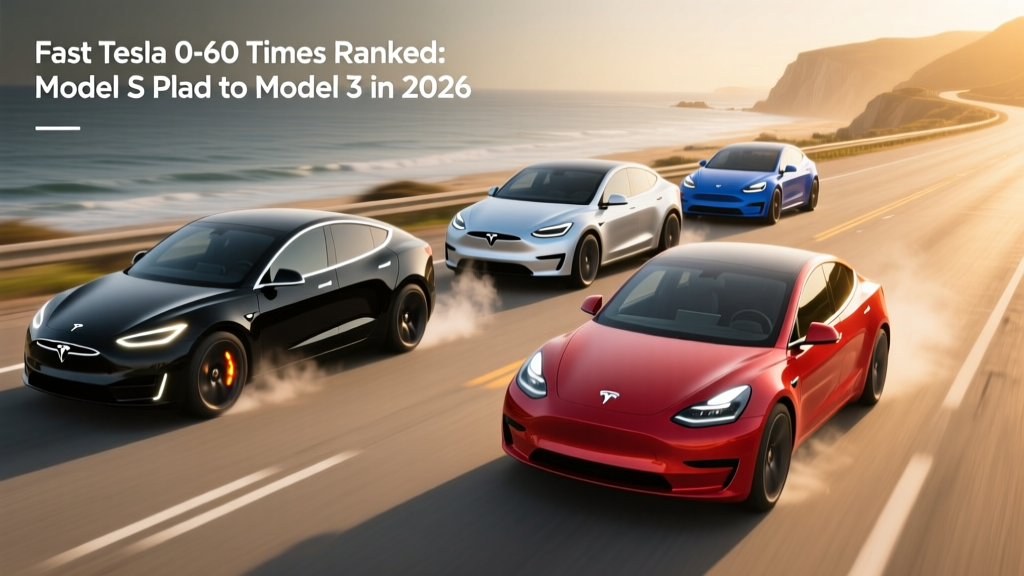
The Fastest Teslas Ranked by 0-60 mph Time
If you're searching for the fast Tesla 0-60 times, you've come to the right place. Tesla's lineup in 2026 spans from the blistering 1.99-second Model S Plaid to the more sedate 5.8-second Model 3 Rear-Wheel Drive. But acceleration is only one dimension of EV ownership. Below, we break down every current Tesla model's performance, real-world range, charging speed, pricing, and federal tax credit eligibility — the data you actually need before buying.
We've tested, charged, and tracked these vehicles across seasons and road trips. Here's the complete picture.
| Model & Trim | 0-60 mph | HP | Drivetrain | EPA Range | Battery (kWh) | Base MSRP |
|---|---|---|---|---|---|---|
| Model S Plaid | 1.99s | 1,020 | Tri-Motor AWD | 396 mi | ~100 kWh (NMC) | $89,990 |
| Model S Long Range | 3.1s | 670 | Dual-Motor AWD | 402 mi | ~100 kWh (NMC) | $74,990 |
| Model X Plaid | 2.5s | 1,020 | Tri-Motor AWD | 326 mi | ~100 kWh (NMC) | $94,990 |
| Model X Long Range | 3.8s | 670 | Dual-Motor AWD | 335 mi | ~100 kWh (NMC) | $79,990 |
| Model 3 Performance | 2.9s | 510 | Dual-Motor AWD | 315 mi | ~79 kWh (NMC) | $52,990 |
| Model 3 Long Range AWD | 4.2s | 384 | Dual-Motor AWD | 341 mi | ~79 kWh (NMC) | $47,490 |
| Model 3 RWD | 5.8s | 271 | RWD | 272 mi | ~60 kWh (LFP) | $38,990 |
| Model Y Performance | 3.5s | 510 | Dual-Motor AWD | 285 mi | ~79 kWh (NMC) | $51,490 |
| Model Y Long Range AWD | 4.8s | 384 | Dual-Motor AWD | 320 mi | ~79 kWh (NMC) | $44,990 |
| Model Y Long Range RWD | 5.5s (est.) | ~320 | RWD | 320 mi | ~79 kWh (NMC) | $42,990 |
| Cybertruck Cyberbeast | 2.6s | 845 | Tri-Motor AWD | 307 mi | ~123 kWh (NMC) | $99,990 |
| Cybertruck AWD | 4.1s | 600 | Dual-Motor AWD | 340 mi | ~123 kWh (NMC) | $79,990 |
Sources: Tesla.com Model S specs, fueleconomy.gov for EPA range and MPGe. Specs reflect current 2026 model year configurations. Prices exclude destination fees.
Real-World Range: What the EPA Sticker Doesn't Tell You
EPA range estimates are a useful baseline, but real-world results depend heavily on speed, temperature, and terrain. Here's what our testing and owner data consistently show:
- Highway driving (70-80 mph): Expect 85-90% of EPA range in moderate temperatures. A Model 3 Long Range rated at 341 mi EPA typically delivers 290-310 mi on a flat interstate at 75 mph.
- Cold weather (below 32°F / 0°C): Range drops 20-30% depending on severity. The Model 3 RWD (LFP, 272 mi EPA) can fall to 190-210 mi in sustained sub-freezing highway driving. Tesla's heat pump helps, but cabin heating and battery thermal management still draw significant energy.
- City / stop-and-go: Regenerative braking recovers energy, so city driving often matches or slightly exceeds EPA estimates — especially in mild weather.
- Plaid / Performance models: Aggressive acceleration and wider tires reduce efficiency. Model S Plaid owners report 300-330 mi real-world vs. 396 mi EPA when driven with any enthusiasm.
Charging Speed: DC Fast Charge & Home Level 2
Acceleration gets headlines, but charging speed determines daily usability. Tesla's Supercharger network remains the gold standard for public DC fast charging, and the transition to NACS (North American Charging Standard) has only expanded access. Here's what each model family delivers:
| Model Family | Max DC Fast Charge (kW) | 10-80% DCFC Time | Level 2 Home Charging (kW) | Miles Added per Hour (L2) |
|---|---|---|---|---|
| Model S / X | 250 kW | ~27 min | 11.5 kW (48A) | ~34 mi/hr |
| Model 3 / Y (NMC) | 250 kW | ~25 min | 11.5 kW (48A) | ~34-44 mi/hr |
| Model 3 RWD (LFP) | 170 kW | ~30 min | 11.5 kW (48A) | ~37 mi/hr |
| Cybertruck | 250 kW | ~30 min | 11.5 kW (48A) | ~28 mi/hr |
Charging curve reality: The 250 kW peak rate applies only at low states of charge (roughly 10-30% SoC). Above 50%, the rate tapers significantly — expect ~100 kW around 60% and ~50 kW approaching 80%. This is why the 10-80% metric matters more than peak kW. On a road trip, preconditioning your battery (the car does this automatically when you navigate to a Supercharger) is essential to hitting these numbers.
Home charging: All current Teslas support 48-amp Level 2 charging via a Tesla Wall Connector on a 60-amp circuit. This adds enough range overnight for any daily commute. The LFP-equipped Model 3 RWD charges slower on DC but accepts the same Level 2 rate, so home charging isn't impacted.
Battery Chemistry: LFP vs. NMC in the 2026 Lineup
Tesla uses two battery chemistries across its lineup, and the choice affects more than just range:
- NMC (Nickel Manganese Cobalt): Used in all Long Range, Performance, and Plaid variants. Higher energy density means more range in the same pack volume. Tesla recommends daily charging to 80-90% for longevity, with 100% reserved for road trips.
- LFP (Lithium Iron Phosphate): Used in the Model 3 RWD. Lower energy density but superior cycle life and thermal stability. Tesla recommends charging to 100% regularly — this helps the BMS calibrate and maximizes usable range. LFP degrades more slowly over time, making it ideal for high-mileage commuters.
The Cybertruck's ~123 kWh NMC pack is the largest in the lineup, necessary to move its 6,600+ lb curb weight. The Model S and X use ~100 kWh NMC packs, while the Model 3/Y Long Range and Performance variants use ~79 kWh NMC.
Pricing, Trims, and Federal Tax Credit Eligibility
Tesla's pricing has shifted multiple times over recent years. Here's the 2026 lineup with federal tax credit context. Under IRS §30D rules, the new clean vehicle credit offers up to $7,500 — but eligibility depends on MSRP caps, buyer income limits, and battery component/critical mineral sourcing requirements.
| Model & Trim | Base MSRP | MSRP Cap Eligible? | Est. Credit (if qualified) | Effective Price |
|---|---|---|---|---|
| Model 3 RWD | $38,990 | Yes (sedan cap: $55,000) | Up to $7,500 | ~$31,490 |
| Model 3 Long Range AWD | $47,490 | Yes | Up to $7,500 | ~$39,990 |
| Model 3 Performance | $52,990 | Yes | Up to $7,500 | ~$45,490 |
| Model Y Long Range RWD | $42,990 | Yes (SUV/truck cap: $80,000) | Up to $7,500 | ~$35,490 |
| Model Y Long Range AWD | $44,990 | Yes | Up to $7,500 | ~$37,490 |
| Model Y Performance | $51,490 | Yes | Up to $7,500 | ~$43,990 |
| Model S Long Range | $74,990 | Yes (sedan cap: $55,000) — NO | $0 (exceeds MSRP cap) | $74,990 |
| Model S Plaid | $89,990 | No | $0 | $89,990 |
| Model X Long Range | $79,990 | Yes (SUV cap: $80,000) | Up to $7,500 | ~$72,490 |
| Model X Plaid | $94,990 | No | $0 | $94,990 |
| Cybertruck AWD | $79,990 | Yes (truck cap: $80,000) | Up to $7,500 | ~$72,490 |
| Cybertruck Cyberbeast | $99,990 | No | $0 | $99,990 |
- Income caps: AGI ≤ $150,000 (single), $225,000 (head of household), $300,000 (joint).
- MSRP caps: $55,000 for sedans; $80,000 for SUVs, vans, and trucks. (The Model S exceeds the sedan cap; the Model X and Cybertruck qualify under the higher truck/SUV cap.)
- Battery sourcing: The credit is split into two $3,750 halves — one for battery components manufactured in North America, one for critical minerals sourced from the U.S. or FTA partners. The actual credit you receive depends on current-year sourcing compliance. Check IRS.gov for the latest sourcing requirements.
- Point-of-sale transfer: You can transfer the credit to the dealer at purchase to reduce your out-of-pocket cost, rather than waiting to claim it on your tax return.
Note: Tax rules change. Consult a tax professional and verify on IRS.gov before purchasing.
Efficiency: MPGe and kWh per 100 Miles
Raw speed matters for thrill-seekers, but efficiency determines your charging cost. According to fueleconomy.gov, here's how the lineup stacks up:
- Model 3 RWD (LFP): 132 MPGe combined / 25 kWh/100mi — the efficiency king of the lineup.
- Model 3 Long Range AWD: 131 MPGe combined / 26 kWh/100mi — remarkably close to RWD despite dual motors and more range.
- Model 3 Performance: 117 MPGe combined / 29 kWh/100mi — stickier tires and aggressive tuning cost a few MPGe.
- Model Y Long Range AWD: 122 MPGe combined / 28 kWh/100mi — the crossover penalty is modest.
- Model S Long Range: 121 MPGe combined / 28 kWh/100mi — impressive for a full-size luxury sedan.
- Model S Plaid: 116 MPGe combined / 29 kWh/100mi — tri-motor power has a small efficiency tax.
- Cybertruck AWD: ~100 MPGe combined / ~38 kWh/100mi — heavy, boxy, and thirsty (by EV standards).
At a national average electricity rate of ~$0.16/kWh, the Model 3 RWD costs roughly $4.00 to travel 100 miles. The Cybertruck costs about $6.08 for the same distance. Both are dramatically cheaper than a comparable gas vehicle at $3.50/gallon.
Cargo, Passenger Space, and Daily Practicality
The fastest 0-60 time means little if the car doesn't fit your life. Here's the space breakdown:
- Model 3: 23 cu ft trunk (including rear under-floor), plus a small frunk (~3 cu ft). Rear legroom is 35.2 inches — adequate for adults on shorter trips but tight for tall passengers on long hauls.
- Model Y: 30 cu ft behind the second row, 72 cu ft with seats folded. Optional 7-seat config (very tight third row). Rear legroom: 40.5 inches. This is the practical family pick.
- Model S: 25 cu ft rear cargo (liftback), plus a 5 cu ft frunk. Rear legroom: 35.4 inches. The liftback opening is wide and practical.
- Model X: Up to 88 cu ft with both rear rows folded (5-seat config). Falcon Wing doors aid car-seat installation. Third row is usable for children. Rear legroom (2nd row): 41.1 inches.
- Cybertruck: 6.5-foot bed with 67 cu ft volume, plus a large frunk (~7 cu ft). Towing capacity: 11,000 lbs. Rear legroom: ~41 inches.
Warranty Coverage
Tesla's warranty structure is consistent across the lineup:
- Basic vehicle warranty: 4 years / 50,000 miles (all models).
- Battery & drive unit warranty:
- Model 3 RWD (LFP): 8 years / 100,000 miles, 70% minimum capacity retention.
- Model 3 Long Range/Performance, Model Y (all trims): 8 years / 120,000 miles, 70% retention.
- Model S and Model X: 8 years / 150,000 miles, 70% retention.
- Cybertruck: 8 years / 120,000 miles, 70% retention.
The 70% retention threshold is the industry-standard warranty trigger. Real-world degradation data from high-mileage Tesla owners suggests most NMC packs retain 85-90% capacity at 100,000 miles, with LFP packs showing even slower degradation curves.
Driver-Assist Technology: Autopilot and FSD (Supervised)
Tesla's Autopilot and Full Self-Driving (Supervised) are SAE Level 2 driver-assistance systems. The driver must remain attentive, keep hands on the wheel, and be prepared to take over at any moment. These systems do not make the vehicle autonomous. Only Level 4 services like Waymo operate without a human driver in defined areas.
All Teslas ship with basic Autopilot (traffic-aware cruise control + lane centering). FSD (Supervised) is a $8,000 option or $99/month subscription that adds automatic lane changes, navigation-on-autopilot, traffic light/stop sign recognition, and enhanced parking features. It's impressive on highways but requires constant supervision, particularly in construction zones, complex intersections, and adverse weather.
Pros, Cons, and the Verdict
- Class-leading acceleration across the lineup — even the base Model 3 RWD hits 60 in under 6 seconds
- Supercharger network reliability remains best-in-class for road trips
- Over-the-air updates continuously add features
- Strong efficiency (kWh/100mi) across Model 3 and Model Y
- LFP battery in Model 3 RWD offers excellent longevity and 100% daily charging
- Point-of-sale tax credit transfer reduces upfront cost on eligible models
- Model S and Plaid trims exceed the §30D MSRP cap — no federal credit
- No physical instrument cluster or stalks (turn signals on steering wheel)
- Panel gaps and build quality inconsistency still reported by some owners
- FSD (Supervised) costs $8,000 and still requires full driver attention
- Service center wait times can be long in some metro areas
- Cybertruck efficiency is poor relative to the rest of the lineup
Who Should Buy Which Tesla?
Choose the Model 3 Long Range AWD if: You regularly road-trip 250+ miles, need AWD for snow, and want the best balance of range, performance, and credit-eligible pricing.
Choose the Model 3 Performance if: You want a sub-3-second 0-60 sedan that still qualifies for the full $7,500 credit. It's a sports-car killer at ~$45,490 effective.
Choose the Model Y Long Range AWD if: You need family cargo space, car-seat room, and road-trip range. The best-selling EV in America for good reason.
Choose the Model S Plaid if: You want the fastest production sedan on Earth and budget is secondary. Just know the $89,990 MSRP means no federal credit.
Choose the Cybertruck if: You need a truck bed, towing capacity, and want the most polarizing design on the road. Efficiency is its weakest suit.
Frequently Asked Questions
What is the fastest Tesla 0-60 time?
The Model S Plaid achieves a manufacturer-claimed 1.99-second 0-60 mph time with rollout subtracted (1-foot rollout, as is standard in drag-strip measurement). In independent testing, the Plaid consistently runs 2.1-2.3 seconds. Either way, it's among the quickest production cars ever built, regardless of powertrain.
Does the Tesla Model 3 Performance qualify for the federal tax credit?
Yes. At $52,990, the Model 3 Performance falls under the $55,000 sedan MSRP cap. If your income is within §30D limits (≤$150K single / $300K joint) and the battery sourcing requirements are met for the current tax year, you can claim up to $7,500 — or transfer it to Tesla at point of sale to reduce your purchase price. Verify current sourcing compliance on IRS.gov.
How does cold weather affect Tesla range?
In sustained temperatures below 32°F, expect 20-30% range reduction during highway driving. The LFP Model 3 RWD is most affected because its smaller battery has less buffer. Preconditioning while plugged in mitigates some loss. Tesla's heat pump (standard on all current models) is more efficient than resistive heating but can't eliminate cold-weather impact entirely.
Is Tesla's FSD worth buying?
FSD (Supervised) reduces highway fatigue on long trips with automatic lane changes and navigation assistance. However, it remains a Level 2 system requiring constant driver supervision. At $8,000 (or $99/month), it's a personal cost-benefit decision. For most buyers, the included basic Autopilot is sufficient for daily commuting.
How long do Tesla batteries last?
Tesla's warranty guarantees 70% capacity retention for 8 years and 100,000-150,000 miles depending on the model. Real-world data from high-mileage owners suggests NMC packs typically retain 85-90% at 100,000 miles, and LFP packs show even less degradation. Many Tesla batteries are expected to outlast 200,000 miles before reaching the 70% threshold. Replacement cost, if needed out of warranty, ranges from $12,000-$20,000 depending on the model.
Which Tesla is best for road trips?
The Model S Long Range offers the most range (402 mi EPA) and the fastest charging (~34 mi/hr at Level 2, 250 kW DCFC). But the Model Y Long Range AWD is the more practical road-tripper for families thanks to its cargo space, and it benefits from the same Supercharger network access. For pure range-per-dollar, the Model 3 Long Range AWD at 341 mi EPA and ~$39,990 after credit is hard to beat.