Quick Answer: What Is the Strongest Electric Power Washer in 2026?
The strongest consumer-grade electric power washer available in 2026 delivers between 2,300 and 3,200 PSI (pounds per square inch) at flow rates of 1.5 to 2.5 GPM (gallons per minute). Top models include the Ryobi RY142300 (2,300 PSI / 1.2 GPM), Sun Joe SPX4001 (2,900 PSI / 1.8 GPM), and Karcher K5 Premium Electric (2,000 PSI / 1.4 GPM). For professional-grade electric units, the NorthStar 15775440 pushes 3,200 PSI at 2.5 GPM using a 230V outlet — the highest electric pressure commercially available without stepping into gas territory.
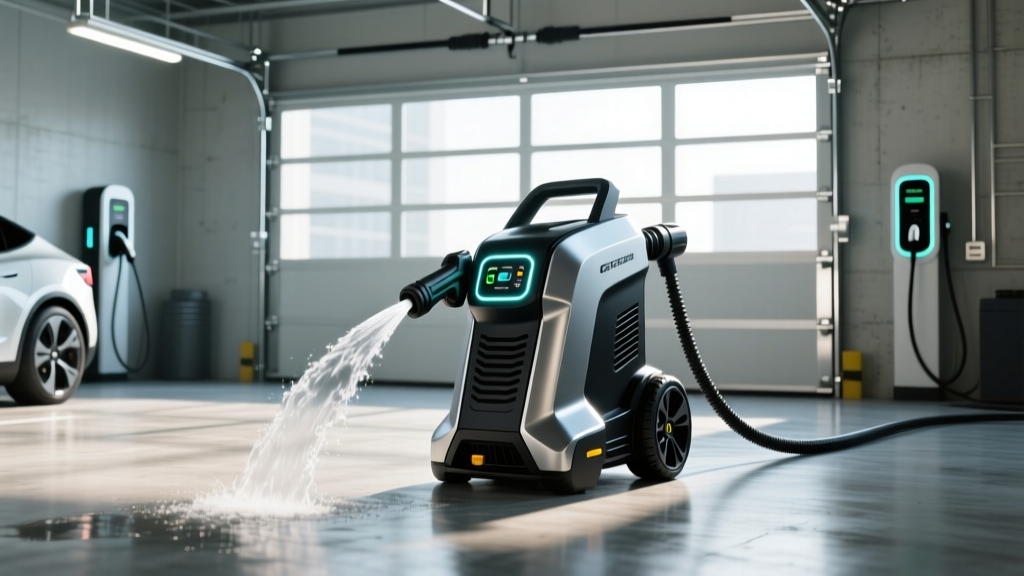
For EV owners washing at home, a 2,000–2,500 PSI electric unit is the practical sweet spot: strong enough for grime and brake dust, safe for automotive paint, and compatible with standard 120V household outlets — no electrical panel upgrade required.
If you own an electric vehicle and wash it at home, you've probably asked whether electric pressure washers can match gas models. The short answer: for automotive use, yes. Electric units have closed the gap significantly, and the strongest electric power washers now rival mid-range gas models in cleaning power while costing less to operate and producing zero direct emissions — a natural pairing for EV owners who've already electrified their driveways.
Electric vs. Gas Power Washers: The Real Numbers
Before choosing the strongest electric power washer for your needs, it helps to see how electric and gas models stack up on the metrics that matter: pressure, flow, cost to run, noise, and maintenance.
| Attribute | Electric (120V Consumer) | Electric (230V Prosumer) | Gas-Powered |
|---|---|---|---|
| Max PSI (Consumer Models) | 2,300–2,900 PSI | 3,000–3,200 PSI | 3,200–4,200 PSI |
| Max GPM | 1.2–1.8 GPM | 2.2–2.5 GPM | 2.5–4.0 GPM |
| Cleaning Units (PSI × GPM) | 2,760–5,220 CU | 6,600–8,000 CU | 8,000–16,800 CU |
| Purchase Price (MSRP) | $150–$450 | $600–$1,200 | $300–$800 |
| Operating Cost per Hour | $0.10–$0.25 (electricity) | $0.20–$0.50 (electricity) | $0.80–$1.50 (gasoline) |
| Noise Level | 60–75 dB | 65–80 dB | 85–100 dB |
| Annual Maintenance | $0–$20 (nozzle/hose) | $0–$30 | $50–$120 (oil, filter, spark plug) |
| Weight | 15–35 lbs | 45–75 lbs | 55–130 lbs |
| Cold Start Issues | None | None | Common below 40°F |
The key metric is Cleaning Units (CU) — PSI multiplied by GPM. A 3,200 PSI gas washer at 2.5 GPM produces 8,000 CU, while a 2,300 PSI electric at 1.2 GPM produces 2,760 CU. For automotive washing, however, you rarely need more than 2,000 PSI. Higher pressures risk damaging clear coats, trim seals, and — critically for EV owners — charging port gaskets and sensor housings.
Top Picks: Strongest Electric Power Washers for EV Owners
Best Overall: Sun Joe SPX4001 (2,900 PSI / 1.8 GPM)
The SPX4001 leads consumer electric models with 2,900 PSI and a 1.8 GPM flow rate, yielding 5,220 Cleaning Units. It runs on a standard 120V/15A outlet, includes five quick-connect nozzle tips (0°, 15°, 25°, 40°, and soap), and weighs 31 lbs. MSRP sits around $279. The 20-foot high-pressure hose and 34-inch extension wand reach most EV rooftops — including taller models like the Rivian R1S and Tesla Model X — without a step stool.
Best Budget: Ryobi RY142300 (2,300 PSI / 1.2 GPM)
At roughly $199, the Ryobi delivers 2,300 PSI through a brushless induction motor that runs quieter (approximately 68 dB) and lasts longer than universal-motor competitors. The 25-foot hose and onboard detergent tank make it a practical grab-and-go unit. For routine EV washing — removing road film, pollen, and light brake dust — 2,300 PSI is more than adequate.
Best Prosumer (230V): NorthStar 15775440 (3,200 PSI / 2.5 GPM)
If you have a 230V outlet (the same circuit type used for Level 2 EV chargers), the NorthStar delivers the strongest electric pressure washer performance available: 3,200 PSI at 2.5 GPM for 8,000 CU. This matches many mid-range gas units. MSRP is approximately $899. The tradeoff: you need a dedicated 230V/20A circuit, which may already be available if you've installed a home Level 2 EV charger.
Cost Breakdown: Electric Power Washer Ownership vs. Gas
One of the strongest arguments for an electric power washer — particularly for EV owners already thinking about total cost of ownership — is the five-year cost picture. Here's a realistic breakdown assuming 50 wash sessions per year (roughly weekly use).
| Cost Category | Electric (120V, 2,300 PSI) | Gas (3,200 PSI) |
|---|---|---|
| Purchase Price | $200 | $450 |
| Energy/Fuel (50 sessions/yr × 5 yrs) | $30 (at $0.13/kWh avg) | $375 (at $3.50/gal avg) |
| Maintenance (oil, plugs, pump winterization) | $50 | $500 |
| Replacement Parts (hoses, nozzles, O-rings) | $40 | $75 |
| Expected Lifespan | 5–8 years | 3–6 years |
| 5-Year Total | $320 | $1,400 |
The electric unit costs roughly $1,080 less over five years, even before factoring in the time and hassle of gas-engine maintenance — oil changes, air filter replacements, carburetor cleaning, and winterization. Electric motors have no consumables beyond occasional O-ring and hose replacements.
For EV owners who charge at home using solar panels or off-peak utility rates (as low as $0.06/kWh in some regions), the operating cost drops even further. A 2,300 PSI electric pressure washer draws approximately 1,800 watts — running it for 30 minutes consumes about 0.9 kWh, costing roughly $0.05 to $0.12 per wash session.
Real-World Ownership: What EV Owners Should Know
Electrical Circuit Compatibility
Most 120V electric pressure washers draw 12–15 amps. This means they need a dedicated 15A or 20A household circuit. If your outdoor outlet shares a circuit with interior lights or appliances, you may trip the breaker. Before purchasing, check your panel to confirm the outdoor outlet is on its own breaker.
If you're considering a 230V prosumer model like the NorthStar, you'll need a 230V/20A outlet. Many EV owners already have one installed for a Level 2 home charger (such as a NEMA 14-50 or hardwired 240V circuit). A licensed electrician can add a dedicated 230V outlet for $200–$600 if your panel has spare capacity, or $1,500–$3,000 if a panel upgrade from 100A to 200A is needed.
Washing an EV Safely: Pressure and Paint
EVs have unique exterior features that require care during pressure washing:
- Charging port seals: Avoid directing high-pressure streams directly into the charging port door seams. Use a 25° or 40° nozzle tip and maintain 12+ inches of distance.
- Sensor housings and cameras: ADAS sensors (used by systems like Tesla Autopilot, Ford BlueCruise, and GM Super Cruise) are housed behind trim panels and windshield-mounted camera clusters. Use low pressure (under 1,500 PSI) and wider spray angles around these areas.
- Flush door handles: Many EVs (Tesla Model 3/Y, Hyundai Ioniq 5/6, Lucid Air) feature flush or electronic door handles. High-pressure water can force moisture into the electronic mechanisms. Spray at an angle, not directly into the handle recess.
- Underbody battery enclosure: EV battery packs are sealed to IP67 or IP68 ratings and can withstand water immersion. Pressure washing the underbody is safe at normal consumer PSI levels, but avoid holding a zero-degree nozzle within 6 inches of any sealed joint or cable conduit.
Climate and Seasonal Considerations
Electric pressure washers have a clear cold-weather advantage: they start instantly regardless of temperature. Gas models frequently struggle with cold starts below 40°F due to carburetor and fuel-line issues. If you live in a northern climate and wash year-round (or need to remove road salt from your EV's undercarriage during winter), electric eliminates the seasonal starting frustration entirely.
Store electric units indoors during freezing months. While they don't have engine oil to worry about, residual water in the pump can freeze and crack the housing — a $50–$80 repair that's easily avoided by draining the pump and storing the unit in a garage.
Common Misconceptions About Electric Power Washers
| Myth | Fact |
|---|---|
| "Electric power washers are too weak for real cleaning." | Top 120V electric models reach 2,900 PSI — more than enough for automotive, deck, and driveway cleaning. 230V models match mid-range gas at 3,200 PSI. |
| "You need a gas washer to clean a car properly." | Professional car detailers typically use 1,200–1,800 PSI. Higher pressures risk paint damage. Electric units are in the ideal range for automotive use. |
| "Electric washers don't last as long." | Brushless induction motors in quality electric units have fewer moving parts than gas engines. With basic pump care, 5–8 year lifespans are common. |
| "You need a special outlet or solar panels." | 120V models plug into any standard outdoor GFCI outlet. No special wiring required for consumer-grade units. |
| "Higher PSI is always better." | For car washing, GPM matters more than PSI. A 2,000 PSI / 1.8 GPM unit rinses faster than a 3,000 PSI / 1.0 GPM unit. Cleaning Units (PSI × GPM) is the true performance metric. |
Decision Framework: Which Electric Power Washer Is Right for You?
Choose a 120V electric (1,800–2,300 PSI, $150–$300) if:
- You wash your EV weekly or biweekly at home
- You have a standard outdoor 120V outlet on a dedicated circuit
- Your primary use is automotive washing with occasional light patio/deck cleaning
- You want the lowest possible operating cost and zero engine maintenance
- You store equipment in a small garage or apartment storage area
Choose a 120V premium electric (2,500–2,900 PSI, $250–$450) if:
- You wash larger EVs (trucks like the Ford F-150 Lightning or Rivian R1T) with heavy road grime
- You also clean driveways, fences, or second-story siding
- You want higher GPM for faster rinsing without stepping up to 230V
Choose a 230V prosumer electric (3,000–3,200 PSI, $600–$1,200) if:
- You already have a 230V outlet (from a Level 2 EV charger installation)
- You need gas-equivalent power for large properties, concrete stripping, or frequent heavy-duty use
- You want the strongest electric power washer available without gas-engine maintenance
- You're willing to invest in a dedicated 230V circuit if you don't already have one
Stick with gas if:
- You need to wash in remote locations without electrical access
- You regularly need 3,500+ PSI for paint stripping, heavy concrete work, or agricultural use
- You need flow rates above 3.0 GPM for large commercial jobs
Frequently Asked Questions
Can I wash my EV with a pressure washer without damaging the battery?
Yes. EV battery packs are sealed to IP67 (submersible in 1 meter of water for 30 minutes) or IP68 ratings. Consumer pressure washers at 2,000–3,000 PSI will not compromise these seals during normal undercarriage washing. Avoid concentrating a zero-degree nozzle directly on battery enclosure seams or high-voltage cable connectors at close range.
How much electricity does an electric power washer use?
A typical 2,300 PSI electric pressure washer draws approximately 1,800 watts (15 amps at 120V). Running it for one hour consumes 1.8 kWh. At the U.S. average electricity rate of $0.13/kWh (per EIA data), that's about $0.23 per hour of continuous operation — or roughly $0.10 per typical 25-minute car wash session.
Is a 2,000 PSI pressure washer strong enough to wash a car?
More than strong enough. Professional auto detailers typically use 1,200–1,800 PSI with foam cannons and wide-angle nozzles. At 2,000 PSI, you'll have ample pressure for pre-rinsing, foam application, and final rinse. The key is using the correct nozzle tip (25° or 40° for paint) and maintaining 12–18 inches of distance from the surface.
Can I use the same 230V outlet for my EV charger and a pressure washer?
Not simultaneously — both devices draw significant current, and running them at the same time on a shared circuit would trip the breaker. However, you can use the same outlet sequentially: unplug the EV charger and plug in the pressure washer. For frequent use, a licensed electrician can install a second dedicated 230V circuit for $200–$500 (assuming panel capacity).
What's more important for washing a car: PSI or GPM?
For automotive washing, GPM (flow rate) generally matters more than PSI (pressure). Higher GPM rinses soap and loosened dirt faster, reducing total wash time. A unit with 2,000 PSI and 1.8 GPM will clean a car faster than one with 3,000 PSI and 1.0 GPM. Look for the highest Cleaning Units (PSI × GPM) within the 1,500–2,500 PSI range for the best automotive results.
Do electric power washers work in cold weather?
Electric pressure washers start instantly in any temperature — a major advantage over gas models that struggle below 40°F. However, you should still winterize the pump by draining residual water and running pump-safe antifreeze through the system before storage. The motor itself is unaffected by cold temperatures.