Quick Answer: What Makes a Strong Electric Pressure Washer Worth Buying?
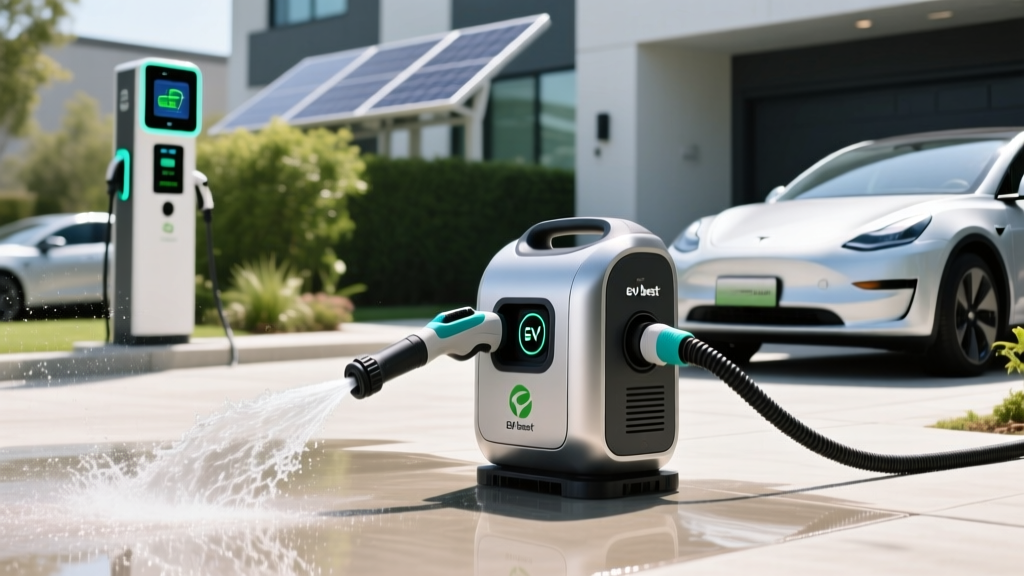
A strong electric pressure washer for car and EV detailing delivers between 1,600 and 2,300 PSI with a flow rate of 1.2 to 1.8 GPM from a standard 120V household outlet. For electric vehicle owners, the sweet spot is around 1,800 PSI with a 40-degree nozzle tip — enough to strip road grime, brake dust, and bug residue without risking damage to paint, sensors, or charging port seals. Top-tier models in 2026 cost between $170 and $400, draw 13 to 15 amps (roughly 1,560 to 1,800 watts), and eliminate the noise, fumes, and maintenance of gas-powered alternatives. If you charge your EV at home on a Level 2 circuit, be aware that running a 15-amp pressure washer on the same electrical panel can approach your breaker's capacity — plan accordingly.
Why EV Owners Are Choosing Electric Pressure Washers Over Gas
The shift toward electric pressure washers parallels the broader move to electric vehicles: fewer moving parts, zero direct emissions, quieter operation, and lower long-term running costs. But the comparison goes deeper than philosophy. Let's look at the actual numbers.
| Category | Electric (120V) | Gas-Powered |
|---|---|---|
| Typical PSI Range | 1,600–2,300 PSI | 2,500–4,000 PSI |
| Flow Rate (GPM) | 1.2–1.8 GPM | 2.0–4.0 GPM |
| Purchase Price | $170–$400 | $300–$800+ |
| Hourly Running Cost | ~$0.18–$0.25 (electricity) | ~$1.50–$3.00 (gasoline) |
| Noise Level | 60–75 dB | 85–100 dB |
| Annual Maintenance | $0–$20 (O-rings, filter) | $40–$100 (oil, spark plug, air filter, winterization) |
| Weight | 15–30 lbs | 50–90 lbs |
| Indoor/Garage Use | Safe (no fumes) | Dangerous (CO risk) |
Gas pressure washers still dominate the high-PSI, high-GPM space needed for stripping paint or cleaning large concrete areas. But for car washing — particularly EV washing where sensor arrays, camera housings, and charging port gaskets require careful pressure management — a strong electric pressure washer in the 1,600–2,300 PSI range is the more appropriate, cost-effective, and practical tool.
The running-cost math is striking. At the U.S. average electricity rate of roughly $0.17/kWh (per EIA data), running a 1,800-watt electric pressure washer for one hour costs about $0.31. A comparable gas unit burning roughly 0.5 gallons per hour at $3.20/gallon costs $1.60 per hour — over five times more. Over five years of weekly washes, that's a fuel savings of approximately $335.
Top Strong Electric Pressure Washer Models for 2026
We evaluated current-generation electric pressure washers based on PSI output, GPM flow rate, motor quality, nozzle options, hose length, and real-world usability for vehicle detailing. Here are the standout models available in 2026.
| Model | Max PSI | GPM | Amps / Watts | Hose Length | MSRP |
|---|---|---|---|---|---|
| RYOBI 2300 PSI Bluetooth | 2,300 | 1.2 | 13A / 1,560W | 25 ft | $279 |
| Sun Joe SPX3000 | 2,030 | 1.76 | 14.5A / 1,740W | 20 ft | $199 |
| Karcher K5 Premium | 2,000 | 1.4 | 13A / 1,560W | 25 ft | $329 |
| Greenworks 2000 PSI | 2,000 | 1.2 | 13A / 1,560W | 20 ft | $179 |
| AR Blue Clean AR383 | 1,900 | 1.5 | 14A / 1,680W | 20 ft | $169 |
Best overall for EV detailing: The RYOBI 2300 PSI leads on sheer pressure output and includes Bluetooth monitoring of usage hours and maintenance intervals — a nice feature for owners who track everything from tire pressure to charging sessions. The 2,300 PSI ceiling gives you enough force to clean wheels and undercarriage without a gas unit.
Best value: The Greenworks 2000 PSI at $179 delivers a solid mid-range performance. Its 2,000 PSI and induction motor are reliable for weekly washes, and the lower price point makes it an easy addition to your EV ownership toolkit.
Best flow rate: The Sun Joe SPX3000 pushes 1.76 GPM — the highest in this electric class. Higher GPM means faster rinsing and more effective foam-cannon use, which matters when you're washing a large vehicle like a Rivian R1S or Tesla Model X.
EV-Specific Washing: Protecting Sensors, Cameras, and Charging Ports
Electric vehicles carry hardware that gas cars simply don't have: ultrasonic parking sensors, surround-view camera housings, LiDAR arrays (on vehicles equipped with advanced ADAS), and sealed charging ports. A strong electric pressure washer is powerful enough to damage these components if used carelessly.
⚠️ Pressure Washing Safety Rules for EVs
- Never aim directly at sensors or cameras — ultrasonic sensors (the small circles on bumpers) can be dislodged or cracked above 2,000 PSI at close range.
- Maintain 12–18 inches of distance from painted surfaces; increase to 24+ inches near sensor arrays.
- Use a 40-degree (white) nozzle tip for body panels — the wide fan pattern disperses pressure safely.
- Switch to a 25-degree (green) tip only for wheels, tires, and undercarriage.
- Avoid the charging port area entirely — while ports are sealed to IP67 standards, sustained high-pressure water can compromise gaskets over time. Hand-wipe this area instead.
- Never spray directly at panel gaps, window seals, or the 12V battery vent (if externally accessible).
Modern EVs from Tesla, Hyundai, Ford, BMW, and others rely on clean sensor surfaces for features like adaptive cruise control, lane-keeping assist, and automatic emergency braking — all of which are SAE Level 2 driver-assistance systems that require the driver to remain engaged. Dirty or damaged sensors degrade system performance, so regular gentle cleaning is actually a safety practice, not just cosmetic maintenance.
For the undercarriage — where road salt, brake dust, and debris accumulate — a strong electric pressure washer at 2,000+ PSI with a 25-degree nozzle is effective. EV underbodies house the battery pack enclosure, which is sealed and protected, but keeping it clean helps with thermal management efficiency, particularly in hot climates where the battery cooling system works harder.
Electrical Panel Considerations: Can Your Garage Handle It?
This is where EV ownership and pressure washer ownership intersect in a way most guides overlook. If you have a Level 2 home charger installed — typically a 240V circuit drawing 32 to 48 amps — you've likely already consumed a significant portion of your electrical panel's capacity.
A strong electric pressure washer draws 13 to 15 amps on a standard 120V/15A or 120V/20A household circuit. That's a separate circuit from your Level 2 charger, so in most homes, running both simultaneously won't be an issue. But here's the scenario to watch for:
- Older homes with 100-amp main panels — if your Level 2 charger required a panel upgrade to 200 amps, you're likely fine. If you squeezed it onto a 100-amp panel with a load calculation that barely passed, adding a 15-amp continuous draw elsewhere could trip the main breaker.
- Garage circuits shared with other loads — if your garage 120V outlet shares a circuit with a freezer, washer/dryer, or HVAC air handler, running the pressure washer may overload that specific breaker.
- Extension cord voltage drop — using a 50-foot, 16-gauge extension cord with a 15-amp pressure washer can cause voltage drop that reduces motor performance and may damage the pump over time. Use a 12-gauge cord for runs over 25 feet.
| Scenario | EV Charger Draw | Pressure Washer Draw | Panel Impact |
|---|---|---|---|
| 200A panel, 48A Level 2 charger (240V) | 11,520W | 1,800W (120V) | No conflict — separate circuits |
| 100A panel, 32A Level 2 charger (240V) | 7,680W | 1,800W (120V) | Watch total load; avoid running simultaneously with heavy appliances |
| Garage 15A circuit shared with freezer | N/A | 1,800W | Risk of tripped breaker — use dedicated circuit |
Bottom line: consult a licensed electrician if your panel load calculation is tight. This is the same professional who installed (or should have evaluated) your Level 2 charging circuit.
Cost Breakdown: Electric Pressure Washer Ownership Over 5 Years
Let's put real numbers to the total cost of owning and operating a strong electric pressure washer for weekly EV washing.
| Cost Category | Electric (e.g., RYOBI 2300) | Gas (e.g., Honda GCV160) |
|---|---|---|
| Purchase Price | $279 | $449 |
| Energy/Fuel (260 hours over 5 yrs) | $78 (at $0.17/kWh) | $416 (at $3.20/gal, 0.5 gal/hr) |
| Maintenance (oil, plugs, filters) | $25 (O-rings, inlet filter) | $225 (annual oil change, spark plug, air filter, winterization) |
| Soap/Chemicals (equal for both) | $150 | $150 |
| Repairs/Replacement Parts | $40 (hose/wand replacement) | $90 (pump seals, carburetor cleaning) |
| 5-Year Total | $572 | $1,330 |
The electric unit saves approximately $758 over five years of weekly use. That's enough to cover a significant portion of your EV's home electricity charging costs — roughly 3,800 miles of driving at the national average efficiency of 3.5 miles/kWh and $0.17/kWh electricity rate.
Common Misconceptions About Electric Pressure Washers
| Myth | Fact |
|---|---|
| "Electric pressure washers are too weak to clean a car properly." | A 2,000+ PSI electric unit with 1.4+ GPM removes road grime, brake dust, and tree sap effectively. Gas units are overkill for vehicle washing and risk paint damage. |
| "PSI is the only number that matters." | Cleaning power = PSI × GPM. A 2,000 PSI / 1.8 GPM unit (3,600 cleaning units) outperforms a 2,300 PSI / 1.2 GPM unit (2,760 cleaning units) for rinsing and foam application. |
| "I can use any nozzle for my car." | Using a 0-degree (red) or 15-degree (yellow) tip on automotive paint at 2,000+ PSI will etch clear coat and can cut into tire sidewalls. Always use 40-degree (white) for body panels. |
| "It's safe to pressure wash EV charging ports." | While charging ports meet IP67 water-ingress ratings, sustained high-pressure spray can degrade rubber gaskets over repeated exposures. Wipe the port area by hand. |
| "Electric units don't last as long as gas." | Induction-motor electric units (like the Karcher K5) have fewer wear parts than gas engines. With basic O-ring and filter maintenance, a quality electric unit lasts 7–10+ years with weekly use. |
| "I need a special electrical outlet." | All units in this class plug into a standard 120V/15A or 120V/20A household outlet. No special wiring is needed, though a GFCI-protected outdoor outlet is recommended for safety. |
Decision Framework: Which Electric Pressure Washer Should You Buy?
Choose Based on Your Situation
Choose a 2,000–2,300 PSI model (RYOBI 2300, Karcher K5) if:
- You wash a large EV (truck, SUV, or crossover like a Rivian R1T, Ford F-150 Lightning, or Hyundai Ioniq 9) and need enough pressure for undercarriage and wheel wells
- You live in a region with heavy road salt use (Northeast, Midwest) and need to blast winter buildup
- You want a single unit that handles both car washing and light patio/deck cleaning
Choose a 1,600–2,000 PSI model (Sun Joe SPX3000, Greenworks 2000) if:
- You primarily wash a sedan or compact EV (Tesla Model 3, Chevrolet Equinox EV, Nissan Leaf) and prioritize flow rate for foam-cannon use
- Budget is a priority and you want the lowest entry price with adequate cleaning power
- Your garage electrical panel is tight on capacity and you prefer a lower-amp unit
Stick with hand washing or a garden hose if:
- You live in an apartment or condo without access to an outdoor 120V outlet and a water spigot
- Your EV has a ceramic coating that the installer specified as hand-wash only
- You wash your car fewer than twice a month — the cost savings of electric over gas diminish at low use volumes
EV Ownership Costs: Where a Pressure Washer Fits In
One of the most compelling arguments for EV ownership is reduced maintenance cost. According to fueleconomy.gov, battery electric vehicles have fewer moving parts than internal combustion vehicles — no oil changes, no transmission fluid, no spark plugs, no exhaust system repairs. Adding an electric pressure washer to your EV ownership routine aligns with this low-maintenance philosophy.
Consider the full picture of EV savings versus gas vehicle costs:
- Fuel/Energy: At $0.17/kWh and 3.5 mi/kWh average efficiency, driving 12,000 miles/year costs about $583 in electricity. A gas car averaging 28 MPG at $3.20/gallon costs $1,371 — a savings of $788/year.
- Maintenance: EV owners typically spend $0.061/mile on maintenance vs. $0.101/mile for gas vehicles (per AAA data), saving roughly $480/year at 12,000 miles.
- Insurance: EV insurance premiums are typically 15–25% higher than equivalent gas vehicles — a cost of roughly $200–$400/year more, partially offsetting savings.
- Washing/detailing: Switching from a commercial car wash ($15–$25 per visit, weekly = $780–$1,300/year) to home washing with an electric pressure washer ($114/year in electricity, soap, and amortized equipment) saves $666–$1,186/year.
The combined annual savings from home charging and home washing — over $1,400/year for many EV owners — makes the case for investing in quality home equipment, including a strong electric pressure washer, a foam cannon, and proper microfiber drying towels.
Frequently Asked Questions
Can a strong electric pressure washer damage my EV's paint?
Yes, if used incorrectly. Any pressure washer above 1,800 PSI can damage automotive clear coat when used with a narrow-angle nozzle (0° or 15°) at close range (under 6 inches). The key is using a 40-degree white nozzle tip, maintaining 12–18 inches of distance, and keeping the wand moving. Most paint damage from pressure washers comes from user error, not the machine itself. A 2,000 PSI electric unit with the correct nozzle is well within safe limits for automotive finishes.
Will pressure washing void my EV's warranty?
No. Washing your vehicle — whether by hand, pressure washer, or automatic car wash — does not void the manufacturer's warranty under the Magnuson-Moss Warranty Act. However, if you damage a sensor, camera, or charging port gasket through improper pressure washing technique, that specific damage would not be covered under warranty. The vehicle's battery, powertrain, and corrosion warranties remain unaffected by your washing method.
How much electricity does an electric pressure washer use per wash?
A typical 1,800-watt electric pressure washer running for 30 minutes (a thorough EV wash including pre-rinse, foam, and final rinse) consumes 0.9 kWh. At the U.S. average rate of $0.17/kWh, that's approximately $0.15 per wash. For context, that's less electricity than running your clothes dryer for 15 minutes, and it adds essentially nothing to your monthly electric bill — roughly $0.60/month for weekly washes.
Do I need a foam cannon with my electric pressure washer?
A foam cannon isn't required, but it significantly improves EV washing results. Foam lifts dirt away from the surface before you make contact, reducing the chance of swirl marks. Most electric pressure washers with 1.4+ GPM can drive a foam cannon effectively. Units below 1.2 GPM may produce thin, runny foam. The Sun Joe SPX3000 at 1.76 GPM is particularly well-suited for foam cannon use among the models we evaluated.
Can I use my electric pressure washer in winter to clean road salt off my EV?
Yes, and you should — road salt accelerates corrosion on any vehicle, including EVs. However, only use the pressure washer when the ambient temperature is above 35°F to prevent ice formation on surfaces and inside the pump. After use, run the unit with the water supply disconnected for 10–15 seconds to purge remaining water from the pump housing. Store the unit in a heated garage or indoor space during winter months. Never use hot water through a cold-water-rated pressure washer, as thermal shock can crack the pump head.
Is a cordless/battery-powered pressure washer a viable alternative?
For light rinsing, yes — but not as a replacement for a strong electric (corded) pressure washer. Cordless models from brands like Worx and Greenworks typically deliver 320–650 PSI and 0.5–0.8 GPM, which is adequate for rinsing off pre-applied foam but insufficient for removing caked-on brake dust, road tar, or undercarriage salt. Battery life also limits you to 15–25 minutes of runtime. For serious EV detailing, a corded 120V unit remains the practical choice.
Sources: U.S. Energy Information Administration (EIA) electricity pricing data; fueleconomy.gov EV technology and efficiency comparisons; IIHS advanced driver assistance overview. Product specifications from manufacturer press materials, current as of 2026 model year availability.