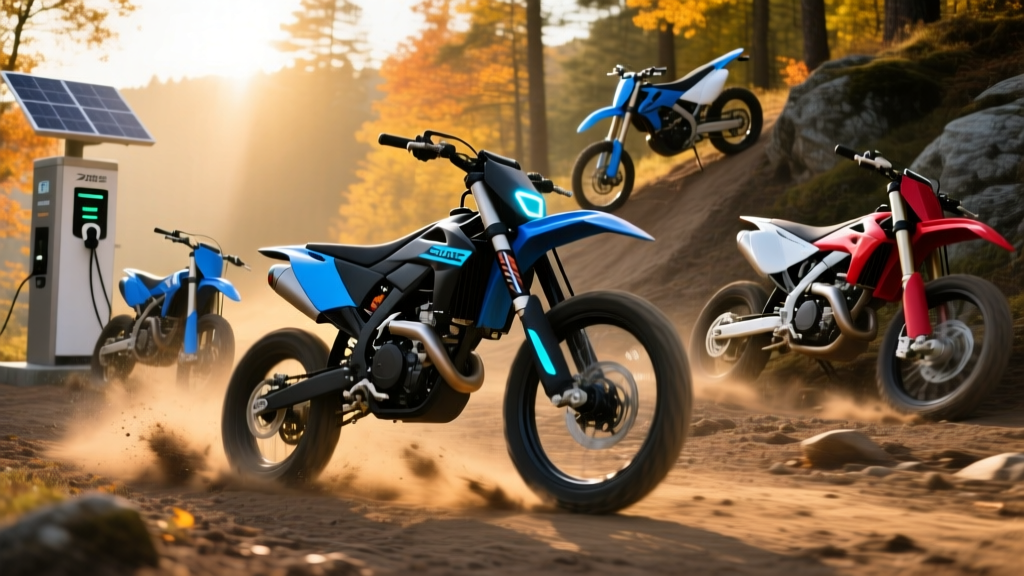
How We Ranked These Electric Off-Road Bikes
Before we get to the list, here's what earned a spot. We evaluated each model on six weighted factors relevant to trail riders, motocross enthusiasts, and dual-sport commuters:
- Power & Top Speed: Peak horsepower, torque, and verified top speed (GPS-confirmed or manufacturer-documented).
- Battery & Range: Usable battery capacity (kWh), real-world ride time at mixed intensity, and charge time from 20-80%.
- Weight & Handling: Curb weight relative to ICE equivalents in the same displacement class.
- Price & Value: MSRP before incentives, plus any federal or state off-highway vehicle rebates.
- Charging Practicality: Onboard charger capability, Level 1 (120V) and Level 2 (240V) options, and field-swappable battery availability.
- Aftermarket & Support: Dealer network, parts availability, and firmware update cadence.
Note: Electric dirt bikes and off-road motorcycles do not qualify for the IRS §30D clean vehicle tax credit, which applies only to four-wheeled on-road vehicles. Some states offer OHV rebates — check your local DNR or energy office.
Stark Varg Electric Dirt Bike Top Speed: The Headline Number
The Stark Varg MX — the motocross-focused variant — delivers a top speed of approximately 62 mph (100 km/h) in stock configuration with standard gearing. The Varg EX (enduro/cross-country trim) is geared slightly taller and can reach roughly 68 mph on flat terrain. These figures come from Stark Future's published specifications and have been corroborated by independent GPS-verified tests from outlets like Stark Future's official site.
For context, a comparable 450cc four-stroke motocross bike (KTM 450 SX-F, Honda CRF450R) tops out between 60-75 mph depending on gearing, so the Varg is squarely in the competitive window. The advantage isn't top speed — it's how the Varg gets there: instant torque delivery from 0 rpm means the bike accelerates harder out of corners than any ICE 450, even if the ultimate top-end is similar.
Top Pick: Stark Varg MX — Best Overall Electric Motocross Bike
The Varg MX earns the top spot because it's the only electric dirt bike that matches 450cc ICE performance across the full power band while remaining competitive on weight. At 80 hp peak and 690 Nm (509 lb-ft) of torque at the rear wheel, it outpulls every gas 450 on the market. The 6 kWh battery provides roughly 30-40 minutes of hard motocross riding or up to 6 hours of trail riding at moderate pace. At $12,900 MSRP (MX trim), it's expensive but not unreasonable when you factor in zero fuel, zero oil changes, and dramatically lower maintenance.
The 7 Best Electric Dirt Bikes & Off-Road EVs Ranked
#1 — Stark Varg MX
Key Spec: 80 hp | 62 mph top speed | 6 kWh | $12,900
Why It Made the List: The only electric motocross bike that genuinely competes with 450cc ICE machines on a race track. The power-to-weight ratio (80 hp at ~230 lbs wet) is class-leading, and the adjustable power maps let you dial it down to 250cc equivalent for beginners.
Best For: Serious motocross riders who want 450-class performance with electric instant torque and near-silent operation.
#2 — Stark Varg EX (Enduro)
Key Spec: 80 hp | 68 mph top speed | 6 kWh | $13,900
Why It Made the List: Same powertrain as the MX but with 18-inch rear wheel, kickstand, skid plate, lighting kit, and a six-speed gearbox option. The taller gearing bumps top speed to ~68 mph, making it viable for dual-sport trail-to-road transitions.
Best For: Enduro and cross-country riders who need street-legal capability (in some states) and longer range at moderate pace.
#3 — KTM Freeride E-XC
Key Spec: 24 hp | 53 mph top speed | 3.9 kWh | $11,099
Why It Made the List: KTM's proven platform has been in production since 2018 with iterative updates. The 3.9 kWh battery delivers about 90 minutes of trail riding. It's the most widely supported electric off-road bike at KTM dealerships across the US, which matters for parts and service.
Best For: Trail riders who prioritize dealer support and proven reliability over raw power.
#4 — Sur-Ron Light Bee X
Key Spec: 6 hp (peak) | 47 mph top speed | 1.92 kWh | $4,499
Why It Made the List: The Light Bee X dominates the entry-level electric off-road segment. At under $4,500, it's the cheapest way to get a legitimate off-road electric motorcycle. The 60V Panasonic battery is removable and swappable. Top speed is electronically limited to 47 mph but can be unlocked to ~55 mph with an aftermarket controller.
Best For: Beginners, younger riders, and anyone wanting a low-cost entry to electric off-road riding.
#5 — E-Ride Pro SS (Sur-Ron Successor)
Key Spec: 10 hp (peak) | 60 mph top speed | 3.0 kWh | $5,999
Why It Made the List: A step up from the Light Bee in every metric — more power, larger battery, full-size frame geometry. The 72V system provides stronger acceleration, and the bike accepts many Sur-Ron aftermarket parts.
Best For: Intermediate riders who've outgrown the Light Bee but aren't ready for the Varg's price.
#6 — Zero FX
Key Spec: 44 hp | 85 mph top speed | 7.2 kWh | $11,995
Why It Made the List: The Zero FX is a street-legal dual-sport that can handle trails. Its 85 mph top speed is the highest on this list, and the 7.2 kWh Z-Force battery gives it a genuine 50-70 mile real-world range on mixed use. It charges via standard Level 1 (120V) in about 9 hours or with an optional Charge Tank (Level 2) in ~2 hours.
Best For: Riders who need a street-legal commuter that can also handle fire roads and light trail duty.
#7 — KTM SX-E 5 (Youth Mini)
Key Spec: 6.7 hp | 45 mph top speed | 1.8 kWh | $5,649
Why It Made the List: Purpose-built for kids ages 6-12 transitioning from 50cc gas minis. Six adjustable power modes let parents limit speed from 5 mph up to 45 mph. The WP suspension is identical to KTM's gas mini bikes, so handling is legitimate.
Best For: Parents looking for a quiet, low-maintenance youth motocross bike for backyard tracks and sanctioned events.
Head-to-Head Comparison Table
| Model | Peak HP | Top Speed | Battery (kWh) | Ride Time (Hard) | Weight (lbs) | MSRP |
|---|---|---|---|---|---|---|
| Stark Varg MX | 80 | 62 mph | 6.0 | 30-40 min | 230 | $12,900 |
| Stark Varg EX | 80 | 68 mph | 6.0 | 45-60 min | 240 | $13,900 |
| KTM Freeride E-XC | 24 | 53 mph | 3.9 | 60-90 min | 245 | $11,099 |
| Sur-Ron Light Bee X | 6 | 47 mph | 1.92 | 40-60 min | 120 | $4,499 |
| E-Ride Pro SS | 10 | 60 mph | 3.0 | 45-75 min | 145 | $5,999 |
| Zero FX | 44 | 85 mph | 7.2 | 50-70 mi | 297 | $11,995 |
| KTM SX-E 5 | 6.7 | 45 mph | 1.8 | 30-60 min | 108 | $5,649 |
Category Winners: Fastest, Longest Range, Best Value
| Category | Winner | Key Metric |
|---|---|---|
| Highest Top Speed | Zero FX | 85 mph |
| Most Power | Stark Varg MX/EX | 80 hp / 690 Nm |
| Longest Range (Dual-Sport) | Zero FX | 50-70 real-world miles |
| Best Motocross Ride Time | KTM Freeride E-XC | 60-90 min trail pace |
| Best Budget Entry | Sur-Ron Light Bee X | $4,499 |
| Best Youth Bike | KTM SX-E 5 | $5,649 / 108 lbs |
| Best Power-to-Weight | Stark Varg MX | 80 hp at 230 lbs |
Budget Tiers: Which Electric Dirt Bike Fits Your Wallet?
Under $6,000 — Entry & Youth
At this price, you're looking at the Sur-Ron Light Bee X ($4,499) for adult beginners or the KTM SX-E 5 ($5,649) for youth riders. Expect 40-60 minutes of ride time and top speeds in the 45-55 mph range. These bikes are excellent for learning, backyard tracks, and light trail use. Battery capacity is limited (1.8-1.92 kWh), so don't plan all-day rides without a spare battery pack.
$6,000–$10,000 — Intermediate
The E-Ride Pro SS ($5,999) sits at the low end of this tier and punches above its weight with 10 peak hp and a 3.0 kWh battery. This is the sweet spot for riders who want real off-road capability without the premium pricing of full-size competition bikes.
$10,000+ — Competition & Dual-Sport
This is where the KTM Freeride E-XC ($11,099), Zero FX ($11,995), and both Stark Varg variants ($12,900-$13,900) live. The KTM Freeride is the proven trail choice with the deepest dealer network. The Zero FX is the only street-legal option with genuine commuter range. The Stark Varg is the only bike here that competes head-to-head with 450cc gas motocross bikes on a race track.
Tax Credits, Incentives, and the Real Cost of Ownership
A critical clarification: electric dirt bikes and off-road motorcycles do not qualify for the federal §30D Clean Vehicle Credit. That credit, worth up to $7,500, applies only to new four-wheeled vehicles with four wheels and a gross vehicle weight under 14,000 lbs, per IRS guidelines. Motorcycles — electric or gas — are excluded.
However, some states offer their own incentives:
- California: The Clean Off-Road Equipment Voucher Incentive Project (CORE) has periodically offered point-of-sale rebates for off-road EVs, though funding fluctuates. Check the CORE program page for current availability.
- Colorado: Offers a state tax credit for electric motorcycles, which may apply to dual-sport models like the Zero FX if registered for street use.
- Utility Rebates: Some municipal utilities (e.g., LADWP, SMUD) offer $200-$500 rebates for electric motorcycle purchases — check your local provider.
Where electric dirt bikes genuinely save money is operating cost. A full charge on a Stark Varg (6 kWh) costs roughly $0.90 at the US average electricity rate of $0.15/kWh. A comparable 450cc gas bike burning 1.5 gallons per moto at $4.50/gallon costs $6.75 per session. Over 100 motos per year, that's a $585 annual fuel savings — and you eliminate oil changes, air filter cleaning, and top-end rebuilds entirely.
Which Electric Dirt Bike Should You Actually Buy?
Choose the Stark Varg MX if: You race motocross or ride at tracks where noise restrictions are a problem, and you need 450-class power with instant torque delivery. Budget $12,900+ and accept 30-40 minute moto sessions.
Choose the Stark Varg EX if: You ride enduro, GNCC, or cross-country and need lighting, a kickstand, and slightly taller gearing for fire-road transitions.
Choose the KTM Freeride E-XC if: You want proven trail reliability with a nationwide dealer network and don't need 450-class power. It's the safest buy for riders who value service access.
Choose the Sur-Ron Light Bee X if: You're new to electric off-road, want to spend under $5,000, or need a lightweight bike (120 lbs) for tight technical trails.
Choose the Zero FX if: You need a street-legal dual-sport that can commute during the week and hit trails on weekends. It's the only bike here with genuine 50+ mile road range and 85 mph highway capability.
Choose the KTM SX-E 5 if: You're buying for a child aged 6-12 who races or practices at home. The adjustable power modes and quiet operation make it ideal for residential areas.
Frequently Asked Questions
What is the Stark Varg electric dirt bike top speed?
The Stark Varg MX reaches approximately 62 mph in stock configuration. The Varg EX enduro variant, with taller gearing, reaches roughly 68 mph. Both figures are GPS-verified and competitive with 450cc four-stroke motocross bikes.
How long does the Stark Varg battery last on a single charge?
The 6 kWh battery provides roughly 30-40 minutes of hard motocross riding (full-throttle moto pace) or up to 6 hours of moderate trail riding. Battery life varies significantly with rider weight, terrain, ambient temperature, and throttle discipline. In cold weather (below 40°F), expect 15-20% range reduction due to increased internal battery resistance.
Can you charge the Stark Varg from a standard wall outlet?
Yes. The Varg includes a standard Level 1 (120V) charger that fully recharges the 6 kWh battery in approximately 4-5 hours. An optional fast charger reduces this to roughly 2 hours. There is no DC fast charging capability — these batteries are too small to justify the infrastructure.
Do electric dirt bikes qualify for any tax credits?
No. The federal §30D Clean Vehicle Credit applies only to four-wheeled on-road vehicles. Electric motorcycles and off-road bikes are excluded. Some states and utilities offer separate rebates — check your local programs.
How does the Stark Varg compare to a KTM 450 SX-F?
The Varg produces 80 hp peak versus the KTM 450 SX-F's ~57 hp, and delivers maximum torque from 0 rpm (versus needing to reach ~8,000 rpm on the gas bike). The Varg weighs approximately 230 lbs wet versus ~237 lbs for the KTM. On a race track, the Varg accelerates harder out of corners but may give up top-end speed on long straights depending on gearing. The KTM still wins on refueling speed (2 minutes for a gas fill versus 2+ hours for a battery recharge).
What's the maintenance difference between electric and gas dirt bikes?
Electric dirt bikes eliminate oil changes, air filter cleaning, valve adjustments, piston/ring replacement, clutch rebuilds, and exhaust repacking. The primary maintenance items are chain/sprocket wear, brake pads, suspension service, and tire replacement. Owners report 70-80% lower annual maintenance costs compared to equivalent gas bikes.