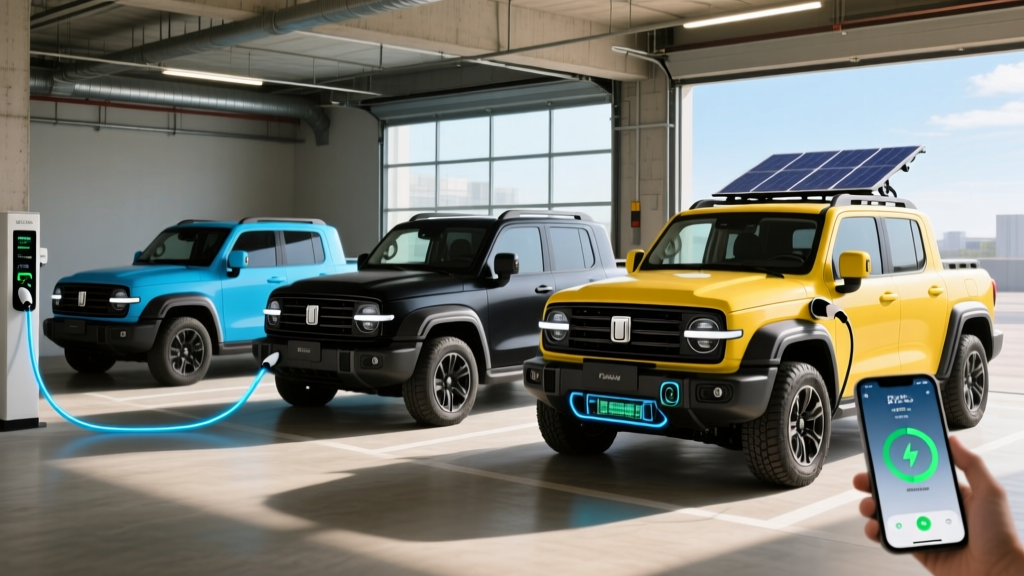
The Quick Answer: Is a Small EV Truck Right for You?
Bottom line: A small EV truck makes financial sense if you drive 10,000–15,000 miles/year, have access to Level 2 home charging, and need a bed for weekend projects rather than daily commercial hauling. Expect 230–320 miles of EPA range, $4,500–$7,500 in federal tax credits (if you meet income and sourcing rules), and fuel savings of $1,200–$1,800 annually versus a comparable gas truck. If you regularly tow over 5,000 lbs, live in a charging desert, or lack home charging access, a hybrid truck like the Ford Maverick Hybrid may serve you better today.
The compact truck segment is electrifying fast. Ford's Maverick EV and Hyundai's upcoming Santa Cruz EV are leading the charge into 2026, targeting buyers who want truck utility without full-size EV pricing or gas-truck fuel bills. But "small EV truck" doesn't mean compromise-free — range under load, charging infrastructure, and upfront cost all require honest evaluation before you sign.
2026 Small EV Truck Lineup: Specs & Pricing
Here's how the current and announced small electric trucks stack up on paper. Note: Hyundai Santa Cruz EV specs are preliminary based on manufacturer announcements; final EPA certification may differ.
| Spec | Ford Maverick EV (2026) | Hyundai Santa Cruz EV (2026, announced) |
|---|---|---|
| Base MSRP | $34,995 | $36,500 (est.) |
| EPA Range | ~300 mi (target) | ~280 mi (est.) |
| Battery (usable) | ~75 kWh, NMC | ~77 kWh, NMC (est.) |
| Peak DC Charge Rate | 150 kW | 180 kW (est.) |
| 10–80% DC Fast Charge | ~28 min | ~22 min (est.) |
| Level 2 Charge Rate | 11.5 kW | 10.9 kW (est.) |
| Horsepower | ~285 hp (AWD) | ~300 hp (AWD, est.) |
| 0–60 mph | ~5.8 sec | ~5.5 sec (est.) |
| Max Towing | 2,000 lbs | 2,500 lbs (est.) |
| Bed Length | 4.5 ft (48 in) | 4.3 ft (52 in) |
| §30D Tax Credit Eligible | Up to $7,500 (sourcing dependent) | TBD — likely partial |
| Battery Warranty | 8 yr / 100,000 mi | 10 yr / 100,000 mi |
Sources: fueleconomy.gov, Ford and Hyundai manufacturer press releases. Verify final EPA figures before purchasing.
Real-World Range: What the EPA Sticker Doesn't Tell You
EPA vs. Reality: A 300-mile EPA rating on the Maverick EV translates to roughly 240–260 miles on the highway at 70+ mph, and 200–220 miles in sub-30°F weather without preconditioning. Add a 1,500-lb payload or trailer, and expect a further 15–25% range reduction.
This is physics, not a defect. EVs lose efficiency at high speeds because there's no multi-gear transmission to keep the motor in its sweet spot, and cold temperatures slow battery chemistry while demanding cabin heat. The Maverick EV's liquid-cooled NMC pack handles thermal management well, but no battery escapes winter.
Preconditioning matters. If you use the FordPass app to warm the battery 15–20 minutes before hitting a DC fast charger, you'll hit closer to that 150 kW peak rate. Arrive cold, and the truck may cap charging at 60–80 kW until the pack warms up — adding 10–15 minutes to your stop.
For daily driving under 60 miles round-trip with home charging, real-world range is a non-issue. It becomes critical only on road trips exceeding 200 miles one-way, where you'll need to plan a DC fast-charge stop.
EV Truck vs. Gas Truck: 5-Year Cost Breakdown
Let's compare the Maverick EV against the gas-powered Maverick EcoBoost AWD over 5 years and 60,000 miles. Assumptions: $0.14/kWh national average electricity, $3.40/gallon regular unleaded, 25 mpg combined for gas Maverick.
| Cost Category | Maverick EV (2026) | Maverick EcoBoost AWD |
|---|---|---|
| Base MSRP | $34,995 | $28,995 |
| Federal Tax Credit (§30D) | −$7,500 (if eligible) | $0 |
| Effective Purchase Price | $27,495 | $28,995 |
| Fuel/Energy (60k mi) | $2,520 (3.0 mi/kWh) | $8,160 (25 mpg) |
| Maintenance (5 yr) | ~$1,200 | ~$3,200 |
| Insurance (5 yr avg.) | ~$9,500 | ~$7,800 |
| Estimated Depreciation | ~$12,000 | ~$10,500 |
| 5-Year Total Cost | ~$52,715 | ~$58,655 |
Net savings over 5 years: ~$5,940 in favor of the EV, primarily from fuel and maintenance. However, this assumes you qualify for the full $7,500 credit and have home charging. Without the credit, the EV's advantage shrinks to about $1,500 — still positive, but less compelling.
Key nuances:
- Insurance is higher for EVs — typically 15–25% more due to repair costs and battery replacement risk. Get a quote before committing.
- Maintenance savings are real: no oil changes, no spark plugs, regenerative braking extends pad life to 80,000+ miles.
- Depreciation uncertainty: EV resale values have been volatile. The Maverick EV is new enough that long-term depreciation curves are unproven.
Charging at Home and on the Road: What You Actually Need
Home charging is where EV truck ownership lives or dies. If you can install a Level 2 charger, you'll wake up to a full "tank" every morning and rarely visit a public charger except on road trips.
| Level | Power (kW) | Miles Added/Hour | Use Case |
|---|---|---|---|
| Level 1 (120V) | 1.4 kW | ~4 mi/hr | Emergency/overnight top-up |
| Level 2 (240V, home) | 7.7–11.5 kW | 25–38 mi/hr | Daily charging (7–10 hr for full) |
| DC Fast Charge | 50–150 kW | 150–500 mi/hr | Road trips (10–80% in ~28 min) |
Home Level 2 installation costs typically run $800–$2,500 for the charger unit plus $500–$2,000 for electrician labor, depending on whether your panel needs an upgrade. If you have a 200-amp electrical panel with spare capacity, expect the lower end. A panel upgrade to 200A can add $1,500–$3,500.
For the Maverick EV at 11.5 kW, a full charge from 10% takes about 6.5 hours — easily accomplished overnight. At $0.14/kWh, filling the ~75 kWh battery costs roughly $10.50 for 300 miles. Compare that to $40+ for a gas Maverick's 16.5-gallon tank.
On the road, the Maverick EV uses the NACS (Tesla) connector, giving you access to Tesla Supercharger stations — the most reliable DC fast-charging network in the US. The Hyundai Santa Cruz EV is expected to use NACS as well, following Hyundai's 2024 connector switch announcement.
Always check charging infrastructure along your common routes using apps like PlugShare or A Better Routeplanner before buying. If your area is a charging desert, factor in the inconvenience honestly.
Federal Tax Credit: Do You Actually Qualify?
The §30D federal EV tax credit can reduce your effective purchase price by up to $7,500, but eligibility is not automatic. Here's the 2026 checklist per IRS guidelines:
- MSRP cap: Truck/van/SUV must have an MSRP at or below $80,000 — both small EV trucks clear this easily.
- Buyer income limits: AGI must not exceed $300,000 (married filing jointly), $225,000 (head of household), or $150,000 (single).
- Battery sourcing: A percentage of critical minerals and battery components must be sourced from the US or free-trade-agreement countries. This determines whether you get $3,750 or the full $7,500.
- Point-of-sale transfer: As of 2024, you can transfer the credit to the dealer at purchase, reducing your out-of-pocket cost immediately rather than waiting for tax filing.
- Final assembly: Vehicle must undergo final assembly in North America.
Critical caveat: Battery-sourcing requirements tighten annually. A truck that qualifies for the full $7,500 in early 2026 may qualify for only $3,750 later if supply chains shift. Always verify eligibility on fueleconomy.gov for the specific model and build date before purchasing.
Common Misconceptions About Small EV Trucks
| Myth | Fact |
|---|---|
| "EV trucks can't tow anything" | The Maverick EV tows 2,000 lbs — sufficient for a small utility trailer, jet ski, or pop-up camper. It won't haul a 7,000-lb boat, but most compact truck buyers don't need that. |
| "The battery will need a $20,000 replacement in 5 years" | NMC batteries degrade ~1–2% per year under normal use. At 8 years, expect ~85–90% capacity retention. Both trucks carry 8–10 year / 100,000-mile battery warranties covering drops below 70% capacity. |
| "Charging takes too long for road trips" | At 150 kW, the Maverick EV adds ~180 miles in 20 minutes. Plan a rest stop, grab food, and you're back on the road. Yes, it's longer than a gas fill-up — but you're also saving $30+ per stop. |
| "EVs don't work in cold weather" | Range drops 20–30% in freezing temps. A 300-mile truck becomes a ~220-mile truck. With preconditioning and route planning, this is manageable — but if you live in northern Minnesota and drive 150 miles one-way in January, be honest about the trade-off. |
| "I need a home garage to own an EV" | A garage is ideal, but a driveway with a 240V outlet works fine. Street-only parking makes EV ownership significantly harder unless your workplace or city offers reliable public Level 2 charging. |
Decision Framework: Should You Buy a Small EV Truck?
Choose the small EV truck if:
- You have Level 2 home charging (or can install it for under $2,500)
- Your daily driving is under 80 miles round-trip
- You qualify for at least $3,750 in federal tax credits
- Your towing needs stay under 2,000–2,500 lbs
- You want to eliminate oil changes, spark plugs, and transmission fluid
- You value instant torque and a quiet cabin for daily commuting
Choose the gas or hybrid Maverick instead if:
- You lack reliable access to home or workplace charging
- You regularly tow over 4,000 lbs
- You frequently drive 300+ mile one-way trips in cold weather
- Your AGI exceeds the §30D income caps
- You need a 6-foot bed for commercial or large-item hauling
- Upfront cost (even after credits) strains your budget versus a $28,000 gas Maverick
Choose a PHEV or wait if:
- You want some electric-only commuting but need gas flexibility for long rural trips — the Maverick Hybrid (42 mpg combined) is a strong middle ground today
- You're considering the Santa Cruz EV — wait for final EPA certification and pricing before committing
Frequently Asked Questions
Can I charge a small EV truck from a regular 120V outlet?
Yes, but slowly. Level 1 charging at 1.4 kW adds about 4 miles of range per hour — roughly 40–50 miles overnight. This works if your daily driving is under 30 miles, but it's not practical as a primary charging strategy for most truck owners.
How long will the battery last before needing replacement?
Based on degradation data from similar NMC packs, expect 85–90% capacity at 8 years and 100,000 miles. Full replacement is rare and covered under warranty if capacity drops below 70%. Out-of-warranty replacement costs $12,000–$18,000 depending on the pack — but most EVs are retired or sold before this becomes necessary.
Does the small EV truck qualify for state incentives too?
Possibly. States like California, Colorado, Massachusetts, and New York offer additional rebates of $1,000–$5,000, often stackable with the federal credit. Check your state energy office or afdc.energy.gov for current programs. These change frequently and may have income or residency requirements.
What happens if I need to tow — how much range do I lose?
Towing a 1,500-lb trailer typically reduces range by 25–35%. A 300-mile EPA truck becomes a ~200-mile truck under tow. Plan charging stops accordingly and keep highway speeds under 65 mph to minimize the aerodynamic penalty.
Is the Maverick EV available now or still announced?
Ford has confirmed the Maverick EV for the 2026 model year with production beginning in late 2025. Check Ford's website for current availability and delivery timelines in your area, as initial supply may be limited to certain markets.