The Quick Answer: Is a Small EV Pickup Truck Right for You?
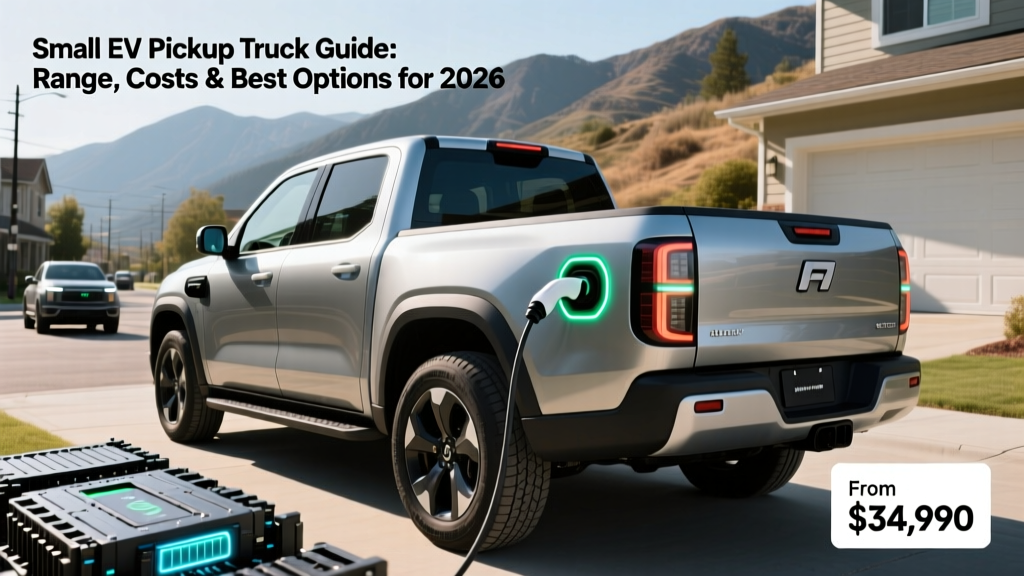
As of 2026, the small EV pickup truck segment is just emerging. The closest production options include the Ford Maverick EV (announced for late 2026, targeting ~250 miles EPA range and a ~$35,000 starting MSRP) and the Hyundai Santa Cruz EV (expected 2027 model year, preliminary specs). If you need a compact electric truck today, your only real option is stepping up to the midsize Rivian R1T (~$69,900 base, 270–420 miles EPA depending on battery pack) or the Ford F-150 Lightning (~$54,995 base, 240–320 miles EPA). Neither qualifies as "small," but both are the most manageable electric trucks currently on sale.
If you can wait 12–18 months, the Maverick EV promises to be the first true small EV pickup truck with mainstream pricing. Here's what you need to know before you commit—or decide to stick with a gas or hybrid compact truck instead.
What Defines a Small EV Pickup Truck (and What's Actually Available)?
The compact truck segment—vehicles like the Ford Maverick, Hyundai Santa Cruz, and Honda Ridgeline—sits below midsize trucks (Tacoma, Ranger, Colorado) in footprint, price, and payload. A small EV pickup truck applies that same compact formula to a battery-electric powertrain: unibody construction, a 4–5-foot bed, ~1,500 lbs payload capacity, and pricing ideally under $40,000.
The challenge is that batteries are heavy and expensive. Packing enough kWh for 250+ miles of range while keeping a compact truck under $40,000 is an engineering tightrope. Here's the current landscape:
| Model | Status | EPA Range | Battery (kWh) | Peak DC Charge | 0–60 mph | Base MSRP |
|---|---|---|---|---|---|---|
| Ford Maverick EV | Announced (late 2026) | ~250 mi (est.) | ~75 kWh (est.) | ~150 kW (est.) | TBD | ~$35,000 (est.) |
| Hyundai Santa Cruz EV | Announced (2027 MY) | TBD | TBD | TBD | TBD | TBD |
| Rivian R1T (Dual-Motor) | On sale | 270 mi (Standard) | 95 kWh usable (NMC) | 220 kW | 4.5 sec | $69,900 |
| Ford F-150 Lightning (Std Range) | On sale | 240 mi | 98 kWh usable (NMC) | 150 kW | 4.0 sec | $54,995 |
Key takeaway: The true small EV pickup truck doesn't quite exist yet at scale. The Maverick EV is the most anticipated entry, but specs remain preliminary. If you need to buy now, you're choosing between larger, more expensive trucks or sticking with gas/hybrid compacts.
EV vs. Gas vs. Hybrid: How a Small Electric Truck Compares
The current small truck market is dominated by gas and hybrid models. Here's how the economics and capability stack up when you compare a small EV pickup truck against the segment leaders:
| Metric | Ford Maverick EV (est.) | Ford Maverick Hybrid (2026) | Hyundai Santa Cruz 2.5T AWD (2026) |
|---|---|---|---|
| Powertrain | BEV (est. 75 kWh) | 2.5L HEV | 2.5L Turbo Gas |
| EPA Range / MPG | ~250 mi | 42 MPG combined | 22 MPG combined |
| Base MSRP | ~$35,000 | $28,995 | $33,200 |
| Fuel/Energy Cost per Mile | ~$0.04 (home L2) | ~$0.08 (gas) | ~$0.15 (gas) |
| Annual "Fuel" Cost (12,000 mi) | ~$480 | ~$960 | ~$1,800 |
| Maintenance (Annual Est.) | ~$300 | ~$600 | ~$700 |
| Payload Capacity | ~1,200 lbs (est.) | 1,500 lbs | 1,753 lbs |
| Towing Capacity | ~2,000 lbs (est.) | 2,000 lbs | 5,000 lbs |
| Federal Tax Credit (§30D) | Up to $7,500 (if eligible) | None | None |
The Maverick Hybrid at 42 MPG combined is already remarkably efficient, making the cost-per-mile gap between gas-hybrid and EV narrower than in larger vehicle segments. At $0.08/mile for the hybrid versus $0.04/mile for the EV (charging at home on a Level 2 at $0.13/kWh national average), you save roughly $480/year over 12,000 miles. That's real money, but the Maverick Hybrid starts $6,000 cheaper before any tax credit, so the break-even timeline stretches to 5+ years unless you qualify for the full §30D federal tax credit.
Where the EV wins decisively: instant torque for merging, a smoother ride (no transmission shifts), regenerative braking that reduces brake wear, and the convenience of "refueling" at home overnight. Where it loses: payload and towing are constrained by battery weight, and highway range drops 15–25% in cold weather or at sustained 75+ mph speeds.
Real Ownership Costs: Purchase, Charging, Insurance, and Maintenance
Buying a small EV pickup truck involves more than sticker price. Here's a realistic 5-year total cost of ownership (TCO) projection for the Maverick EV versus the Maverick Hybrid, assuming 12,000 miles/year, home Level 2 charging, and a $0.13/kWh electricity rate:
| Cost Category | Maverick EV (est.) | Maverick Hybrid |
|---|---|---|
| Purchase Price (base) | $35,000 | $28,995 |
| §30D Tax Credit | −$3,750 to −$7,500* | $0 |
| Home Level 2 Charger Install | $800–$2,000 | $0 |
| Energy/Fuel (5 yrs, 60k mi) | $2,400 | $4,800 |
| Maintenance (5 yrs) | $1,500 | $3,000 |
| Insurance (5 yrs, avg.) | $9,000 | $7,200 |
| Estimated Depreciation | $14,000 | $10,150 |
| Total 5-Year Cost | $44,950–$50,000 | $54,145 |
*The §30D credit depends on battery sourcing (critical minerals + component requirements), your income (≤$150k single / ≤$300k joint), and the vehicle's MSRP (≤$80,000 for trucks). The Maverick EV is expected to qualify for at least a partial credit, but final battery sourcing details are unconfirmed. The credit can now be transferred to the dealer at point of sale, reducing your out-of-pocket cost immediately. Always verify current rules at IRS.gov and consult a tax professional.
Insurance note: EVs typically cost 15–25% more to insure than equivalent gas vehicles due to higher repair costs and battery replacement risk. Get quotes before purchasing—this line item can erase your fuel savings if you're not careful.
Charging at Home and on the Road: What Small EV Truck Owners Need
Charging is the make-or-break factor for EV truck ownership. A compact truck's smaller battery (estimated 75 kWh for the Maverick EV) actually works in your favor here—it charges faster than a 130+ kWh pack in an F-150 Lightning Extended Range.
| Level | Power (kW) | Miles Added per Hour | Full Charge Time | Typical Use |
|---|---|---|---|---|
| Level 1 (120V outlet) | 1.4 kW | ~4–5 mi/hr | ~55 hours | Emergency / trickle only |
| Level 2 (240V, 32A) | 7.7 kW | ~25–30 mi/hr | ~10 hours | Home daily charging |
| Level 2 (240V, 48A) | 11.5 kW | ~38–42 mi/hr | ~7 hours | Home fast overnight |
| DC Fast (150 kW peak) | 150 kW | ~500+ mi/hr (peak) | 10–80% in ~30 min | Road trips |
kW vs. kWh reminder: kW (kilowatts) measures power—the rate at which energy flows into the battery. kWh (kilowatt-hours) measures energy capacity—how much the battery holds total. A 150 kW charger can theoretically deliver 150 kWh in one hour, but in practice, charge speed tapers significantly above 80% State of Charge (SoC) to protect battery health. That 10–80% time is the number that actually matters for road trips.
Home charging access is critical. If you have a garage or driveway with access to a 240V outlet (like a dryer outlet) or can install a dedicated Level 2 circuit, a small EV pickup truck is highly practical—you wake up every morning with a "full tank." If you rely solely on street parking or apartment living with no charging access, the daily logistics become significantly harder. Public DC fast charging costs $0.30–$0.50/kWh (roughly double home rates) and availability varies widely by region.
Cold-weather reality: Expect 15–30% range loss in sustained sub-freezing temperatures. A truck with a 250-mile EPA estimate may deliver only 175–210 miles in January in Minnesota. Battery preconditioning (warming the pack before fast charging) is essential in cold climates—confirm the vehicle supports this feature.
Common Misconceptions About Small EV Pickup Trucks
| Myth | Fact |
|---|---|
| "EV trucks can't tow anything." | A compact EV truck will likely tow 2,000–3,500 lbs—enough for a small trailer, jet skis, or a utility trailer. That's less than a gas Santa Cruz (5,000 lbs) but matches the Maverick Hybrid. Towing does cut range by 30–50%, so plan accordingly. |
| "The battery will need replacing in 5 years." | Modern NMC and LFP batteries are warrantied for 8 years/100,000 miles (federally mandated minimum) with capacity retention above 70%. Real-world data from Tesla, Hyundai, and Chevrolet shows most packs lose only 10–15% capacity over 150,000+ miles. Replacement is rare and typically covered under warranty within the coverage period. |
| "You'll get the full $7,500 tax credit." | Eligibility requires meeting income caps, MSRP caps (≤$80k for trucks), and strict battery-sourcing rules for critical minerals and components. Many EVs qualify for only $3,750 or nothing at all depending on model year and manufacturing origin. Always check the latest IRS guidance before assuming. |
| "Charging takes too long for a work truck." | If you charge at home overnight, you start every day with a full battery—zero time spent at a gas station. For road trips, a 25–30 minute DC fast charge (10–80%) aligns with a rest stop. Fleet operators are increasingly using depot-based overnight Level 2 charging to eliminate fueling downtime entirely. |
| "A small EV truck is just a golf cart with a bed." | Even with a ~75 kWh battery, a compact EV truck will produce an estimated 250–300 horsepower with instant torque delivery. The Maverick Hybrid makes 191 HP and hits 60 mph in ~7.5 seconds. Expect the EV variant to be quicker, smoother, and significantly more responsive at highway merge speeds. |
What First-Time EV Truck Buyers Should Know
If this is your first electric vehicle and you're specifically shopping for a small EV pickup truck, here are the non-obvious realities that spec sheets don't highlight:
- The frunk is a game-changer for truck owners. An electric truck has no engine, so the front trunk (frunk) gives you secure, weatherproof storage separate from the bed. On the F-150 Lightning, the frunk holds 14.1 cubic feet—more than many sedan trunks. Expect a compact EV truck frunk to offer 6–10 cubic feet, ideal for tools, charging cables, or groceries you don't want sliding around the bed.
- Regenerative braking changes how you drive. Most EVs offer adjustable regen, and in its strongest setting, you can drive almost entirely with the accelerator pedal ("one-pedal driving"). This reduces brake pad wear dramatically—many EV owners report original brake pads lasting 100,000+ miles.
- Tire wear is higher. EVs are heavier (battery mass) and produce instant torque, which accelerates tire wear by 15–30% compared to gas vehicles. Budget for tire replacement every 30,000–40,000 miles rather than the 50,000+ miles typical of gas trucks.
- Route planning matters on road trips. Apps like A Better Routeplanner or the vehicle's native navigation will factor in charging stops, elevation, temperature, and payload. A small EV truck with 250 miles of range can comfortably cover 200 miles between charge stops when you account for the 10–80% charging sweet spot.
- Your electrical panel may need an upgrade. Installing a 48-amp Level 2 charger requires a dedicated 60-amp circuit. If your home has a 100-amp panel that's already near capacity, an upgrade to 200 amps can cost $1,500–$3,000 on top of the charger and installation. Get an electrician's assessment before committing to a purchase.
Decision Framework: Should You Buy a Small EV Pickup Truck?
Choose a Small EV Pickup Truck If:
- You have reliable home Level 2 charging access (garage or driveway with 240V)
- Your daily driving is under 100 miles round-trip (well within the battery buffer)
- You rarely tow more than 2,000 lbs or haul more than 1,000 lbs of payload
- You live in a moderate climate, or you're prepared for 20–30% winter range loss
- You qualify for at least a partial §30D tax credit (check income and sourcing rules)
- You value instant torque, quiet operation, and zero tailpipe emissions for daily commuting
Choose a Hybrid Compact Truck Instead If:
- You lack home charging access and can't install a Level 2 charger
- You frequently tow 3,000+ lbs or take long road trips through charging deserts
- Your budget is firm under $30,000 and you can't wait for EV pricing to drop
- You need maximum payload for work use (construction materials, heavy equipment)
- You live in an area with extreme cold (sustained below 0°F) and need maximum range reliability
Wait for the Maverick EV (or Santa Cruz EV) If:
- You want a true compact EV truck at mainstream pricing but don't need to buy today
- You're currently driving a gas truck that still has 12–18 months of life left
- You want confirmed EPA range, tax-credit eligibility, and real-world reviews before committing
Frequently Asked Questions
When will the Ford Maverick EV actually be available?
Ford announced the Maverick EV as part of its next-generation EV platform rollout, with production expected to begin in late 2026 for the 2027 model year. Exact timing, final specs, and pricing have not been confirmed. Treat all current figures as estimates until Ford publishes official EPA certification data.
Will the Maverick EV qualify for the $7,500 federal tax credit?
It's likely to qualify for at least a partial credit, given its expected MSRP well under the $80,000 truck cap. However, the §30D credit's battery-sourcing requirements (critical minerals and battery components must meet increasing domestic/free-trade-partner thresholds each year) mean the exact amount can change by model year. Your personal eligibility also depends on income limits ($150k single / $300k joint modified AGI). Check IRS.gov and confirm with a tax professional before relying on the credit in your budget.
How much does it cost to install a home charger for an EV truck?
A Level 2 home charger (240V, 32–48 amps) costs $500–$800 for the unit itself, plus $300–$1,500 for professional electrician installation depending on the distance from your panel and whether a panel upgrade is needed. Total typical range: $800–$2,500. If your panel needs upgrading from 100A to 200A, add $1,500–$3,000.
Can a small EV pickup truck handle a job site?
For light-duty work—carrying tools, materials, and small equipment—an EV compact truck is perfectly capable. The instant torque is actually an advantage when hauling from a stop. But if you regularly max out payload (1,500+ lbs), tow heavy trailers (4,000+ lbs), or drive long distances between remote job sites without charging infrastructure, a gas or hybrid truck remains the more practical choice today.
What happens to the battery after 10 years?
Federal law requires EV battery warranties of at least 8 years/100,000 miles. Most manufacturers warrant the battery to retain 70% or more of its original capacity during that period. Real-world data from fueleconomy.gov and long-term fleet studies show most modern NMC and LFP packs lose roughly 1–2% capacity per year under normal use. A 10-year-old pack might hold 80–85% of its original capacity—still providing 200+ miles of range from a 250-mile pack.
Is an electric truck good in snow and ice?
EVs have a weight advantage in snow (battery mass over the drive wheels improves traction), and electric motors deliver precise torque control that reduces wheelspin. However, cold temperatures reduce battery efficiency and range by 15–30%. If you live in a heavy-snow region, prioritize an AWD configuration and plan for reduced winter range. Preconditioning the cabin and battery while plugged in at home helps preserve range significantly.