If you're searching for small EV cars in the USA that balance affordability, city-friendly size, and genuine daily usability, the shortlist is short but solid. As of early 2026, the most compelling subcompact and compact EVs include the Chevrolet Equinox EV (EPA 319 mi, ~$33,600 base), Hyundai Kona Electric (EPA 261 mi, ~$32,975), Nissan LEAF (EPA 212 mi, ~$28,140), and Volvo EX30 (EPA 265 mi, ~$36,950). Most qualify for partial or full §30D federal tax credits depending on your income, sourcing, and point-of-sale transfer rules, which can drop effective prices by up to $7,500. The real deciding factor isn't just sticker price—it's whether you can charge at home, how far your commute is, and whether you live in a cold climate that will shave 20–30% off that EPA range in winter.
Quick Answer: Are Small EVs Worth It in 2026?
Yes—if you can install a Level 2 home charger, drive under 150 miles round-trip daily, and want to eliminate gas and oil changes. Expect $600–$1,200 in annual electricity vs. $1,800–$2,400 in gas for a comparable 30 MPG compact. The trade-off: higher upfront cost (offset by credits), limited road-trip fast-charging speed on budget models, and reduced winter range. If you rely solely on public charging or regularly drive 300+ miles in cold weather, a PHEV like the Toyota Prius Prime may serve you better.
The Small EV Market in America: What's Actually Available
The subcompact and compact EV segment has thinned out since the Chevrolet Bolt EV and EUV were discontinued, but several strong options remain for buyers who don't need a crossover or truck. Here's how the current field stacks up on paper:
| Model | EPA Range | Battery (kWh) | Peak DC Charge (kW) | 10–80% Time | 0–60 mph | Base MSRP |
|---|---|---|---|---|---|---|
| Chevrolet Equinox EV 2LT | 319 mi | 85 kWh (NMC) | 150 kW | ~30 min | 8.2 sec | $33,600 |
| Hyundai Kona Electric SEL | 261 mi | 65 kWh (NMC) | 100 kW | ~43 min | 7.8 sec | $32,975 |
| Nissan LEAF SV PLUS | 212 mi | 60 kWh (NMC) | 100 kW (CCS adapter) | ~45 min | 6.9 sec | $28,140 |
| Volvo EX30 Single Motor | 265 mi | 69 kWh (NMC) | 153 kW | ~26 min | 6.0 sec | $36,950 |
| Mini Cooper SE (2025+) | 114 mi | 40.7 kWh (NMC) | 95 kW | ~28 min | 7.3 sec | $30,900 |
Sources: fueleconomy.gov, manufacturer press sites. Real-world highway range typically 10–20% below EPA; cold-weather (below 30°F) can reduce range 20–30%.
Real-World Range Reality Check
EPA 319 mi (Equinox EV): Expect ~260–280 mi on a mixed highway trip at 70 mph; ~220–240 mi in sub-freezing temperatures. The 85 kWh battery gives you a comfortable buffer, but sustained 80 mph driving and roof cargo boxes will push consumption above 3.5 mi/kWh.
EV vs Gas vs Hybrid: The Cost Comparison That Matters
The biggest question for small EV car shoppers in the USA isn't "which EV?"—it's "EV, hybrid, or gas?" Let's run the numbers over five years and 75,000 miles, assuming $3.50/gal gas, $0.16/kWh electricity (national average), and 12,000 miles/year.
| Cost Category | Small EV (e.g., Kona Electric) | Gas Compact (e.g., Honda Civic 30 MPG) | PHEV (e.g., Prius Prime) |
|---|---|---|---|
| Purchase Price (before credits) | $32,975 | $26,450 | $33,450 |
| Federal Tax Credit (§30D) | Up to $3,750–$7,500* | $0 | Up to $3,750* |
| Fuel/Energy (5 yr) | $2,880 | $8,750 | $4,200 (mixed) |
| Maintenance (5 yr) | $1,200 | $3,500 | $2,800 |
| Insurance (5 yr est.) | $9,500 | $7,200 | $8,100 |
| 5-Year Total Cost | ~$39,055–$42,805 | ~$45,900 | ~$44,800–$48,550 |
*Tax credit eligibility depends on MSRP caps, buyer income limits, and battery-component/critical-mineral sourcing rules under IRS §30D. Consult a tax professional. Credit amounts vary by model year and sourcing compliance; some models qualify for $3,750 (critical minerals only) rather than the full $7,500.
The EV wins on operating costs—saving roughly $5,870 on fuel and $2,300 on maintenance over five years (no oil changes, fewer brake replacements thanks to regenerative braking, no transmission fluid). But insurance premiums run 15–30% higher on EVs due to repair costs and battery replacement risk. If your effective purchase price drops by $7,500 via the credit, the EV becomes the cheapest option outright.
Charging at Home vs. Public: The Make-or-Break Factor
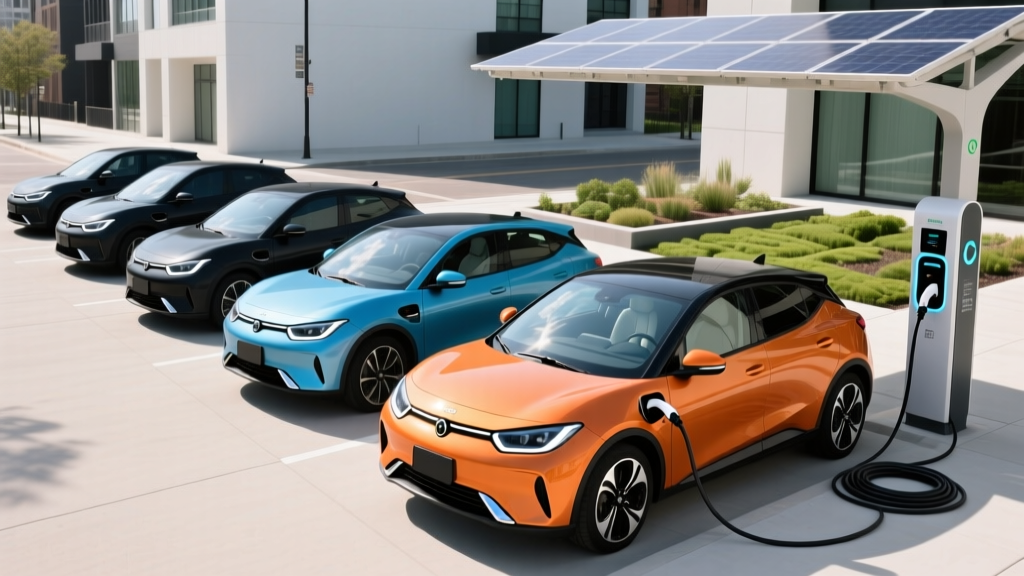
Small EVs in the USA work best when you charge at home overnight. Here's what each charging level actually delivers—note that kW (kilowatts) measures charging power (speed), while kWh (kilowatt-hours) measures battery capacity (energy stored).
| Level | Power (kW) | Miles Added per Hour | Where | Cost per kWh |
|---|---|---|---|---|
| Level 1 (120V outlet) | 1.2–1.4 kW | 3–5 mi/hr | Any standard outlet | $0.12–$0.20 |
| Level 2 (240V home) | 7.2–11.5 kW | 20–35 mi/hr | Home garage, workplaces | $0.10–$0.20 |
| DC Fast Charge | 50–150+ kW | 150–400 mi/hr | Public stations (EA, Tesla, EVgo) | $0.30–$0.55 |
Home Level 2 Installation: What It Actually Costs
If you have a garage or driveway near your electrical panel, a Level 2 home charger install typically runs $800–$2,500 all-in. If your panel needs upgrading from 100A to 200A, add $1,500–$3,000. Here's a realistic breakdown:
| Item | Low End | High End |
|---|---|---|
| Level 2 Charger (hardware) | $350 (Emporia, Lectron) | $700 (ChargePoint, Wallbox) |
| Electrician labor (240V run) | $400 | $1,500 |
| Permit & inspection | $50 | $300 |
| Panel upgrade (if needed) | $1,500 | $3,000 |
| Total | $800 | $5,500 |
Always get a licensed electrician to assess your panel capacity. A 40A circuit (for a 32A charger) requires 8 AWG wire and adequate spare breaker slots.
Without home charging, public DC fast charging at $0.40–$0.55/kWh erases most of the fuel savings advantage, and the time cost of 30–45 minute stops adds up. If you live in an apartment without charging access, seriously consider a PHEV instead.
Federal Tax Credits: Who Actually Gets $7,500?
The §30D Clean Vehicle Credit has become significantly more restrictive since the Inflation Reduction Act reshaped the rules. Here's what determines your eligibility in 2026:
- MSRP Cap: Cars (including small EVs) must be under $55,000 MSRP. All models in this guide qualify.
- Income Limits: Adjusted gross income ≤ $150,000 (single), ≤ $225,000 (head of household), ≤ $300,000 (joint).
- Battery Sourcing: $3,750 requires battery components manufactured in North America; additional $3,750 requires critical minerals sourced from the US or FTA partners. Sourcing compliance changes yearly—check fueleconomy.gov for current eligibility per model.
- Point-of-Sale Transfer: You can transfer the credit to the dealer at purchase, reducing your out-of-pocket cost immediately rather than waiting for a tax refund.
- Final Assembly: Vehicle must be assembled in North America.
In practice, many small EVs in 2026 qualify for $3,750 (meeting critical-mineral requirements but not full component sourcing), while some assembled in the US with compliant supply chains hit the full $7,500. Always verify the specific model year and trim before signing—sourcing rules shift annually.
Common Misconceptions About Small EVs
| Myth | Fact |
|---|---|
| "Small EVs can't handle road trips." | A 261-mi Kona Electric can do 200-mi highway legs with a 30-min fast-charge stop. It's slower than a 320-mi EV, but entirely practical for 2–3 trips/year. |
| "EV batteries need replacing every few years." | Modern NMC and LFP batteries typically retain 85–90% capacity after 100,000 miles. Federal law mandates 8-year/100,000-mile battery warranties (10 years in CARB states). Full replacement costs $8,000–$15,000 but is rarely needed. |
| "Charging takes too long." | Home Level 2 charging adds 25+ miles per hour—plug in at night, wake up full. DC fast charging adds 150+ miles in 30 minutes. The only slow scenario is Level 1 at 3–5 mi/hr. |
| "Small EVs aren't safe." | The Kona Electric earned IIHS Top Safety Pick+ ratings. EVs have low centers of gravity and perform well in crash tests. Weight helps in collisions but increases tire wear. |
| "EVs are worse for the environment because of electricity." | Even on a coal-heavy US grid, an EV produces fewer lifetime emissions than a 30 MPG gas car. On a clean grid or with home solar, the advantage is enormous. Source: Union of Concerned Scientists. |
Decision Framework: Which Small EV (or Alternative) Is Right for You?
Choose a Small EV If:
- You can install a Level 2 charger at home (garage, driveway, or landlord-approved outlet)
- Your daily round-trip commute is under 150 miles
- You take fewer than four road trips over 300 miles per year
- You qualify for at least $3,750 in federal/state credits
- You want to eliminate oil changes, smog checks, and most brake replacements
Choose a PHEV (Prius Prime, etc.) If:
- You can't charge at home but want some electric-only driving (30–44 mi range)
- You regularly drive 300+ miles and don't want to plan around chargers
- You live in an area with sparse DC fast-charging infrastructure
- You want one vehicle for city commuting AND long rural road trips
Stick With Gas If:
- You drive 500+ miles weekly in extreme cold (Alaska, northern Maine)
- You can't charge at home AND your workplace has no charging
- Your budget is strictly under $25,000 and you can't wait for used-EV credits
First-Time EV Buyer Checklist
Before you sign, make sure you've covered these bases:
- Verify your electrical panel — have an electrician confirm you have capacity for a 240V/40A circuit near your parking spot.
- Check §30D eligibility for the exact model year and trim on fueleconomy.gov, not just the dealer's claim.
- Test-charge on a DC fast charger during your test drive — experience the 10–80% charge time and app/payment flow firsthand.
- Understand preconditioning — most EVs warm the battery before fast charging to hit peak kW. Navigate to a charger using the car's built-in nav to trigger this automatically.
- Insurance quote before purchase — EV premiums can surprise first-time buyers. Get a binding quote before committing.
- Winter plan — if you live where temperatures drop below 30°F, budget for 20–30% range loss and consider a heat-pump-equipped model (standard on most 2026 EVs, but verify).
Frequently Asked Questions
What's the cheapest small EV available in the USA in 2026?
The Nissan LEAF S starts around $28,140 before any tax credits. With a $3,750 credit, the effective price drops to ~$24,390. However, the LEAF uses a CHAdeMO charging connector (not CCS or NACS), which limits public fast-charging options as networks have shifted to CCS and Tesla's NACS standard.
Can I take a small EV on a road trip?
Yes, with planning. A 261-mi Kona Electric can handle 180-mi highway legs before needing a 30-min DC fast charge. Apps like PlugShare and A Better Routeplanner make trip planning straightforward. The main limitation is that budget small EVs typically peak at 100–150 kW DC charging, meaning stops are 10–15 minutes longer than a 250+ kW vehicle like a Hyundai Ioniq 5.
How long do small EV batteries last?
Data from NHTSA and long-term fleet studies show modern NMC batteries retaining 85–92% capacity after 100,000 miles. Federal warranty requirements mandate coverage for 8 years/100,000 miles (10 years/150,000 miles in CARB states like California) against dropping below 70% capacity. Full battery replacement costs $8,000–$15,000 but is uncommon before 150,000+ miles.
Is a small EV practical without home charging?
It's possible but significantly more expensive and time-consuming. Public DC fast charging costs $0.35–$0.55/kWh (vs. $0.12–$0.16 at home), erasing most fuel savings. You'll also spend 2–4 hours per week at charging stations. If home charging is impossible, a PHEV or a gas-efficient hybrid is a better fit.
Do small EVs qualify for the full $7,500 tax credit?
It depends on the specific model, model year, and your income. Many small EVs in 2026 qualify for $3,750 (meeting critical-mineral sourcing but not full battery-component requirements). The Chevrolet Equinox EV, assembled in Mexico, has faced sourcing-related credit fluctuations. Always check the latest data on fueleconomy.gov and consult a tax professional.