Quick Answer: Which Small Electric Truck Should You Buy?
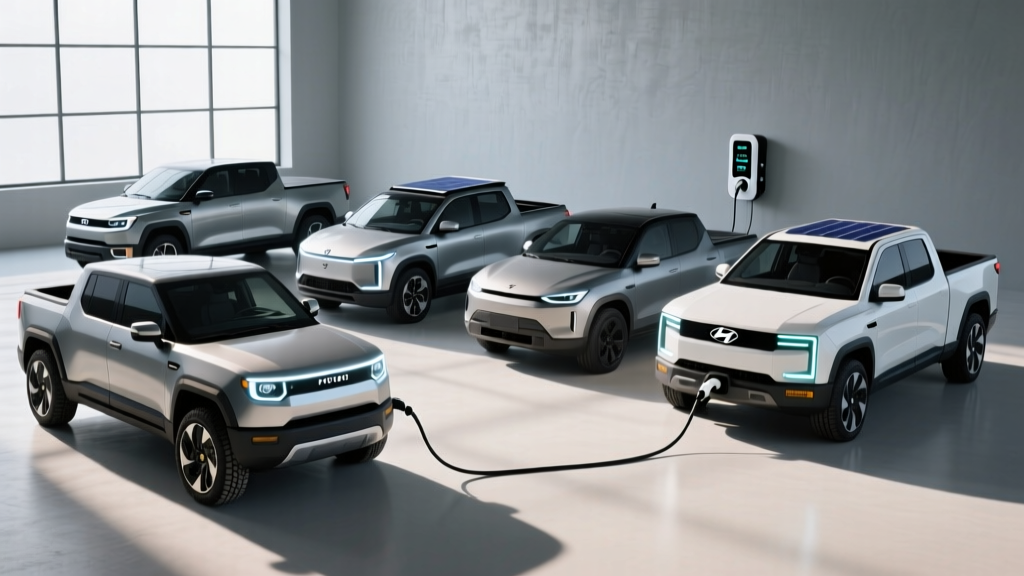
The compact electric truck segment in 2026 comes down to three main choices. The Ford Maverick EV (announced for late 2025, now reaching dealers) targets budget buyers with a projected starting MSRP near $35,000 and ~250 miles of EPA range. The Hyundai Santa Cruz EV (announced) aims for the lifestyle-adventure crowd with an estimated 270+ mile range and unibody comfort. The Tesla Cybertruck remains the only widely available electric truck in a smaller footprint, though its polarizing design and $80K+ pricing push it into a different tier. If you need a true compact truck today with accessible pricing, the Maverick EV is the one to watch — but availability remains limited.
The 2026 Small Electric Truck Landscape
The phrase "electric truck small" describes a segment that's still forming. Unlike the full-size electric truck market — where the Ford F-150 Lightning, Rivian R1T, Chevrolet Silverado EV, and GMC Sierra EV compete with 300+ mile ranges and 10,000-lb towing — the compact and midsize electric truck space has fewer proven options. Most buyers searching for a small electric truck want something they can park in a standard garage, drive daily without range stress, and still use for weekend hauling.
Here's what's actually available or imminent for the 2026 model year:
| Model | Status | Est. EPA Range | Battery (kWh) | Max DC Charge (kW) | 0-60 mph | Base MSRP |
|---|---|---|---|---|---|---|
| Ford Maverick EV | Rolling out 2026 | ~250 mi (est.) | ~75 kWh (est., NMC) | ~150 kW (est.) | ~6.5s (est.) | ~$35,000 (est.) |
| Hyundai Santa Cruz EV | Announced | ~270 mi (est.) | ~80 kWh (est., NMC) | ~170 kW (est.) | ~6.0s (est.) | ~$40,000 (est.) |
| Tesla Cybertruck (AWD) | Available | 340 mi (EPA) | 123 kWh usable (NMC) | 250 kW peak | 4.1s | $79,990 |
| Rivian R1T (Dual-Motor Standard) | Available (midsize) | 270 mi (EPA) | 95 kWh usable (NMC) | 200 kW peak | 4.5s | $69,900 |
Real-World Range Reality: EPA estimates assume moderate temperatures and mixed driving. Expect 15-25% range reduction on sustained highway trips at 75+ mph, and 20-35% loss in sub-freezing weather. A Cybertruck rated at 340 miles EPA may deliver 255-280 miles on a cold winter highway run. The smaller, lighter Maverick EV, if rated around 250 miles, could realistically deliver 190-210 miles in those same conditions.
Electric Truck vs. Gas Truck: The Real Cost Comparison
The most common question from compact truck shoppers is whether going electric actually saves money. The answer depends heavily on your driving patterns, electricity rates, and whether you qualify for federal incentives.
| Cost Factor | Small Electric Truck (est.) | Gas Compact Truck (e.g., Maverick Hybrid) |
|---|---|---|
| Purchase Price (base) | $35,000 - $80,000 | $27,000 - $35,000 |
| Federal Tax Credit (§30D) | Up to $7,500 (if eligible) | $0 |
| Fuel/Energy Cost per Mile | $0.04 - $0.06 (home charging) | $0.12 - $0.15 (gas at $3.50/gal, 37 MPG) |
| Annual Fuel/Energy (12,000 mi) | $480 - $720 | $1,440 - $1,800 |
| Maintenance (annual) | $200 - $400 | $600 - $900 |
| Insurance (annual avg.) | $1,800 - $2,400 | $1,200 - $1,600 |
| 5-Year Total Operating Cost | $15,000 - $22,000 | $16,000 - $20,000 |
The electric truck wins on per-mile energy cost — home charging at $0.13/kWh and an efficiency of 3.0 miles/kWh works out to roughly $0.043/mile. A gas compact truck averaging 30 MPG combined at $3.50/gallon costs about $0.117/mile. Over 12,000 miles annually, that's a $720 vs. $1,400 energy gap — about $680/year in savings.
However, EV insurance premiums run 20-40% higher than comparable gas vehicles, according to industry data. And the upfront price gap — even after a potential $7,500 tax credit — can take 5-7 years of fuel savings to recoup. The math works best if you drive high annual miles, charge at home on cheap electricity, and plan to keep the truck long-term.
Federal Tax Credit: What You Actually Qualify For
The IRS §30D Clean Vehicle Credit offers up to $7,500, but eligibility is not guaranteed. For 2026, these rules apply:
- MSRP Cap: Trucks (including pickups) must have an MSRP at or below $80,000. This eliminates higher-trim Cybertruck models.
- Buyer Income Cap: Modified adjusted gross income must not exceed $150,000 (single), $225,000 (head of household), or $300,000 (joint filing).
- Battery Sourcing: The battery must meet critical mineral and component sourcing thresholds that tighten annually. For 2026, 80% of critical minerals must be sourced from the US or FTA partners, and 100% of battery components must be manufactured or assembled in North America.
- Point-of-Sale Transfer: You can transfer the credit to the dealer at purchase, reducing your out-of-pocket cost immediately — you don't need to wait until tax filing.
- Assembly: Final assembly must occur in North America.
Always verify current eligibility on IRS.gov and confirm with a tax professional before purchasing. Battery sourcing requirements have disqualified several previously eligible models, and the list changes throughout the year.
Charging a Small Electric Truck: Home and Public Realities
Truck owners often park in driveways or garages, which makes home Level 2 charging feasible — but not automatic. A Level 2 home charger (240V, 40-48 amps) delivers roughly 7.7-11.5 kW, adding about 25-38 miles of range per hour of charging. Overnight, that's a full battery for most compact electric trucks.
| Charging Level | Power (kW) | Miles Added per Hour | Full Charge Time (75 kWh battery) |
|---|---|---|---|
| Level 1 (120V outlet) | 1.2 - 1.4 kW | 3 - 5 mi/hr | 50+ hours |
| Level 2 (240V, 48A) | ~11.5 kW | 30 - 38 mi/hr | ~7 hours |
| DC Fast Charge (150 kW peak) | Up to 150 kW | N/A (session-based) | 10-80% in ~25-30 min |
| DC Fast Charge (250 kW peak) | Up to 250 kW | N/A (session-based) | 10-80% in ~15-20 min |
Charging Curve Reality: Peak kW ratings apply only at low state of charge (typically 10-30% SoC). Above 80%, charging speed drops dramatically — often to under 50 kW. A "30-minute" fast charge session realistically means 10-80%, not 0-100%. Plan road-trip stops accordingly.
Home Installation Costs: If you already have a 240V outlet (like a dryer plug) near your parking spot, a Level 2 charger install can cost $500-$1,200 (equipment + basic electrician labor). If you need a new 240V circuit run from your panel, expect $1,200-$3,000. A full panel upgrade from 100A to 200A service — sometimes required in older homes — adds $2,000-$5,000. Get a quote from a licensed electrician before committing to a purchase.
Public Charging: If you lack home charging access, public DC fast charging costs significantly more — typically $0.30-$0.50/kWh at networks like Electrify America or EVgo. At $0.40/kWh and 3.0 mi/kWh efficiency, your per-mile cost jumps to ~$0.13/mile, nearly matching gasoline. This is a critical ownership consideration often overlooked in EV enthusiasm.
Compact Electric Truck Ownership: What First-Time Buyers Should Know
| Myth | Fact |
|---|---|
| "EV batteries need replacing every few years." | Modern NMC and LFP batteries are warrantied for 8 years/100,000 miles with guaranteed capacity retention (typically 70%+ at warranty end). Real-world degradation data shows most packs retain 85-92% capacity at 100K miles. |
| "You can't tow or haul with an electric truck." | Electric trucks deliver instant torque and competitive payload ratings. The Cybertruck AWD tows up to 11,000 lbs. However, towing cuts range by 40-55% — a 340-mile truck may only go 160-200 miles while towing at highway speeds. |
| "EVs are cheaper to own in every scenario." | Not true. Higher purchase prices, elevated insurance, and public charging costs can erase fuel savings. The break-even point is typically 5-7 years with home charging, or may never arrive if you rely on expensive DC fast charging. |
| "Electric trucks can't handle cold weather." | They can, but range drops 20-35% in sub-freezing temperatures due to battery chemistry and cabin heating demands. Preconditioning (warming the battery while plugged in) mitigates charging-speed loss but doesn't fully recover range. |
| "All EVs qualify for the $7,500 tax credit." | Far from it. MSRP caps, buyer income limits, and increasingly strict battery-sourcing rules disqualify many vehicles and buyers. Always check fueleconomy.gov for current eligible vehicles. |
Battery Chemistry: LFP vs. NMC
Most compact electric trucks will use NMC (nickel manganese cobalt) chemistry, which offers higher energy density — more range in a smaller, lighter pack. LFP (lithium iron phosphate) batteries are heavier and less energy-dense but offer longer cycle life, better thermal stability, and no cobalt. If a future Maverick EV or Santa Cruz EV offers an LFP option (as Ford has done with the Mustang Mach-E and F-150 Lightning standard-range), expect slightly lower range but potentially better long-term durability and the ability to charge to 100% regularly without degradation concern.
Decision Framework: Is a Small Electric Truck Right for You?
Choose a Small Electric Truck If:
- You have reliable home charging (garage or driveway with 240V access)
- Your daily driving is under 150 miles round-trip
- You drive 10,000+ miles annually (fuel savings compound)
- You qualify for the §30D tax credit (check income and vehicle eligibility)
- You value low per-mile operating costs and reduced maintenance
- You want instant torque for light towing and hauling
Stick with a Gas or Hybrid Compact Truck If:
- You lack home charging and your area has limited DC fast-charging infrastructure
- You regularly tow heavy loads over long distances (range loss is severe)
- You live in an extremely cold climate and need consistent year-round range
- Your budget is under $30,000 (EV options don't exist here yet)
- You plan to keep the vehicle under 4 years (you won't recoup the price premium)
- You frequently drive in remote areas far from charging stations
Consider a Plug-In Hybrid (PHEV) Truck If:
- You want electric-only commuting (20-40 miles) but gas flexibility for road trips
- You're not ready to commit to full electric but want some emissions and fuel-cost reduction
- The Ford Maverick Hybrid (42 MPG combined, ~$27,000) is a compelling alternative that bridges the gap with no range anxiety
Bottom Line: Timing Your Small Electric Truck Purchase
The compact electric truck segment is in its infancy. As of early 2026, the Tesla Cybertruck is the only widely available option, but its $80,000 starting price and large footprint place it outside what most "small truck" shoppers envision. The Ford Maverick EV and Hyundai Santa Cruz EV represent the true compact electric truck future — affordable, garageable, practical — but both are either just arriving or still in pre-production.
If you need a truck now and want to reduce fuel costs, the Maverick Hybrid at 42 MPG combined and ~$27,000 is genuinely hard to beat on total cost of ownership. If you can wait 12-18 months and have home charging, the Maverick EV could reshape the compact truck market the way the gas Maverick did when it launched. Track announcements on Ford.com and watch for EPA certification data before committing.
Frequently Asked Questions
What is the cheapest small electric truck available in 2026?
The most affordable option reaching the market is the Ford Maverick EV, with an estimated starting MSRP around $35,000 before incentives. If eligible for the full $7,500 §30D credit, the effective price could drop near $27,500 — competitive with gas compact trucks. The Tesla Cybertruck starts at $79,990 and the Rivian R1T at $69,900, placing both in a higher tier.
How far can a small electric truck tow before running out of range?
Towing reduces EV range by 40-55% depending on trailer weight, aerodynamics, speed, and terrain. A truck rated at 250 miles EPA could realistically tow for 120-150 miles before needing a charge. Plan conservatively and identify DC fast chargers along your route.
Do small electric trucks qualify for the federal tax credit?
They can, but only if the specific model meets all §30D requirements: MSRP under $80,000, buyer income within limits, North American final assembly, and battery sourcing thresholds. Eligibility changes as manufacturers adjust supply chains. Verify on IRS.gov before purchasing.
Is an electric truck practical without home charging?
It's possible but expensive and inconvenient. Public DC fast charging costs $0.30-$0.50/kWh, raising your per-mile energy cost to near gasoline levels. You'll also spend 25-40 minutes per session, 2-3 times per week. Most EV owners rate home charging as essential to a positive ownership experience.
Will a small electric truck fit in a standard garage?
Compact trucks like the Maverick (gas version is 199.7 inches long) fit comfortably in most single-car garages. The Cybertruck, at 223.6 inches long and 79.5 inches wide (excluding mirrors), requires a larger garage and may not fit in older or compact structures. Always measure your garage before purchasing.