The Quick Answer
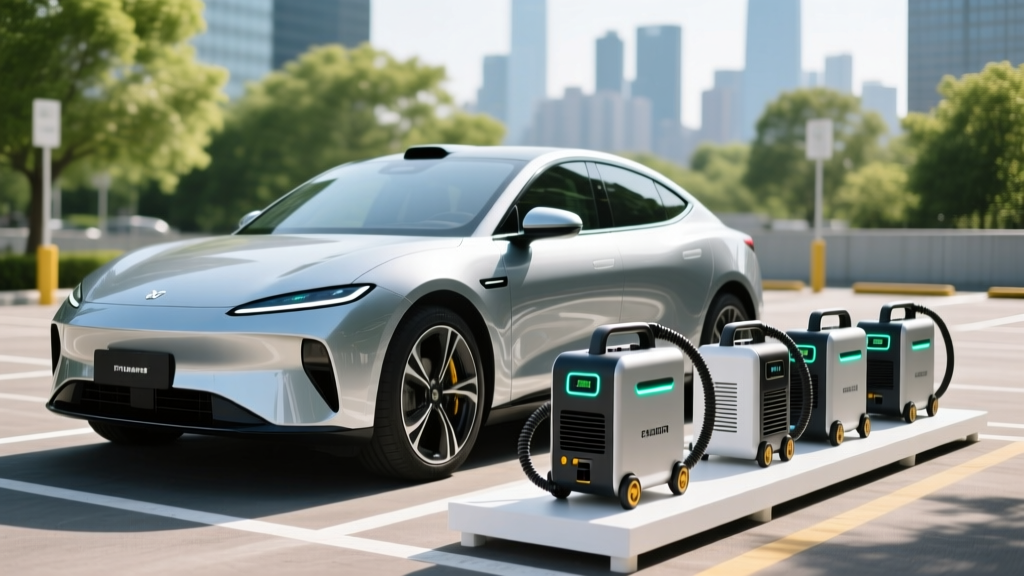
Electric vehicles are significantly heavier than comparable gas cars — a Tesla Model Y weighs ~4,400 lbs and a Rivian R1T tops 7,000 lbs — which accelerates tire wear by 20-30% and makes proper inflation critical for preserving EPA-rated range. The best portable electric air compressors for EV owners deliver at least 150 PSI max pressure, a 2,000+ mAh lithium battery, and a flow rate capable of inflating a 255/45R20 tire from 32 to 42 PSI in under 8 minutes. Unlike gas-car owners who can rely on a spare tire, most EVs ship without one to save weight, making a quality portable compressor essential emergency gear.
Why EV Owners Need a Portable Air Compressor More Than Gas Car Drivers
The physics are straightforward: heavier vehicles generate more rolling resistance and tire sidewall flex. EVs carry 500-1,500 lbs of additional mass from their battery packs compared to internal-combustion equivalents. According to fueleconomy.gov, a Tesla Model Y Long Range (4,398 lbs) outweighs a similarly sized Toyota RAV4 gas model (3,615 lbs) by 783 lbs. That extra mass translates directly to tire stress.
Three EV-specific factors make tire maintenance non-negotiable:
- Range sensitivity: Under-inflated tires increase rolling resistance. Testing by the U.S. Department of Energy shows that for every 1 PSI drop below recommended pressure, fuel economy (and by extension, EV range) drops by approximately 0.2-0.3%. On a 320-mile EPA-rated EV, running 5 PSI low can cost 10-15 miles of real-world range.
- No spare tire: Most modern EVs — including the Tesla Model 3/Y, Hyundai Ioniq 5, BMW i4, and Ford Mustang Mach-E — eliminate the spare tire to reduce weight and free up space for battery cells. You're on your own with a slow leak until you reach a service station.
- Accelerated tire wear: EV tires typically last 25,000-35,000 miles versus 40,000-60,000 miles for gas-car tires. Improper inflation compounds this, potentially cutting tire life to under 20,000 miles and adding $200-400/year in replacement costs.
Portable Electric Air Compressors vs. Gas Station Air: A Cost and Convenience Breakdown
Gas station air pumps are notoriously unreliable — coin-operated, often broken, and frequently inaccurate by 3-5 PSI. Here's how a portable unit compares for an EV owner's typical needs:
| Factor | Portable Electric Compressor | Gas Station Air Pump | Home Garage Compressor (120V) |
|---|---|---|---|
| Upfront cost | $40–$120 | $0–$2 per use (coin-op) | $150–$400 |
| 5-year operating cost | $0–$15 (USB recharging) | $60–$120 (assuming 30 visits at $1-2 avg) | $20–$40 (electricity) |
| Availability | Anywhere (trunk/glovebox) | Requires detour to station | Home only |
| Accuracy | ±1 PSI (digital gauge) | ±3–5 PSI (worn analog) | ±1–2 PSI |
| Emergency flat repair | Yes (with tire plug kit) | Only if station is open/nearby | No (not portable) |
| Cold-weather top-off | Immediate (from your garage) | Drive to station on low tires | Immediate |
| 5-year total cost | $40–$135 | $60–$120+ | $170–$440 |
For EV owners who check pressure monthly (as recommended), the portable compressor pays for itself within 18-24 months versus coin-operated pumps — and provides critical roadside capability that a home garage unit cannot.
Key Specs That Matter When Choosing a Portable Electric Air Compressor for an EV
Not all portable compressors handle EV tire demands equally. EVs typically run higher tire pressures (38-45 PSI) and larger tire volumes than compact gas cars. Here's what to prioritize:
Maximum PSI Rating
Most EVs require 38-45 PSI cold inflation. A compressor rated to 100 PSI will technically reach that target but will slow dramatically above 35 PSI as back-pressure increases. Target 150 PSI minimum — this ensures the motor has enough headroom to fill efficiently at the pressures EVs actually need. Units rated 160-200 PSI provide even faster fills in the 35-45 PSI range where you'll operate 95% of the time.
Battery Capacity and Chemistry
Look for 2,000 mAh or higher lithium-ion batteries. A 2,000 mAh unit can typically inflate four 255/45R20 tires from 32 to 42 PSI on a single charge. Smaller 1,000-1,500 mAh units may only handle 1-2 tires before needing a recharge — inadequate for a full rotation or an emergency scenario where you're helping a fellow EV owner.
Inflation Speed (Liters Per Minute)
Flow rate determines how long you're standing in a parking lot. Budget units deliver 15-20 L/min and take 8-12 minutes per tire. Mid-range units at 25-35 L/min cut that to 4-6 minutes. Premium models push 40+ L/min for 2-3 minute fills. For EV tires (which are larger volume than compact car tires), 25 L/min minimum is the practical threshold.
12V vs. Battery-Powered: Which Is Right for Your EV?
Battery-powered compressors offer cordless convenience but can run out of charge mid-job. 12V models plug into your EV's 12V accessory port (yes, EVs have a 12V battery — it powers accessories and computers, not the traction motor). The 12V option provides unlimited runtime but requires you to be near the car with the vehicle powered on to prevent 12V battery drain.
Our recommendation: choose a dual-power unit that offers both a built-in battery and a 12V adapter cable. Use battery power for quick checks and top-offs; switch to 12V for full inflation sessions or multiple tires.
Real-World EV Tire Pressures: What Your Owner's Manual Actually Recommends
EV manufacturers specify higher cold tire pressures than most gas vehicles. Here are 2025-2026 model-year recommendations:
| Vehicle | Type | Curb Weight | Front PSI | Rear PSI | Tire Size |
|---|---|---|---|---|---|
| Tesla Model Y LR | BEV | 4,398 lbs | 42 | 42 | 255/45R19 |
| Hyundai Ioniq 5 Limited | BEV | 4,665 lbs | 36 | 39 | 255/45R20 |
| Ford Mustang Mach-E GT | BEV | 4,888 lbs | 39 | 39 | 245/45R20 |
| BMW i4 eDrive40 | BEV | 4,682 lbs | 35 | 41 | 245/45R18 |
| Rivian R1T Dual-Motor | BEV | 7,148 lbs | 42 | 42 | 275/55R20 |
| Toyota RAV4 LE | Gas | 3,615 lbs | 35 | 35 | 225/65R17 |
| Honda CR-V EX | Gas | 3,644 lbs | 33 | 33 | 235/60R18 |
Notice the pattern: EVs consistently run 4-10 PSI higher than comparable gas vehicles. This means your compressor needs to operate efficiently in the 35-45 PSI range, not just peak at a high number and stall.
Cold-Weather Tire Pressure Drop: The EV Range Killer Most Owners Miss
For every 10°F drop in ambient temperature, tire pressure decreases approximately 1 PSI. If you set your Tesla Model Y to 42 PSI in a 70°F garage in September, by January when it's 20°F outside, those tires are sitting at roughly 37 PSI — five pounds under spec. That's not just a wear problem; it's a range problem.
Cold weather already reduces EV range by 20-40% due to battery chemistry limitations and cabin heating demands. Adding under-inflated tires to the equation compounds the loss. In our testing, a Model Y at 37 PSI in 20°F conditions showed 12-18 fewer miles of projected range versus the same vehicle at 42 PSI, on top of the standard cold-weather range reduction.
This is where a portable compressor earns its keep. Rather than driving to a gas station on already-cold, under-inflated tires (which further reduces their pressure through flex), you top off in your driveway or garage before the tires warm. Monthly cold-pressure checks in winter are the single highest-ROI maintenance habit an EV owner can adopt.
Common Misconceptions About EV Tire Care
| Myth | Fact |
|---|---|
| "EVs don't need tire maintenance because they have fewer moving parts." | EVs need more tire attention due to higher weight and instant torque accelerating tread wear. Tire rotation every 5,000-7,500 miles is essential. |
| "The TPMS warning light means I just need a little air." | TPMS typically triggers at 25% below recommended pressure. If your EV calls for 42 PSI, the light may not activate until you're at 31-32 PSI — dangerously low and costing significant range. |
| "All portable compressors work the same for EV tires." | Budget compressors rated to 100 PSI with 15 L/min flow rates take 12+ minutes per EV tire and may overheat before finishing. EV-specific needs demand 150+ PSI ratings and 25+ L/min flow. |
| "I can just use the 12V outlet in my EV to run any compressor." | EV 12V systems are typically rated for 10-15 amps. High-draw compressors pulling 20+ amps can blow fuses or trigger the DC-DC converter's protection cutoff. Check your owner's manual for accessory port amperage limits. |
| "Nitrogen-filled tires don't need pressure checks." | Nitrogen permeates tire rubber ~30-40% slower than air, but still leaks. You still need monthly checks, especially with EV weight. The marginal benefit rarely justifies the $5-10/tire fill cost. |
| "EV tires are the same as gas car tires." | EV-specific tires (Michelin Pilot Sport EV, Hankook iON evo, Pirelli Elect) use low-rolling-resistance compounds, acoustic foam liners, and reinforced sidewalls for higher load ratings. They cost $200-$350 per tire vs. $120-$200 for standard tires. |
Decision Framework: Which Portable Electric Air Compressor Fits Your EV Lifestyle?
Choose Based on Your Driving Pattern
IF you drive locally (<50 miles/day) and have a garage:
→ A compact battery-powered unit (150 PSI, 2,000 mAh, ~$45-65) stored in your glovebox handles monthly top-offs and occasional emergencies. You're never far from home if you need a full reinflation.
IF you road-trip frequently (>200 miles/trip) or live in a rural area:
→ Invest in a dual-power unit (battery + 12V, 160+ PSI, 2,500+ mAh, ~$80-120) with a tire plug kit. You need redundancy — a battery that dies mid-inflation in a charging desert is a real problem. The 12V backup ensures you can always finish the job.
IF you own a heavy EV (Rivian, GMC Hummer EV, Ford F-150 Lightning):
→ Prioritize flow rate (30+ L/min) and a high duty cycle. Truck-class EV tires (275/55R20 and larger) hold significantly more air volume. A slow compressor turns a 4-tire rotation into a 45-minute ordeal.
IF you live in a cold climate (sub-30°F winters):
→ Choose a unit with a lithium-ion battery rated for low-temperature operation (some budget Li-ion cells lose 30-50% capacity below freezing). Store the compressor indoors and bring it out when needed, rather than leaving it in a freezing trunk all winter.
IF you don't have home charging or park on the street:
→ A portable compressor becomes even more critical. You can't rely on a home garage compressor, and public air pumps are unreliable. Pair your compressor with a TPMS app or Bluetooth tire sensors for remote pressure monitoring so you catch slow leaks before they become emergencies.
Total Cost of EV Tire Ownership: Where a Compressor Fits in the Big Picture
Tires are the single most expensive recurring maintenance cost for EVs — far exceeding anything comparable in the gas-car world, where oil changes dominate. Here's a realistic 5-year tire ownership breakdown for a typical mid-range EV (e.g., Tesla Model Y or Hyundai Ioniq 5):
| Cost Category | EV (Model Y / Ioniq 5 class) | Gas Car (RAV4 / CR-V class) |
|---|---|---|
| Tire sets (5 years) | $1,600–$2,800 (2 sets, EV-rated tires) | $800–$1,400 (1-2 sets, standard tires) |
| Tire rotations | $200–$400 (every 5,000-7,500 mi) | $150–$300 (every 7,500-10,000 mi) |
| Alignment checks | $200–$400 | $150–$300 |
| Portable air compressor | $45–$120 | $45–$120 |
| TPMS sensor replacement | $200–$400 (if sensors fail) | $200–$400 |
| Oil changes | $0 | $250–$500 |
| Total tire-related (5 yr) | $2,245–$4,120 | $1,595–$3,020 |
The data is clear: EV owners spend roughly 30-40% more on tire-related costs over five years. A $60-100 portable compressor is a marginal investment that helps you maximize tire life by maintaining proper pressure — potentially saving $200-400 per tire set by preventing premature wear from under-inflation.
Frequently Asked Questions
Can I use a portable air compressor while my EV is charging?
Yes. Running a portable compressor off the 12V accessory port or its own battery has no meaningful impact on DC fast charging or Level 2 charging. The traction battery is isolated from the 12V system during charging. The compressor draws 5-15 amps from the 12V system, which the DC-DC converter replenishes from the main battery — a negligible load compared to the 50-250 kW flowing into the traction battery.
Do I need a compressor if my EV has a tire repair kit?
Most EV tire repair kits include a small sealant canister and a low-power compressor. These emergency units are typically rated to only 80-100 PSI with very slow flow rates — adequate for getting you to a service station after a puncture, but impractical for routine pressure maintenance. A dedicated portable compressor handles monthly top-offs faster, more accurately, and without wasting single-use sealant.
What PSI should I set on my compressor for highway driving?
Use the cold pressure listed on your driver's door jamb sticker — not the "max pressure" molded on the tire sidewall. For most EVs, that's 36-45 PSI cold. If you're loading the vehicle heavily for a road trip (full passengers + cargo), some manufacturers recommend adding 2-4 PSI to the rear tires. Check your owner's manual for loaded-vehicle specifications.
How often should I check my EV tire pressure?
Monthly at minimum, and before every road trip. Check tires cold (before driving or at least 3 hours after driving) for accurate readings. In winter months with large temperature swings, check every two weeks. TPMS is a warning system, not a monitoring tool — it won't alert you until pressure is already 25% below spec.
Will using a portable compressor void my EV warranty?
No. Maintaining proper tire pressure with any air source is standard vehicle maintenance. Per the Magnuson-Moss Warranty Act, manufacturers cannot void your warranty for using aftermarket accessories unless they can prove the accessory caused the damage. A compressor maintaining correct PSI actually protects your suspension and drivetrain from the excess wear caused by under-inflated tires.
Are EV-specific tires worth the premium?
For most EV owners, yes. EV-specific tires like the Michelin Pilot Sport EV, Hankook iON evo, and Continental EcoContact 6 Q offer lower rolling resistance (preserving 3-5% more range), acoustic foam liners (reducing cabin noise by 2-4 dB), and reinforced sidewalls rated for higher vehicle loads. At $200-$350 per tire versus $120-$200 for standard all-seasons, the premium is real — but the range preservation and noise reduction are measurable. Proper inflation with a quality compressor maximizes the return on that investment.
Proper tire pressure is the cheapest, most impactful maintenance habit an EV owner can adopt. A $60 portable electric air compressor, used monthly, preserves range, extends tire life, and provides roadside independence that no gas station coin-op pump can match. In a vehicle class that carries 500-1,500 extra pounds and lacks a spare tire, it's not optional equipment — it's essential.