Quick Answer: Can an EV Actually Go Offroad?
Yes — and in several ways, electric trucks and SUVs are better trail rigs than their gas counterparts. Instant torque at 0 RPM means precise rock-crawling control without clutch feathering. A low center of gravity from the under-floor battery pack reduces rollover risk. And there's no air intake to flood during water crossings. The catch: range drops 25–40% on technical trails due to low-speed, high-load driving, and DC fast chargers are scarce near most trailheads. If you can charge at home and your typical trail day is within 80–100 miles of your garage, an offroad EV works today. If you regularly drive 200+ miles to remote BLM land with no charging infrastructure, a hybrid or gas rig remains the pragmatic choice.
The Current Offroad EV Lineup: What's Actually Available
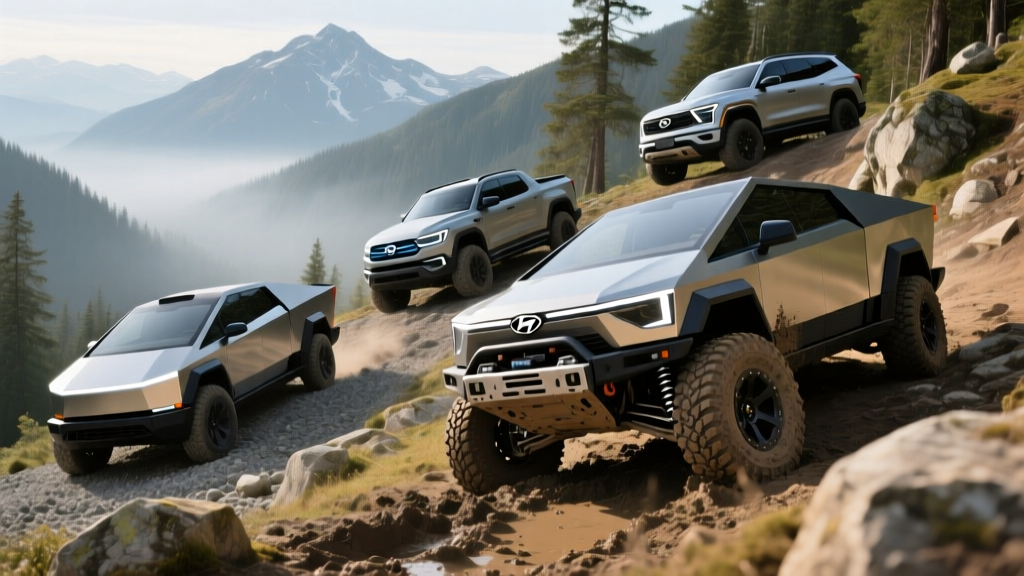
The offroad EV segment has matured past the early-adopter phase. Here are the serious contenders you can buy and take to a trailhead in 2026, ranked by trail capability:
| Vehicle | EPA Range | Battery (kWh) | Ground Clearance | 0–60 mph | Tow Rating | Starting MSRP |
|---|---|---|---|---|---|---|
| Rivian R1S Adventure (Tri Motor) | 370 mi | 141 (NMC) | 14.9 in | 4.9 sec | 7,700 lb | $99,900 |
| Rivian R1T Adventure (Tri Motor) | 380 mi | 141 (NMC) | 14.9 in | 4.5 sec | 11,000 lb | $89,900 |
| Jeep Wrangler 4xe (Willys '41) | 22 mi elec / 49 MPGe | 17 (NMC) | 10.8 in | 6.0 sec | 3,500 lb | $57,790 |
| Ford F-150 Lightning (Platinum) | 320 mi | 131 (NMC) | 8.9 in | 4.0 sec | 10,000 lb | $62,995 |
| Mercedes G 580 EQ | 268 mi | 116 (NMC) | 9.5 in | 4.7 sec | N/A | $164,900 |
The Rivian R1S and R1T remain the segment benchmarks. The quad-motor configuration (one motor per wheel) enables true torque vectoring, letting the rig pivot around a single wheel on technical rock sections — something no open-differential gas truck can match. The 14.9 inches of max ground clearance in the air-suspension Off-Road mode exceeds a stock Jeep Wrangler Rubicon's 10.8 inches. Per fueleconomy.gov, the R1T Dual Motor achieves 73 MPGe combined.
The Jeep Wrangler 4xe occupies a different niche: it's a plug-in hybrid, not a full BEV, but its 22 miles of electric-only range is enough for silent, low-emission trail crawling. The solid front and rear axles with locking differentials remain the gold standard for hardcore rock crawling, and you can drive home on gas when the battery is depleted.
The Ford F-150 Lightning is a capable light-duty trail truck — Pro Power Onboard (up to 9.6 kW of V2L output) turns it into a basecamp generator — but its 8.9 inches of ground clearance limits it on technical terrain. It's best suited for forest roads, overlanding, and campsite access rather than boulder fields.
Offroad EV vs. Gas Truck: Trail Performance & Cost Comparison
| Factor | Offroad EV (Rivian R1T Tri) | Gas Equivalent (Toyota Tacoma TRD Pro) |
|---|---|---|
| Peak Torque | 827 lb-ft (instant, 0 RPM) | 317 lb-ft @ 1,600 RPM |
| Low-Speed Control | Individual wheel torque vectoring | Locking rear diff + crawl control |
| Water Fording | ~36 in (no air intake) | ~33 in (snorkel recommended for deep) |
| Trail Range (real-world) | ~150–200 mi (low-speed technical) | ~280–340 mi (18.5-gal tank) |
| Refuel / Recharge on Trail | Not practical (no DCFC at trailheads) | 5 min with spare jerry can |
| Fuel/Energy Cost (per trail day, ~100 mi) | ~$8–12 (home charging at $0.14/kWh) | ~$25–35 (premium gas, low MPG) |
| Maintenance (annual, trail use) | ~$400 (tires, cabin filter, fluid top-offs) | ~$1,200+ (oil, diffs, transfer case, plugs) |
| Base Price | $89,900 | $57,990 |
The EV's instant torque and per-wheel control are genuine advantages on rocks and steep grades. But the gas truck's range and 5-minute refuel are decisive advantages in remote backcountry. This is the core tradeoff every offroad EV buyer must evaluate honestly.
Real-World Range on Trails: What the EPA Sticker Won't Tell You
EPA vs. Trail Reality: The Rivian R1T's EPA-rated 380 miles assumes mixed highway/city driving at moderate speeds. On a technical trail — low range, steep grades, sand, or mud — energy consumption can spike from a normal 2.0 kWh/mi to 3.5–5.0 kWh/mi. That collapses your effective range to 120–200 miles of trail driving before you need to turn back.
Highway driving to the trailhead also costs range: at 75 mph with all-terrain tires and a roof rack, expect roughly 280–310 real-world highway miles from the R1T's 141 kWh pack. Cold weather (below 32°F) further reduces usable capacity by 15–25% due to battery chemistry limitations, even with the heat pump running.
This is where route planning becomes critical. Apps like A Better Routeplanner and PlugShare let you map DC fast chargers along your approach route. But once you leave pavement, you're on battery alone. The practical rule: plan to use no more than 50% of your battery on the trail itself, reserving the other half for the drive home to your nearest known charger.
Charging Infrastructure Near Trailheads: The Honest Picture
This is the offroad EV's biggest real-world limitation. A survey of popular trailhead areas reveals sparse DC fast-charging coverage:
- Moab, UT: Two Electrify America stalls (150 kW) in town, ~15 min from most Slickrock trailheads. Adequate.
- Rubicon Trail (Georgetown, CA): Nearest DCFC is a Tesla Supercharger in Auburn, ~30 min away. Tight for a full trail day.
- Ouray, CO (Imogene Pass): One ChargePoint DCFC (62.5 kW) in town. Slow — a 10–80% session on the R1T takes over 90 minutes at this rate.
- Ocala National Forest, FL: No DCFC within 40 miles of primary trailheads. A gas rig is the only practical option here.
Level 2 charging (240V, typically 7.7–11.5 kW) is more common at campgrounds and lodges near trail systems. A full overnight charge at a 40-amp campground outlet adds roughly 30–45 miles per hour of charging — enough to replenish a trail day's battery use in 6–8 hours. Many Rivian and Ford owners carry a portable Level 2 EVSE (like the Emporia J1772 or Tesla Mobile Connector) with a NEMA 14-50 adapter for exactly this scenario.
Total Cost of Ownership: Offroad EV vs. Gas Truck (5-Year)
| Cost Category (5 Years / 75,000 mi) | Rivian R1T (Dual Motor) | Toyota Tacoma TRD Pro |
|---|---|---|
| Purchase Price (MSRP) | $89,900 | $57,990 |
| Federal Tax Credit (§30D) | $0 (exceeds $80K MSRP cap for trucks) | $0 (not electrified) |
| Estimated Depreciation | -$36,000 (40%) | -$14,500 (25%) |
| Energy/Fuel Cost | $4,200 (home charging avg) | $13,500 (premium gas, 17 MPG avg trail/tow) |
| Maintenance | $2,100 | $6,200 |
| Insurance (avg) | $12,500 | $7,800 |
| 5-Year Total Cost | $72,700 | $71,090 |
The numbers are surprisingly close. The Rivian's higher purchase price is offset by dramatically lower fuel and maintenance costs. However, insurance premiums for offroad EVs run 40–60% higher than comparable gas trucks, driven by battery replacement costs and lower repair-network density. Get quotes before committing. Depreciation is also a wild card — EV resale values have been volatile, and the Rivian's 40% estimated drop reflects current market trends for luxury EVs.
Note on the federal tax credit: the Rivian R1T and R1S do not qualify for the §30D new clean vehicle credit because their MSRP exceeds the $80,000 cap for vans, SUVs, and pickup trucks, and certain battery sourcing requirements further restrict eligibility. Per IRS §30D rules, always verify current-year eligibility including income caps ($300K joint / $150K single for trucks) before purchasing.
Myths vs. Facts: Offroad EV Misconceptions
| Myth | Fact |
|---|---|
| "EVs can't handle water crossings." | Battery packs are sealed to IP67 (submersion-rated). The Rivian R1T is rated for ~36 inches of water fording — comparable to a stock Wrangler. There is no air intake to hydrolock. Source: NHTSA safety filings. |
| "The battery will get destroyed on rocks." | All serious offroad EVs use thick titanium or steel skid plates over the battery. Rivian's underbody armor is standard on Adventure trim. No widespread reports of trail-related battery damage as of 2026. |
| "You'll get stranded with no way to refuel." | This is a real risk on remote trails — not a myth. Unlike a gas truck, you can't carry a jerry can of electrons. Route planning and the 50% battery rule are non-negotiable. |
| "EVs are too heavy for soft terrain." | The Rivian R1T weighs ~7,150 lb — heavier than a Tacoma (~4,900 lb). On deep sand or mud, this is a real disadvantage. Airing down to 15–18 PSI helps, but weight is physics. |
| "Towing a trailer kills EV range." | True. Towing a 5,000-lb camper cuts highway range by 40–50%. A Rivian R1T rated for 380 EPA miles drops to ~180–200 real-world miles while towing. Gas trucks lose 30–40% — less severe. |
Decision Framework: Is an Offroad EV Right for You?
Choose an offroad EV (Rivian R1T/R1S, F-150 Lightning) if:
- You have reliable Level 2 home charging (240V / 40A+ circuit)
- Your typical trail days are within 80–100 miles of home or a known DC fast charger
- You value instant torque, quiet trail operation, and V2L campsite power
- You're willing to pay $85K–$100K+ upfront for the EV premium
- You mostly drive forest roads, moderate trails, and overlanding routes — not extreme rock crawling
Choose a gas truck (Tacoma TRD Pro, Wrangler Rubicon, 4Runner TRD Pro) if:
- You regularly drive 200+ miles to remote trailheads with no charging infrastructure
- You need to carry auxiliary fuel (jerry cans) for multi-day backcountry expeditions
- You want maximum aftermarket support (winches, armor, suspension lifts — EV aftermarket is still limited)
- Your budget is under $60K
- You do extreme rock crawling where solid axles and ultra-low gearing matter most
Choose a PHEV (Jeep Wrangler 4xe) if:
- You want silent electric crawling on the trail AND unlimited gas range to get there
- You want to keep total spend under $60K
- You need proven solid-axle articulation and a massive aftermarket ecosystem
- You can charge at home to capture the 22-mile electric range for daily driving
What First-Time Offroad EV Buyers Must Know
If you're transitioning from a gas trail rig to an electric one, these ownership realities matter:
Tire selection is even more critical. EVs are heavier and deliver instant torque, which accelerates tire wear on pavement and tears sidewalls faster on sharp rocks. Budget $1,600–$2,400 for a set of quality all-terrain or mud-terrain tires (33–35 inch) and expect 25,000–35,000 miles of life — less than on a lighter gas truck.
Regen braking changes trail technique. In one-pedal or high-regen mode, lifting off the accelerator applies significant braking force. On steep descents, this can act like engine braking — useful — but on loose surfaces it can break traction. Most offroad EVs let you reduce regen in off-road drive modes. Practice before your first technical trail.
Battery warranty protection. Rivian covers the battery for 8 years / 175,000 miles against degradation below 70% capacity. Ford covers the Lightning's battery for 8 years / 100,000 miles. Trail use does not void these warranties, but physical damage from impacts (despite skid plates) would not be covered. Per IIHS, the R1T has earned top safety ratings, reflecting robust structural protection of the battery enclosure.
Preconditioning matters for charging speed. If you're driving to a DC fast charger after a trail day, use the vehicle's built-in navigation to route to the charger — this triggers battery preconditioning, warming the pack for faster charging. Without preconditioning, a cold battery may accept only 50–80 kW instead of its 200+ kW peak rate, adding 20–30 minutes to your stop.
Frequently Asked Questions
Can I install a solar charger at my off-grid cabin to charge an EV?
Yes, but plan for adequate capacity. A Level 2 charger draws 7.7–11.5 kW continuously. To charge an R1T from 20–80% (~85 kWh) in 8 hours, you need roughly 11 kW of sustained solar output, which typically requires a 14–16 kW solar array with battery storage to buffer cloud cover. Expect $25,000–$40,000 for a complete off-grid solar + EV charging setup.
Do offroad EVs qualify for any federal tax credits in 2026?
Under current IRS §30D rules, the new clean vehicle credit offers up to $7,500 but requires the vehicle MSRP to be under $80,000 for trucks/SUVs/vans. The Rivian R1T and R1S exceed this cap. The Ford F-150 Lightning qualifies on price for lower trims (starting ~$55K for the Pro), but battery-sourcing and critical-mineral requirements may reduce or eliminate the credit amount. Always verify eligibility on the IRS website and consult a tax professional — rules change frequently.
What happens if I damage the battery pack on a trail?
A punctured or severely impacted battery pack is the single most expensive repair on any EV — potentially $15,000–$25,000 for a full replacement. Skid plates mitigate this risk substantially. Rivian and Ford both offer underbody protection, and some owners add aftermarket UHMW polyethylene sliders for additional coverage. Comprehensive insurance typically covers trail damage, but confirm with your provider that off-road use doesn't trigger exclusions.
How do I plan a multi-day offroad EV trip?
Map every DC fast charger along your route using PlugShare and A Better Routeplanner. Identify Level 2 charging at campgrounds (many national forest campgrounds now offer 240V/50A outlets). Carry a portable Level 2 EVSE with NEMA 14-50 and 14-30 adapters. Follow the 50% rule: never use more than half your battery on the trail portion. For truly remote multi-day expeditions with no charging access, a gas truck or PHEV remains the safer choice.
Is the Rivian R1T better offroad than a Jeep Wrangler Rubicon?
They excel in different areas. The R1T offers more ground clearance (14.9 vs. 10.8 in), superior torque vectoring, and a quieter trail experience. The Wrangler Rubicon has solid axles for maximum articulation, a lighter weight (~5,000 lb vs. ~7,150 lb), an unlimited-range gas engine, and the deepest aftermarket support in off-roading. For moderate trails and overlanding, the R1T is arguably more capable. For extreme rock crawling and remote expeditions, the Wrangler still wins.