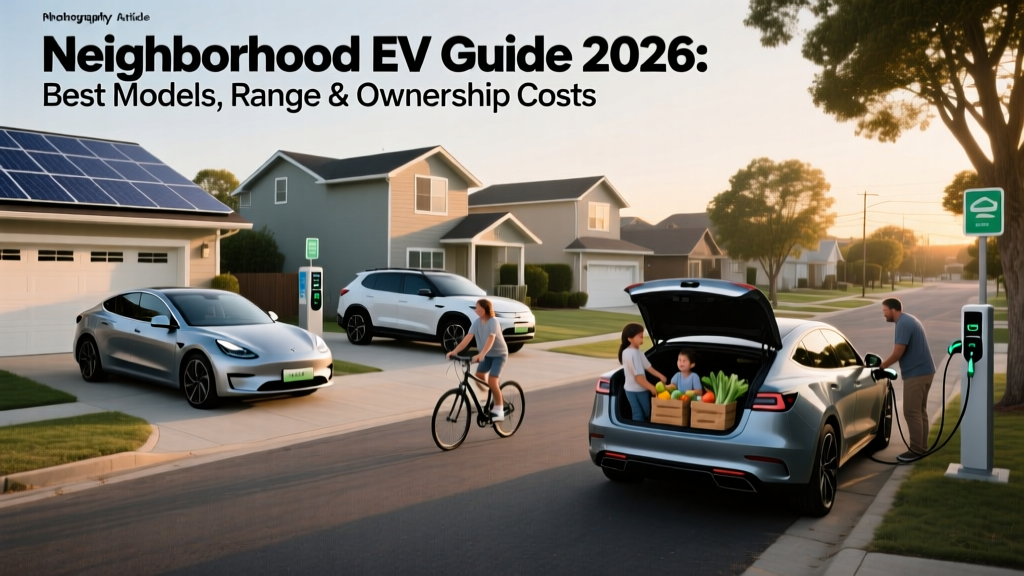
Quick Answer: A neighborhood EV is a compact, affordable electric vehicle optimized for daily local driving — school runs, grocery trips, and commutes under 40 miles round-trip. For 2026, models like the Nissan LEAF (starting ~$28,140), Chevrolet Equinox EV (starting ~$33,600), and Hyundai Kona Electric (starting ~$32,975) deliver 150–319 miles of EPA-rated range, cost roughly $0.04–$0.06 per mile to charge at home, and qualify for up to $7,500 in federal tax credits (subject to income, MSRP caps, and battery-sourcing rules). If you can charge at home and drive under 50 miles daily, a neighborhood EV typically saves $1,200–$1,800 per year in fuel and maintenance compared to a comparable gas car.
What Makes a Neighborhood EV Different?
The term "neighborhood EV" doesn't refer to a regulatory class like a Neighborhood Electric Vehicle (NEV) — those are low-speed vehicles capped at 25 mph with minimal crash protection. Here, we mean a full-size, highway-capable battery electric vehicle (BEV) chosen specifically for local, low-mileage driving patterns. These are real cars with real safety ratings, full climate control, and enough range to eliminate daily charging stress.
The ideal neighborhood EV buyer drives 20–50 miles per day, has access to home charging (even a standard 120V outlet works for low daily mileage), and wants to cut fuel and maintenance costs without paying the premium of a long-range luxury EV. You don't need 350+ miles of range if your longest regular trip is 25 miles each way — and paying for battery capacity you'll never use means higher purchase price, heavier weight, and slower charging.
Best Neighborhood EVs for 2026: Specs at a Glance
Here are the top contenders for local-first EV ownership in 2026, with EPA data sourced from fueleconomy.gov and manufacturer specifications:
| Model | Base MSRP | EPA Range | Battery (kWh) | Peak DC Charge | 10–80% Time | MPGe (Combined) | 0–60 mph |
|---|---|---|---|---|---|---|---|
| Nissan LEAF S | $28,140 | 149 mi | 40 kWh (NMC) | 50 kW (CHAdeMO) | ~40 min | 111 | 7.9 sec |
| Nissan LEAF SV Plus | $36,190 | 212 mi | 60 kWh (NMC) | 100 kW (CHAdeMO) | ~35 min | 109 | 6.9 sec |
| Hyundai Kona Electric SE | $32,975 | 261 mi | 65.4 kWh (NMC) | 100 kW (CCS/NACS) | ~43 min | 120 | 7.0 sec |
| Chevrolet Equinox EV LT | $33,600 | 319 mi | 85 kWh (NMC) | 150 kW (CCS/NACS) | ~30 min | 115 | 7.8 sec |
| Volkswagen ID.4 Standard | $37,795 | 206 mi | 62 kWh (NMC) | 170 kW (CCS/NACS) | ~28 min | 107 | 8.3 sec |
Real-World Range Reality: EPA estimates assume mixed driving at moderate temperatures. In practice, expect 10–20% less range during sustained highway driving (70+ mph) and 20–40% loss in freezing temperatures (below 32°F) without preconditioning. A Kona Electric rated at 261 miles EPA may deliver ~200 miles on a cold January highway trip. For neighborhood driving at 25–45 mph in mild weather, you'll often exceed EPA range.
Neighborhood EV vs Gas Car: Cost Breakdown
The strongest argument for a neighborhood EV is economics — not environmental guilt. Here's a 5-year cost comparison assuming 12,000 miles/year, home charging at $0.16/kWh (national average per the EIA), and gas at $3.40/gallon:
| Category | Neighborhood EV (Kona Electric) | Gas Equivalent (Kona 2.0L) |
|---|---|---|
| Purchase Price (MSRP) | $32,975 | $24,250 |
| Federal Tax Credit (§30D) | –$7,500* | $0 |
| Effective Purchase Price | $25,475 | $24,250 |
| Fuel/Energy (5 years) | $3,520 | $7,020 |
| Maintenance (5 years) | ~$1,800 | ~$3,600 |
| Insurance (5 years avg) | ~$9,400 | ~$7,800 |
| 5-Year Total Cost | $40,195 | $42,670 |
*Federal §30D credit eligibility depends on buyer income (≤$150K single / $300K joint), vehicle MSRP (≤$55K for cars), battery sourcing requirements, and point-of-sale transfer. Check current rules at IRS.gov.
The EV wins on total cost by roughly $2,475 over five years — and that gap widens if gas prices rise or you qualify for state/utility rebates (many offer $500–$2,000 additional incentives for EV purchase or home charger installation). The main offset is higher insurance premiums, which average 15–25% more for EVs due to repair cost structures.
Charging at Home: What Neighborhood Drivers Actually Need
Here's the key insight most EV guides miss: if you drive 30 miles per day, you only need to replenish about 8–10 kWh daily. That's achievable on a standard 120V Level 1 outlet (which delivers ~1.4 kW, adding roughly 4–5 miles of range per hour of charging). Plug in at 7 PM, and by 7 AM you've gained 50+ miles — more than enough for neighborhood use.
| Charging Level | Power | Miles Added/Hour | Equipment Cost | Install Cost | Best For |
|---|---|---|---|---|---|
| Level 1 (120V) | 1.4 kW | 3–5 mi | $0 (included cord) | $0 | <30 mi/day driving |
| Level 2 (240V, 32A) | 7.7 kW | 22–30 mi | $350–$700 | $400–$1,500 | 30–80 mi/day driving |
| Level 2 (240V, 48A) | 11.5 kW | 35–44 mi | $500–$900 | $600–$2,000 | Heavy daily use / future-proofing |
| DC Fast Charge | 50–350 kW | 150–1,000+ mi/hr | Per-use ($0.30–$0.55/kWh) | N/A | Road trips, emergency top-ups |
For most neighborhood EV owners, a 32-amp Level 2 charger on an existing 240V circuit (like a dryer outlet) is the sweet spot. Total install cost typically runs $800–$1,800 including a quality EVSE (ChargePoint Home Flex, Emporia Level 2, or similar) and electrician labor. If your panel needs upgrading from 100A to 200A service, add $1,500–$3,000 — but most homes with existing 240V appliances won't need this.
Common Neighborhood EV Myths vs. Facts
| Myth | Fact |
|---|---|
| "EV batteries need replacing every 5 years" | Federal law mandates battery warranties of at least 8 years/100,000 miles. Real-world data shows modern NMC batteries retain 85–92% capacity after 100K miles. Replacement (rare) costs $6,000–$18,000 depending on model. |
| "I need 300+ miles of range for daily driving" | The average American drives 37 miles/day (FHWA data). A 150-mile EV covers 4 days of driving between charges — with a massive buffer. |
| "EVs are worse in cold weather" | Range drops 20–40% in freezing temps, but EVs start instantly, warm up faster with preconditioning, and have no cold-start engine wear. Garage-kept EVs lose far less range. |
| "Public charging is unreliable" | For neighborhood drivers, public charging is a backup, not a daily need. Home charging covers 95%+ of local driving. For road trips, networks like Tesla Supercharger (now open to NACS-equipped non-Teslas) and Electrify America have improved uptime significantly. |
| "EVs cost more to insure" | True — typically 15–25% higher premiums due to repair complexity. But this is offset by fuel/maintenance savings. Shop quotes before buying. |
Decision Framework: Is a Neighborhood EV Right for You?
Choose a neighborhood EV if:
- Your daily round-trip driving is under 50 miles
- You have access to home charging (even a standard 120V outlet)
- You want to cut fuel costs by 50–60% and eliminate oil changes
- You qualify for the §30D federal tax credit (income under $150K single / $300K joint, MSRP under $55K for cars)
- You prefer a lower purchase price and don't need frequent 300+ mile road trips
Choose a longer-range EV or PHEV instead if:
- You regularly drive 80+ miles one-way or take monthly road trips over 200 miles
- You live in an apartment without charging access and rely on public infrastructure
- You frequently tow or carry heavy cargo (range drops significantly under load)
- You live in extreme cold (below 0°F regularly) and lack garage parking — consider a PHEV like the Toyota RAV4 Prime (42 mi electric range, 94 MPGe) for flexibility
What First-Time Neighborhood EV Buyers Should Know
Test the charging situation before you buy. Confirm your electrical panel has capacity for a 240V circuit, or verify that your daily mileage works on Level 1 alone. A $500 electrician consultation now prevents a $3,000 surprise later.
Understand the charge curve. DC fast charging speeds are peak rates, not sustained rates. A car rated for "100 kW peak" may only sustain that rate between 10–50% state of charge, then taper significantly. For neighborhood driving, this barely matters — you'll charge at home overnight at a gentle Level 2 rate, which is actually better for long-term battery health.
Factor in the tax credit correctly. The §30D credit is non-refundable but can now be transferred to the dealer at point of sale (as of 2024), effectively reducing your purchase price at the dealership. However, battery critical-mineral and component sourcing requirements change yearly — verify current eligibility for your specific model at IRS.gov before committing.
Preconditioning matters. Most EVs allow you to set a departure time while plugged in. The car warms or cools the battery and cabin using grid power, preserving range and improving regenerative braking performance. For neighborhood drivers in cold climates, this single feature recovers 10–15% of winter range.
Frequently Asked Questions
What's the cheapest neighborhood EV I can buy in 2026?
The Nissan LEAF S starts at $28,140 and offers 149 miles of EPA range — adequate for local driving. After a potential $7,500 federal credit (if eligible), the effective price drops to ~$20,640. However, the LEAF uses the CHAdeMO charging connector, which is being phased out in favor of NACS. If DC fast-charging access matters to you, the Hyundai Kona Electric at $32,975 with CCS/NACS is a stronger long-term choice.
Can I charge a neighborhood EV with just a regular wall outlet?
Yes — if your daily driving is under 30 miles. A standard 120V outlet delivers about 1.4 kW, adding 3–5 miles of range per hour. Over 12 hours of overnight charging, that's 36–60 miles — enough for most neighborhood routines. For heavier daily use, a Level 2 (240V) installation is recommended.
How long do EV batteries last in a neighborhood driving scenario?
Battery degradation is driven more by time, temperature, and charging habits than mileage. A neighborhood EV driven 10,000 miles/year with regular Level 2 home charging (gentle on the battery) should retain 85–90% of original capacity after 10 years. Federal warranty requires at least 8 years/100,000 miles with a capacity retention threshold (typically 60–70% depending on manufacturer).
Do I need a long-range EV for road trips?
Not necessarily. A 200-mile range EV can handle road trips with 20–30 minute DC fast-charge stops every 150–170 miles. If you take 2–3 long trips per year, the savings from a cheaper, smaller-battery neighborhood EV the other 350 days far outweigh the minor inconvenience of one extra charging stop per trip.