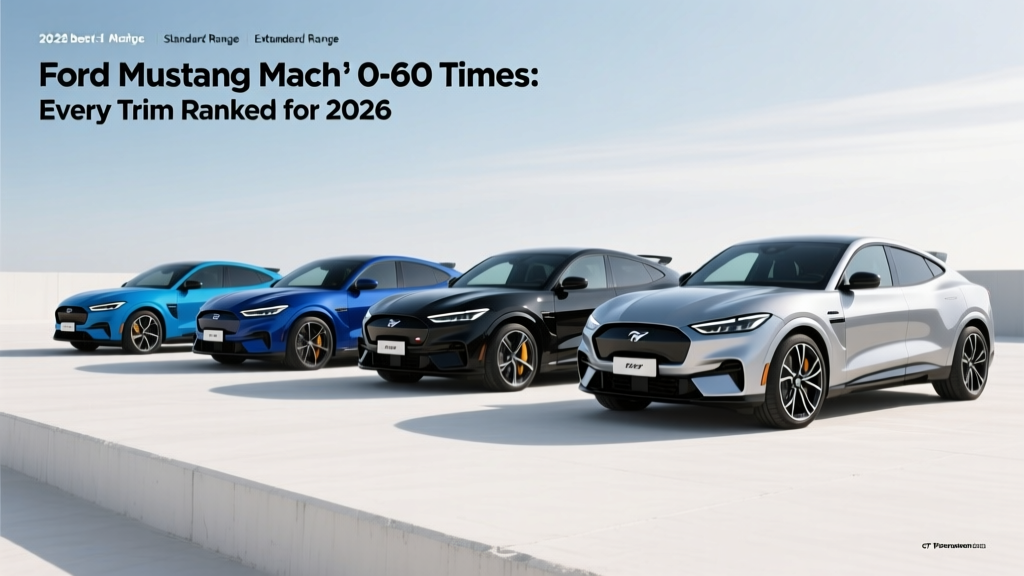
The Quick Answer: Mustang Mach-E 0-60 Times by Trim
If you're researching the electric Mustang 0-60 performance, here are the manufacturer-claimed and independently tested acceleration figures for the 2026 Ford Mustang Mach-E lineup:
- Select (RWD): 5.8 seconds (266 hp)
- Premium (RWD): 5.8 seconds (266 hp)
- Premium (AWD / eAWD): 5.1 seconds (346 hp)
- GT (AWD): 3.3 seconds (480 hp / 634 lb-ft with Performance Upgrade)
- Rally (AWD): 3.4 seconds (estimated, 480 hp, raised suspension)
For context, the base Mach-E hits 60 mph in roughly the same time as a 2025 EcoBoost Mustang coupe (5.5–5.8s), while the GT trim matches or beats the V8 Mustang GT (4.1–4.3s) and approaches Shelby GT500 territory. Electric torque delivery is instant — no turbo lag, no gear shifts — which makes real-world roll-on acceleration feel even quicker than the numbers suggest.
Full 2026 Mustang Mach-E Spec Table: 0-60, Range, Battery, and Price
| Trim | Drivetrain | 0-60 mph | Horsepower | Torque (lb-ft) | Battery (usable kWh) | EPA Range | Peak DC Fast Charge | 10–80% DC Time | Base MSRP |
|---|---|---|---|---|---|---|---|---|---|
| Select | RWD | 5.8s | 266 | 387 | 75.7 (LFP) | 250 mi | 150 kW | ~27 min | $39,995 |
| Premium | RWD | 5.8s | 266 | 387 | 91.0 (NMC) | 320 mi | 150 kW | ~30 min | |
| Premium | eAWD | 5.1s | 346 | 428 | 91.0 (NMC) | 300 mi | 150 kW | ~30 min | |
| GT | eAWD | 3.3s | 480 | 634 | 91.0 (NMC) | 280 mi | 150 kW | ~30 min | |
| Rally | eAWD | 3.4s (est.) | 480 | 634 | 91.0 (NMC) | 265 mi | 150 kW | ~30 min |
Sources: Ford Motor Company 2026 Mach-E specs, fueleconomy.gov. Range figures are EPA estimates; real-world highway range is typically 10–15% lower. Cold-weather (below 30°F) range loss can reach 20–30% depending on cabin heating usage.
Electric Mustang 0-60 vs. Gas Mustang: The Acceleration Reality
The Mach-E nameplate borrows Mustang branding, so the natural comparison is the gas-powered Mustang coupe. Here's how the electric Mustang stacks up on acceleration against the current ICE lineup:
| Model | 0-60 mph | Horsepower | Drivetrain | MSRP (approx.) |
|---|---|---|---|---|
| Mach-E Select (RWD) | 5.8s | 266 | Rear Electric | $39,995 |
| Mustang EcoBoost Coupe | 5.5s | 315 | RWD / Turbo I-4 | $32,515 |
| Mach-E Premium eAWD | 5.1s | 346 | Dual Motor AWD | $46,995 |
| Mustang GT (5.0L V8) | 4.3s | 480 | RWD / V8 | $44,090 |
| Mach-E GT | 3.3s | 480 | Dual Motor AWD | $59,995 |
| Mustang Dark Horse | 3.9s | 500 | RWD / V8 | $60,920 |
Key takeaway: The Mach-E GT's 3.3-second 0-60 time is quicker than any production Mustang coupe currently sold, including the track-focused Dark Horse. The instant torque from dual electric motors eliminates the rev-build and gear-drop delay inherent to internal combustion. However, the gas Mustang still wins on top-end highway passing above 100 mph, curb weight (the Mach-E GT weighs roughly 4,900 lbs vs. ~3,800 for the EcoBoost), and total range on a single fill-up.
For daily driving and stoplight-to-stoplight performance, the electric Mustang's acceleration advantage is real and immediately felt. On a track with sustained high-speed corners and long straights, the gas Mustang's lower weight and dedicated performance chassis still offer dynamics the Mach-E can't fully replicate — though Ford's MagneRide suspension on the GT and Rally trims closes that gap considerably.
Real-World Ownership Costs: Mach-E vs. Gas Mustang Over 5 Years
Performance is only part of the purchase decision. Here's a realistic five-year total cost of ownership (TCO) breakdown comparing the Mach-E Premium eAWD against the Mustang GT coupe, assuming 15,000 miles/year, national average electricity and fuel prices, and typical insurance premiums.
| Cost Category | Mach-E Premium eAWD | Mustang GT (5.0L V8) |
|---|---|---|
| Purchase Price (MSRP) | $46,995 | $44,090 |
| Est. Federal Tax Credit (§30D) | Up to $3,750* | $0 |
| Effective Purchase Price | ~$43,245 | $44,090 |
| 5-Year Fuel / Electricity | $4,200 (home charging avg.) | $12,750 (17 MPG city, $3.40/gal) |
| 5-Year Maintenance | $1,800 (tire rotations, cabin filter, fluid top-offs) | $4,500 (oil changes, brake pads, spark plugs, belts) |
| 5-Year Insurance (avg.) | $9,600 | $8,400 |
| Estimated 5-Year Depreciation | $18,500 | $16,200 |
| 5-Year Total Cost | ~$77,345 | ~$85,940 |
*The IRS §30D credit for the Mach-E varies by battery component and critical-mineral sourcing compliance. As of 2026, the Mach-E qualifies for a partial credit (typically $3,750) due to battery-sourcing rules. Eligibility also depends on buyer income caps ($150K single / $300K joint) and MSRP limits ($55K for SUVs). The credit is now available as a point-of-sale transfer to the dealer. Always verify current-year eligibility with your tax professional.
The Mach-E saves roughly $8,500 over five years despite a slightly higher sticker price and steeper depreciation. The fuel savings alone (~$8,550) nearly cover the entire cost differential. Insurance runs 10–15% higher on the Mach-E due to EV repair cost structures and battery replacement exposure — a common ownership consideration that buyers should budget for.
Charging at Home and on the Road: What Mach-E Buyers Must Know
Acceleration numbers grab headlines, but charging infrastructure determines daily livability. Here's what the 2026 Mach-E charging experience actually looks like:
Home Charging (Level 2)
The Mach-E accepts up to 10.5 kW on Level 2 AC (48-amp circuit, requiring a 60-amp breaker). At that rate, the extended-range 91 kWh battery refills from 10% to 100% in roughly 9 hours — overnight for most owners. Ford's Connected Charge Station (sold separately, ~$550) or any quality J3400 (NACS) / J1772 Level 2 unit works. Home installation typically costs $600–$2,000 depending on panel proximity and whether a 200-amp service upgrade is needed.
DC Fast Charging
The Mach-E peaks at 150 kW on DC fast chargers. The 10–80% charge takes approximately 30 minutes under ideal thermal conditions. Important caveats:
- Charge curve taper: The Mach-E sustains ~130–150 kW up to about 55% state of charge, then tapers to ~90 kW through 70%, and drops to ~45 kW above 80%. Plan your road-trip stops to charge to 80% max — the last 20% can add another 25+ minutes.
- Preconditioning: The Mach-E battery preconditioning activates when you navigate to a DC charger via the built-in navigation. Always use this feature in cold weather — arriving at a charger with a cold battery can double your charge time.
- Connector: 2026 Mach-E models ship with the NACS (Tesla-style) charge port natively, granting direct access to Tesla Superchargers (now 20,000+ stalls in the U.S.) without an adapter. CCS1 adapters are available for legacy Electrify America and EVgo stations.
Real-World Range Expectations
EPA vs. Reality: The Mach-E Premium eAWD carries a 300-mile EPA estimate. In real-world mixed driving at 70 mph with climate control, expect 255–275 miles. In winter conditions (below 30°F) with cabin heat, plan for 210–240 miles of usable range. The GT trim, with its stickier summer tires and higher power draw, typically delivers 235–255 miles in fair weather and as little as 190 miles in deep cold.
Common Misconceptions About the Electric Mustang
| Myth | Fact |
|---|---|
| "The Mach-E isn't a real Mustang" | It's a Ford-badged performance EV under the Mustang brand. It shares no platform with the S650 coupe, but the GT trim's 3.3s 0-60 time outperforms every gas Mustang currently produced. Whether that makes it a "real" Mustang is subjective — but the performance credentials are objective. |
| "EV batteries need replacing every 5 years" | Ford warranties the Mach-E battery for 8 years / 100,000 miles against capacity loss below 70%. Industry-wide degradation data from Recurrent Auto shows most modern NMC and LFP packs retain 90%+ capacity at 100K miles. Full replacement (rare) runs $12,000–$18,000 out of warranty. |
| "The Mach-E qualifies for the full $7,500 tax credit" | As of 2026, the Mach-E typically qualifies for $3,750 (half credit) due to battery critical-mineral and component sourcing requirements under §30D. The full $7,500 requires both sourcing thresholds to be met. Rules change annually — verify on IRS.gov before purchasing. |
| "You can't road-trip an EV" | With native NACS access to the Supercharger network and 150 kW DC capability, the Mach-E can handle road trips with 25–30 minute charge stops every 200–240 miles. It's slower than a gas fill-up, but entirely practical with route planning via Ford's built-in navigation or apps like A Better Routeplanner. |
| "The 0-60 time is the same as my gas car's" | Electric motors deliver peak torque at 0 RPM with no gear shifts. Even when the 0-60 numbers match (e.g., Mach-E Select at 5.8s vs. EcoBoost at 5.5s), the EV feels noticeably quicker in city driving due to instant throttle response and seamless power delivery. The difference is most pronounced in 0-30 mph sprints and rolling acceleration. |
Decision Framework: Which Mach-E Trim Is Right for You?
Choose the Mach-E Select (RWD, 5.8s, $39,995) if:
- You want the lowest entry price and primarily drive in urban/suburban environments
- 250 miles of EPA range covers your daily commute with margin
- You have reliable home charging and rarely road-trip more than 200 miles
- The LFP battery's longer cycle life and 100% daily-charge tolerance appeals to you
Choose the Mach-E Premium eAWD (5.1s, ~$46,995) if:
- You need all-weather traction and want a sub-5.5-second 0-60 without the GT price premium
- 300 miles of EPA range (255–275 real-world) fits your longest regular drives
- You value the upgraded interior (perforated seats, B&O sound, panoramic roof)
- This is the best all-around value trim for most buyers
Choose the Mach-E GT (3.3s, ~$59,995) if:
- Sub-3.5-second acceleration is a non-negotiable performance requirement
- You're cross-shopping a Mustang Dark Horse or Tesla Model Y Performance and want more interior space
- You accept the range trade-off (280 EPA, ~235–255 real-world) for 480 hp
- You want MagneRide adaptive suspension and Ford Performance tuning
Choose the Mach-E Rally (~$57,995) if:
- You want GT-level power with a more compliant, off-road-capable suspension
- You drive on unpaved roads, fire roads, or want a more rugged EV crossover
- The 1-inch ride height increase and RallySport drive mode match your lifestyle
Skip the Mach-E entirely if:
- You have no access to home or workplace charging and your area has sparse public DC infrastructure
- You regularly tow more than 3,000 lbs (the Mach-E maxes at 2,200–3,300 lbs depending on trim)
- You need 400+ miles of range without stopping — consider the Lucid Air or a PHEV like the RAV4 Prime
What First-Time EV Buyers Should Know Before Ordering a Mach-E
If the Mach-E is your first electric vehicle, here are the practical ownership realities that don't appear in the brochure:
- Home charging is the foundation. Over 80% of EV charging happens at home. Budget $800–$2,000 for a quality Level 2 station and professional installation. If your electrical panel is maxed at 100 amps, a panel upgrade to 200 amps can add $1,500–$3,000. Confirm your setup with a licensed electrician before ordering the car.
- Tire wear accelerates. The Mach-E's instant torque and 4,800+ lb curb weight wear tires 20–30% faster than a comparable gas crossover. Budget $1,200–$1,800 for a set of EV-optimized touring tires every 25,000–35,000 miles.
- Insurance quotes vary wildly. Get quotes before ordering. Some insurers charge 25–30% more for EVs due to battery replacement cost exposure; others offer EV-specific discounts. Shop at least three carriers.
- The FordPass app is essential. Remote preconditioning, charge monitoring, and route planning all flow through the app. Learn it before delivery day — it's how you'll maximize range in winter by warming the battery and cabin while still plugged in.
- BlueCruise is Level 2, not self-driving. Ford's hands-free highway assist (available on mapped divided highways) is an SAE Level 2 system. You must remain attentive, keep your eyes on the road, and be ready to take over instantly. It's an excellent highway fatigue reducer — not autonomous driving.
Frequently Asked Questions
Is the Mustang Mach-E faster than the gas Mustang GT?
Yes, in a straight-line 0-60 sprint. The Mach-E GT hits 60 mph in 3.3 seconds, beating the gas Mustang GT's 4.3 seconds and the Dark Horse's 3.9 seconds. However, the gas Mustang retains advantages in sustained high-speed performance, track lap times on circuits with long straights, and overall curb weight (the Mach-E GT is roughly 1,100 lbs heavier).
Does the Mach-E use the NACS or CCS charging connector?
The 2026 Mach-E ships with the NACS (J3400) charge port natively, the same connector used by Tesla. This provides direct access to the Tesla Supercharger network without an adapter. Ford also supports CCS1 adapters for use with Electrify America, EVgo, and other legacy networks.
How much does it cost to charge a Mach-E at home?
At the U.S. national average residential electricity rate of ~$0.16/kWh, fully recharging the 91 kWh extended-range battery from 10% costs approximately $13.10. That translates to roughly $0.04–$0.05 per mile — compared to $0.18–$0.22 per mile for a gas Mustang GT averaging 20 MPG combined at $3.40/gallon. Annual fuel savings for a 15,000-mile driver typically exceed $1,700.
What is the real-world range of the Mach-E GT?
The EPA rates the 2026 Mach-E GT at 280 miles. In real-world highway driving at 70–75 mph with climate control, expect 235–255 miles in mild weather. In winter conditions below freezing, plan for 190–220 miles of usable range. Aggressive driving (frequent hard acceleration) will further reduce range by 10–15%.
Does the Mach-E battery degrade significantly?
All lithium-ion batteries degrade, but modern thermal management systems have slowed this considerably. Data aggregated by Recurrent Auto shows Mach-E packs retaining 92–95% of original capacity at 60,000 miles and 88–92% at 100,000 miles. Ford's battery warranty guarantees at least 70% capacity retention for 8 years or 100,000 miles. The Select trim's LFP battery chemistry typically shows even slower degradation and can be charged to 100% daily without the longevity concerns associated with NMC packs.
Can I tow with the Mustang Mach-E?
Yes, with limits. The Mach-E Select and Premium with the factory tow package can tow up to 2,200 lbs (RWD) or 3,300 lbs (eAWD). The GT is rated at 2,200 lbs. This covers small utility trailers, bike racks, and light jet skis — but not full-size campers or boats. Towing also cuts range by 30–50% depending on trailer weight and aerodynamics.
Is the Mach-E eligible for the $7,500 federal EV tax credit in 2026?
The Mach-E currently qualifies for a partial credit of $3,750 under IRS §30D rules, reflecting partial compliance with battery critical-mineral and component sourcing requirements. Full $7,500 eligibility requires both thresholds to be met. Additionally, the buyer must meet income caps ($150,000 single / $300,000 joint AGI) and the vehicle MSRP must not exceed $55,000 for SUVs (some GT configurations exceed this cap). The credit can now be transferred to the dealer as a point-of-sale discount. Confirm current-year rules with a tax professional before finalizing your purchase.