The Quick Answer
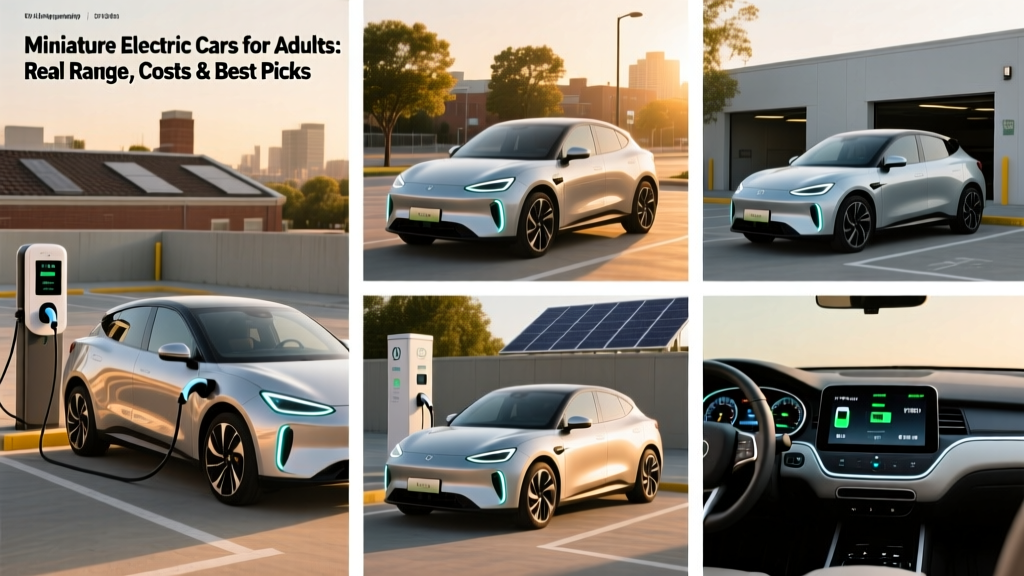
Miniature electric cars for adults — legally classified as Neighborhood Electric Vehicles (NEVs) or Low-Speed Vehicles (LSVs) — are street-legal on roads with speed limits up to 35 mph in most U.S. states. Expect a real-world range of 30–60 miles on a full charge, top speeds of 25 mph, and purchase prices from roughly $10,000 to $25,000. They charge on standard 120V household outlets, eliminating the need for a dedicated Level 2 home charger. However, they lack highway capability, crash-test ratings comparable to full-size EVs, and meaningful DC fast-charging infrastructure. They work best as secondary vehicles for short, predictable urban and suburban trips.
What Exactly Are Miniature Electric Cars for Adults?
The term "miniature electric cars" covers a spectrum of small, low-speed electric vehicles designed for adult drivers. The most common legal category is the Low-Speed Vehicle (LSV), defined under Federal Motor Vehicle Safety Standard (FMVSS) No. 500 and regulated by NHTSA. To qualify, an LSV must:
- Have a top speed between 20 and 25 mph
- Include headlamps, turn signals, tail lamps, brake lamps, reflex reflectors, parking brakes, rearview mirrors, windshield (glazed), VIN, and seat belts
- Not be required to meet the full suite of FMVSS crash-test standards that apply to passenger cars
Some buyers also use the term to refer to micro-EVs — small, fully enclosed electric cars sold in markets like China and Europe (e.g., the Wuling Hongguang Mini EV or the Citroën Ami). Most of these are not currently street-legal as passenger vehicles in the United States, though a few are imported under off-road or LSV classifications.
The distinction matters enormously for insurance, registration, and where you can legally drive.
Top Models and Specs: A Side-by-Side Look
Here's how the most widely available miniature electric vehicles in the U.S. compare on the numbers that matter. All figures reflect manufacturer specs and EPA or manufacturer-published data as of the 2025–2026 model years.
| Model | Type | Battery (kWh) | EPA/Claimed Range | Top Speed | Charge Time (120V) | Base MSRP |
|---|---|---|---|---|---|---|
| GEM e2 / e4 | LSV/NEV | ~11–14 kWh (lead-acid or lithium options) | 30–50 mi | 25 mph | 6–8 hrs | ~$12,000–$16,000 |
| Arcimoto FUV (Forward Utility Vehicle) | LSV (street-legal in select states) | ~12–20 kWh (NMC lithium) | 40–70 mi | 75 mph (unrestricted) / 25 mph (LSV mode) | 4–6 hrs (L1) / ~2 hrs (L2) | ~$18,000–$24,000 |
| Aptera (announced/preliminary) | Full passenger EV (3-wheel) | 25–60 kWh (varies by trim) | 250–1,000 mi (claimed, by trim) | 110+ mph | DC fast capable | ~$29,800–$50,000+ (preliminary) |
| Polk Ranger XP (UTV-class) | Off-road / not LSV | ~7–10 kWh | 25–40 mi | 25 mph | 6–8 hrs | ~$10,000–$13,000 |
Real-world range caveat: Manufacturer range claims for NEVs are often tested at steady low speeds on flat terrain. In practice, expect 15–25% less range with frequent stops, hills, headwinds, or passenger/cargo loads. Cold weather (below 40°F) can reduce usable range by an additional 20–30% due to battery chemistry limitations and lack of sophisticated thermal management in most NEVs.
Miniature EV vs. Gas Car vs. Hybrid: The Cost and Practicality Gap
Most buyers considering a miniature electric car already own a primary vehicle. The real question is whether a micro-EV can replace a second car — often a gas commuter — for short daily trips. Here's how the economics compare for a 15-mile daily round trip, 250 workdays per year (3,750 miles annually):
| Cost Factor | Miniature EV (NEV) | Compact Gas Car (e.g., 2026 Honda Civic) | Compact Hybrid (e.g., 2026 Prius) |
|---|---|---|---|
| Purchase Price (base) | $12,000–$18,000 | $25,000–$28,000 | $28,000–$32,000 |
| Annual Fuel/Energy | ~$110–$150 (electricity at $0.14/kWh) | ~$560 (at $3.20/gal, 30 mpg) | ~$300 (at $3.20/gal, 55 mpg) |
| Annual Maintenance | $50–$150 (no oil, minimal brakes) | $400–$700 | $350–$600 |
| Insurance (annual avg.) | $300–$600 | $1,200–$1,800 | $1,100–$1,700 |
| Annual Total Operating | $460–$900 | $2,160–$3,200 | $1,750–$2,600 |
The operating savings are significant — typically $1,200 to $2,500 per year versus a gas car. But the trade-offs are equally concrete: no highway access, minimal crash protection, limited cargo capacity, and zero DC fast-charging capability on most models.
The Federal Tax Credit Question (§30D)
This is where miniature electric cars diverge sharply from full-size EVs. Under current IRS §30D rules, the federal clean vehicle credit of up to $7,500 applies to vehicles that meet specific criteria, including battery capacity thresholds, MSRP caps ($55,000 for sedans, $80,000 for SUVs/trucks/vans), buyer income limits, and critical-mineral/battery-component sourcing requirements.
Key §30D requirements for 2026:
- Vehicle must be a new qualified plug-in electric drive motor vehicle
- Battery capacity ≥ 7 kWh (most LSVs meet this)
- Gross vehicle weight rating (GVWR) < 14,000 lbs (LSVs easily qualify)
- Final assembly in North America
- MSRP under applicable cap
- Buyer AGI within income limits ($150K single / $300K joint)
- Battery components and critical minerals must meet phased-in sourcing thresholds
- Credit can be transferred to dealer at point of sale as a price reduction
Reality check: Many LSV manufacturers are small companies whose battery sourcing may not meet the increasingly strict critical-mineral and component requirements. Always verify eligibility for the specific model and model year on the IRS qualified vehicles list before counting on the credit. Consult a tax professional for your situation.
Real-World Ownership: What First-Time Buyers Must Know
Charging Is Simple — and Limited
Most NEVs and LSVs charge on a standard 120V household outlet (Level 1), drawing roughly 1.0–1.5 kW. This is genuinely convenient — no dedicated 240V circuit or electrician required. A full charge typically takes 6–8 hours, which works fine for overnight replenishment of a 30–50 mile range.
However, kW is power (charge rate) and kWh is energy (battery capacity) — a 12 kWh battery charging at 1.2 kW takes roughly 10 hours from empty, minus charging inefficiency. Don't confuse the two when reading specs.
Where You Can (and Cannot) Legally Drive
LSVs are federally permitted on roads with posted speed limits of 35 mph or below. Individual states may allow crossing higher-speed roads at intersections, but driving on highways, interstates, or most roads above 35 mph is illegal and dangerous. Check your state DMV for specific rules — Florida, Arizona, and California have relatively permissive NEV laws, while other states are more restrictive.
Safety Is the Biggest Trade-Off
LSVs are not required to meet FMVSS crash-test standards for frontal impact, side impact, or rollover protection that full-size passenger vehicles must pass. They have seat belts and basic safety equipment, but in a collision with a full-size vehicle, occupants are at significantly greater risk. Neither NHTSA nor IIHS crash-tests LSVs. This is the single most important factor to weigh against the low purchase price and operating cost.
Climate and Battery Degradation
Most LSV batteries lack active thermal management (no liquid cooling or heat pumps). This means:
- Cold weather: Range drops 20–30% below 40°F. Lead-acid batteries are hit harder than lithium.
- Hot climates: Sustained high heat accelerates degradation. Expect 3–5% annual capacity loss in lithium packs without thermal management, versus 1–2% in thermally managed full-size EVs.
- Battery replacement: Lead-acid packs ($1,500–$3,000) last 3–5 years. Lithium packs ($3,000–$6,000) last 8–12 years but are more expensive upfront.
Common Misconceptions, Corrected
| Myth | Fact |
|---|---|
| "They're just golf carts." | Golf carts are a separate legal category with fewer safety requirements. LSVs must meet FMVSS 500 and are registered/titled as motor vehicles in most states. |
| "I can drive them on the highway." | Illegal and extremely dangerous. Top speed is 25 mph; highways are off-limits. |
| "They qualify for the full $7,500 tax credit." | Some may, but battery-sourcing rules are strict and many small manufacturers do not meet them. Verify per model. |
| "The range is the same year-round." | Cold weather reduces range 20–30% or more, especially with lead-acid batteries. |
| "No maintenance means no costs." | Tires, brakes, suspension, and battery replacement are real costs over 5–10 years of ownership. |
Decision Framework: Is a Miniature EV Right for You?
Choose a miniature electric car (LSV/NEV) if:
- Your daily trips are under 25 miles round-trip and never require roads above 35 mph
- You live in a mild climate or can accept significant winter range loss
- You already own a full-size vehicle for highway trips and longer drives
- You have access to a standard 120V outlet for overnight charging (apartment-friendly)
- You want the lowest possible operating cost for local errands and commuting
Choose a full-size EV (e.g., Chevy Equinox EV, Hyundai Ioniq 5, Tesla Model 3) if:
- You need highway capability, full crash-test safety ratings, and year-round range above 200 miles
- You don't have a second vehicle and need one car to do everything
- You want DC fast-charging for road trips (10–80% in 18–30 minutes at 150–250 kW)
- Safety is a top priority for you and your passengers
Choose a PHEV or hybrid if:
- You want low fuel costs without range or speed limitations
- You lack reliable home charging access for a battery-electric vehicle
- You frequently drive in cold climates where EV range loss is a concern
5-Year Cost of Ownership: Miniature EV vs. Compact Gas Car
| Category | Miniature EV (LSV, $15K base) | Compact Gas Car ($27K base) |
|---|---|---|
| Purchase Price | $15,000 | $27,000 |
| Tax Credit (est.) | $0–$7,500 (varies — verify eligibility) | $0 |
| 5-Year Energy/Fuel | $550–$750 | $2,800–$3,500 |
| 5-Year Maintenance | $400–$750 | $2,000–$3,500 |
| 5-Year Insurance | $1,500–$3,000 | $6,000–$9,000 |
| Battery Replacement (if needed) | $1,500–$6,000 | N/A |
| Estimated 5-Year Total | $13,450–$25,500 | $37,800–$43,000 |
| Resale Value (est.) | $3,000–$6,000 | $12,000–$16,000 |
| Net 5-Year Cost | $7,450–$22,500 | $21,800–$31,000 |
The miniature EV wins on operating cost, but depreciation is steeper and resale value is lower in absolute terms. The net savings over five years are real but narrower than the raw operating-cost gap suggests.
Frequently Asked Questions
Do I need a driver's license to operate a miniature electric car?
Yes, in virtually all U.S. states. LSVs are registered motor vehicles and require a valid driver's license, registration, and insurance. Golf carts may have different rules depending on local ordinances, but if it's classified as an LSV, full licensing applies.
Can I charge a miniature EV at a public charging station?
Generally no. Most LSVs use a standard 120V plug (NEMA 5-15) and do not have CCS, NACS, or CHAdeMO charge ports. They cannot connect to public Level 2 or DC fast-charging stations. The Arcimoto FUV is a partial exception, offering an optional Level 2 (J1772) inlet.
How long do the batteries last?
Lead-acid batteries in budget NEVs typically last 3–5 years or 500–800 charge cycles before significant capacity loss. Lithium-ion packs (NMC or LFP) last 8–15 years or 1,500–3,000+ cycles. Check the manufacturer's battery warranty — most offer 2–5 years on lead-acid and 5–8 years on lithium.
Are miniature electric cars safe in a crash?
LSVs are not crash-tested to the same standards as full-size passenger vehicles. They provide seat belts and basic structural protection but lack airbags (in most models), crumple zones engineered for high-speed impacts, and advanced driver-assistance systems. They are safest when used on low-speed roads as intended.
Can I drive a miniature EV in winter?
You can, but expect 20–30% range reduction in temperatures below 40°F, and potentially more below 20°F. Most LSVs have minimal or no cabin heating beyond resistive heaters, which further drain the battery. Lithium batteries handle cold better than lead-acid but still lose performance.
Do miniature electric cars qualify for HOV lane access?
This varies by state. California, for example, has historically offered Clean Air Vehicle decals for qualifying ZEVs, but LSVs are often excluded because they cannot legally use highways in the first place. Check your state's DMV or DOT for current rules.