The Short Answer on the Miata EV
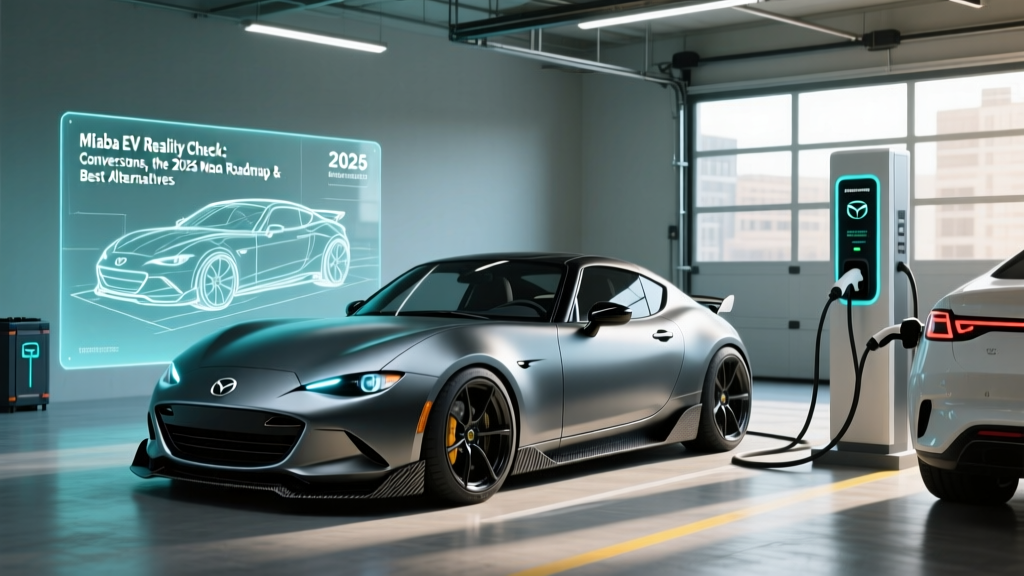
As of 2026, Mazda does not sell a production electric Miata (MX-5). The current fourth-generation ND2 Miata remains a gasoline-only roadster. Your options for an electric Miata experience are: (1) a custom EV conversion costing $20,000–$45,000+ on top of a donor car, (2) waiting for Mazda's electrified sports car plans (announced but not confirmed as a pure EV), or (3) choosing an existing electric sports car that captures the lightweight, driver-focused spirit. Below, we break down the real numbers, conversion economics, and the best alternatives with exact specs.
Why Mazda Hasn't Built an Electric Miata (Yet)
The MX-5 Miata's identity rests on two pillars: sub-2,400-pound curb weight and near-perfect 50/50 weight distribution. Battery mass is the enemy of both. A usable 50 kWh battery pack—the minimum for 200+ miles of EPA range—adds roughly 650–800 pounds of cell weight alone, pushing a Miata-sized chassis well past 3,000 pounds and fundamentally altering the handling dynamics that define the car.
Mazda's current electrification strategy focuses on larger vehicles. The CX-90 PHEV and CX-70 PHEV carry inline-six plug-in hybrid powertrains. Mazda has discussed a next-generation MX-5, with executives hinting at some form of electrification, but as of early 2026, no production electric Miata has been officially announced with a timeline or specs. Industry analysts suggest Mazda may pursue a synthetic-fuel-compatible hybrid or a lightweight EV architecture in partnership with another automaker, but these remain speculative.
The EV Conversion Route: Real Costs and Compromises
For enthusiasts unwilling to wait, aftermarket Miata EV conversions are a real but expensive path. Companies like EV West, Zero EV, and independent shops have converted NA, NB, NC, and ND-generation Miatas to battery power. Here's what the economics actually look like:
| Component | Budget Build | Mid-Range | Premium Build |
|---|---|---|---|
| Donor Miata (NA/NB/NC) | $3,000–$6,000 | $8,000–$15,000 | $18,000–$25,000 (ND) |
| Battery Pack (kWh) | 20–25 kWh (used cells) | 35–45 kWh (new LFP) | 50–60 kWh (NMC) |
| Motor + Controller | $4,000–$6,000 | $6,000–$9,000 | $10,000–$14,000 |
| BMS + Wiring + Integration | $2,500–$4,000 | $4,000–$6,000 | $6,000–$8,000 |
| Charger (Level 2 onboard) | $800–$1,500 | $1,500–$2,500 | $2,500–$3,500 |
| Labor (shop-built) | $8,000–$12,000 | $15,000–$22,000 | $25,000–$35,000 |
| Total Estimated Cost | $18,300–$29,500 | $34,500–$54,500 | $61,500–$85,500 |
What You Actually Get
Range: Budget 20–25 kWh builds deliver 60–80 miles of real-world range. Mid-range 40 kWh builds manage 120–150 miles. Premium 50+ kWh builds can reach 170–200 miles, but at significant weight and cost penalties.
Performance: Most conversions produce 150–250 horsepower—more than the stock Miata's 181 hp—but the instant torque and added weight change the character. A well-sorted conversion hits 0-60 mph in roughly 4.5–6.0 seconds depending on motor selection and weight.
Charging: Most conversions use a J1772 Level 2 inlet at 6.6–7.2 kW. DC fast charging is rare and adds $3,000–$6,000 to the build. A 40 kWh pack charges from 10–80% in about 4.5 hours on Level 2.
Conversion Ownership Realities
- No federal tax credit: The IRS §30D credit applies only to new qualifying vehicles from certified manufacturers. Custom conversions do not qualify.
- Insurance: Specialty insurers like Hagerty or Grundy American can cover conversions, but premiums run 20–40% higher than a stock Miata due to modified-vehicle underwriting.
- Resale: The conversion market is niche. Expect to recoup 40–60% of conversion cost at resale, depending on build quality and documentation.
- Warranty: Zero factory warranty. You're reliant on component warranties from motor and battery suppliers (typically 2–5 years).
Electric Roadster Alternatives: Spec-for-Spec Comparison
If the goal is an engaging, open-air or sporty electric driving experience, several production vehicles deliver real-world thrills with full warranties, DC fast charging, and tax-credit eligibility. Here's how they stack up against the 2026 Mazda MX-5 Miata (gasoline baseline):
| Spec | 2026 Mazda MX-5 (Gas) | 2026 MG4 XPOWER | 2026 Fiat 500e | 2026 Mini Cooper SE Convertible | 2025 Tesla Roadster (Announced) |
|---|---|---|---|---|---|
| Powertrain | 2.0L I4 Gas | Dual Motor AWD EV | FWD EV | FWD EV | Tri-Motor AWD EV |
| Horsepower | 181 hp | 429 hp | 118 hp | 184 hp | ~1,000+ hp (est.) |
| 0–60 mph | 5.8 sec | ~4.5 sec | 8.5 sec | 7.3 sec | <2.0 sec (claimed) |
| EPA Range | ~330 mi (tank) | ~240 mi (est.) | 149 mi | ~150 mi (est.) | ~390 mi (claimed) |
| Battery (usable kWh) | N/A (12.7 gal) | 64 kWh (NMC) | 37.3 kWh (NMC) | ~40 kWh (est.) | ~200 kWh (claimed) |
| DC Fast Charge (peak kW) | N/A | ~140 kW | 85 kW | ~95 kW (est.) | ~250 kW (est.) |
| 10–80% Charge Time | N/A | ~28 min | ~32 min | ~30 min (est.) | ~20 min (est.) |
| Curb Weight | ~2,340 lbs | ~3,700 lbs | ~2,950 lbs | ~3,100 lbs (est.) | ~4,400 lbs (est.) |
| Body Style | 2-seat Roadster | 5-door Hatchback | 2-door Hatchback | 2-seat Convertible | 2-seat Roadster |
| Base MSRP | $30,170 | ~$38,000 (est.) | $36,500 | ~$38,000 (est.) | ~$200,000+ (est.) |
| Federal Tax Credit (§30D) | $0 | $0 (Mfg. ineligible) | $0 (Mfg. ineligible) | $0 (Mfg. ineligible) | Up to $7,500 (if eligible) |
Note: Tesla Roadster specs are preliminary/announced and subject to change. MG4 XPOWER, Fiat 500e, and Mini Cooper SE are not currently eligible for the §30D new-vehicle credit due to manufacturer/sourcing rules. Always verify current eligibility on IRS.gov.
The Closest Production Match: Mini Cooper SE Convertible
The Mini Cooper SE Convertible is the only mainstream production EV that directly mirrors the Miata formula: two seats, a soft top, rear-wheel-drive dynamics, and a sub-$40K price. Its ~150-mile EPA range is limiting for road trips but sufficient for daily driving and weekend canyon runs. The 184 hp electric motor delivers brisk city acceleration, and the ~3,100-pound curb weight—while heavier than a Miata—is among the lightest of any production EV.
Cost of Ownership: Miata Gas vs. EV Conversion vs. EV Alternative
Let's compare five-year ownership costs across three realistic scenarios: a new 2026 gas Miata, a mid-range Miata EV conversion, and a production electric alternative (using the Mini Cooper SE Convertible as the proxy).
| Cost Category | 2026 MX-5 (Gas) | Miata EV Conversion (Mid) | Mini Cooper SE Convertible |
|---|---|---|---|
| Purchase Price (base) | $30,170 | $45,000 (donor + build) | $38,000 |
| Federal Tax Credit | $0 | $0 | $0 |
| Fuel/Energy (75K mi) | $8,400 (30 MPG, $3.35/gal) | $2,700 ($0.13/kWh, 3.5 mi/kWh) | $2,850 ($0.13/kWh, 3.4 mi/kWh) |
| Maintenance (5 yr) | $2,800 (oil, brakes, belts) | $800 (tires, cabin filter, fluid top-offs) | $1,500 (tires, cabin filter, brake fluid) |
| Insurance (5 yr avg) | $7,500 | $10,500 | $8,000 |
| Estimated Depreciation | -$9,000 | -$22,500 (40-60% recovery) | -$13,000 |
| Total 5-Year Cost | $39,870 | $76,500 | $47,350 |
| Cost Per Mile | $0.53 | $1.02 | $0.63 |
Fuel costs based on national averages as of early 2026 (fueleconomy.gov). Electricity at $0.13/kWh national residential average. Actual costs vary by region, driving style, and utility rates.
Common Miata EV Misconceptions — Fact-Checked
| Myth | Fact |
|---|---|
| "Mazda is releasing an electric Miata in 2026." | No production electric MX-5 has been officially announced. Mazda's 2026 EV lineup includes the CX-60e and updated MX-30, but no Miata EV. |
| "An EV conversion makes the Miata faster and better." | Conversions add 300–600 lbs, fundamentally changing the handling balance. Straight-line acceleration improves, but the Miata's magic is cornering feel, which often suffers with added mass. |
| "EV conversions qualify for the $7,500 tax credit." | The §30D credit applies only to new vehicles from qualified manufacturers meeting battery-sourcing and MSRP caps. Custom conversions are ineligible. |
| "I can convert a Miata for under $10,000." | Only if you perform all labor yourself, source used/salvaged battery cells, and accept 40–60 miles of range. Shop-built conversions with reliable range start at $25,000+. |
| "A converted Miata can DC fast charge." | DC fast charging requires a CCS or NACS inlet, a high-voltage contactor system, and a battery pack rated for high C-rates. Most conversions are Level 2 only, adding 25–30 miles per hour of charging. |
Real-World Ownership Considerations Before You Commit
Home Charging Access
Both a converted Miata and a production EV like the Mini SE Convertible need reliable home charging to be practical. A Level 2 home charger (240V, 32–48A) adds roughly 25–35 miles of range per hour and costs $500–$1,200 for equipment plus $800–$2,500 for professional installation depending on panel capacity and conduit runs. Without home charging, daily EV ownership requires discipline around public infrastructure—something a 150-mile-range roadster doesn't afford much margin for.
Climate and Range Loss
Lithium-ion batteries lose 15–30% of their rated range in sustained freezing temperatures. A converted Miata with a 40 kWh pack rated for 140 miles in mild weather may deliver only 100–115 miles in a 25°F winter commute. Production EVs like the Mini SE mitigate this with active thermal management (heat pumps and battery preconditioning), which most aftermarket conversions lack.
Driving Patterns
A Miata is typically a second car or weekend vehicle. If your use case is sunny-day canyon carving within 60 miles of home, even a budget EV conversion works. If you need a single-vehicle daily driver with road-trip capability, the 150-mile range of most EV alternatives becomes a real limitation—and the gas Miata's 330-mile tank range looks more practical.
Decision Framework: Which Path Is Right for You?
Choose a gas Mazda MX-5 Miata if:
- You want the authentic, lightweight roadster experience at the lowest total cost
- You need 300+ mile range for road trips without planning charging stops
- You live in an apartment or lack home charging access
- You want full factory warranty and predictable depreciation
Choose an EV conversion Miata if:
- You're a hands-on enthusiast who values the project as much as the product
- You have home charging and a short daily commute (under 50 miles)
- You already own a Miata and want to repurpose it as an EV
- You accept the total cost will exceed $40,000 with poor resale recovery
Choose a production EV alternative (Mini SE Convertible, etc.) if:
- You want an open-air electric experience with full warranty and dealer support
- You have home charging and realistic range expectations (~150 miles)
- You want modern safety features, infotainment, and reliability
- You're okay with a heavier car that doesn't replicate the Miata's featherweight feel
Frequently Asked Questions
Will Mazda ever make an electric Miata?
Mazda executives have acknowledged the MX-5 will need some form of electrification to meet future emissions regulations, but no production EV Miata has been officially announced as of 2026. The most likely path is a mild-hybrid or plug-in-hybrid variant before a full EV, potentially on a new lightweight platform. Any announcement would likely target a 2028–2030 model year at the earliest.
How far can a converted Miata EV actually go?
Real-world range depends on battery capacity, driving style, and climate. A 25 kWh budget build delivers 60–80 miles. A 40 kWh mid-range build manages 120–150 miles. A 55+ kWh premium build can reach 170–200 miles. Highway driving at 70+ mph reduces these figures by 15–25%, and cold weather (below 35°F) cuts range an additional 15–30%.
Can I daily-drive a 150-mile-range EV convertible?
Yes, if your round-trip commute is under 80 miles and you have home charging. For a 40-mile daily commute, you'll charge overnight to 80% and still have a comfortable buffer. The challenge arises with detours, errands, and weather—plan conservatively and you'll be fine. For longer trips, you'll need to plan DC fast-charging stops (30–40 minutes at 10–80%).
Is a Miata EV conversion street-legal?
Yes, but the process varies by state. Most states require a rebuilt/special-construction vehicle inspection, updated registration noting the electric powertrain, and sometimes a BAR (Bureau of Automotive Repair) certification in California and similar states. Insurance requires specialty classic-car or modified-vehicle coverage. Check your state DMV for specific requirements before starting a build.
What's the cheapest way to get an electric roadster experience in 2026?
The lowest-cost production option is the Fiat 500e at ~$36,500, though it's a hatchback, not a true roadster. The Mini Cooper SE Convertible at ~$38,000 is the closest open-air production EV. A used Tesla Model 3 (2019–2021) can be found for $18,000–$25,000 and may qualify for the §25E used-EV credit (up to $4,000), but it's a sedan, not a roadster. For the true Miata experience at the lowest cost, the gasoline MX-5 remains unbeaten.