The Data-Driven Approach to EV Sedan Efficiency
When evaluating the best electric sedans on the market, consumers are often bombarded with marketing jargon, subjective driving impressions, and glossy brochure photography. However, for the analytical buyer, the true measure of an electric vehicle's prowess lies in its hard data: energy efficiency, aerodynamic drag coefficients, battery utilization, and real-world range retention. In this comprehensive data-driven comparison analysis, we strip away the marketing fluff and rank the top electric sedans based strictly on their EPA-estimated range, MPGe (Miles Per Gallon equivalent) efficiency ratings, and verified real-world performance metrics. Whether you are a high-mileage commuter or a cross-country road-trip enthusiast, understanding the mathematical relationship between a sedan's battery capacity and its energy consumption is critical for making a smart, long-term purchasing decision.
Methodology: How We Measure Range and Efficiency
To rank these vehicles, we rely on standardized testing data from the EPA's official Fuel Economy guide, cross-referenced with independent highway range tests conducted by major automotive publications. The EPA's MPGe rating provides a baseline for how efficiently a vehicle converts electrical energy from the grid into forward momentum. However, MPGe does not tell the whole story. We also analyze the vehicle's miles per kilowatt-hour (mi/kWh) consumption rate, which is the EV equivalent of traditional MPG. Furthermore, we factor in the aerodynamic drag coefficient (Cd) and the total usable battery capacity (kWh) to understand how each automaker achieves their respective range figures. A massive battery pack can yield high range, but if the vehicle is inefficient, it will suffer from slower charging times and higher operating costs. Therefore, our ranking heavily weights efficiency and engineering elegance over brute-force battery sizing.
The Math Behind the Magic: Kilowatt-Hours vs. MPGe
Before diving into the rankings, it is essential to understand the math that dictates EV sedan efficiency. According to the Alternative Fuels Data Center, one gallon of gasoline contains the energy equivalent of 33.7 kilowatt-hours (kWh). Therefore, an EV that achieves 100 MPGe is consuming exactly 33.7 kWh of electricity to travel 100 miles, or roughly 3.0 miles per kWh. The most efficient electric sedans on the market today push this boundary well past 130 MPGe, meaning they can travel over 4.0 miles on a single kilowatt-hour of energy. This level of efficiency is achieved through a combination of advanced silicon-carbide power inverters, highly optimized thermal management systems, low-rolling-resistance tires, and teardrop-like aerodynamic profiles.
The Contenders: Top Electric Sedans Ranked
1. Lucid Air Grand Touring (The Range and Efficiency King)
The Lucid Air Grand Touring is an engineering marvel that currently sits at the absolute pinnacle of EV sedan efficiency and range. Despite being a large, luxurious, and heavy executive sedan, the Air Grand Touring achieves an astonishing EPA-estimated range of 516 miles. More impressively, it accomplishes this with an EPA rating of 131 MPGe (approximately 3.9 mi/kWh). Lucid achieves this through its proprietary miniaturized drive units, which are incredibly compact and lightweight, allowing for a 112 kWh battery pack to be housed without compromising cabin space. Furthermore, the Air boasts a remarkably low drag coefficient of 0.20, slicing through the air with less resistance than almost any other production sedan. For buyers who demand maximum distance between charging stops without sacrificing luxury or performance, the data overwhelmingly points to the Lucid Air as the undisputed champion.
2. Hyundai Ioniq 6 SE Long Range RWD (The Aerodynamic Marvel)
While the Lucid Air dominates the luxury tier, the Hyundai Ioniq 6 SE Long Range RWD is the undisputed efficiency champion of the mainstream market. With an EPA-estimated range of 361 miles and a class-leading 140 MPGe (4.2 mi/kWh), the Ioniq 6 proves that you do not need a six-figure budget to achieve top-tier efficiency. The secret to the Ioniq 6's success lies in its polarizing but highly functional 'Electrified Streamliner' design. Hyundai engineers obsessed over aerodynamics, resulting in a drag coefficient of just 0.21. Paired with a highly efficient 77.4 kWh battery pack and a standard heat pump for climate control, the Ioniq 6 extracts every possible mile from its electrons. In real-world highway testing, the Ioniq 6 consistently outperforms its EPA estimates at moderate speeds, making it an exceptional choice for eco-conscious commuters and budget-minded road trippers alike.
3. Tesla Model 3 Long Range (The Benchmark Standard)
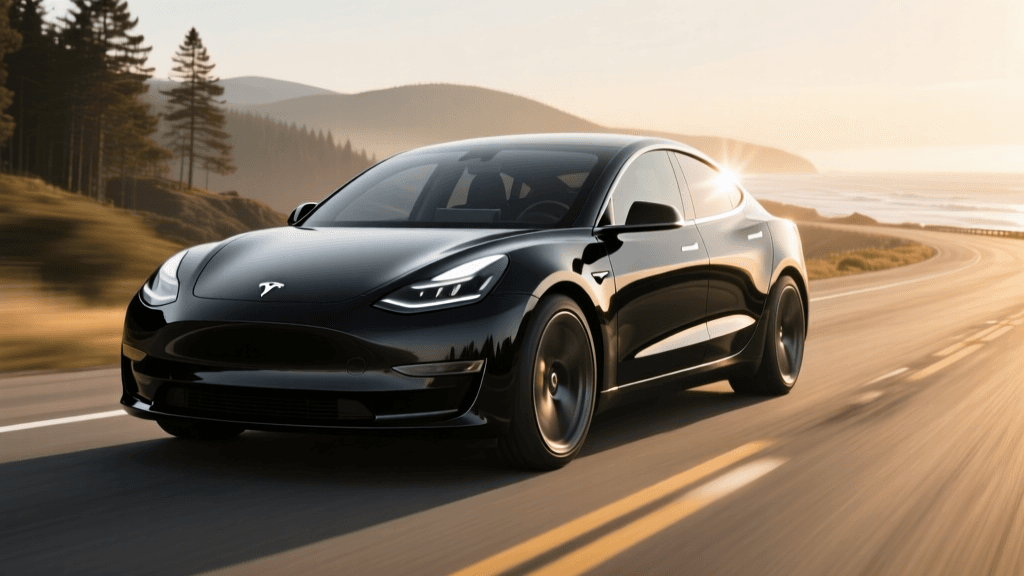
The Tesla Model 3 Long Range (Highland refresh) remains the benchmark against which all other electric sedans are measured. Achieving an EPA-estimated range of 341 miles and an efficiency rating of 132 MPGe (3.9 mi/kWh), the Model 3 balances range, performance, and charging infrastructure access better than almost any other vehicle on the road. Tesla's industry-leading powertrain efficiency and advanced thermal management system allow the Model 3 to minimize energy loss during both propulsion and regenerative braking. While its drag coefficient of 0.219 is slightly higher than the Ioniq 6, Tesla's software optimization and motor efficiency more than make up the difference. Furthermore, as verified by the extensive Car and Driver EV Range Test, the Model 3 exhibits excellent range retention at sustained highway speeds of 75 mph, a critical metric for long-distance travel that separates good EVs from great ones.
4. BMW i4 eDrive40 (The Luxury Cruiser)
The BMW i4 eDrive40 represents the traditional luxury sedan's successful transition to electrification. While it does not chase absolute efficiency records like the Ioniq 6 or the Lucid Air, it offers a compelling blend of range, build quality, and driving dynamics. Equipped an 83.9 kWh battery pack, the i4 eDrive40 delivers an EPA-estimated range of 301 miles and an efficiency rating of 109 MPGe (3.2 mi/kWh). The i4 is built on a shared platform with internal combustion vehicles, which results in a slightly heavier curb weight and a less optimal drag coefficient of 0.24 compared to dedicated EV architectures. However, BMW's fifth-generation eDrive technology is remarkably smooth and predictable. For buyers who prioritize traditional luxury, acoustic refinement, and analog driving feel over absolute maximum efficiency, the i4's data profile remains highly competitive and respectable within the premium segment.
Comparative Data Table: Efficiency vs. Range
The following table summarizes the critical data points for each sedan, highlighting the direct correlation between aerodynamic efficiency, battery size, and total EPA range.
| Vehicle Model | Battery Capacity (kWh) | Drag Coefficient (Cd) | EPA Range (Miles) | Efficiency (MPGe) |
|---|---|---|---|---|
| Lucid Air Grand Touring | 112.0 | 0.20 | 516 | 131 |
| Hyundai Ioniq 6 SE LR | 77.4 | 0.21 | 361 | 140 |
| Tesla Model 3 LR | 79.0 (est) | 0.219 | 341 | 132 |
| BMW i4 eDrive40 | 83.9 | 0.24 | 301 | 109 |
Real-World Variables: Temperature and Highway Speeds
While EPA data provides an excellent baseline, a true data-driven analysis must account for real-world variables that drastically alter EV sedan efficiency. The most significant factor is ambient temperature. Lithium-ion batteries experience increased internal resistance in cold weather, and the energy required to heat the cabin can reduce an EV's effective range by 20% to 30%. Sedans equipped with highly efficient heat pumps, such as the Tesla Model 3 and Hyundai Ioniq 6, mitigate this loss significantly better than older resistance-based heating systems.
Another critical variable is highway speed. Aerodynamic drag increases with the square of velocity, meaning that driving at 80 mph requires exponentially more energy than driving at 65 mph. This is where the Lucid Air and Hyundai Ioniq 6 shine; their ultra-low drag coefficients allow them to retain a higher percentage of their EPA range at sustained interstate speeds compared to bluffier or less aerodynamic sedans.
Actionable Advice for Maximizing Sedan Efficiency
To extract the maximum possible range from your electric sedan, apply the following data-backed strategies:
- Optimize Tire Pressure: Under-inflated tires increase rolling resistance. Check your tire pressure monthly and inflate to the exact PSI listed on the driver's door jamb, as even a 3 PSI drop can reduce efficiency by up to 2%.
- Utilize One-Pedal Driving: Maximize regenerative braking by using the highest regen setting in stop-and-go traffic. This recaptures kinetic energy that would otherwise be lost as heat through the friction brakes.
- Precondition the Cabin: While plugged into a Level 2 charger, use your vehicle's smartphone app to precondition the cabin temperature. This draws power from the grid rather than the battery pack, preserving your total range for the drive ahead.
- Manage Highway Speeds: When range anxiety strikes on a long road trip, dropping your cruising speed from 75 mph to 65 mph can increase your effective range by 15% to 20%, easily bridging the gap to the next charging station.
Final Verdict: Which EV Sedan Wins?
The data clearly illustrates that the electric sedan market has matured into a highly competitive arena where engineering efficiency is just as important as raw battery size. If your primary metric is absolute, uncompromising range and you have the budget for it, the Lucid Air Grand Touring is a mathematical masterpiece that redefines what is possible in a four-door vehicle. However, for the vast majority of buyers, the Hyundai Ioniq 6 SE Long Range offers the best efficiency-to-cost ratio on the market, delivering exceptional MPGe numbers thanks to its brilliant aerodynamic profile. Meanwhile, the Tesla Model 3 Long Range remains the safest, most well-rounded bet, offering a perfect equilibrium of efficiency, range, and Supercharger network reliability. By focusing on the hard data rather than marketing narratives, you can confidently select the electric sedan that best aligns with your specific driving patterns and efficiency goals.