Quick Answer: Is a Light EV Right for You?
A light EV — typically a subcompact or compact electric car with a 40–65 kWh battery, 200–300 miles of EPA range, and a curb weight under 4,000 lbs — is ideal if you drive under 100 miles daily, have access to home or workplace Level 2 charging, and want to minimize operating costs. Models like the 2026 Chevrolet Bolt EV (EPA 259 mi, ~$28,900 MSRP) and 2026 Nissan Leaf (EPA 212–226 mi, ~$29,230 MSRP) offer the lowest cost-per-mile in the EV market. However, if you regularly road-trip over 300 miles, live in an apartment without charging access, or face extreme cold climates, a plug-in hybrid or long-range EV may serve you better.
What Exactly Qualifies as a Light EV?
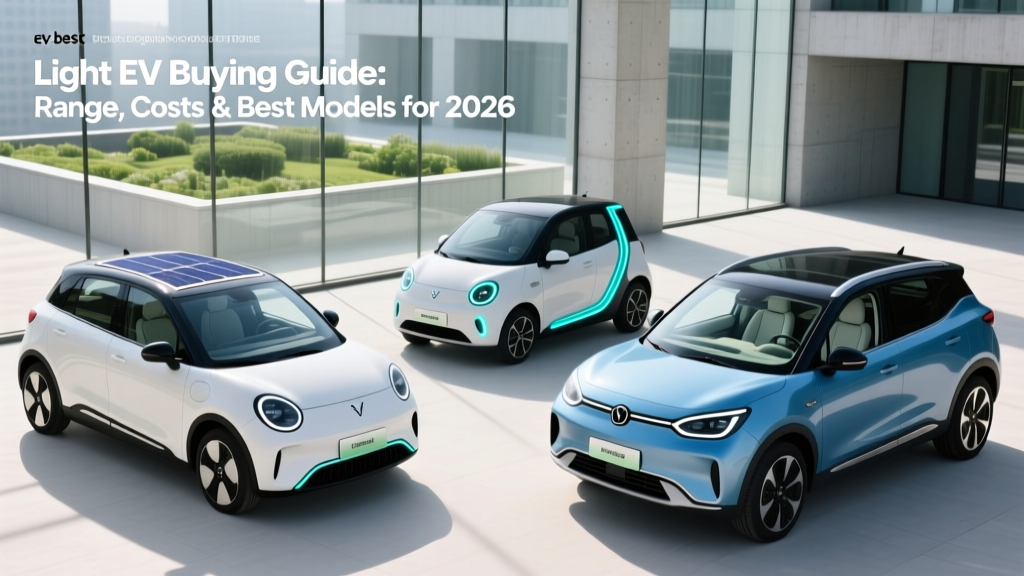
The term "light EV" isn't an official EPA classification, but in the market it refers to electric vehicles built on compact or subcompact platforms with smaller battery packs (40–65 kWh usable capacity) and lower curb weights than midsize electric SUVs or trucks. Think of them as the electric equivalents of the Honda Civic or Toyota Corolla — efficient, practical for daily commuting, and more affordable than larger electric vehicles.
Key characteristics of light EVs in the 2026 market:
- Battery capacity: 40–65 kWh (typically NMC or LFP chemistry)
- EPA range: 200–310 miles
- Curb weight: 3,200–3,900 lbs (compared to 4,500–5,500 lbs for electric SUVs)
- MSRP range: $27,000–$38,000 before incentives
- DC fast charging: 50–150 kW peak (10–80% in 25–40 minutes)
- Energy efficiency: 110–140 MPGe combined
The lighter weight matters for efficiency. A 3,500-lb light EV with a 60 kWh battery will achieve more miles per kWh than a 5,000-lb electric SUV with an 85 kWh battery, even though the SUV carries more total energy. Physics favors lighter vehicles: less mass means less energy spent accelerating and less brake wear thanks to regenerative braking.
Light EV vs Gas Car vs Hybrid: The Numbers
The strongest argument for a light EV is operating cost. Here's how a typical light EV stacks up against a comparable gas compact and a hybrid over five years and 75,000 miles of driving.
| Cost Factor | Light EV (e.g., Bolt EV) | Gas Compact (e.g., Civic) | Hybrid (e.g., Prius) |
|---|---|---|---|
| MSRP (base) | $28,900 | $24,900 | $28,550 |
| Federal tax credit (§30D) | Up to $7,500* | $0 | Up to $7,500* (PHEV trims) |
| Effective purchase price | ~$21,400 | $24,900 | ~$21,050 (PHEV) |
| Fuel/energy cost (75k mi) | $2,250–$3,750 | $7,500 | $4,500 |
| Maintenance (75k mi) | $900–$1,200 | $2,800–$3,500 | $2,200–$2,800 |
| Insurance (5-yr avg) | $7,200–$8,500 | $6,000–$7,200 | $6,200–$7,500 |
| 5-yr total cost | $31,750–$34,850 | $41,200–$43,100 | $33,950–$36,850 |
*Federal §30D credit eligibility depends on MSRP caps, buyer income limits, battery sourcing requirements, and vehicle assembly location. Check current rules at IRS.gov. Credit can now be transferred at point of sale as an upfront discount.
The data makes the case clear: a light EV with the federal tax credit becomes the cheapest vehicle to own over five years, even accounting for slightly higher insurance premiums. The fuel savings alone — roughly $3,750–$5,250 over 75,000 miles compared to gas — offset the EV's higher base price. Maintenance savings come from eliminating oil changes, transmission fluid, spark plugs, and most brake replacements (regenerative braking handles the majority of deceleration, extending pad life to 100,000+ miles in many cases).
However, the hybrid wins if you lack home charging. A Prius PHEV gives you 44 miles of electric-only range for daily commuting (covering most round trips) plus a gas engine for road trips — no charging infrastructure required.
Real-World Range: What the EPA Sticker Doesn't Tell You
EPA range estimates for light EVs are calculated under controlled laboratory conditions. Real-world range depends on speed, temperature, terrain, and driving style. Here's what to expect from a typical 250-mile EPA-rated light EV:
Real-World Range Expectations (250 mi EPA Baseline)
- City/suburban driving (30–45 mph): 240–270 mi — regenerative braking recovers energy in stop-and-go traffic
- Highway driving (70–80 mph): 190–220 mi — aerodynamic drag increases exponentially with speed
- Cold weather (below 32°F / 0°C): 150–195 mi — battery chemistry slows, cabin heating draws 2–5 kW continuously
- Hot weather with A/C (above 95°F / 35°C): 215–240 mi — climate control draws 1–3 kW
- Mountain driving (significant elevation gain): 160–200 mi uphill, partially recovered on descent via regen
Source: fueleconomy.gov and real-world owner testing data.
The cold-weather penalty is the biggest surprise for first-time EV buyers. Lithium-ion batteries operate less efficiently below freezing, and resistive cabin heating (or even a heat pump) consumes significant energy. If you live in Minnesota, Montana, or northern New England, plan for a 25–40% range reduction in January. A light EV rated at 250 miles EPA may deliver only 160 miles on a 10°F day at highway speeds.
This matters for trip planning. If your daily commute is 40 miles round-trip, even a cold-weather-reduced 160-mile range leaves plenty of buffer. But if you're planning a 200-mile one-way trip in winter, you'll need a DC fast-charging stop — and that's where charging infrastructure becomes critical.
Charging a Light EV: Home, Work, and Public Networks
Light EVs typically accept slower DC fast-charging rates than premium long-range EVs. Here's what to expect across charging levels:
| Charging Level | Power (kW) | Miles Added per Hour | Typical Use Case |
|---|---|---|---|
| Level 1 (120V household outlet) | 1.0–1.4 kW | 3–5 mi/hr | Overnight trickle for low-mileage drivers |
| Level 2 (240V home/public) | 7.2–11.5 kW | 25–40 mi/hr | Primary home charging; full charge in 6–9 hours |
| DC Fast Charge (CCS/NACS) | 50–150 kW peak | 150–350 mi/hr (peak) | Road trips; 10–80% in 25–40 min |
A critical concept: kW is power (how fast energy flows), while kWh is energy (how much the battery holds). A 60 kWh battery charged at 7.2 kW (Level 2) takes roughly 8.3 hours from empty to full. At 100 kW DC fast charge, the same battery could theoretically fill in 36 minutes — but charging speed tapers significantly above 80% State of Charge to protect battery health.
Home Level 2 installation costs:
| Item | Cost Range |
|---|---|
| Level 2 charger hardware (40A–48A) | $350–$700 |
| Electrician labor (240V circuit, 50A breaker) | $500–$1,500 |
| Electrical panel upgrade (if needed, 100A → 200A) | $1,500–$3,500 |
| Permit and inspection | $50–$250 |
| Total (no panel upgrade) | $900–$2,450 |
| Total (with panel upgrade) | $2,400–$5,950 |
If you live in a single-family home with a garage or driveway, Level 2 home charging is straightforward and transforms EV ownership. You plug in at night and wake up to a full battery every morning — no gas station visits. The average US electricity rate of ~$0.16/kWh means a full 60 kWh charge costs about $9.60, delivering 250 miles of range at roughly $0.038 per mile.
Apartment dwellers face a harder reality. Without a dedicated parking spot with electrical access, you're dependent on public Level 2 chargers (often $0.25–$0.49/kWh) or DC fast chargers ($0.30–$0.60/kWh). At $0.45/kWh, that same 60 kWh charge costs $27 — still cheaper than gas, but the convenience gap widens. Before buying any EV, confirm your charging situation. A light EV without reliable charging access becomes a burden, not a savings.
Tax Credits, Incentives, and the True Purchase Price
The federal §30D Clean Vehicle Credit can reduce a light EV's effective price by up to $7,500, but eligibility is not automatic. Here's the current checklist:
Federal §30D Tax Credit Requirements (2026)
- MSRP cap: Vans, SUVs, and pickup trucks ≤ $80,000; sedans and other vehicles ≤ $55,000 (most light EVs qualify)
- Buyer income cap: Modified AGI ≤ $150,000 (single), $225,000 (head of household), $300,000 (married filing jointly)
- Battery sourcing: Increasing percentages of critical minerals and battery components must be sourced from the US or free-trade-agreement countries; vehicles with foreign entities of concern (FEOC) battery components are disqualified
- Final assembly: Vehicle must be assembled in North America
- Point-of-sale transfer: Buyers can transfer the credit to the dealer at purchase, receiving it as an upfront price reduction rather than waiting for tax filing
Verify eligibility for your specific vehicle at fueleconomy.gov and consult a tax professional for your personal situation.
Many light EVs — including the Chevrolet Bolt EV and certain Nissan Leaf trims — qualify for the full $7,500 credit when all sourcing and income requirements are met. This can drop a $28,900 Bolt to an effective $21,400, making it one of the cheapest new cars available in the US market, period.
State incentives stack on top. California's CVRP program (income-dependent), Colorado's $5,000 state credit, and various utility rebates for home charger installation can further reduce costs. However, these programs change frequently and have funding caps — always check your state's energy office or utility provider for current availability.
Common Light EV Misconceptions — Addressed with Data
| Myth | Fact |
|---|---|
| "EV batteries need replacement every 5 years and cost $20,000" | Modern EV batteries are warrantied for 8 years/100,000 miles (federally mandated minimum). Data from NHTSA and fleet operators shows average degradation of 10–15% over 150,000 miles. Full replacement is rare and costs $5,000–$9,000 for light EV battery packs (smaller packs = lower replacement cost). |
| "Light EVs can't handle road trips" | A 250-mile EPA light EV with 100 kW DC fast charging can add ~150 miles in 20 minutes. Plan stops at Electrify America, EVgo, or Tesla Supercharger (NACS-equipped) stations and a 400-mile trip takes ~6 hours including one charge stop — manageable for most drivers. |
| "EVs are worse for the environment because of battery mining" | Lifecycle analyses from Argonne National Laboratory show EVs produce 50–70% fewer emissions over their lifetime than gas cars, even accounting for battery manufacturing. The emissions advantage grows as the grid decarbonizes. |
| "Charging takes too long" | Home Level 2 charging happens while you sleep — zero active time. DC fast charging on road trips takes 20–35 minutes for 10–80%, comparable to a rest stop for food and bathroom. |
| "Light EVs aren't safe because they're small" | EV platforms have low centers of gravity (battery under floor), reducing rollover risk. Check IIHS ratings — many light EVs earn Top Safety Pick designations. |
Decision Framework: Should You Buy a Light EV?
Choose a Light EV If:
- You drive under 100 miles per day (covers 90%+ of US commuters)
- You have access to home or workplace Level 2 charging
- You qualify for the federal §30D tax credit (income under $150k single / $300k joint)
- You want the lowest possible cost-per-mile for daily transportation
- Your climate is moderate, or you accept a 25–40% winter range reduction
- You don't regularly tow or carry more than 4 passengers
Choose a Long-Range EV or PHEV Instead If:
- You drive over 150 miles daily or frequently take 300+ mile road trips
- You live in an apartment with no charging access and public chargers are sparse
- You regularly face sub-freezing temperatures and need 200+ miles of real winter range
- You need towing capacity (3,500+ lbs) or third-row seating
- You don't qualify for federal or state incentives due to income or vehicle sourcing rules
Frequently Asked Questions
What's the cheapest light EV available in 2026?
The 2026 Chevrolet Bolt EV starts at approximately $28,900 MSRP and qualifies for the full $7,500 federal tax credit for eligible buyers, bringing the effective price to ~$21,400. The Nissan Leaf S starts around $29,230 with 212 miles of EPA range. Both are significantly cheaper than midsize electric SUVs starting at $40,000+.
How long does it take to charge a light EV at home?
With a Level 2 home charger (7.2 kW), a 60 kWh battery charges from empty to full in approximately 8–9 hours. Most drivers plug in overnight and never deplete the battery fully — if you use 30% of the battery during the day (about 75 miles), recharging takes roughly 2.5 hours. Level 1 (standard 120V outlet) adds only 3–5 miles per hour and is best suited for drivers covering under 30 miles daily.
Will a light EV's battery last the life of the car?
Federal law mandates that EV batteries carry a warranty of at least 8 years or 100,000 miles (10 years/150,000 miles in CARB states like California). Real-world data shows modern LFP and NMC batteries lose approximately 1–2% capacity per year under normal use. After 10 years, expect 80–90% of original capacity — meaning a 250-mile EV might deliver 200–225 miles. That's still practical for daily driving.
Can I use a light EV as my only car?
For most households, yes — if you have home charging. A 250-mile range covers the vast majority of daily needs, and DC fast charging handles road trips with brief stops. The exception is households that frequently tow, carry large cargo, or drive 300+ miles in a single day without time for a charging stop. For those cases, a two-car household with one EV for commuting and one gas/hybrid for long trips is a practical solution.
Do light EVs qualify for HOV lane access?
In many states, yes. California, Colorado, Virginia, and several other states offer HOV lane stickers or plates for EVs, including light EVs. California's Clean Air Vehicle decal program has specific income and vehicle requirements that change annually — check your state's DMV for current rules.