Why a Level 2 Charger for Tesla Changes Your Ownership Experience
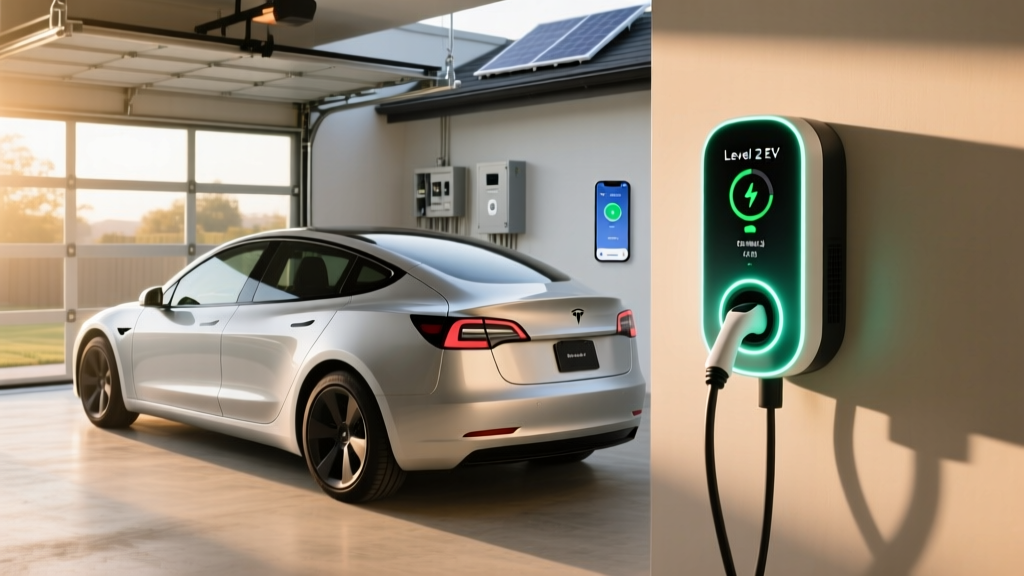
Plugging into a standard 120V outlet (Level 1) adds roughly 3–5 miles of range per hour to a Tesla Model Y or Model 3. For a 75 kWh battery, that means a full recharge could take over 20 hours. A Level 2 charger operating on a 240V circuit delivers 7–11.5 kW of power, replenishing 25–44 miles of range per hour and cutting a full charge to 6–10 hours. For Tesla owners who drive 30–50 miles daily, overnight Level 2 charging means waking up with a full battery every morning — no public charging stops required.
This guide breaks down exactly what you need to install a Level 2 charger for your Tesla at home: electrical requirements, real costs, the best hardware on the market in 2026, and how NACS (North American Charging Standard) compatibility works across the EV landscape.
Charging Levels Explained: Speeds, Power, and Range Added
Before choosing equipment, understand the three charging tiers available to Tesla owners. The critical distinction: kW (kilowatts) measures power — how fast energy flows into your car. kWh (kilowatt-hours) measures energy — how much your battery holds. A 75 kWh battery charged at 11.5 kW takes roughly 6.5 hours from empty to full.
| Level | Voltage | Power (kW) | Miles of Range/Hour | Typical Use Case |
|---|---|---|---|---|
| Level 1 | 120V AC | 1.0–1.4 kW | 3–5 mi/hr | Emergency/trickle; low-mileage drivers |
| Level 2 | 240V AC | 3.3–11.5 kW | 14–44 mi/hr | Home daily charging; workplace |
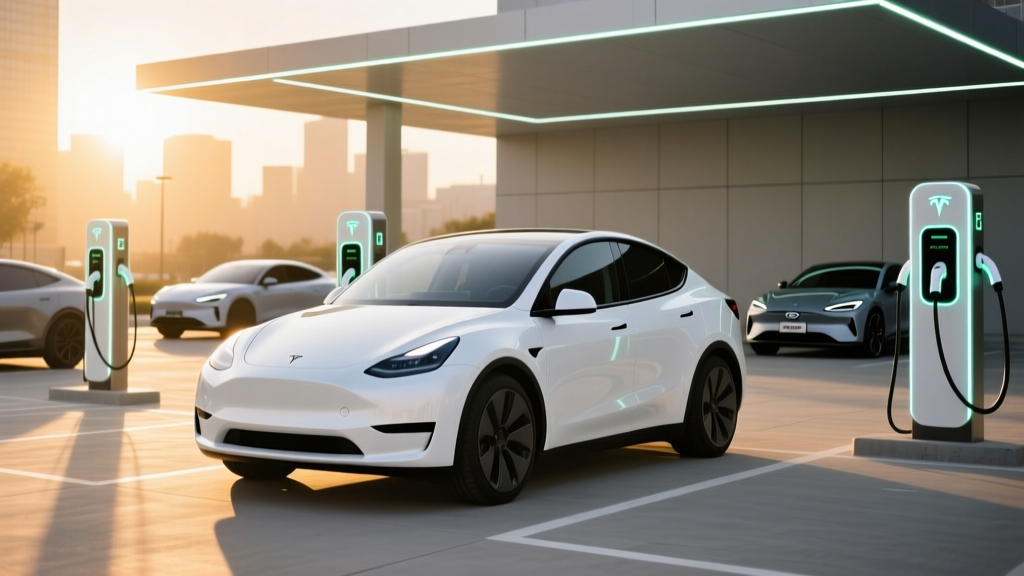
| DC Fast (Supercharger) | 400–800V DC | 50–250+ kW | 150–1,000+ mi/hr | Road trips; rapid top-ups |
Tesla's onboard charger (the hardware inside the car that converts AC to DC) maxes out at 11.5 kW on current Model 3 and Model Y vehicles. That means even if you install a 19.2 kW wall connector, your Tesla will only draw 11.5 kW. There's no benefit to oversizing the charger beyond what your vehicle can accept.
Electrical Requirements: What Your Home Needs
A Level 2 charger requires a dedicated 240V circuit — the same voltage your electric dryer or oven uses. The amperage of that circuit determines your charging speed:
- 40-amp circuit → 32 amps continuous draw → 7.7 kW → ~30 mi/hr (most common residential setup)
- 50-amp circuit → 40 amps continuous → 9.6 kW → ~37 mi/hr
- 60-amp circuit → 48 amps continuous → 11.5 kW → ~44 mi/hr (matches Tesla's max onboard rate)
National Electrical Code (NEC) requires that continuous loads (anything running 3+ hours, which includes EV charging) use only 80% of a circuit's rated capacity. A 60-amp breaker therefore delivers 48 amps to the car.
Does Your Panel Need an Upgrade?
Most modern homes with a 200-amp electrical panel can accommodate a 40–60 amp EV circuit without a panel upgrade. However, if your home has a 100-amp panel, or your existing loads (HVAC, electric range, dryer, water heater) are already consuming significant capacity, you may need:
- Panel upgrade from 100A to 200A: $1,500–$3,500
- Load management device (e.g., Emporia Smart Load Manager): $200–$500 installed, avoids a panel upgrade by dynamically limiting charger draw when other appliances are running
- Sub-panel installation if the charger is far from the main panel: $300–$800
How Much Does It Cost to Install a Home Level 2 Charger?
Total installed cost varies dramatically based on your home's electrical setup, the distance from panel to charger location, and local labor rates. Here's a realistic breakdown based on 2026 national averages:
| Component | Basic Install (Near Panel) | Complex Install (Far Run / Upgrade) |
|---|---|---|
| Level 2 Charger (Equipment) | $400–$600 | $400–$700 |
| Electrician Labor (2–6 hrs @ $85–$150/hr) | $170–$450 | $510–$900 |
| Electrical Materials (conduit, wire, breaker) | $50–$150 | $200–$600 |
| Permit Fee | $50–$150 | $50–$200 |
| Panel Upgrade (if needed) | $0 | $1,500–$3,500 |
| Total Range | $670–$1,350 | $2,660–$5,900 |
Pro tip: Get at least three quotes from licensed electricians. Ask specifically whether the quote includes the permit and final inspection — some jurisdictions require both, and skipping them can void your homeowner's insurance coverage for electrical fires.
NACS Connector Compatibility: Tesla and Beyond
As of 2026, the NACS (North American Charging Standard) connector — originally Tesla's proprietary design — has become the dominant charging connector in North America. Ford, GM, Rivian, Volvo, Hyundai, and most other major automakers have adopted NACS for their new EVs. This means a Level 2 charger with a NACS plug will work natively with any current Tesla and an expanding range of non-Tesla EVs.
| Connector | Brands Using It | Adapter Needed for Tesla? |
|---|---|---|
| NACS (Tesla) | Tesla, Ford, GM, Rivian, Volvo, Hyundai, Kia (2025+) | None — native on Tesla |
| CCS1 | Legacy VW, BMW, older Ford/GM EVs | Tesla CCS adapter (~$175) or third-party |
| CHAdeMO | Nissan Leaf (legacy, phasing out) | No standard Tesla adapter available |
| J1772 | All non-Tesla EVs for Level 2 AC | Tesla includes J1772-to-NACS adapter with vehicle |
If you own only Teslas, buy a charger with a native NACS plug. If your household includes a non-Tesla EV that still uses CCS1 or J1772, consider a charger with a J1772 connector and use the adapter your Tesla came with — or invest in a dual-connector charger like the Emporia Vista with interchangeable cables.
Top Level 2 Chargers for Tesla in 2026
These are the chargers we recommend based on real-world testing, build quality, smart features, and value:
Tesla Wall Connector (Gen 4) — Best Overall for Tesla Owners
- Power Output: Up to 11.5 kW (48A on 60A circuit)
- Connector: NACS (native Tesla plug)
- Cable Length: 24 feet
- Smart Features: Wi-Fi enabled, over-the-air updates, Power-Sharing (link up to 6 units on one circuit), Tesla app integration
- Price: ~$475
- Why it wins: Seamless integration with the Tesla app, sleek design, and the ability to share a single circuit between two chargers if you park two Teslas side by side. Power-Sharing is a genuine innovation — two Wall Connectors on one 60-amp circuit will dynamically split the available amperage.
ChargePoint Home Flex (NACS) — Best for Multi-EV Households
- Power Output: Up to 12 kW (50A on 60A circuit); adjustable from 16A–50A via dip switches
- Connector: NACS (2025+ model) or J1772
- Cable Length: 23 feet
- Smart Features: ChargePoint app scheduling, Alexa/Google Home integration, detailed energy reporting, amperage adjustment without buying new hardware
- Price: ~$599
- Why it wins: The adjustable amperage is ideal if your circuit capacity is limited — set it to 32A on a 40A circuit today, reconfigure to 48A if you upgrade your panel later. The app ecosystem is the most mature in the industry.
Emporia Level 2 EV Charger — Best Budget Smart Charger
- Power Output: Up to 11.5 kW (48A); configurable down to 16A
- Connector: NACS or J1772 options available
- Cable Length: 24 feet
- Smart Features: Emporia app with real-time energy monitoring, solar integration (pair with Emporia Vue home energy monitor to charge only on excess solar), scheduling, load management
- Price: ~$399
- Why it wins: At under $400 with full smart features and solar-aware charging, this is the value leader. The solar integration is genuinely useful if you have rooftop panels — the charger draws only surplus solar energy, making your charging effectively free and carbon-neutral.
Charging Cost: Level 2 at Home vs. Gas vs. Public DC Fast
One of the strongest financial arguments for home Level 2 charging is the per-mile cost advantage. Here's how it compares in 2026 using national average energy prices:
| Scenario | Energy Cost | Cost per Mile (Model Y, 3.5 mi/kWh) | Annual Cost (12,000 mi) |
|---|---|---|---|
| Home Level 2 (national avg. $0.17/kWh) | $0.17/kWh | $0.049 | $583 |
| Home Level 2 (off-peak TOU rate $0.09/kWh) | $0.09/kWh | $0.026 | $309 |
| Public DC Fast (avg. $0.40/kWh) | $0.40/kWh | $0.114 | $1,371 |
| Tesla Supercharger (avg. $0.30/kWh) | $0.30/kWh | $0.086 | $1,029 |
| Gas car (28 MPG combined, $3.40/gal) | $3.40/gal | $0.121 | $1,457 |
A Tesla Model Y owner charging at home on an off-peak time-of-use (TOU) rate spends roughly $309 per year on electricity for 12,000 miles of driving. A comparable gas-powered SUV at 28 MPG costs $1,457 — that's a $1,148 annual savings. Even at standard residential rates, home charging saves over $870 per year.
Contact your utility about EV-specific TOU plans. Many utilities offer rates as low as $0.06–$0.10/kWh for charging between midnight and 6 AM. According to the U.S. Energy Information Administration, the national average residential electricity rate in late 2025 was approximately $0.17/kWh, but EV-specific plans can cut that nearly in half.
Charging Time Examples: What to Expect
Here's how long common Tesla models take to charge from 10% to 80% State of Charge (SoC) on a Level 2 charger at various power levels. Note: charging slows significantly above 80% to protect battery health — the 10–80% window is where most of the speed advantage lives.
| Vehicle | Battery (usable kWh) | At 7.7 kW (40A circuit) | At 11.5 kW (60A circuit) |
|---|---|---|---|
| Model 3 RWD | 57.5 kWh (LFP) | ~5.2 hours | ~3.5 hours |
| Model 3 Long Range | 75 kWh (NMC) | ~6.8 hours | ~4.6 hours |
| Model Y Long Range | 75 kWh (NMC) | ~6.8 hours | ~4.6 hours |
| Model S | 95 kWh (NMC) | ~8.6 hours | ~5.8 hours |
| Cybertruck AWD | 123 kWh (NMC) | ~11.2 hours | ~7.5 hours |
For daily driving of 30–50 miles, even a 40-amp circuit replenishes your used range in under 2 hours. The 60-amp circuit mainly benefits high-mileage drivers or Cybertruck owners who need to recover larger energy deficits overnight.
Safety, Code, and Installation Best Practices
EV charging is a high-draw, long-duration electrical load. Cutting corners here creates fire risk. Follow these requirements:
- Dedicated circuit: Your Level 2 charger must be on its own breaker — never shared with other outlets or appliances.
- GFCI protection: NEC 2023 and later require GFCI (Ground Fault Circuit Interrupter) protection for all EV charging receptacles. Hardwired chargers may not require a GFCI breaker in some jurisdictions — confirm with your inspector. Hardwiring also eliminates the plug/receptacle as a failure point.
- Outdoor rating: If your charger is installed outdoors (garage exterior, driveway), ensure it carries a NEMA 4 or IP65 weather rating. All three chargers recommended above are rated for outdoor use.
- Wire gauge: A 60-amp circuit requires 4 AWG copper wire (or 3 AWG aluminum) for runs up to 50 feet. Longer runs may require upsizing to prevent voltage drop. Your electrician will calculate this.
- Permit and inspection: Most jurisdictions require an electrical permit for a new 240V circuit. The inspection verifies wire gauge, breaker sizing, grounding, and GFCI compliance. Typical permit cost: $50–$200.
For detailed code requirements, the National Fire Protection Association's NEC page provides the current National Electrical Code standards that your local jurisdiction adopts.
Federal Tax Credits and Utility Rebates
The federal Alternative Fuel Vehicle Refueling Property Credit (IRS §30C) was available for home charger installation through prior years but has undergone changes for 2026. Check the IRS §30C page for current eligibility — the credit historically covered up to 30% of equipment and installation costs (max $1,000), but availability depends on your location (must be in an eligible census tract) and current-year legislation.
More reliably, many utilities and municipalities offer direct rebates for Level 2 charger purchases and installations. Common examples include $250–$500 equipment rebates and $200–$1,000 installation rebates, particularly if you enroll in a TOU rate plan. Check your utility's website or the Alternative Fuels Data Center for incentives in your ZIP code.
Frequently Asked Questions
Can I plug my Tesla into a regular household outlet?
Yes, using the Tesla Mobile Connector with the 120V adapter. However, Level 1 charging adds only 3–5 miles of range per hour. This works for low-mileage drivers (under 20 miles/day) or as an emergency backup, but a dedicated Level 2 installation is strongly recommended for daily use.
Do I need a Tesla Wall Connector, or can I use a third-party charger?
Any NACS-equipped Level 2 charger will work with your Tesla. The Tesla Wall Connector offers the deepest app integration and Power-Sharing capability, but ChargePoint, Emporia, and other NACS chargers deliver the same charging speed and reliability. Choose based on features you value — solar integration, energy monitoring, or smart-home compatibility.
Should I hardwire the charger or use a NEMA 14-50 receptacle?
Hardwiring is generally preferred: it eliminates the receptacle as a point of failure, may exempt you from GFCI breaker requirements in some jurisdictions (saving $50–$100 on the breaker itself), and provides a cleaner installation. A NEMA 14-50 outlet offers portability — you can take the charger with you if you move — but requires a GFCI breaker under current NEC rules and introduces a plug connection that can loosen or corrode over time.
Will a Level 2 charger degrade my Tesla's battery faster?
No. Level 2 AC charging is gentler on lithium-ion batteries than DC fast charging because it generates less heat. Battery degradation is primarily driven by sustained high State of Charge (above 90%), extreme temperatures, and frequent DC fast charging. For daily use, set your Tesla's charge limit to 80% (or 100% for LFP batteries, as Tesla recommends) and your battery will retain the vast majority of its capacity well beyond 150,000 miles.
What if my home only has a 100-amp electrical panel?
You have two options: upgrade to a 200-amp panel ($1,500–$3,500) or install a load management device that dynamically reduces charger amperage when other major appliances are running. Load management devices like the Emporia Smart Load Manager or the Tesla Gateway can allow a 40-amp EV circuit on a 100-amp panel without an upgrade, saving thousands. Your electrician can perform a load calculation to determine which path is appropriate.
Is a Level 2 charger worth it if I have free Supercharging?
Yes, for two reasons. First, home charging is far more convenient — plug in when you park, wake up full. No detours to Supercharger stations. Second, frequent DC fast charging (Supercharging) accelerates battery degradation compared to Level 2 AC charging. Reserve Superchargers for road trips and use Level 2 at home for daily needs to maximize long-term battery health.