Quick Answer: What Is the Largest Electric Vehicle You Can Buy?
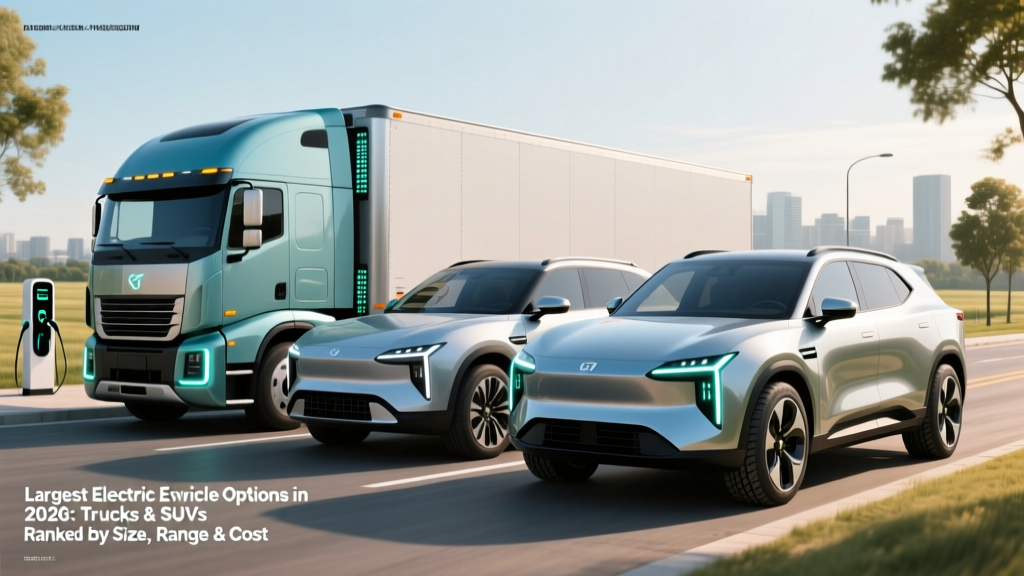
If you mean by sheer physical dimensions and curb weight, the GMC Hummer EV Pickup is the largest electric vehicle currently on sale in the U.S. — stretching 216.8 inches long, 86.7 inches wide (excluding mirrors), and weighing over 9,000 lbs in its top 3X trim. For the largest electric SUV, the GMC Hummer EV SUV and Rivian R1S (with its long-wheelbase option) lead the pack. If "largest" means maximum cargo and bed utility, the Chevrolet Silverado EV (233.1 inches in max-length Extended Cab configuration) offers the longest footprint of any production electric vehicle available in 2026.
Size alone doesn't tell the full story for buyers in the full-size electric truck and SUV segment. These vehicles push battery packs past 200 kWh, tow ratings above 10,000 lbs, and MSRPs well into six figures. Below, we break down every major contender by dimensions, range, charging performance, real-world ownership costs, and how they compare to their gas-powered equivalents.
Spec-by-Spec: The Largest Electric Vehicles Compared
The table below captures the key numbers buyers in this segment actually cross-shop. All figures reflect 2025–2026 model-year EPA data and manufacturer specifications where available.
| Vehicle | Length (in) | Curb Weight (lbs) | Battery (kWh usable) | EPA Range (mi) | Peak DC Charge (kW) | 10–80% Time | Max Tow (lbs) | Base MSRP |
|---|---|---|---|---|---|---|---|---|
| GMC Hummer EV Pickup 3X | 216.8 | ~9,046 | ~212 (NMC) | 329 | 350 | ~30 min | 7,500 | $106,400 |
| GMC Hummer EV SUV 3X | 195.6 | ~8,600 | ~170 (NMC) | 314 | 300 | ~28 min | 7,500 | $99,800 |
| Chevrolet Silverado EV 4WT | 233.1 | ~8,800 | ~200 (NMC) | 492 | 350 | ~25 min | 12,500 | $77,900 |
| Rivian R1S (Tri Motor, LWB) | 208.8 | ~7,100 | ~149 (NMC) | 410 | 220 | ~24 min | 7,700 | $99,900 |
| Ford F-150 Lightning (Ext. Range) | 232.7 | ~6,790 | 131 (NMC) | 320 | 150 | ~36 min | 10,000 | $69,995 |
Sources: EPA / fueleconomy.gov, manufacturer pressrooms. Range figures are EPA estimates; real-world results vary with speed, temperature, and payload.
Real-World Range: What the EPA Sticker Doesn't Tell You
EPA vs. Reality: Full-size electric trucks and SUVs suffer the widest gap between EPA estimates and actual delivered range of any EV category. Here's what to expect:
- Highway driving (75 mph): Expect 15–22% below EPA. The Silverado EV's 492-mile sticker drops to roughly 380–415 miles at sustained interstate speeds. Aerodynamic drag on a 6,800–9,000 lb box-shaped vehicle is immense.
- Cold weather (below 30°F): Add another 20–35% loss. A Hummer EV Pickup rated at 329 miles may deliver 215–260 miles in freezing conditions without a preconditioned battery.
- Towing: This is where range collapses. Towing a 7,000-lb trailer at highway speed can cut range by 45–55%. The F-150 Lightning's 320-mile EPA rating falls to roughly 145–170 miles while towing near its max capacity.
- Charging curve taper: Peak DC charge rates (e.g., 350 kW on the Hummer EV) are sustained only between ~10–40% SoC. Above 60%, rates drop sharply. Plan stops based on average charge rate, not peak.
Cost Breakdown: Purchase, Charging, and 5-Year Ownership
The largest electric vehicles command premium prices, but their operating costs diverge sharply from gas equivalents. Below is a 5-year / 75,000-mile ownership comparison using the Chevrolet Silverado EV vs. a comparably equipped gas Silverado 1500 (4.3L V6 / 5.3L V8) and the Ford F-150 Lightning vs. the gas F-150 (3.5L EcoBoost).
| Cost Category | Silverado EV 4WT | Gas Silverado 1500 (5.3L V8) | F-150 Lightning (Ext. Range) | Gas F-150 (3.5L EcoBoost) |
|---|---|---|---|---|
| Base MSRP | $77,900 | $48,200 | $69,995 | $49,150 |
| Federal Tax Credit (§30D) | Up to $7,500* | $0 | Up to $7,500* | $0 |
| 5-Yr Fuel / Energy Cost | ~$5,400 (home L2 avg) | ~$14,200 (18 mpg, $3.40/gal) | ~$5,800 | ~$13,600 (20 mpg, $3.40/gal) |
| 5-Yr Maintenance | ~$2,200 | ~$5,100 | ~$2,400 | ~$4,900 |
| 5-Yr Insurance (avg) | ~$11,500 | ~$8,800 | ~$10,200 | ~$8,500 |
| Est. 5-Yr Total Cost | ~$91,600 | ~$76,300 | ~$80,895 | ~$76,150 |
*§30D eligibility depends on buyer income caps ($150K single / $300K joint), MSRP caps ($80K for trucks), battery critical-mineral sourcing, and point-of-sale transfer. Verify current rules at IRS.gov. The Silverado EV 4WT at $77,900 falls under the $80K truck cap; higher trims may exceed it.
Key takeaway: Electric trucks save $7,000–$9,000 on fuel and maintenance over five years, but the upfront price premium ($20,000–$30,000 before credits) means total cost parity is difficult to achieve unless you drive high annual mileage (20,000+ miles/year) or benefit from state-level incentives on top of the federal credit.
Home Charging: The Make-or-Break Factor for Large EVs
The largest electric vehicles carry battery packs ranging from 131 to 212 kWh. That capacity creates a home-charging math problem many first-time buyers underestimate.
| Charging Level | Power (kW) | Miles Added Per Hour | Full Charge Time (200 kWh pack) |
|---|---|---|---|
| Level 1 (120V standard outlet) | 1.4 kW | ~3–4 mi/hr | ~140+ hours (impractical) |
| Level 2 (240V, 48A circuit) | 11.5 kW | ~28–35 mi/hr | ~17–18 hours |
| Level 2 (240V, 80A circuit) | 19.2 kW | ~48–55 mi/hr | ~10–11 hours |
| DC Fast Charge (350 kW peak) | 350 kW | ~600+ mi/hr (peak) | 10–80% in ~25–30 min |
The real-world implication: If you drive a Hummer EV Pickup with its 212 kWh battery and arrive home at 10% SoC, a standard 48A Level 2 charger needs roughly 17–18 hours to reach full. That means overnight charging only gets you to ~70–75% unless you install an 80A circuit (requiring a 100A breaker and likely a panel upgrade).
Home Level 2 Installation Cost Estimate (240V / 48–80A)
| Component | Typical Cost Range |
|---|---|
| Level 2 charger hardware (48A–80A) | $500–$1,200 |
| Electrical panel upgrade (200A → 400A, if needed) | $2,000–$5,000 |
| Wiring, conduit, breaker (50–100 ft run) | $800–$2,500 |
| Licensed electrician labor | $1,500–$3,500 |
| Permits and inspection | $100–$400 |
| Total (typical) | $1,500–$12,000+ |
Always get a site-specific quote from a licensed electrician. Many homes built before 2010 have 100A or 150A panels that cannot support an 80A EV circuit without a full service upgrade.
For buyers without home charging access — apartment dwellers, street parkers, or those in condos with no charging infrastructure — owning a 9,000-lb electric truck with a 200 kWh battery is significantly harder. Public DC fast charging at $0.35–$0.55/kWh means a full Hummer EV charge costs $70–$115, and doing this weekly adds up fast.
EV vs. Gas Trucks: Towing, Payload, and Daily Driving Trade-Offs
| Factor | Electric Trucks (Silverado EV / F-150 Lightning / Hummer EV) | Gas Trucks (Silverado 1500 / F-150) |
|---|---|---|
| Towing capacity | 7,500–12,500 lbs (Silverado EV leads) | 9,000–14,000 lbs (gas still leads at max config) |
| Range while towing | 100–180 mi (severely reduced) | 300–450 mi (refueling in 5 min) |
| Daily commuting cost | $0.08–$0.14/mi (home charging) | $0.17–$0.22/mi |
| Frunk / cargo flexibility | Yes — front trunk adds 5–10 cu ft secure storage | No — engine occupies front bay |
| Off-grid / remote power | V2L / V2H available (power tools, appliances, home backup) | Limited 120V bed outlets, no home backup |
| Refueling/charging in remote areas | DC fast chargers sparse in rural regions | Gas stations ubiquitous |
| Cold-weather starting | Instant start, no engine cranking; range reduced | Engine cranking in extreme cold; range unaffected |
The honest assessment: if your primary use case involves frequent long-distance towing (over 200 miles one-way), a gas or diesel truck remains the more practical choice in 2026. Charging infrastructure along rural towing corridors is still developing, and a 45-minute DC fast-charge stop every 120 miles while towing is a significant time penalty.
However, if your truck serves as a daily commuter, weekend hauler, and job-site power source — with towing limited to shorter trips — the electric option delivers lower running costs, instant torque for merging and hill starts, and vehicle-to-load capability that gas trucks can't match.
Common Misconceptions About the Largest Electric Vehicles
| Myth | Fact |
|---|---|
| "A bigger battery means I'll never worry about range." | A 212 kWh battery (Hummer EV) is massive, but towing and highway speeds consume energy at 3–4× the rate of city driving. Real-world highway range at 75 mph can be 250 miles or less in cold weather. |
| "These trucks charge just as fast as a Tesla." | Peak charge rate (kW) matters, but charging a 200+ kWh pack from 10–80% takes 25–35 minutes even at 350 kW. A Tesla Model Y with an 82 kWh pack fills 10–80% in roughly 15–18 minutes at 250 kW. Larger batteries take longer in absolute time. |
| "The $7,500 federal tax credit applies to all electric trucks." | The §30D credit has an $80,000 MSRP cap for trucks/vans/SUVs, buyer income limits, and battery-sourcing requirements that change annually. Many top-trim electric trucks exceed $80K and may not qualify. Always check IRS guidelines before purchasing. |
| "I don't need a home charger — public charging is everywhere now." | Public DC fast-charger density has improved, but reliability remains inconsistent. Studies show 15–20% of public charging sessions encounter hardware or payment issues. For a 200 kWh battery, relying on public charging also costs 2–4× more per mile than home Level 2. |
| "Electric trucks can't handle real work." | The Silverado EV tows 12,500 lbs and the F-150 Lightning tows 10,000 lbs — both competitive with half-ton gas trucks. The limitation isn't capability; it's range under load and charging logistics on long hauls. |
Decision Framework: Which Largest Electric Vehicle Fits You?
Choose Based on Your Primary Use Case
Choose the GMC Hummer EV Pickup if: You want maximum physical size, the Watts to Freedom launch mode (0–60 in ~3.0 seconds with 1,000 hp), and CrabWalk diagonal driving as a trail-capability feature — and you accept the $100K+ price, 9,000-lb curb weight, and 329-mile EPA range that shrinks sharply under load.
Choose the Chevrolet Silverado EV 4WT if: Maximum range (492 miles EPA) and highest towing capacity (12,500 lbs) are your priorities, and you need a true work truck with a functional midgate for extended bed length. At ~$78K base, it's the most value-oriented option in this size class.
Choose the Rivian R1S (Tri Motor, LWB) if: You need a three-row electric SUV with genuine off-road capability (14.9 inches of ground clearance), a 410-mile range, and access to the Rivian Adventure Network. Best for families who want the largest electric SUV with premium interior quality and over-the-air updates.
Choose the Ford F-150 Lightning if: You want the most affordable entry point into a full-size electric truck ($69,995 for Extended Range), Pro Power Onboard for job-site use, and the broadest dealer service network. Range (320 miles) is the lowest in this group, making it best for regional rather than cross-country use.
Stick with a gas or hybrid truck if: You regularly tow over 200 miles one-way, operate in rural areas with sparse DC fast-charging, or need sub-$50K pricing. The gas F-150 and Silverado 1500 remain the pragmatic choice for long-haul towing and remote-area work in 2026.
First-Time EV Buyer Checklist for Large Electric Trucks & SUVs
- Verify your electrical panel: Before ordering, have a licensed electrician assess whether your home's panel can support a 48A or 80A Level 2 circuit. A 200+ kWh battery makes Level 2 a necessity, not a luxury.
- Calculate your real range: Take the EPA number and subtract 20% for highway driving, another 20–30% for cold climates, and 45–55% if towing. If the remaining number doesn't cover your typical trip, this vehicle may not fit your use case.
- Check §30D eligibility before signing: Confirm your AGI falls under the income cap ($150K single / $300K joint), the MSRP is under $80K (trucks), and the specific VIN qualifies for battery-sourcing requirements. Use the point-of-sale transfer option at a registered dealer if eligible.
- Budget for insurance: Full-size electric trucks carry 20–40% higher insurance premiums than their gas counterparts due to higher repair costs, battery replacement risk, and vehicle weight. Get a quote before committing.
- Test the charging network on your routes: Drive your most common long-distance route using PlugShare or A Better Routeplanner to verify DC fast-charger availability, connector compatibility (NACS vs. CCS), and charger power ratings.
- Understand battery warranty: Most manufacturers offer 8 years / 100,000 miles on the battery pack with a minimum 70% capacity retention guarantee. For a $20,000+ replacement cost out of warranty, this coverage matters.
Frequently Asked Questions
What is the heaviest electric vehicle on sale in 2026?
The GMC Hummer EV Pickup in 3X trim weighs approximately 9,046 lbs — making it the heaviest production passenger vehicle sold in the U.S. This mass impacts tire wear, braking distance, and energy consumption. For comparison, a gas Ford F-150 weighs roughly 4,700–5,700 lbs depending on configuration.
Can the largest electric vehicles tow a camper long-distance?
They can tow campers, but long-distance towing remains their biggest limitation. Towing a 6,000–8,000 lb travel trailer at highway speed typically cuts EV range by 45–55%. A Silverado EV rated at 492 miles EPA may deliver only 220–270 miles while towing. Plan charging stops accordingly, and confirm that DC fast chargers along your route can accommodate a truck-and-trailer combination (many cannot without unhitching).
Do these large electric trucks qualify for the $7,500 federal tax credit?
It depends on the specific model, trim, MSRP, and your income. Under current IRS §30D rules, trucks must have an MSRP at or below $80,000, and buyer AGI must not exceed $150,000 (single) or $300,000 (joint). Battery critical-mineral and component sourcing requirements also apply and shift annually. The Silverado EV 4WT at $77,900 may qualify; the Hummer EV at $106,400 does not. Always confirm eligibility with a tax professional before purchase.
Is a hybrid truck a better option than a full EV for large vehicle buyers?
For buyers who need long-distance towing without range compromise, a hybrid like the Ford F-150 PowerBoost (hybrid, ~25 mpg combined) or the Toyota Tundra i-FORCE MAX (hybrid, ~22 mpg) offers a middle ground — improved fuel economy, no range anxiety while towing, and no charging dependency. However, hybrids don't offer V2L/V2H home backup power, have higher maintenance costs (engine + transmission), and don't qualify for the full §30D EV tax credit.
What's the cheapest way to own the largest electric vehicle?
The Ford F-150 Lightning at $69,995 (Extended Range) is the lowest-priced full-size electric truck in 2026. To minimize total cost: install a home Level 2 charger ($1,500–$4,000 if no panel upgrade is needed), charge overnight on off-peak utility rates ($0.08–$0.12/kWh), and confirm §30D eligibility for up to $7,500 off at point of sale. Lease deals may also pass through the commercial clean vehicle credit (§45W) even when purchase credit eligibility is uncertain — consult a tax professional.
How long do the batteries in large electric trucks last?
Current NMC (nickel manganese cobalt) battery packs in the Hummer EV, Silverado EV, and F-150 Lightning are warrantied for 8 years / 100,000 miles with a minimum 70% capacity retention threshold. Real-world degradation data from earlier EVs suggests these packs will retain 80–85% capacity at 150,000 miles with normal use. Replacement costs for a 200+ kWh pack are estimated at $20,000–$35,000 out of warranty, though prices are expected to decline as battery manufacturing scales.