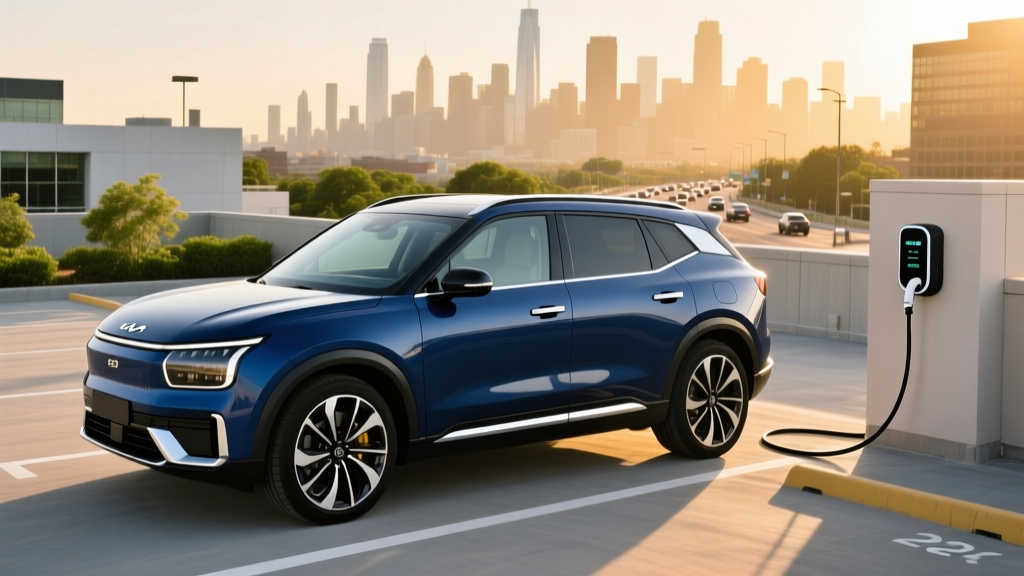
The Kia EV9 is one of the few three-row electric SUVs on the market, and for 2026, it's a frequent target of aggressive dealer incentives, lease pull-ahead offers, and federal tax credit eligibility. But before you sign on the dotted line, the real question isn't just the sticker price — it's what this 5,000-plus-pound electric hauler actually costs to own over five years. We ran the numbers on fuel, insurance, maintenance, depreciation, and incentives so you can evaluate Kia EV9 deals with full financial clarity.
2026 Kia EV9: Quick Spec Primer
Before dissecting ownership costs, here's what you're buying. The 2026 Kia EV9 rides on the Hyundai Motor Group E-GMP platform with an 800-volt architecture, meaning DC fast-charge capability that outpaces most competitors in this price bracket.
| Spec | Light Long Range (RWD) | GT-Line AWD |
|---|---|---|
| Battery (usable) | 99.8 kWh (NMC) | 99.8 kWh (NMC) |
| EPA Range | 304 miles | 270 miles |
| Real-World Range (highway 75 mph) | ~255–270 miles | ~225–240 miles |
| Peak DC Fast Charge | 236 kW | 236 kW |
| 10–80% DC Charge Time | ~24 minutes | ~24 minutes |
| Level 2 Charge Rate | 10.9 kW | 10.9 kW |
| Horsepower | 215 hp | 379 hp (boost) |
| 0–60 mph | 7.7 sec | 4.5 sec |
| MPGe (combined) | 88 MPGe | 83 MPGe |
| Starting MSRP | $54,900 | $73,900 |
| Battery/Powertrain Warranty | 10 yr / 100,000 mi | 10 yr / 100,000 mi |
Federal Tax Credit: Does the EV9 Qualify Under §30D?
The IRS §30D Clean Vehicle Credit offers up to $7,500 for qualifying new EVs, but eligibility hinges on several moving targets: buyer income, vehicle MSRP, battery component sourcing, and critical mineral requirements. As of the 2026 tax year, here's where the EV9 stands.
- MSRP Cap: SUVs/vans/pickups must be ≤ $80,000 MSRP. The EV9 Light, Wind, and Land trims qualify. The GT-Line AWD at $73,900 also qualifies. The GT-Line Prestige (if MSRP exceeds $80,000 with destination) may not — verify exact window sticker.
- Buyer Income Limits (MAGI): Married filing jointly: ≤ $300,000. Head of household: ≤ $225,000. Single/other: ≤ $150,000.
- Battery Sourcing: The $7,500 credit splits into two halves — $3,750 for battery components (must be manufactured/assembled in North America) and $3,750 for critical minerals (must be sourced from the US or a free-trade-agreement country). The EV9 is assembled in West Point, Georgia, and Kia has been progressively shifting battery supply chains. Check the DOE/EPA qualifying vehicle list for the specific trim's current credit amount — it may be $3,750 or $7,500 depending on the latest sourcing determinations.
- Point-of-Sale Transfer: Since 2024, you can transfer the credit to the dealer at purchase, reducing your out-of-pocket cost immediately rather than waiting to claim it on your tax return. This makes the EV9 effectively cheaper on day one.
- One Credit Per Vehicle, Per Taxpayer: You cannot claim the credit more than once per year for a new vehicle, and the vehicle must be for personal use, primarily in the US.
Bottom line on the credit: Many EV9 trims will qualify for at least $3,750, and potentially the full $7,500 — but the exact amount shifts as Kia's battery supply chain evolves. Confirm the specific trim's credit status at fueleconomy.gov before purchasing, and consult a tax professional for your personal eligibility.
5-Year Total Cost of Ownership: The Full Breakdown
This is where most "EV9 review" articles stop — at the sticker price minus the tax credit. But real ownership costs include electricity, insurance, maintenance, depreciation, and financing. Here's a data-driven 5-year / 75,000-mile projection for the EV9 Land AWD (MSRP ~$69,900), compared against a similarly priced three-row gas SUV (e.g., Kia Telluride SX-Prestige, MSRP ~$52,000).
| Category | Kia EV9 Land AWD | Kia Telluride SX-Prestige (Gas) |
|---|---|---|
| Purchase Price (MSRP + dest.) | $71,290 | $53,590 |
| Federal Tax Credit | –$3,750 to –$7,500 | $0 |
| Effective Purchase Price | $63,790–$67,540 | $53,590 |
| Fuel / Electricity (75k mi) | $4,875 (home) – $7,500 (public) | $10,125 |
| Maintenance (5 yr) | $1,100 | $3,400 |
| Insurance (5 yr avg.) | $12,500 | $8,750 |
| Depreciation (est. 5 yr) | $33,000–$38,000 | $22,000–$25,000 |
| Total 5-Year Cost (est.) | $115,265–$129,165 | $97,865–$100,865 |
| Cost Per Mile (all-in) | $1.54–$1.72 | $1.30–$1.35 |
Key takeaway: Even with the tax credit and fuel/maintenance savings, the EV9 costs roughly $15,000–$30,000 more over five years than a loaded Telluride, primarily due to higher purchase price, steeper depreciation, and elevated insurance premiums. The EV9 makes financial sense if you value the driving experience, zero tailpipe emissions, and home charging convenience — but it is not, in 2026, a pure cost-savings play against a mainstream gas three-row SUV.
Charging vs. Gasoline: Cost Per Mile in the Real World
Electricity costs vary enormously depending on where and when you charge. Here's the math using the EV9's real-world efficiency of approximately 2.8 kWh/mile (derived from its ~83–88 MPGe rating).
- EV9, home charging (avg. $0.16/kWh national residential rate): $0.045/mile
- EV9, home charging with time-of-use optimization ($0.09/kWh off-peak): $0.025/mile
- EV9, DC fast charging (avg. $0.48/kWh public rate): $0.134/mile
- Telluride (21 MPG combined, $3.15/gal avg. regular): $0.150/mile
Over 15,000 miles/year: home-charged EV9 costs ~$675/yr in electricity vs. ~$2,250/yr for gas. That's roughly $1,575/year in fuel savings — but only if you charge primarily at home. Exclusive public fast-charging erases the advantage entirely.
The lesson: home Level 2 charging is non-negotiable for EV9 economics. If you're relying on Electrify America or EVgo at $0.40–$0.55/kWh, your per-mile cost matches or exceeds gasoline. Factor a Level 2 home charger installation ($500–$2,000 depending on electrical panel capacity) into your year-one budget.
Maintenance Savings: Where the EV9 Actually Wins
This is the most clear-cut financial advantage of the EV9 over a gas three-row SUV. Electric motors have a fraction of the moving parts of an internal combustion engine, and regenerative braking dramatically reduces brake pad wear.
| Service Item | Kia EV9 | Kia Telluride (Gas) |
|---|---|---|
| Oil changes | $0 | $750 (5–6 changes) |
| Transmission fluid | $0 (no multi-speed trans) | $250 |
| Brake pads (front) | $0–$200 (regen extends life 2–3×) | $600 |
| Air filters (engine/cabin) | $80 (cabin only) | $200 |
| Coolant / spark plugs | $0 | $400 |
| Tire rotation / replacement | $1,800 (EV tires wear faster due to weight/torque) | $1,200 |
| Tire rotation / replacement | ||
| Total Estimated | ~$1,100–$1,500 | ~$3,400 |
Net maintenance savings over 5 years: ~$1,900–$2,300. The caveat is tires — the EV9's 5,500+ lb curb weight and instant torque chew through rubber faster than a gas SUV. Budget for a set of EV-rated touring tires (like the Michelin Pilot Sport EV or Hankook iON evo) around $1,200–$1,600 at 35,000–45,000 miles.
Insurance: The Uncomfortable Reality
EV insurance premiums are typically 15–30% higher than equivalent gas vehicles, and the EV9 is no exception. The reasons are structural, not arbitrary:
- Higher repair costs: Battery pack replacement after collision damage can exceed $20,000. Even minor rear-end collisions may trigger battery safety inspections that total the vehicle.
- Specialized labor: High-voltage system repairs require certified EV technicians, which fewer shops employ.
- Higher vehicle value: The EV9's MSRP is simply higher than a comparably equipped gas SUV, so comprehensive/collision coverage costs more.
- Parts availability: EV-specific body panels and battery modules may have longer lead times, increasing rental-car reimbursement claims.
Based on national averages, expect to pay $2,300–$2,700/year for full-coverage EV9 insurance (good driver, 35-year-old, garaged in a suburban zip code). That compares to roughly $1,600–$1,900/year for a Telluride. Over five years, that's an additional $3,500–$4,500 in insurance costs.
Tip: Shop quotes from insurers with dedicated EV programs (GEICO, Progressive, and State Farm all have EV-specific rating models). Some offer discounts for vehicles with advanced ADAS — the EV9's Highway Driving Assist 2 and remote smart parking may qualify.
Depreciation & Resale Value: The Elephant in the Room
EV depreciation has been volatile. According to iSeeCars and Kelley Blue Book data, three-row electric SUVs have seen 40–55% depreciation over 3 years in recent model years — steeper than comparable gas SUVs (typically 30–40% over 3 years). Several factors drive this:
- Tax credit cascade: When new buyers can access $7,500 in federal credit (plus state incentives), used EV prices must drop to remain competitive. A new EV9 effectively costs $7,500 less, pulling down used values.
- Price wars: Tesla's aggressive price cuts on the Model X (the EV9's closest premium competitor) ripple through the entire used EV market.
- Battery health uncertainty: Used buyers discount for unknown battery degradation, even though the EV9's 10-year/100,000-mile battery warranty is transferable to second owners.
- Technology obsolescence: Newer EVs with faster charging, NACS ports, and updated software make 2–3-year-old models feel dated faster than gas vehicles.
For the EV9 specifically, expect 45–55% depreciation over 5 years — meaning a $70,000 EV9 might be worth $31,500–$38,500 at the five-year mark. This is the single largest ownership cost and the main reason the EV9's TCO exceeds a Telluride's despite lower fuel and maintenance expenses.
Silver lining: Kia's 10-year/100,000-mile powertrain warranty is fully transferable, which supports resale values better than brands with shorter or non-transferable coverage. As the used EV market matures and battery health reporting improves (Kia's EV app shows State of Health percentage), depreciation may stabilize.
State, Local & Utility Incentives Beyond the Federal Credit
State and utility incentives can stack on top of the federal §30D credit, but they vary enormously by jurisdiction and change frequently. Examples (verify current availability):
- California (CVRP): Up to $2,000 rebate for income-qualified buyers (program rules tightened in 2025).
- Colorado: Up to $5,000 state tax credit for new EVs (income caps apply).
- New York (Drive Clean Rebate): Up to $2,000 point-of-sale rebate (MSRP caps apply).
- Utility rebates: Many utilities offer $250–$1,000 for Level 2 charger purchase/installation, plus time-of-use rate plans that slash charging costs by 40–60%.
Check the Alternative Fuels Data Center for your state's current incentive landscape, and contact your local utility about EV rate plans before purchasing.
Leasing vs. Buying: The Smartest Kia EV9 Deal May Be a Lease
Given the EV9's steep depreciation, leasing is worth serious consideration — and it has a unique tax advantage. Under the IRS "commercial entity" loophole (§45W), lease companies can claim the $7,500 commercial clean vehicle credit on EVs that don't qualify for the consumer §30D credit due to battery sourcing rules. Many automakers pass this through as "lease cash" or a capitalized-cost reduction.
For the 2026 EV9, watch for:
- Kia Finance lease cash: Often $2,000–$5,000 applied as a cap-cost reduction, varying by month and region.
- Money factor: EV lease rates have been higher than gas vehicle rates (reflecting residual-value risk). A 0.00250+ money factor (~6% APR equivalent) is common for EV9 leases.
- Mileage limits: Standard leases are 10,000–12,000 miles/year. If you drive 15,000+, pre-purchase extra miles at $0.15–$0.25/mile to avoid punitive end-of-lease charges.
- Disposition fee: Typically $400–$595 at lease end if you don't purchase or lease another Kia.
If you can secure a 36-month EV9 lease with $3,000–$5,000 in combined lease cash and federal credit passthrough, your effective monthly cost may undercut financing by $150–$300/month — while sidestepping the depreciation risk entirely.
Frequently Asked Questions
How much does it really cost to own a Kia EV9 over 5 years?
Our analysis puts the 5-year / 75,000-mile total cost of ownership for an EV9 Land AWD at approximately $115,000–$130,000, including purchase (net of tax credit), electricity, insurance, maintenance, and depreciation. That works out to roughly $1.54–$1.72 per mile all-in. The largest single cost is depreciation ($33,000–$38,000), not fuel or maintenance.
Do I qualify for the federal tax credit on the Kia EV9?
You may qualify for up to $7,500 under IRS §30D if your modified adjusted gross income is ≤ $150,000 (single), $225,000 (head of household), or $300,000 (married filing jointly), and the EV9 trim you choose has an MSRP ≤ $80,000. The exact credit amount ($3,750 or $7,500) depends on battery component and critical mineral sourcing — check the current status at fueleconomy.gov for the specific trim. You can transfer the credit to the dealer at point of sale for an immediate price reduction.
How much do I save on fuel and maintenance vs. a gas SUV?
If you charge primarily at home at $0.16/kWh, expect to save roughly $1,575/year on fuel compared to a 21 MPG gas SUV at $3.15/gallon. Maintenance savings run approximately $1,900–$2,300 over five years (no oil changes, fewer brake replacements). Combined, that's roughly $9,800–$11,200 in 5-year savings on fuel and maintenance — significant, but not enough to offset the EV9's higher purchase price and depreciation.
Are EVs more expensive to insure?
Yes, typically 15–30% more expensive. The EV9 costs an estimated $2,300–$2,700/year to insure (full coverage, good driver, suburban area), compared to ~$1,600–$1,900/year for a Telluride. The premium reflects higher repair costs (battery damage in collisions), specialized labor requirements, and the vehicle's higher MSRP. Shop multiple insurers — some have EV-specific programs with better rates.
How well does the Kia EV9 hold its value?
Based on current market data for large electric SUVs, expect 45–55% depreciation over 5 years. A $70,000 EV9 may be worth $31,500–$38,500 at the five-year mark. Factors weighing on resale include the federal tax credit making new EVs cheaper (compressing used prices), rapid technology advancement, and buyer uncertainty about battery health. Kia's transferable 10-year/100,000-mile battery warranty provides some support.
Is the Kia EV9 a good deal in 2026?
The EV9 is an excellent vehicle — spacious, fast-charging, well-equipped, and one of the only three-row EVs under $80,000. But "good deal" depends on your priorities. If you want the lowest total cost of ownership for a three-row family hauler, a gas Telluride or Toyota Grand Highlander still wins on pure economics. If you value home charging, instant torque, zero tailpipe emissions, and the latest tech — and you can secure a strong lease incentive or the full $7,500 tax credit — the EV9 is a compelling, future-forward choice. Always negotiate based on the out-the-door price minus incentives, not the monthly payment alone.