The Short Answer on Japanese EVs in 2026
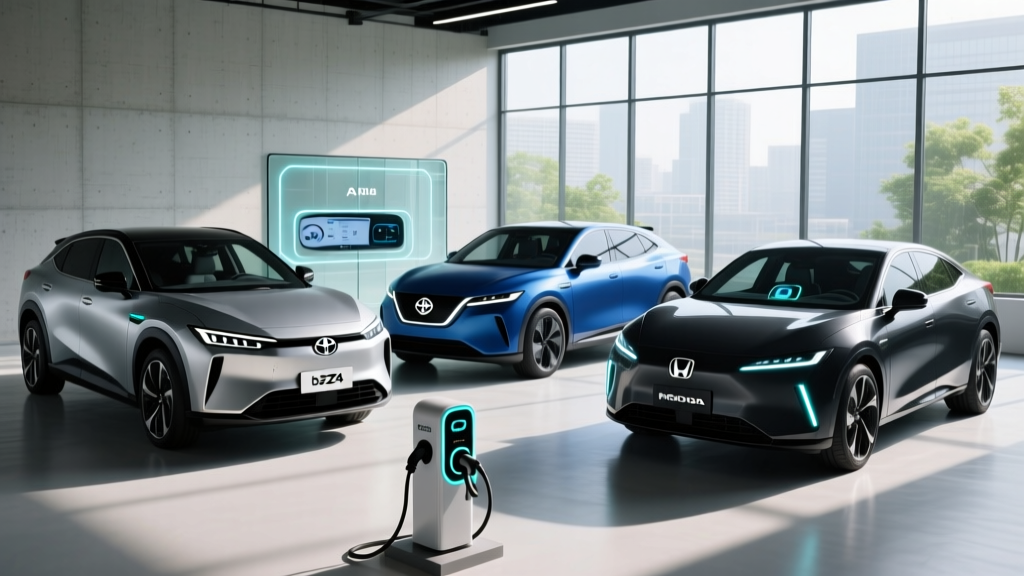
Japan's automakers now field a credible lineup of battery-electric vehicles, though the selection is smaller and more cautious than what Korean and American brands offer. The strongest Japanese EV options right now are the Nissan Ariya (up to 304 miles EPA range, starting ~$39,590), the Honda Prologue (296 miles, from ~$41,900, built on GM's Ultium platform), the Toyota bZ4X (252 miles, from ~$37,070), and the Subaru Solterra (227 miles, from ~$38,495, a bZ4X twin). Japanese brands lean heavily on PHEVs and HEVs as bridge options, so if you need 350+ miles of range or sub-20-minute DC fast charging, you'll still need to look at Tesla, Hyundai/Kia, or Lucid. But for buyers who value brand trust, dealer proximity, and conservative engineering, the Japanese EV lineup now covers most daily-driving needs.
Why Japanese Automakers Were Slow to Go Electric
Toyota, Honda, Nissan, and Subaru invested heavily in hybrid technology for two decades — Toyota alone has sold over 25 million hybrids globally since the original Prius. That bet paid off in fuel-economy leadership but left these companies behind on full battery-electric platforms. While Tesla scaled vertically and Hyundai/Kia launched dedicated EV architectures (E-GMP), most Japanese OEMs either adapted existing platforms or partnered with other companies to close the gap.
The result: Honda partnered with GM for the Prologue (using Ultium), Subaru co-developed the Solterra with Toyota, and Nissan leveraged its Leaf experience into the Ariya on the CMF-EV platform. For 2026, this means Japanese EVs are competent, well-built, and backed by massive dealer networks — but generally trail on charging speed and range-per-dollar compared to the segment leaders.
The 2026 Japanese EV Lineup: Spec-by-Spec Comparison
Here's how the four main Japanese EVs stack up on the numbers that matter most to buyers.
| Spec | Nissan Ariya (e-4ORCE AWD) | Honda Prologue (Elite AWD) | Toyota bZ4X (Limited AWD) | Subaru Solterra (Limited) |
|---|---|---|---|---|
| EPA Range | 289 mi (304 mi FWD) | 281 mi (296 mi FWD) | 228 mi (252 mi FWD) | 222 mi |
| Battery (usable) | 87 kWh (NMC) | 85 kWh (NMC, Ultium) | 64 kWh (NMC) | 64 kWh (NMC) |
| Peak DC Fast Charge | 130 kW | 150 kW | 100 kW | 100 kW |
| 10–80% DCFC Time | ~35 min | ~30 min | ~35 min | ~35 min |
| Level 2 Rate | 7.2 kW | 11.5 kW | 6.6 kW | 6.6 kW |
| Horsepower | 389 hp | 288 hp | 214 hp | 215 hp |
| 0–60 mph | 4.8 sec | 5.9 sec | 7.0 sec | 6.9 sec |
| MPGe (combined) | 97 MPGe | 100 MPGe | 104 MPGe | 102 MPGe |
| Base MSRP | ~$39,590 | ~$41,900 | ~$37,070 | ~$38,495 |
| Battery Warranty | 8 yr / 100,000 mi | 8 yr / 100,000 mi | 10 yr / 150,000 mi | 8 yr / 100,000 mi |
| Charging Port | CCS (NACS adapter avail.) | NACS (2025+ models) | CCS (NACS adapter avail.) | CCS (NACS adapter avail.) |
Sources: EPA fueleconomy.gov, manufacturer specifications. Range and pricing reflect 2025–2026 model year data and may vary by trim.
Real-World Range: What the EPA Sticker Doesn't Tell You
EPA estimates assume a mix of city and highway driving at moderate temperatures. In practice, your mileage will differ based on speed, climate, and terrain. Here's what to expect from these Japanese EVs in the real world:
Real-World Range Adjustments
Highway driving (70–80 mph, sustained): Expect a 10–15% reduction from EPA. The Ariya FWD's 304-mile sticker drops to roughly 260–275 miles at interstate speeds. The bZ4X and Solterra, with smaller 64 kWh batteries, fall to approximately 190–210 miles on a full highway charge.
Cold weather (below 32°F): All EVs lose range in winter, but the penalty varies. The Ariya and Prologue, with liquid thermal management and heat pumps (standard or available), typically lose 15–25%. The bZ4X and Solterra, which use a less robust heating strategy in early model years, can lose 25–35% in sustained sub-freezing conditions.
Mountain driving: Ascending grades consumes significantly more energy; regenerative braking on descent recovers some but not all of it. Budget an extra 10–20% consumption for hilly routes.
The Ariya stands out with the best real-world range cushion in this group. The Prologue's Ultium platform gives it a competitive edge in charging infrastructure compatibility now that Honda has adopted NACS. The bZ4X and Solterra are best suited for commuters with reliable home charging and daily drives under 150 miles round-trip.
Cost of Ownership: Japanese EV vs. Gas vs. Hybrid
One of the most common questions from first-time EV buyers is whether going electric actually saves money. The answer depends on your electricity rate, annual mileage, and whether you qualify for incentives. Here's a five-year cost comparison for a typical driver covering 12,000 miles per year.
| Cost Factor (5 Years) | Nissan Ariya AWD | Toyota RAV4 Hybrid AWD (Gas) | Toyota RAV4 Gas AWD |
|---|---|---|---|
| Purchase Price (base) | $39,590 | $33,425 | $30,095 |
| Federal Tax Credit (§30D) | $0–$7,500* | $0 | $0 |
| Fuel / Electricity (5 yr) | $3,150** | $4,725 | $6,300 |
| Maintenance (5 yr) | $1,200 | $2,800 | $3,200 |
| Insurance (5 yr avg) | $9,500 | $7,800 | $7,200 |
| Est. 5-Year Total Cost | $45,940–$53,440 | $48,750 | $46,800 |
*§30D credit eligibility depends on MSRP caps ($55,000 for SUVs), buyer income limits ($150K single / $300K joint), and battery critical-mineral sourcing requirements. Check current rules at IRS.gov. Not all Japanese EV trims qualify in every model year.
**Electricity cost assumes $0.15/kWh national average and home Level 2 charging. Public DC fast charging at $0.35–$0.50/kWh raises this figure significantly.
The Ariya's lower fuel and maintenance costs narrow the gap with gas alternatives, but insurance premiums for EVs remain 15–25% higher on average. If you qualify for the full $7,500 point-of-sale credit, the Ariya becomes cost-competitive with a RAV4 Hybrid by year three. Without the credit, the hybrid remains the more economical choice for most buyers.
Charging Infrastructure and the NACS Transition
Home charging is where most Japanese EV owners will do 80–90% of their charging. A Level 2 home charger (240V) installation typically costs $800–$2,500 depending on panel capacity and wiring distance, and adds 20–35 miles of range per hour of charging — more than enough to replenish a full day's driving overnight.
For public fast charging, the connector landscape is shifting rapidly. Honda's 2025+ Prologue ships with the NACS (Tesla-style) port, granting direct access to Tesla Superchargers — over 20,000 stations and the most reliable DC network in North America. Nissan, Toyota, and Subaru still use CCS1 but offer or will offer NACS adapters. Here's how that breaks down:
| Brand | Native Port | Tesla Supercharger Access | CCS Networks (EA, EVgo) |
|---|---|---|---|
| Honda (2025+) | NACS | Direct plug-in | Requires CCS adapter |
| Nissan | CCS1 | NACS adapter (available) | Direct plug-in |
| Toyota | CCS1 | NACS adapter (available) | Direct plug-in |
| Subaru | CCS1 | NACS adapter (available) | Direct plug-in |
One critical note on DC fast charging: peak kW ratings (e.g., 130 kW for the Ariya) represent the maximum rate at a low state of charge. Charging speed tapers significantly above 80% SoC to protect battery health. On a road trip, plan stops around the 10–80% window where charging is fastest, rather than waiting for a full charge.
Tax Credits and Incentives: What Japanese EV Buyers Need to Know
The federal §30D clean vehicle credit offers up to $7,500 for qualifying new EVs, but eligibility is a moving target. Key requirements include:
- MSRP cap: $55,000 for SUVs, $55,000 for sedans (most Japanese EV base trims qualify)
- Buyer income cap: $150,000 single / $225,000 head of household / $300,000 joint filers
- Battery sourcing: Increasing percentages of critical minerals and battery components must be sourced from the U.S. or FTA partners — this requirement tightens annually and has disqualified some trims mid-year
- Point-of-sale transfer: As of 2024, buyers can transfer the credit to the dealer for an immediate price reduction rather than waiting to claim it at tax time
- FEOC restriction: Vehicles with battery components from a "foreign entity of concern" (including certain Chinese suppliers) are disqualified
The Honda Prologue, built in the U.S. on GM's Ultium platform, has historically qualified more easily for the full credit due to domestic battery sourcing. The Nissan Ariya is assembled in Japan, which can complicate eligibility depending on the current year's sourcing thresholds. Always verify credit eligibility for the specific trim and model year at fueleconomy.gov before purchasing, and consult a tax professional for your specific situation.
Many states and utilities also offer additional rebates — California's CVRP, Colorado's state credit, and various utility-company Level 2 installation rebates can stack with the federal credit. Check your state energy office and local utility for current programs.
Common Misconceptions About Japanese EVs
| Myth | Fact |
|---|---|
| "Japanese brands don't make good EVs" | The Ariya and Prologue are competitive mid-range EVs with 280–300+ miles of range. They trail Hyundai/Kia and Tesla on charging speed, but offer strong build quality and dealer support. |
| "Toyota refused to build EVs" | Toyota prioritized hybrids and hydrogen but now sells the bZ4X globally and has announced a next-generation EV platform for 2027+. The bZ4X is a competent, if unexciting, commuter EV. |
| "Japanese EV batteries degrade faster" | No evidence supports this. Toyota offers a 10-year/150,000-mile battery warranty on the bZ4X — among the longest in the industry. All major OEMs use liquid-cooled NMC packs with proven longevity. |
| "You can't road-trip a Japanese EV" | The Ariya (304 mi FWD) and Prologue (296 mi FWD) handle road trips fine with DC fast charging. Plan stops every 200–230 real-world miles. The bZ4X/Solterra are more limited for long-distance travel due to smaller batteries and slower charging. |
| "Hybrids are always a better deal" | For low-mileage drivers without home charging, yes. For high-mileage commuters with Level 2 home charging, the EV's lower per-mile energy cost and minimal maintenance often win over 5+ years — especially with tax credits. |
Decision Framework: Which Japanese EV Is Right for You?
Choose Based on Your Situation
Choose the Nissan Ariya if: You want the most range and performance in a Japanese EV, you value a premium interior, and you primarily drive in moderate climates. The e-4ORCE AWD system is excellent in rain and light snow. Best all-around pick in this group.
Choose the Honda Prologue if: You want direct Tesla Supercharger access (2025+ models with NACS), you prefer a roomy midsize SUV layout, and you want a vehicle built in the U.S. with a higher likelihood of qualifying for the full §30D credit. The Ultium platform also offers a smoother, more compliant ride than the bZ4X.
Choose the Toyota bZ4X if: You're a Toyota loyalist who wants the brand's industry-leading 10-year battery warranty, you have reliable home charging, and your daily commute is under 120 miles round-trip. It's the most affordable entry point but has the shortest range and slowest charging.
Choose the Subaru Solterra if: You need genuine off-road capability and standard AWD in a Japanese EV. Subaru's X-Mode and 8.3 inches of ground clearance give it trail credibility no other EV in this group matches. Range is the trade-off.
Look outside Japan if: You need 350+ miles of range, sub-20-minute DC fast charging, or the lowest price-per-mile of range. The Hyundai Ioniq 5, Kia EV6, Tesla Model Y, and Chevrolet Equinox EV all outperform the Japanese options on at least one of these metrics.
Frequently Asked Questions
Is the Nissan Ariya a good first EV?
Yes. With up to 304 miles of EPA range, a comfortable ride, and available AWD, the Ariya covers most daily needs with a large buffer. Its 130 kW peak charge rate isn't class-leading, but 10–80% in about 35 minutes is adequate for road trips. Pair it with a home Level 2 charger and you'll rarely need public charging for daily use.
Does the Toyota bZ4X qualify for the $7,500 tax credit?
Eligibility varies by model year and trim due to battery-sourcing requirements that tighten annually. Check the current status at fueleconomy.gov for the specific model year you're considering. The bZ4X's MSRP falls well under the $55,000 SUV cap, so it clears the price requirement.
How do Japanese EVs compare to Hyundai and Kia electric cars?
Hyundai (Ioniq 5, Ioniq 6) and Kia (EV6, EV9) generally lead on DC fast charging speed (up to 350 kW peak on 800V architecture, 10–80% in ~18 minutes) and offer comparable or better range. Japanese EVs compete on dealer network density, brand loyalty, and in Toyota's case, longer battery warranty coverage. If fast charging is your top priority, the Korean brands win.
Can I charge a Japanese EV at a Tesla Supercharger?
Yes. Honda's 2025+ Prologue has a native NACS port for direct Supercharger access. Nissan, Toyota, and Subaru models with CCS ports can use Tesla Superchargers with a NACS adapter — available from the manufacturer or aftermarket. Verify adapter compatibility with your specific model year before purchasing.
What's the best Japanese EV for cold climates?
The Nissan Ariya e-4ORCE AWD is the strongest cold-weather choice, with 389 hp, capable torque vectoring, and liquid battery thermal management that mitigates winter range loss. Subaru's Solterra offers standard AWD and X-Mode for snow and ice, but its 222-mile range drops to roughly 150–170 miles in sustained sub-freezing weather — plan accordingly.
Should I buy a Japanese hybrid instead of a Japanese EV?
If you lack home charging access, regularly drive over 300 miles between stops, or live in an area with limited public charging infrastructure, a Toyota RAV4 Hybrid or Honda CR-V Hybrid is the more practical choice. If you can charge at home and your daily driving is under 200 miles, the EV's lower operating costs and smoother driving experience make it the better long-term pick — especially with federal and state incentives applied.