Understanding Hybrid Car Chargers: What You Actually Need
If you own a plug-in hybrid electric vehicle (PHEV) like the Toyota RAV4 Prime, Jeep Wrangler 4xe, or Chrysler Pacifica Hybrid, you've probably searched for a "hybrid car charger" and found a confusing mix of cables, wall boxes, and public stations. The good news: PHEVs have smaller batteries (typically 10–25 kWh usable), which means charging them is faster, cheaper, and simpler than topping up a full battery-electric vehicle. But picking the right equipment still requires understanding a few key distinctions — especially the difference between kW (power, or how fast energy flows) and kWh (energy, or how much your battery holds).
This guide covers every charging level, real-world install costs, connector compatibility, and the specific chargers we recommend for PHEV owners in 2026. Whether you're plugging into a standard 120V outlet or installing a dedicated 240V Level 2 circuit, you'll know exactly what to expect.
Charging Levels Explained: Speeds, kW, and Miles Per Hour
Every PHEV and EV in the US charges via one of three levels. The table below shows typical power delivery in kilowatts (kW) and approximate miles of electric range added per hour of charging. Because PHEVs have smaller batteries, a full charge at Level 2 often takes just 2–4 hours — a major advantage over BEVs.
| Level | Voltage | Typical kW | Miles of Range / Hour | PHEV Full Charge Time (15 kWh battery) |
|---|---|---|---|---|
| Level 1 (120V AC) | 120V | 1.2–1.9 kW | 3–5 mi/hr | 8–13 hours |
| Level 2 (240V AC) | 240V | 3.3–19.2 kW | 12–60+ mi/hr | 1.5–4.5 hours |
| DC Fast Charging | 400–800V DC | 50–350 kW | 150–1,000+ mi/hr | N/A (most PHEVs lack DC fast charge) |
Critical note on PHEVs and DC fast charging: Most plug-in hybrids — including the RAV4 Prime, Pacifica Hybrid, and Tucson PHEV — do not support DC fast charging. Their batteries are too small to absorb high kW rates safely, and manufacturers omit the hardware to save cost and weight. A few exceptions exist (the Mitsubishi Outlander PHEV supports CHAdeMO DC fast charging at up to ~22 kW), but for the vast majority of PHEV owners, Level 2 at home is the practical ceiling.
Onboard charger limits matter: Even if you plug a PHEV into a 48-amp Level 2 wall connector capable of 11.5 kW, the vehicle's onboard charger will cap the draw. The RAV4 Prime, for instance, accepts a maximum of 6.6 kW on Level 2. That means a 14.9 kWh usable battery charges from 0–100% in roughly 2.5 hours — regardless of whether your wall box can deliver more. Buying a 48-amp charger isn't wasted, though; it future-proofs you for a BEV down the road.
Home Installation: Electrical Requirements, Costs, and Panel Upgrades
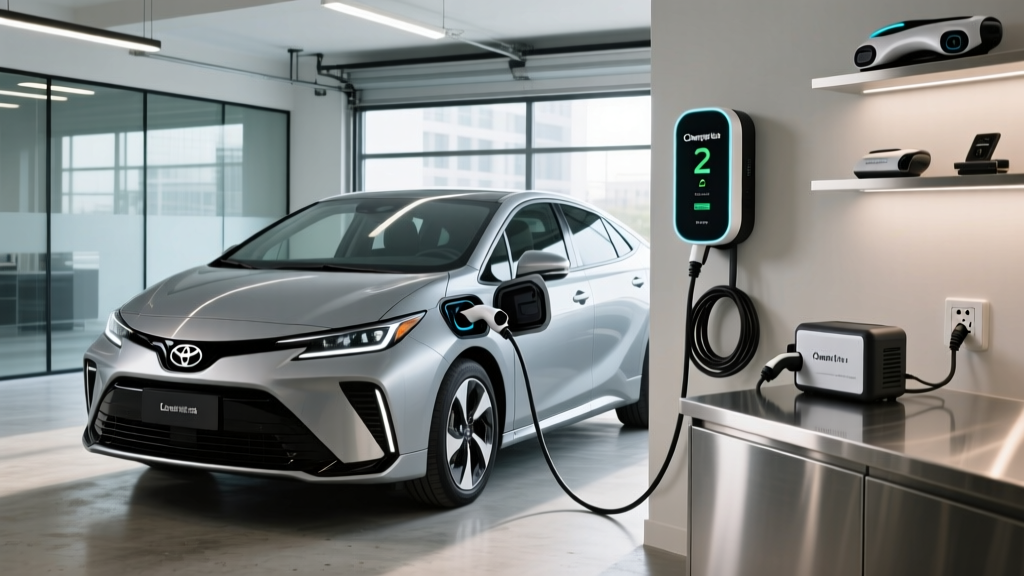
Installing a Level 2 hybrid car charger at home is the single best upgrade a PHEV owner can make. You'll wake up to a full battery every morning, avoid public charging entirely, and pay the lowest possible per-kWh rate. But the install cost varies dramatically based on your home's electrical panel, the distance from panel to charger location, and local permitting.
Electrical Requirements for Level 2 Charging
A typical Level 2 home charger runs on a 240V dedicated circuit, similar to what an electric dryer or oven requires. The most common configurations:
- 32-amp charger (7.7 kW): Requires a 40-amp breaker and 8 AWG copper wire. Sufficient for most PHEVs.
- 40-amp charger (9.6 kW): Requires a 50-amp breaker and 6 AWG copper wire. Covers all current PHEVs and most BEVs.
- 48-amp charger (11.5 kW): Requires a 60-amp breaker and 6 AWG copper wire. Ideal for future-proofing.
The National Electrical Code (NEC) requires that continuous loads (like EV charging, which runs for 3+ hours) use no more than 80% of the circuit's rated capacity. That's why a 40-amp breaker supports a 32-amp charger, not a 40-amp one. Your licensed electrician will calculate this, but it helps to understand the logic before getting quotes.
Installation Cost Breakdown
| Component | Simple Install (panel nearby, no upgrade) | Complex Install (long run or panel upgrade) |
|---|---|---|
| Level 2 charger equipment | $300–$700 | $300–$700 |
| Electrician labor (2–6 hrs) | $300–$800 | $800–$2,500 |
| Materials (wire, conduit, breaker) | $100–$300 | $300–$800 |
| Permit and inspection | $50–$200 | $50–$200 |
| Electrical panel upgrade (if needed) | $0 | $1,500–$4,000 |
| Total estimated cost | $750–$2,000 | $2,950–$8,200 |
The panel-upgrade wildcard: Homes built before 1990 often have 100-amp main panels. Adding a 40–60 amp dedicated circuit for EV charging may push total load beyond the panel's capacity, requiring an upgrade to 200 amps. This is the single biggest cost variable, and it's not always apparent until an electrician does a load calculation. According to the National Renewable Energy Laboratory (NREL), roughly 20–30% of older homes need some form of panel work for EV charger installation.
Federal incentive note: The IRS §30D tax credit applies to new EV purchases, not charging equipment. However, the Alternative Fuel Vehicle Refueling Property Credit (IRS §30C) previously offered up to $1,000 for home charger installation. As of 2026, check IRS.gov for current availability — incentive rules change frequently and depend on your census tract and income.
Connector Compatibility: NACS, CCS, CHAdeMO, and Your PHEV
Every PHEV sold in North America uses one of three connector standards for AC charging. Here's what fits what:
| Connector | Brands That Use It | Notes |
|---|---|---|
| J1772 (standard AC) | Toyota, Hyundai, Kia, Chrysler, Mitsubishi, Subaru, most non-Tesla PHEVs | Universal standard for AC Level 1 and Level 2 in North America |
| NACS (Tesla / North American Charging Standard) | Tesla (all models), Ford (2025+), GM (2025+), Rivian, and growing list | Tesla vehicles use NACS natively; adapters available for J1772 chargers |
| CHAdeMO (DC fast, legacy) | Mitsubishi Outlander PHEV (DC), Nissan Leaf (BEV) | Largely deprecated for new models; most PHEVs don't support DC fast charge |
For most PHEV owners: Your vehicle almost certainly uses the J1772 connector for AC charging. Every Level 2 home charger sold in the US (except Tesla Wall Connector) ships with a J1772 plug. If you buy a Tesla Wall Connector, you'll need a Tesla-to-J1772 adapter (~$200) to charge a non-Tesla PHEV — or choose a universal charger instead.
As of 2026, the industry is rapidly migrating to NACS. Ford and GM vehicles now ship with NACS ports, and most automakers have committed to NACS adoption by 2027–2028. For PHEV buyers, this transition matters less in the short term (your PHEV uses J1772), but if you plan to buy a BEV eventually, choosing a charger with a J1772 connector plus a NACS adapter (or a dual-connector unit) is the smartest long-term play.
Cost Per Mile: Charging Your Hybrid vs. Filling Up With Gas
One of the strongest arguments for a PHEV — and for installing a home charger — is the dramatic per-mile cost savings when driving on electricity. Here's a realistic comparison using 2026 national averages:
| Scenario | Cost per kWh / Gallon | Efficiency | Cost Per Mile |
|---|---|---|---|
| Home charging (off-peak rate) | $0.12/kWh | 3.5 mi/kWh (typical PHEV) | $0.034 |
| Home charging (standard rate) | $0.18/kWh | 3.5 mi/kWh | $0.051 |
| Public Level 2 (e.g., ChargePoint) | $0.30/kWh | 3.5 mi/kWh | $0.086 |
| DC fast charging (public) | $0.45/kWh | 3.5 mi/kWh | $0.129 |
| Gasoline (PHEV engine, 30 MPG combined) | $3.40/gallon | 30 MPG | $0.113 |
The math is stark: home-charged PHEV driving costs roughly 70% less per mile than gasoline. Even at a standard residential rate of $0.18/kWh, you're paying about 5 cents per mile on electricity versus 11 cents on gas. Over a year of commuting 12,000 miles — say, 8,000 of those on electric power — that's a savings of approximately $480–$640 annually.
The catch? Public charging erodes the advantage quickly. At $0.30/kWh on a public Level 2 charger, you're still saving versus gas, but the margin narrows. At DC fast charging rates ($0.45/kWh), electric driving actually costs more per mile than gas for many PHEVs. This is why a home charger is the single most important investment for PHEV economics.
For real-world efficiency data on specific PHEV models, fueleconomy.gov provides EPA-rated kWh/100mi and MPGe figures for every certified plug-in hybrid sold in the US.
Best Hybrid Car Chargers: Equipment Picks for 2026
Based on power output, reliability, cable management, smart features, and value, here are the Level 2 chargers we recommend for PHEV owners:
Emporia Vue Level 2 EV Charger
- Power output: 48 amps (11.5 kW) on a 60A circuit; adjustable down to 32A/40A
- Connector: J1772 (NACS adapter available separately)
- Cable length: 24 feet
- Smart features: Wi-Fi, app scheduling, solar integration, energy monitoring, load management
- Price: ~$399
- Best for: Budget-conscious buyers who want full smart features and adjustable amperage to match their circuit
ChargePoint Home Flex
- Power output: Up to 50 amps (12 kW) on a 60A circuit; configurable from 16A–50A
- Connector: J1772 (NACS version also available)
- Cable length: 23 feet
- Smart features: Wi-Fi, Alexa integration, ChargePoint app scheduling, detailed energy reports
- Price: ~$599
- Best for: Owners who want a proven, UL-listed unit from a major public-charging brand with excellent app UX
Tesla Wall Connector (Universal or NACS)
- Power output: Up to 48 amps (11.5 kW) on a 60A circuit
- Connector: NACS native; Universal version includes J1772 adapter wand
- Cable length: 24 feet
- Smart features: Wi-Fi, over-the-air updates, power sharing (link two units on one circuit), Tesla app integration
- Price: ~$475 (Universal version)
- Best for: Tesla owners who also need to charge a non-Tesla PHEV, or anyone planning a future Tesla BEV purchase
Grizzl-E Smart Level 2 Charger
- Power output: 40 amps (9.6 kW) on a 50A circuit
- Connector: J1772
- Cable length: 24 feet
- Smart features: OCPP-compatible, works with third-party apps, adjustable amperage via DIP switches
- Price: ~$449
- Best for: Cold-climate owners who prioritize rugged build quality (rated to -40°F) and open-protocol smart charging
What about the included Level 1 cord? Every PHEV ships with a 120V Level 1 charging cable. For owners who drive less than 20 miles daily and can charge overnight (10+ hours), Level 1 may be sufficient. A 15 kWh PHEV battery charges from empty in roughly 10–13 hours at 1.4 kW. But if your commute exceeds 25 miles or you want the flexibility to top up mid-day in 2 hours, Level 2 is worth the investment.
Charging Time Examples: How Long for Common PHEV Batteries?
Here's what to expect with popular 2026 PHEV models at different charging levels:
| Vehicle | Battery (usable kWh) | Level 1 (120V, 1.4 kW) | Level 2 (240V, 6.6 kW) | Level 2 (240V, 3.3 kW) |
|---|---|---|---|---|
| Toyota RAV4 Prime | 14.9 kWh | ~11 hours | ~2.5 hours | ~4.5 hours |
| Chrysler Pacifica Hybrid | 16.0 kWh | ~12 hours | ~2.5 hours | ~5 hours |
| Jeep Wrangler 4xe | 15.3 kWh | ~11 hours | ~2.5 hours | ~4.5 hours |
| Hyundai Tucson PHEV | 13.8 kWh | ~10 hours | ~2 hours | ~4 hours |
| Toyota Prius Prime | 13.6 kWh | ~10 hours | ~4 hours (3.5 kW onboard) | ~4 hours |
Note that the Prius Prime has a 3.5 kW onboard charger, so even on a 6.6 kW or 11.5 kW Level 2 circuit, it draws only 3.5 kW maximum. The RAV4 Prime and Wrangler 4xe support 6.6 kW onboard charging, making them significantly faster to refill. Always check your specific model's onboard charger rating before investing in a high-amperage wall unit.
Safety, Code, and Permit Requirements
EV charging installations are governed by the National Electrical Code (NEC Article 625) and local building codes. Here's what matters:
- Dedicated circuit: Your Level 2 charger must have its own dedicated breaker — it cannot share a circuit with other appliances.
- GFCI protection: The 2020 NEC requires GFCI (Ground Fault Circuit Interrupter) protection for all indoor and outdoor EV charging outlets. Many modern hardwired chargers include built-in GFCI protection; plug-in units require a GFCI breaker.
- Outdoor rating: If your charger is installed outdoors (or in an unenclosed carport), it must carry a NEMA 4 or NEMA 4X rating for weather resistance. All chargers recommended above meet this standard.
- Permit and inspection: Most US jurisdictions require an electrical permit for a new 240V circuit. The permit cost is typically $50–$200, and a city or county inspector will verify the work after installation. Do not skip this — unpermitted work can void home insurance claims and cause problems at resale.
- Cable management: NEC requires that charging cables not create a trip hazard. Wall-mounted cord organizers or retractable reels (like the Tesla Cable Organizer) are recommended and sometimes required by local inspectors.
Always hire a licensed electrician for 240V work. While some jurisdictions allow homeowner-permitted electrical work, a 240V/40–60 amp circuit carries significant arc-flash and fire risk if improperly installed. The National Fire Protection Association (NFPA) publishes the NEC standards that your electrician will follow.
Frequently Asked Questions
How much does it cost to install a home hybrid car charger?
A straightforward Level 2 installation (panel has capacity, charger location is close to the panel) typically costs $750–$2,000 all-in, including equipment, labor, wire, and permit. If your home needs a 200-amp panel upgrade, total cost can reach $3,000–$8,000+. Get at least three quotes from licensed electricians before committing.
How fast will each charging level add range to my PHEV?
Level 1 (120V) adds roughly 3–5 miles of electric range per hour. Level 2 (240V) adds 12–30+ miles per hour depending on your PHEV's onboard charger (most cap at 6.6 kW, yielding about 20–25 mi/hr). DC fast charging is unavailable on most PHEVs.
Which connector is compatible with my plug-in hybrid?
Nearly every PHEV sold in North America uses the J1772 connector for AC charging. If you own a Tesla, it uses the NACS connector. Any Level 2 charger with a J1772 plug will work with your non-Tesla PHEV. Tesla Wall Connector owners charging a non-Tesla PHEV need a Tesla-to-J1772 adapter.
How much does charging cost per mile versus gas?
At the US average residential electricity rate of ~$0.16/kWh and typical PHEV efficiency of 3.5 mi/kWh, home charging costs about $0.046/mile. Gasoline at $3.40/gallon and 30 MPG costs $0.113/mile. That's a 59% savings per mile on electricity — but only if you charge at home. Public charging at $0.30–$0.45/kWh narrows or eliminates the savings.
What electrical upgrades might I need?
The most common upgrade is a panel capacity increase from 100 amps to 200 amps, which costs $1,500–$4,000 depending on your utility connection and local rates. Other potential needs: adding a sub-panel in the garage ($500–$1,500), trenching conduit for detached garages ($800–$3,000), or upgrading the utility service drop (rare, but $2,000–$5,000 if required). Your electrician's load calculation will determine what's necessary.
Can I use my PHEV's included Level 1 charger instead of buying a Level 2 unit?
Yes — if your daily electric driving is under 20 miles and you have 10+ hours to charge overnight. But Level 1 is slow (3–5 mi/hr) and can't recover a depleted battery quickly. For commutes over 25 miles, frequent road-trip top-ups, or cold climates where range drops 20–30%, Level 2 is strongly recommended.
Will a Level 2 charger work with a future BEV if I upgrade from my PHEV?
Absolutely. A 40-amp or 48-amp Level 2 charger installed today will handle any BEV you might buy in the future. The only consideration is the connector: if you install a J1772 charger today and buy a NACS-equipped BEV (like a Ford, GM, or Tesla) later, you'll need a J1772-to-NACS adapter (~$150–$250), or you can swap the charger. Many 2026 chargers offer dual-connector options to handle both standards.