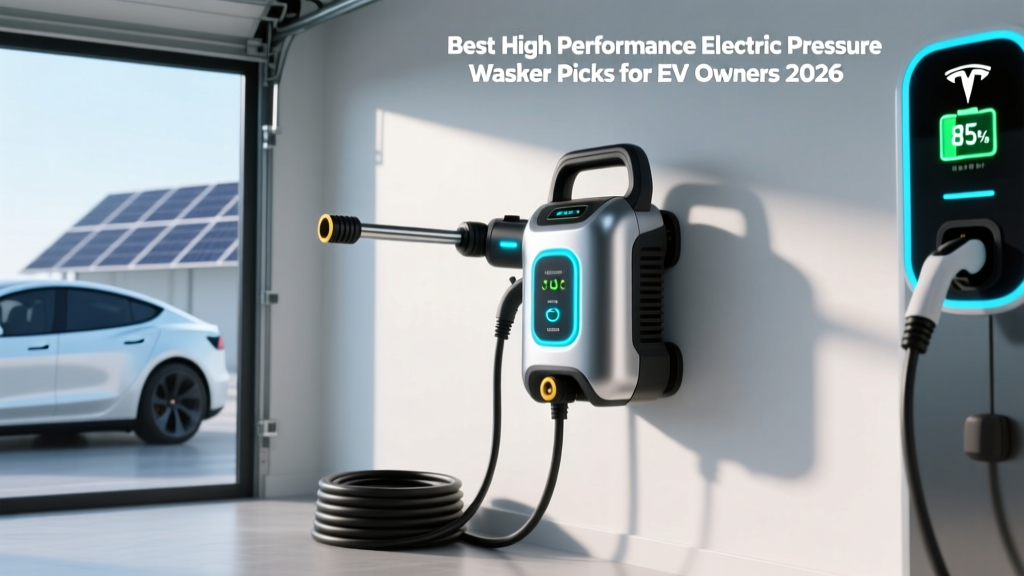
If you own an electric vehicle and wash it at home, a high performance electric pressure washer rated between 2,000 and 3,200 PSI with a flow rate of 1.8 to 2.5 GPM will safely strip road salt, brake dust, and bug splatter without risking your EV's paint or sensor housings. Models like the Sun Joe SPX4601 (3,000 PSI / 2.0 GPM) and the Karcher K5 Premium (2,000 PSI / 1.4 GPM) run on standard 120V/15A outlets, drawing 13–15 amps—roughly 1,560 to 1,800 watts per hour of use. At the U.S. average electricity rate of $0.17/kWh (EIA, 2026), that's about $0.26 to $0.30 per hour of runtime, or roughly $0.05 to $0.08 per typical 15-minute car wash. Gas-powered equivalents cost $0.90 to $1.40 per wash in fuel alone, making the electric option 70–85% cheaper to operate per session.
Why EV Owners Care About Electric Pressure Washers
At first glance, a pressure washer seems unrelated to EV ownership. But the overlap is more practical than it appears. EV owners who've invested in a home Level 2 charger (240V, typically 32A to 48A) already have upgraded electrical infrastructure in their garage or driveway. That same panel capacity that supports a 7.7 kW to 11.5 kW EV charger can often accommodate the 1.5 kW to 1.8 kW draw of a high performance electric pressure washer without tripping breakers—provided you're not running both simultaneously on the same circuit.
Beyond electrical compatibility, EV owners tend to be cost-per-mile analysts. You already track kWh/100mi and compare it to the MPG of your old gas car. Applying that same lens to car care reveals that electric pressure washers are the clear winner on operating cost, noise, and maintenance—just as your EV is against a gas car on fuel and service.
Spec Comparison: Top Electric Pressure Washers for Car Detailing
| Model | PSI | GPM | Power (W) | Voltage | Weight | Price (MSRP) |
|---|---|---|---|---|---|---|
| Sun Joe SPX4601 | 3,000 | 2.0 | 1,800W | 120V/15A | 35 lbs | $349 |
| Karcher K5 Premium | 2,000 | 1.4 | 1,560W | 120V/13A | 32 lbs | $279 |
| Greenworks GPW2700 | 2,700 | 2.3 | 1,800W | 120V/15A | 44 lbs | $299 |
| Ryobi RY142300 | 2,300 | 1.2 | 1,440W | 120V/12A | 28 lbs | $199 |
| AR Blue Clean AR390SS | 2,000 | 1.4 | 1,560W | 120V/13A | 26 lbs | $179 |
Note: All models above are corded electric. Battery-powered pressure washers (like the Worx Hydroshot) offer portability but deliver only 320–725 PSI—insufficient for a true high performance electric pressure washer experience on vehicles with heavy road film.
Cost Breakdown: Electric Pressure Washer vs. Gas Equivalent
The purchase price gap between electric and gas pressure washers has narrowed considerably. But the operating cost difference is where the math gets compelling—much like the EV vs. gas car comparison.
| Cost Factor | Electric (2,700 PSI class) | Gas (2,700 PSI class) |
|---|---|---|
| Purchase Price | $250–$350 | $300–$450 |
| Energy/Fuel per Hour | $0.26–$0.31 (electricity) | $0.90–$1.40 (gasoline) |
| Annual Maintenance | $0 (no oil, spark plugs, or air filters) | $30–$60 (oil changes, spark plugs, winterizing) |
| Noise Level | 60–75 dB | 85–95 dB |
| 5-Year Operating Cost (50 washes/yr) | $65–$78 (energy) + $0 (maintenance) | $225–$350 (fuel) + $150–$300 (maintenance) |
| 5-Year Total Cost of Ownership | $315–$428 | $675–$1,100 |
The 5-year savings of $250 to $670 mirrors the logic that drives EV adoption: higher upfront efficiency and lower recurring costs. The U.S. Department of Energy's EV cost calculator shows similar savings patterns for electricity vs. gasoline on a per-mile basis.
EV-Specific Washing Considerations: Protecting Sensors and Seals
Modern EVs are loaded with exterior sensors that a careless pressure wash can damage. Here's what you need to know before pointing a high performance electric pressure washer at your Tesla Model Y, Hyundai Ioniq 5, Ford Mustang Mach-E, or any ADAS-equipped vehicle:
- Camera housings: Tesla's Autopilot/FSD cameras, GM's Super Cruise cameras, and Ford's BlueCruise sensors are sealed but not pressure-rated. Keep the nozzle at least 12 inches away and avoid direct spray at camera lenses. These systems are SAE Level 2 driver-assist—damage to a single camera can disable lane-keeping and automatic emergency braking.
- Ultrasonic sensors: The small circular discs on bumpers (parking sensors) can be dislodged by high-pressure streams. Use a 25° or wider spray tip and maintain distance.
- Charging port seals: Avoid directing high-pressure water at the J1772/NACS/CCS charge port door. While these ports are sealed to IP67 or better, repeated high-pressure exposure can degrade rubber gaskets over time.
- Frunk and hood seals: EVs with front trunks (Tesla, Ford, Rivian) have additional weather seals. Pressure washing directly at seam lines can force water past aging seals.
- PSI guidance: For automotive paint, 1,500–2,500 PSI with a 25° (green) or 40° (white) nozzle tip is the safe zone. The 3,000+ PSI models should only be used with a foam cannon attachment or at extended distance for car washing.
Electrical Panel Reality: Can Your Garage Handle Both?
A common question from EV owners: "If I'm already charging my car at 40 amps on a 50A circuit, can I also run a 15-amp pressure washer?"
The answer depends on your panel and circuit layout:
- Separate circuits: Most garages have at least one dedicated 120V/15A or 20A GFCI outlet on a different circuit than your Level 2 EV charger (which is 240V). In this case, you can safely run both—just don't expect to charge your EV at full speed and pressure wash simultaneously if your panel is near capacity.
- 200A panel: If you upgraded to a 200A panel for your EV charger (a common recommendation), you almost certainly have enough headroom for a 1.5–1.8 kW pressure washer.
- 100A panel: Homes with older 100A service that added a 40A EV charger are closer to the limit. Running a pressure washer while the EV charges at full rate could approach 80% of panel capacity if other large loads (dryer, oven, HVAC) are also active. Consult a licensed electrician if you're unsure.
Key distinction: Your EV charger draws power in kilowatts (kW)—a 7.7 kW charger is a massive load. A pressure washer draws 1.5 to 1.8 kW. They're not in the same league, but simultaneous use on a constrained panel warrants professional assessment.
Myths vs. Facts: Electric Pressure Washers for Car Care
| Myth | Fact |
|---|---|
| "Electric pressure washers are too weak for cars." | Modern electric models deliver 2,000–3,000 PSI—more than enough. Most professional detailers use 1,500–2,500 PSI for automotive paint. Excessive PSI damages clear coats. |
| "You need a gas washer for serious cleaning." | Gas washers win on peak PSI (3,500+) for concrete stripping. For vehicles, electric units in the 2,000–3,000 PSI range are the practical ceiling anyway. |
| "Running a pressure washer will slow my EV charging." | Only if both are on the same circuit or your panel is near capacity. On separate circuits with a 200A panel, the impact is negligible. |
| "Battery-powered washers are just as good." | Battery models max out around 725 PSI and 0.5 GPM—useful for light rinsing but not a true high performance electric pressure washer for road salt or baked-on grime. |
| "All electric washers are quiet." | Universal motor models (Ryobi, AR Blue Clean) run 60–70 dB. Induction motor models (Karcher K5) are quieter at ~55 dB. Gas units hit 85–95 dB. |
Decision Framework: Which Electric Pressure Washer Fits Your EV Garage?
Choose the Sun Joe SPX4601 (3,000 PSI / 2.0 GPM, $349) if: You want maximum cleaning power for both your EV and driveway/patio furniture, you have a 200A panel with a dedicated 120V/20A GFCI outlet, and you plan to use a foam cannon for touchless pre-wash.
Choose the Karcher K5 Premium (2,000 PSI / 1.4 GPM, $279) if: You prioritize quiet operation (induction motor), you primarily wash your EV and don't need driveway-stripping power, and you want a compact unit that stores easily in a garage alongside your EV charger.
Choose the Greenworks GPW2700 (2,700 PSI / 2.3 GPM, $299) if: You want the best balance of PSI and flow rate—higher GPM means faster rinsing, which matters when you're washing a large EV like a Rivian R1S or Tesla Model X with substantial surface area.
Choose the Ryobi RY142300 (2,300 PSI / 1.2 GPM, $199) if: Budget is the priority, you wash a single EV biweekly, and you already own Ryobi battery tools (the brand ecosystem matters for accessories, though the washer itself is corded).
Frequently Asked Questions
Will a high performance electric pressure washer damage my EV's paint?
Not if used correctly. Keep the nozzle at least 12 inches from painted surfaces, use a 25° or 40° tip, and stay below 2,500 PSI for direct paint contact. Most paint damage from pressure washers comes from using a 0° or 15° tip too close—this concentrates force enough to cut through clear coat regardless of whether the washer is electric or gas.
How much electricity does a pressure washer use compared to charging my EV?
A typical high performance electric pressure washer draws 1.5 to 1.8 kW. Running one for 20 minutes uses about 0.5 to 0.6 kWh—roughly the same energy your EV consumes driving 1.5 to 2 miles. For context, a full charge of a Tesla Model Y Long Range (75 kWh usable battery, ~310 miles EPA range) uses about 125 to 150 times more energy than a single car wash session.
Can I use an extension cord with an electric pressure washer?
Manufacturers generally advise against it due to voltage drop, which can damage the motor. If you must use one, choose a 12-gauge cord no longer than 50 feet. For EV owners whose garage outlet is close to the driveway, this is rarely an issue—just position the washer near the outlet and use the included 25-foot high-pressure hose to reach the vehicle.
Do I need a special outlet to run a high performance electric pressure washer?
No. All the corded electric models in our comparison run on standard 120V/15A household outlets. A GFCI-protected outlet (required by code in garages and outdoors) is essential for safety. This is different from your Level 2 EV charger, which requires a dedicated 240V circuit (NEMA 14-50 or hardwired). The two systems are entirely independent.
Is it worth buying a pressure washer just for washing my EV?
If you wash your EV at home more than twice a month, yes. Professional hand washes cost $15–$40 each; a $250–$350 electric pressure washer pays for itself in 8–18 months. Add the convenience of washing on your schedule (no waiting at a car wash, no dragging quarters), and the math favors ownership—especially if you already have the garage infrastructure from your EV charging setup.