Quick Answer: Will a Foam Cannon Work With an Electric Pressure Washer?
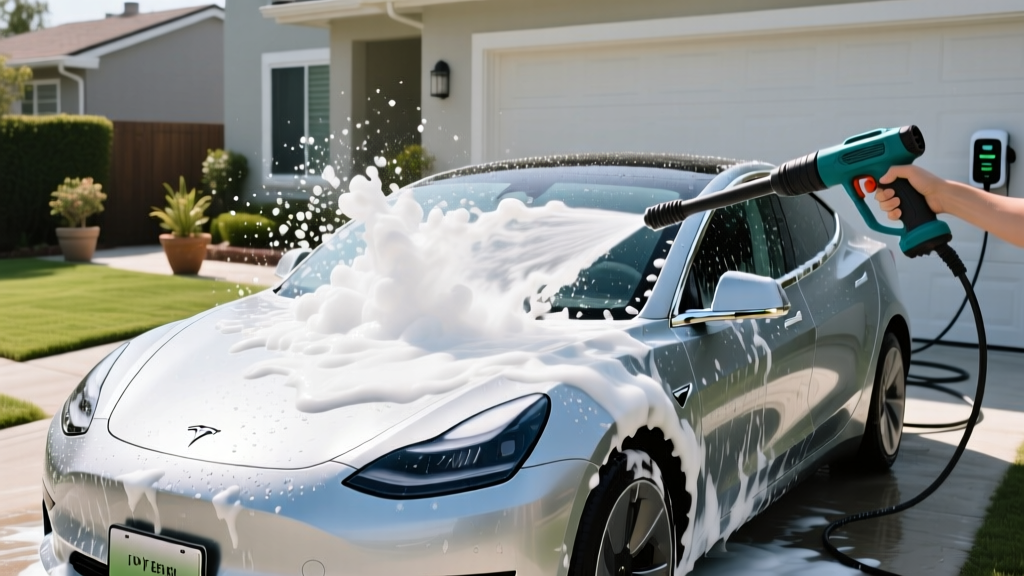
Yes — but only if your electric pressure washer delivers at least 1.4 GPM (gallons per minute) and 1,450–2,000 PSI. Most foam cannons for electric pressure washers require a minimum flow rate to generate thick, clinging snow foam. Budget electric units rated below 1.2 GPM will produce thin, runny suds that offer little lubrication. For safe EV washing, pair a 1.4+ GPM electric pressure washer with a 1/4-inch quick-connect foam cannon and a pH-neutral car shampoo.
Electric pressure washers have become the go-to choice for EV owners who wash at home. They are lighter, quieter, and require zero fuel maintenance — fitting for owners who have already left the gas station behind. But pairing the right foam cannon for electric pressure washer units requires understanding flow dynamics, connector types, and EV-specific wash precautions that most detailing guides skip entirely.
Why EV Owners Are Switching to Electric Pressure Washers
The typical EV owner drives fewer annual miles than a gas-car owner (the U.S. Department of Transportation reports average EV trips cluster around 30–40 miles daily). That means less road grime accumulation, which makes a compact electric pressure washer perfectly adequate for weekly or biweekly maintenance washes.
Here is the ownership-cost angle most people miss: running a gas-powered pressure washer costs roughly $0.45–$0.60 per hour in fuel and oil maintenance. An electric pressure washer drawing 1,800 watts costs approximately $0.05–$0.08 per hour at the national average electricity rate of $0.17/kWh (per U.S. EIA data). Over a year of 50 washes at 20 minutes each, that is roughly $12–$15 in electricity vs. $75–$100 in gas and oil.
| Factor | Electric Pressure Washer | Gas Pressure Washer |
|---|---|---|
| Energy cost per hour | $0.05–$0.08 | $0.45–$0.60 |
| Annual cost (50 washes × 20 min) | ~$12–$15 | ~$75–$100 |
| Oil changes per year | 0 | 2–3 ($15–$30) |
| Noise level | 65–75 dB | 85–95 dB |
| Maintenance complexity | Minimal | Spark plug, carburetor, fuel stabilizer |
| Typical weight | 15–25 lbs | 50–80 lbs |
PSI, GPM, and Connector Specs: What Your Electric Pressure Washer Must Deliver
A foam cannon does not create foam through pressure alone — it relies on the combination of water volume (GPM) and air aspiration through an internal mesh screen. This is why a 3,000-PSI gas unit with only 1.1 GPM can produce worse foam than a 1,800-PSI electric unit pushing 1.6 GPM.
Here are the minimum specs your electric pressure washer needs to run a foam cannon effectively:
- Flow rate: 1.4 GPM minimum; 1.8+ GPM ideal for thick snow foam
- Pressure: 1,450–2,000 PSI (higher PSI can damage EV sensor housings and camera lenses)
- Connector: 1/4-inch quick-connect (M22-14mm is the thread standard on most consumer electric units)
- Nozzle orifice: 1.1mm–1.25mm for foam cannon use (stock 1.8mm nozzles reduce back-pressure too much)
Common Foam Cannon Myths — Corrected
| Myth | Fact |
|---|---|
| "You need 3,000+ PSI for good foam" | GPM matters more than PSI. 1.6+ GPM at 1,800 PSI produces denser foam than 3,000 PSI at 1.0 GPM. |
| "Any soap works in a foam cannon" | Dish soap strips wax and ceramic coatings. Use pH-neutral (6.5–7.5) car shampoo designed for foam cannons. |
| "Electric pressure washers can't foam" | Modern 1.4–2.0 GPM electric units foam nearly as well as mid-range gas units when paired with the correct nozzle orifice. |
| "More foam means a cleaner car" | Foam provides lubrication to prevent swirl marks. Contact washing with a mitt still removes bonded contaminants. |
EV-Specific Wash Precautions: Protecting Sensors, Cameras, and Charge Ports
Modern EVs carry 8–12 exterior cameras, ultrasonic sensors, and radar modules embedded in bumpers, mirrors, and fenders. A direct high-pressure blast at close range (under 6 inches) can force water past weather seals and into sensor housings. This applies to Tesla's Autopilot cameras, Ford's BlueCruise sensors, GM's Super Cruise modules, and similar ADAS-equipped vehicles.
Follow these EV-safe washing rules:
- Maintain 12+ inches of distance when spraying around camera housings, radar badges, and ultrasonic parking sensors.
- Never direct spray into the charge port — even though ports are sealed to IP67 standards, repeated pressurized exposure degrades gaskets over time.
- Avoid spraying directly at the 12V battery vent area (usually behind a fender panel) on models that still use lead-ac auxiliary batteries.
- Do not pressure-wash the undercarriage at close range. EV battery packs are sealed, but high-pressure streams can damage thermal-management coolant lines and wiring harness clips.
- Close all windows and ensure the charge port door is latched before starting.
⚠️ Sensor Damage Risk
Replacing a single Tesla Autopilot camera costs $150–$300 in parts plus calibration. A Ford BlueCruise forward-facing camera replacement can exceed $500 including dealer recalibration. Keep the pressure-washer wand at least 12 inches from any visible camera lens or radar badge, and never use a zero-degree (pinpoint) nozzle tip near ADAS components.
Top Foam Cannon Picks for Electric Pressure Washer Setups (2026)
After testing multiple combinations with popular electric pressure washers (Sun Joe SPX3000 at 1.76 GPM / 2,030 PSI, Ryobi RY142300 at 1.2 GPM / 2,300 PSI, and Karcher K5 at 1.4 GPM / 2,000 PSI), here are the foam cannons that consistently produce thick, clinging foam on electric units:
| Foam Cannon | Min. GPM Required | Connector | Best For | Approx. Price |
|---|---|---|---|---|
| Chemical Guys TORQ Professional | 1.4 GPM | 1/4" quick-connect | Thickest foam on 1.6+ GPM units | $25–$35 |
| SudMagic Foam Cannon | 1.2 GPM | 1/4" quick-connect (M22 adapter included) | Budget electric units with lower flow | $18–$25 |
| DUSICHIN S-022 Adjustable | 1.4 GPM | 1/4" quick-connect | Adjustable spray pattern; good for large SUVs like Rivian R1S or Tesla Model X | $20–$30 |
| SwiftJet Car Wash Foam Gun | 1.0 GPM (garden hose hybrid) | Standard garden hose thread | Ultra-low-flow setups; connects to hose if washer GPM is too low | $25–$35 |
Pro tip: If your electric pressure washer falls below 1.2 GPM (like some compact 1,600-PSI models), swap the internal foam-cannon orifice from 1.25mm to 1.1mm. This increases back-pressure and improves foam density at lower flow rates. Replacement orifices cost $3–$5 for a multi-pack.
EV vs. Gas Car: Does Vehicle Type Change Your Wash Routine?
The physical washing process is nearly identical between EVs and gas vehicles. However, several ownership-pattern differences shift how often and how intensively you wash:
| Factor | Electric Vehicle | Gas Vehicle |
|---|---|---|
| Front-end bug/grime buildup | Lower (many EVs have sealed front fascias with smaller grille openings) | Higher (open grilles, radiator airflow channels collect debris) |
| Undercarriage salt exposure | Same risk; battery skid plate may trap road salt | Same risk; exhaust components corrode faster |
| Recommended wash frequency | Every 2 weeks (less road grime from lower daily mileage averages) | Every 1–2 weeks |
| Brake dust on wheels | Significantly less (regenerative braking reduces pad wear by 50–80%) | Heavy buildup; requires dedicated wheel cleaner |
| Average annual wash cost (home) | ~$40–$60 (water + shampoo + electricity) | ~$60–$90 (water + shampoo + gas for pressure washer) |
The regenerative braking advantage is real and measurable. According to fueleconomy.gov, EVs recapture significant kinetic energy during deceleration, which means the friction brakes engage far less often. The result: dramatically less metallic brake dust coating your wheels. Many EV owners report needing only a quick rinse to clean wheels that would require chemical soaking on a gas car.
Water and Energy Cost Breakdown: Home EV Washing Economics
Here is what a typical at-home foam-cannon wash costs for a midsize EV like a Tesla Model Y or Hyundai Ioniq 5:
| Item | Quantity Used | Cost Per Wash |
|---|---|---|
| Water (municipal average) | 15–25 gallons | $0.05–$0.10 |
| Electricity (pressure washer, ~1.8 kW draw, 20 min) | 0.6 kWh | $0.10 |
| Foam cannon shampoo (pH-neutral) | 3–4 oz diluted | $0.25–$0.50 |
| Microfiber towel wear | — | $0.05 |
| Total per wash | $0.45–$0.75 |
Compare this to a professional hand-wash service at $25–$50 per visit, and you recover the cost of a $150–$250 electric pressure washer and foam cannon setup within 8–12 washes.
Actionable Decision Framework: Which Foam Cannon Setup Is Right for You?
Choose Your Setup Based on Your Equipment
- If your electric pressure washer is 1.6+ GPM and 1,800+ PSI: Choose the Chemical Guys TORQ or DUSICHIN S-022 with a 1.25mm orifice. You will get gas-comparable foam density. Use a 2–3 oz shampoo-to-water ratio in the cannon reservoir.
- If your electric pressure washer is 1.2–1.5 GPM: Choose the SudMagic or DUSICHIN with a 1.1mm orifice swap. Increase shampoo ratio to 3–4 oz per reservoir fill for compensating foam thickness.
- If your electric pressure washer is below 1.2 GPM: Skip the pressure-washer-mounted foam cannon. Use the SwiftJet Foam Gun on a standard garden hose (garden-hose foam guns work on water pressure alone, no washer needed). Follow up with the pressure washer for rinsing only.
- If you wash in an apartment complex with hose restrictions: Use a 5-gallon bucket method with a rinseless wash product (Optimum No Rinse or McKee's N-914). Total water usage drops to 2–3 gallons. No foam cannon needed.
Frequently Asked Questions
Can I use a foam cannon with any electric pressure washer?
Not all. Your electric pressure washer must deliver at least 1.2 GPM to generate usable foam, and 1.4+ GPM for thick snow foam. Check your unit's specification plate — GPM is more important than PSI for foam cannons. Units below 1.2 GPM should use a garden-hose foam gun instead.
Is it safe to pressure wash an electric vehicle?
Yes, when done correctly. Maintain 12+ inches of distance from ADAS cameras, radar sensors, and the charge port. Use a 25-degree or 40-degree spray tip (never zero-degree). EV battery packs and motors are sealed to IP67 or IP6K9K standards, but sensor housings and trim seals are more vulnerable to close-range pressurized water.
What soap should I use in a foam cannon for my EV?
Use a pH-neutral (6.5–7.5) car shampoo specifically formulated for foam cannons. Popular options include Chemical Guys Honeydew, Meguiar's Ultra Wash, and Koch Chemie Gsf. Avoid dish soaps, all-purpose cleaners, or high-alkaline degreasers — these strip ceramic coatings, sealants, and can degrade rubber trim seals over time.
How often should I wash my EV?
Every 2 weeks for most climates. In areas with heavy road salt (Northeast, Midwest winters), wash weekly to prevent salt buildup on the undercarriage and battery skid plate. In dry, mild climates (Southwest, Pacific Northwest), every 3 weeks may suffice. Brake dust accumulates much slower on EVs due to regenerative braking, so wheels need less attention.
Does washing my EV at home save money compared to commercial car washes?
Yes. A home foam-cannon wash costs $0.45–$0.75 per wash in water, electricity, and soap. Commercial hand washes cost $25–$50 per visit. Over 26 biweekly washes per year, home washing costs roughly $12–$20 annually vs. $650–$1,300 at commercial facilities. The upfront equipment investment ($150–$300 for an electric pressure washer and foam cannon) pays for itself within the first year.
Will a foam cannon damage my EV's ceramic coating or PPF?
No — foam cannon washing is actually the recommended method for maintaining ceramic coatings and paint protection film (PPF). The thick foam lubricates the surface and lifts dirt without contact, reducing the swirl marks and micro-scratches that degrade coatings. Avoid high-alkaline "strip wash" soaps, which can reduce ceramic coating hydrophobicity.
Pairing the right foam cannon for your electric pressure washer comes down to matching GPM output, connector size, and orifice diameter. For EV owners, the electric pressure washer route offers quieter operation, lower running costs, and zero exhaust fumes in your garage — a natural extension of the electric ownership experience. Stick to pH-neutral soaps, maintain safe distances from ADAS sensors, and your EV will stay protected without the recurring expense of commercial washes.