How We Picked the Best Micro-EVs for City Driving
Micro-EVs and neighborhood electric vehicles (NEVs) fill a narrow but growing niche: ultra-compact, low-speed electric runabouts for dense urban cores, campuses, and short suburban hops. To rank the best options available or orderable in the U.S. market for 2026, we scored each vehicle on six criteria weighted for this use case:
- Real-world urban range (30%): EPA or manufacturer-estimated miles at city speeds (25-35 mph), with cold-weather and accessory-load adjustments.
- Price and value (25%): Base MSRP, available incentives, and total cost of ownership over 5 years at 8,000 miles/year.
- Charging practicality (15%): Level 1/Level 2 compatibility, charge time from 10-80%, and whether a standard 120V household outlet suffices.
- City usability (15%): Turning radius, parking footprint, cargo capacity, and visibility.
- Safety and road legality (10%): FMVSS compliance, airbag availability, top speed, and street-legal classification (LSV vs. full-speed vehicle).
- Ownership experience (5%): Warranty coverage, dealer/service network, and parts availability.
Important caveat: The Fiat Topolino is not currently sold in the United States. It is a European-market quadricycle, and we include it here because U.S.-based shoppers frequently search for it. We rank it for context and compare it against vehicles you can actually buy stateside.
The Fiat Topolino EV: What U.S. Buyers Need to Know
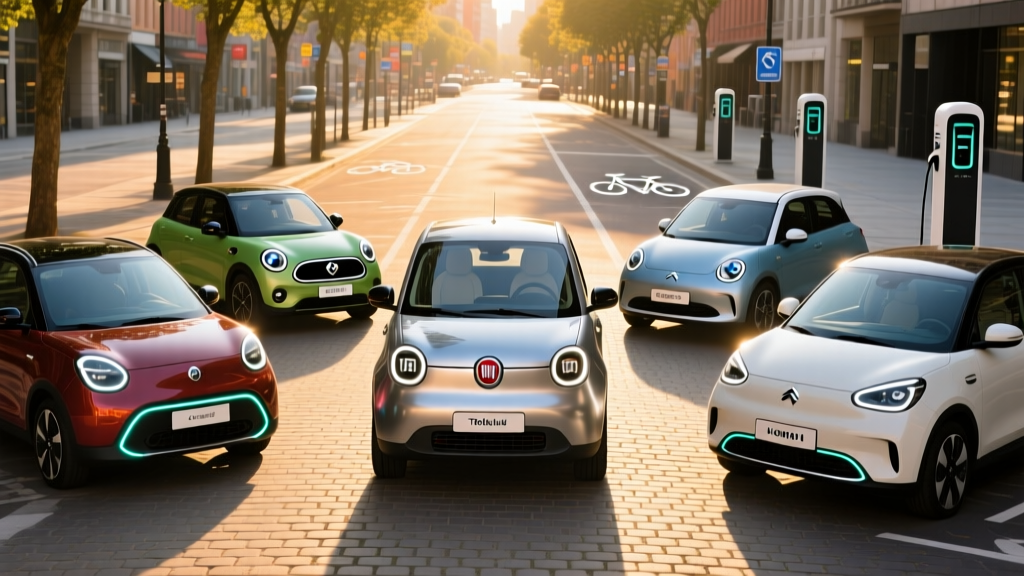
The Fiat Topolino EV is a reborn icon — a tiny, two-seat, doorless (or soft-door) electric quadricycle built on the same Stellantis platform as the Citroën Ami and Opel Rocks Electric. It targets European city centers where narrow streets, congestion charges, and 16-year-old driver eligibility make micro-mobility a practical category.
Fiat Topolino EV Key Specs (European Market)
| Battery | 5.5 kWh (usable), LFP chemistry |
| Range | ~47 miles (WLTP city cycle); expect ~35-40 miles real-world |
| Top Speed | 28 mph (45 km/h) — electronically limited |
| Motor | 6 kW (8 hp) |
| Charging | Level 1 only — standard 220V European household plug, 0-100% in ~4 hours |
| Weight | ~1,058 lbs (480 kg) curb weight |
| Length | 93.5 inches (2,375 mm) |
| Price (Europe) | ~€7,990 (~$8,700 USD) before local incentives |
The Topolino's charm is undeniable — retro-Fiat 500 styling, a canvas roll-back roof, and a footprint small enough to park perpendicular to a curb. But U.S. buyers face hard barriers:
- Not FMVSS-compliant: It lacks the crash structure, airbags, and lighting required for U.S. highway use. It cannot be legally registered as a street vehicle in any U.S. state.
- No U.S. dealer network: Stellantis has not announced plans to import the Topolino, Ami, or Rocks Electric to North America as of early 2026.
- No federal tax credit: The §30D clean vehicle credit requires a vehicle to be on the IRS qualified-vehicle list, which mandates FMVSS compliance and minimum battery/sourcing thresholds the Topolino does not meet.
- 28 mph top speed: Even if importable as a Low-Speed Vehicle (LSV), it would be restricted to roads with speed limits of 35 mph or below in most states.
If you're set on the Topolino aesthetic and can wait, Stellantis executives have hinted at a North American micro-EV concept, but nothing is confirmed. For now, here are the best alternatives you can actually drive in the U.S.
Our 2026 Micro-EV and City EV Rankings
Budget Tiers at a Glance
| Tier | Price Range (MSRP) | Vehicles | Best For |
|---|---|---|---|
| Ultra-Budget (Under $15K) | $8,000–$15,000 | LECTRIC ONE, Eli ZERO | Campus, gated community, last-mile |
| Mid-Budget ($15K–$35K) | $15,000–$35,000 | Nimbus Halo, Arcimoto FUV, Microlino (if available) | Urban commute, covered weather protection |
| Full-Speed City EV ($25K–$42K) | $25,000–$42,000 | Chevrolet Equinox EV 2LT, Nissan LEAF S, Mini Cooper SE, Hyundai Kona Electric | Highway-capable daily driver with city-friendly size |
🏆 Top Pick: Hyundai Kona Electric (2026)
For U.S. buyers who want Topolino-level city agility with full highway capability, real safety equipment, and genuine daily-driver range, the 2026 Kona Electric is the best all-around micro-footprint EV. Its 261-mile EPA range, 100+ kW DC fast charging, and sub-$34,000 starting price (before incentives) make it unbeatable on value per mile of range.
#1 — Hyundai Kona Electric (2026)
| EPA Range | 261 miles (SEL trim); real-world highway ~220-235 mi, cold weather ~190 mi |
| Battery | 65.4 kWh usable, NMC chemistry |
| DC Fast Charging | Peak ~105 kW; 10-80% in ~41 min (tapers sharply above 80%) |
| Level 2 Charging | 10.9 kW onboard charger; ~6.5 hours 0-100% |
| Motor | 150 kW (201 hp), FWD |
| 0-60 mph | 7.0 seconds |
| MSRP | $33,975 (SEL) / $37,975 (Limited) |
| Federal Tax Credit | Up to $7,500 via §30D (point-of-sale transfer available); verify battery sourcing and your AGI on IRS.gov |
| Why It's #1 | Best combination of compact dimensions (171" long, 35.2' turning circle), real highway range, fast charging, and a 10-year/100,000-mile battery warranty. The Topolino parks easier, but the Kona actually gets you anywhere. |
| Best For | Urban commuters who need highway access and weekend trip flexibility |
#2 — Chevrolet Equinox EV 2LT (2026)
| EPA Range | 319 miles (FWD 2LT); real-world highway ~270-285 mi |
| Battery | 85 kWh usable, NMC (Ultium platform) |
| DC Fast Charging | Peak 150 kW; 10-80% in ~32 min |
| Level 2 Charging | 11.5 kW; ~8 hours 0-100% |
| Motor | 156 kW (213 hp), FWD |
| 0-60 mph | 8.1 seconds |
| MSRP | $33,600 (2LT FWD) |
| Federal Tax Credit | Up to $7,500; GM's Ultium batteries meet critical-mineral and battery-component thresholds for full credit eligibility (verify on IRS.gov) |
| Why It's #2 | Highest range per dollar in this list. Slightly larger than the Kona (185" long), but the 319-mile EPA figure crushes range anxiety. Super Cruise availability on higher trims adds genuine hands-off highway driving (SAE Level 2 — you must remain attentive). |
| Best For | Budget-conscious buyers who want maximum range and don't mind a slightly larger footprint |
#3 — Nissan LEAF S (2026)
| EPA Range | 149 miles (S, 40 kWh); 226 miles (SV Plus, 60 kWh) |
| Battery | 40 kWh or 60 kWh usable, NMC |
| DC Fast Charging | Peak 100 kW (CHAdeMO); 10-80% in ~40 min — but CHAdeMO infrastructure is declining |
| Level 2 Charging | 6.6 kW; ~7-11 hours depending on pack size |
| Motor | 110 kW (147 hp, S) / 160 kW (214 hp, SV Plus) |
| 0-60 mph | 7.9 sec (S) / 6.9 sec (SV Plus) |
| MSRP | $28,140 (S) / $36,190 (SV Plus) |
| Federal Tax Credit | Eligible for up to $7,500; Nissan's battery sourcing qualifies under current §30D rules |
| Why It's #3 | The LEAF S at $28K is the cheapest full-speed, full-safety highway-capable EV on this list. Its 35.4' turning radius and 171" length rival the Kona for city maneuverability. The CHAdeMO connector is a real drawback — most new public DC fast chargers use CCS or NACS. |
| Best For | Price-first buyers who charge at home and rarely need public fast charging |
#4 — Mini Cooper SE (2026, 4th Gen)
| EPA Range | 146 miles (Classic); real-world city ~130 mi, highway ~110 mi |
| Battery | 40.7 kWh usable (net), NMC |
| DC Fast Charging | Peak 95 kW (CCS); 10-80% in ~30 min |
| Level 2 Charging | 11 kW; ~4.5 hours 0-100% |
| Motor | 135 kW (181 hp), FWD |
| 0-60 mph | 6.7 seconds |
| MSRP | $30,900 (Classic) / $35,900 (Favorite) |
| Federal Tax Credit | Up to $7,500 (verify sourcing — BMW Group battery supply chain may face partial FEOC restrictions in 2026) |
| Why It's #4 | The closest thing to the Topolino's personality in a street-legal U.S. vehicle. At 157" long with a 35.4' turning circle, it's the most parkable full-speed EV here. The 146-mile range is limiting for road trips but fine for 95% of urban commutes. |
| Best For | Style-conscious city dwellers who want premium feel and don't drive long distances |
#5 — Nimbus Halo (2026)
| EPA/Est. Range | ~98 miles (city cycle, manufacturer est.); real-world ~70-80 mi at mixed speeds |
| Battery | 12 kWh usable, LFP chemistry |
| Charging | Level 1 (120V): ~12 hours 0-100%; Level 2 (240V): ~3 hours |
| Top Speed | 50 mph (electronically limited, classified as an autocycle/motorcycle) |
| Motor | 15 kW (20 hp) |
| Footprint | 90" long × 36" wide — narrower than a motorcycle lane |
| MSRP | $9,980 (base, before shipping) |
| Federal Tax Credit | Not eligible for §30D (classified as motorcycle/autocycle, not a 4-wheel clean vehicle) |
| Why It's #5 | The Nimbus Halo is the closest U.S.-available analog to the Topolino's footprint-and-purpose philosophy. It leans into turns (gyroscopic stabilization), has a roof and doors, and fits in a bike lane. But 50 mph top speed means no freeways, and motorcycle licensing/registration rules vary by state. |
| Best For | Solo urban commuters with motorcycle endorsements who want weather protection in a micro-footprint |
#6 — Arcimoto FUV (Fun Utility Vehicle, 2026)
| Est. Range | 102 miles (city, manufacturer); real-world ~75-85 mi mixed |
| Battery | 17.3 kWh usable, NMC |
| Charging | Level 1: ~8 hours; Level 2 (6.6 kW): ~3 hours; no DC fast charging |
| Top Speed | 75 mph (classified as autocycle in most states) |
| Motor | 57 kW (77 hp) dual front motors |
| 0-60 mph | ~7.5 seconds |
| MSRP | $23,500 (base, 102-mi range package) |
| Federal Tax Credit | Not eligible for §30D (3-wheel autocycle classification) |
| Why It's #6 | Oregon-built, open-air, tandem-seat design with genuine 75 mph highway capability in most states. The 102-mile range is adequate for city-plus-suburb commutes. However, no doors, no climate control, and limited crash protection make it a fair-weather, warm-climate pick. |
| Best For | West Coast fair-weather commuters who want open-air driving with an EV conscience |
#7 — LECTRIC ONE (2026)
| Est. Range | ~40 miles (manufacturer, flat terrain, 165-lb rider); real-world ~25-35 mi |
| Battery | 4.8 kWh, LFP |
| Charging | 120V household outlet, ~5 hours 0-100% |
| Top Speed | 28 mph (LSV/NEV classification) |
| Motor | 5 kW (6.7 hp) |
| MSRP | $8,995 |
| Federal Tax Credit | Not eligible (LSV classification, does not meet §30D vehicle-type requirements) |
| Why It's #7 | The cheapest four-wheel enclosed electric vehicle you can buy in the U.S. It's a neighborhood runabout for gated communities, campuses, and 25-mph zones. No highway access, minimal crash protection, and bare-bones interior. But at under $9K with no fuel or oil costs, the math works for very specific use cases. |
| Best For | Retirement communities, large private campuses, and last-mile errands on low-speed roads |
#8 — Eli ZERO (2026)
| Est. Range | ~55 miles (manufacturer, city cycle); real-world ~40-45 mi |
| Battery | 6.2 kWh, LFP |
| Charging | 120V: ~6 hours; optional 240V: ~2.5 hours |
| Top Speed | 25 mph (NEV/LSV) |
| Motor | 4 kW (5.4 hp) |
| MSRP | $11,990 |
| Federal Tax Credit | Not eligible (§30D does not cover NEVs) |
| Why It's #8 | Slightly more refined than the LECTRIC ONE with better weather sealing, a more car-like cabin, and 55 miles of range. Still limited to 25 mph and low-speed roads. A viable grocery-getter if your entire life happens within a 5-mile radius on 35-mph-or-less streets. |
| Best For | Dense urban neighborhoods with low speed limits and reliable home charging access |
Side-by-Side: All 8 Picks Compared
| Vehicle | Range (mi) | Top Speed | Charge 0-100% | MSRP | §30D Credit | Highway Legal? |
|---|---|---|---|---|---|---|
| Hyundai Kona Electric | 261 (EPA) | 104 mph | ~6.5 hr (L2) | $33,975 | Up to $7,500 | Yes |
| Chevrolet Equinox EV 2LT | 319 (EPA) | 112 mph | ~8 hr (L2) | $33,600 | Up to $7,500 | Yes |
| Nissan LEAF S | 149 (EPA) | 90 mph | ~7 hr (L2) | $28,140 | Up to $7,500 | Yes |
| Mini Cooper SE | 146 (EPA) | 93 mph | ~4.5 hr (L2) | $30,900 | Up to $7,500* | Yes |
| Nimbus Halo | ~98 (est.) | 50 mph | ~3 hr (L2) | $9,980 | No | No (autocycle) |
| Arcimoto FUV | ~102 (est.) | 75 mph | ~3 hr (L2) | $23,500 | No | Limited (autocycle) |
| LECTRIC ONE | ~40 (est.) | 28 mph | ~5 hr (L1) | $8,995 | No | No (LSV) |
| Eli ZERO | ~55 (est.) | 25 mph | ~6 hr (L1) | $11,990 | No | No (NEV) |
| Fiat Topolino (EU only) | ~47 (WLTP) | 28 mph | ~4 hr (L1) | ~$8,700 | No | No (quadricycle) |
*Mini Cooper SE credit eligibility depends on battery-component and critical-mineral sourcing; verify current-year status at fueleconomy.gov.
Best Value After Federal Tax Credits
If you qualify for the full $7,500 §30D clean vehicle credit (income caps: $150K single / $300K joint; vehicle MSRP caps: $55K for sedans, $80K for SUVs/trucks; plus battery-sourcing requirements), the value math shifts dramatically:
| Vehicle | MSRP | After $7,500 Credit | Effective $/Mile of Range |
|---|---|---|---|
| Chevy Equinox EV 2LT | $33,600 | ~$26,100 | $82/mile |
| Nissan LEAF S | $28,140 | ~$20,640 | $139/mile |
| Hyundai Kona Electric SEL | $33,975 | ~$26,475 | $101/mile |
| Mini Cooper SE Classic | $30,900 | ~$23,400* | $160/mile* |
*Mini credit amount subject to sourcing verification. Check IRS clean vehicle credits page before purchasing.
The Chevrolet Equinox EV 2LT delivers the best range-per-dollar after the credit at just $82 per EPA mile. The Nissan LEAF S is the cheapest absolute outlay at ~$20,640, but you're paying more per mile of range and accepting the CHAdeMO connector risk.
Which Should You Pick? A Decision Framework
Choose the Hyundai Kona Electric if: You need one vehicle that handles city commuting, highway merging, road trips, and winter driving — and you want the smallest footprint that still does all of it. The 10-year/100K-mile battery warranty is the best in the business.
Choose the Chevrolet Equinox EV if: Range is your top priority and you don't mind a vehicle that's 14 inches longer than the Kona. The 319-mile EPA range and Super Cruise option make it the best road-trip companion on this list.
Choose the Nissan LEAF S if: You want the lowest purchase price for a full-speed, full-safety EV and you charge primarily at home. Accept that CHAdeMO public charging is a dying standard.
Choose the Mini Cooper SE if: You prioritize driving fun, brand cachet, and the smallest parkable footprint in a highway-legal vehicle. Budget 146 miles realistically and plan your road trips around charging.
Choose the Nimbus Halo or Arcimoto FUV if: You live in a warm climate, have a motorcycle endorsement (or your state doesn't require one for autocycles), and want the absolute smallest footprint with weather protection. These are secondary vehicles, not primary family transport.
Choose the LECTRIC ONE or Eli ZERO if: Your entire driving life happens within 5-10 miles on roads posted 35 mph or below — think retirement community, island living, or dense urban core with dedicated low-speed infrastructure.
Wait for the Fiat Topolino only if: You live in Europe, or you're willing to wait years for a hypothetical U.S. import that Stellantis has not confirmed.
Charging Reality for Micro-EVs and City EVs
One advantage of small-battery EVs: Level 1 charging (standard 120V household outlet) is actually viable. Here's what to expect:
| Vehicle | Battery (kWh) | Level 1 Time (120V/12A) | Level 2 Time (240V) | DC Fast Charge? |
|---|---|---|---|---|
| Kona Electric | 65.4 | ~55 hours (impractical) | ~6.5 hours | Yes, 105 kW peak |
| Equinox EV | 85.0 | ~70 hours (impractical) | ~8 hours | Yes, 150 kW peak |
| LEAF S | 40.0 | ~28 hours | ~7 hours | Yes, 100 kW (CHAdeMO) |
| Mini Cooper SE | 40.7 | ~30 hours | ~4.5 hours | Yes, 95 kW (CCS) |
| Nimbus Halo | 12.0 | ~12 hours | ~3 hours | No |
| LECTRIC ONE | 4.8 | ~5 hours | N/A | No |
| Fiat Topolino | 5.5 | ~4 hours (220V EU) | N/A | No |
Key insight: Vehicles with batteries under 15 kWh (Topolino, LECTRIC, Eli, Nimbus) can fully recharge overnight on a standard wall outlet. This eliminates the $500-$2,000 cost of a Level 2 home charger installation — a significant ownership advantage for the micro-EV segment. Vehicles above 40 kWh need Level 2 to be practical for daily use.
Frequently Asked Questions
Can I import the Fiat Topolino EV to the United States?
Not for street use. The Topolino is classified as a European L6e light quadricycle and does not meet FMVSS safety standards required for U.S. vehicle registration. The "show or display" import exemption applies only to vehicles of historical/technological significance that are at least 25 years old. There is no legal pathway to register a new Topolino for U.S. roads as of 2026.
Will Stellantis bring the Fiat Topolino or Citroën Ami to the U.S.?
Stellantis has not announced any North American launch for its micro-EV quadricycle platform. Company executives have mentioned monitoring the segment, but U.S. safety regulations and the lack of a quadricycle vehicle class make import unlikely without significant redesign. If it happens, expect it no earlier than 2028.
Do the LSV and NEV picks (LECTRIC, Eli) qualify for any tax incentives?
They do not qualify for the federal §30D clean vehicle credit, which requires a 4-wheeled vehicle with a gross vehicle weight rating under 14,000 lbs that meets full FMVSS standards. Some states and municipalities offer local incentives for LSVs — check your state energy office or AFDC incentive database for current programs.
What's the real-world range loss in cold weather for these picks?
Expect 20-35% range reduction at 20°F compared to EPA estimates for NMC-battery vehicles (Kona, LEAF, Mini, Equinox). LFP batteries (Topolino, Nimbus, LECTRIC, Eli) lose 15-25% in cold, slightly better due to LFP's thermal characteristics, but their already-short ranges make this loss more painful in absolute miles. The Kona Electric's heat pump (standard on Limited trim, optional on SEL) mitigates this to ~15-20% loss.
Is the Nimbus Halo safe compared to a regular car?
No. The Nimbus Halo is classified as an autocycle/motorcycle and does not undergo NHTSA crash testing to FMVSS passenger-car standards. It has a roll cage, seatbelts, and airbags, but its lightweight construction and narrow track offer substantially less crash protection than a Kona or LEAF. It's safest on low-speed urban streets, not mixed-traffic arterials.
Which of these vehicles has the lowest total cost of ownership?
Over 5 years at 8,000 miles/year, the Nissan LEAF S (after $7,500 credit) has the lowest TCO among highway-legal picks at roughly $0.04/mile for electricity (home charging at $0.14/kWh), no oil changes, and lower insurance than the Kona or Equinox. The LECTRIC ONE is cheapest overall if your use case fits its limitations — under $0.02/mile for energy and minimal maintenance — but it can't replace a real car for most people.
Sources: EPA range data from fueleconomy.gov; federal tax credit rules from IRS.gov §30D; vehicle specifications from manufacturer press sites. All prices and credit eligibility reflect 2026 model-year data and are subject to change. Verify your personal eligibility with a tax professional before purchase.