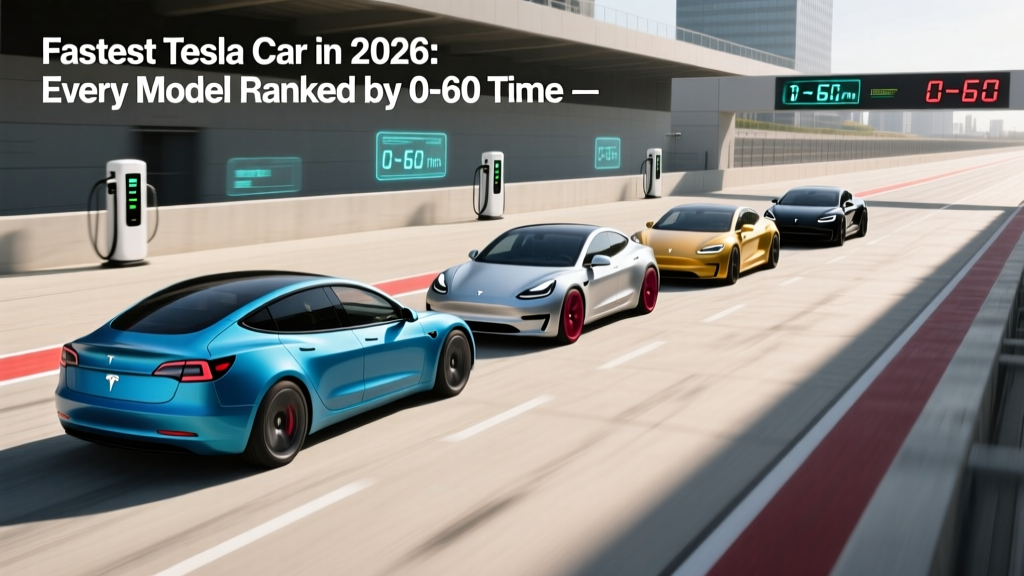
What Makes a Tesla the 'Fastest' — Our Selection Criteria
How we rank the fastest Tesla car: Straight-line acceleration (0-60 mph) is the headline metric, but we evaluate every current-production Tesla across five weighted factors to give buyers a complete picture:
- 0-60 mph time (40% weight) — manufacturer-claimed with rollout subtracted, cross-checked against independent instrumented testing where available.
- Peak horsepower & torque (15%) — total system output across all motors.
- Quarter-mile time and trap speed (15%) — sustained power delivery matters beyond the initial launch.
- Usability trade-offs (15%) — EPA range, cargo capacity, and daily-driver practicality at this performance level.
- Price-to-performance value (15%) — cost per horsepower and federal tax credit (§30D) eligibility.
Only current-production, US-spec models available to order in 2026 are included. Discontinued variants (original Roadster, pre-refresh Model S Plaid with legacy interior) are excluded. The upcoming Roadster 2 is labeled as announced/preliminary.
The Fastest Tesla Car: Every 2026 Model Ranked
Tesla's lineup has stabilized around five core vehicles, but the performance spread is enormous — from a 6.9-second Model Y Long Range to the sub-2-second promise of the next-gen Roadster. Below, we rank every current and announced Tesla by verified or manufacturer-claimed 0-60 mph acceleration, with the full spec context buyers actually need.
#1 — Tesla Roadster (Announced / Preliminary)
0-60 mph: 1.9 seconds (claimed, with SpaceX cold-gas thruster package) | Top Speed: 250+ mph | HP: ~1,000+ (tri-motor AWD) | EPA Range: TBD (claimed 620 mi) | Price: ~$200,000 base / $250,000 Founders Series
Why it made the list: If it ships as specified, the Roadster will be not just the fastest Tesla car ever built, but one of the quickest production vehicles on Earth. The tri-motor powertrain with torque vectoring and the optional SpaceX thruster package (cold-gas nitrogen jets behind the rear license plate area) target sub-1-second 0-60 potential. Tesla has held reservations since 2017.
Best for: Hypercar collectors and early reservation holders willing to wait. Not a practical daily driver — two seats, minimal cargo, and no confirmed delivery timeline as of early 2026.
Tax credit: Not eligible. MSRP far exceeds the §30D cap of $55,000 for sedans/sports cars, and buyer income limits apply. No point-of-sale transfer available at this price tier.
Real-world caveat: All specs are preliminary and unverified by EPA or independent testers. Tesla has delayed this program multiple times. Treat 620-mile range and 1.9-second claims as targets, not guarantees.
#2 — Tesla Model S Plaid
0-60 mph: 1.99 seconds | Top Speed: 200 mph (with Track Package) | HP: 1,020 (tri-motor AWD) | EPA Range: 396 mi | Battery: ~100 kWh usable, NMC | Price: $89,990 (before incentives)
Why it made the list: The Model S Plaid remains the fastest Tesla car you can actually buy and take delivery of today. Its tri-motor setup — one front, two rear — delivers 1,020 hp through carbon-sleeve rotors that spin to 20,000+ RPM without disintegration. Independent testing by Motor Trend and Car and Driver has confirmed sub-2.0-second 0-60 runs with rollout subtracted and prepped surfaces.
Best for: Performance enthusiasts who want supercar acceleration with a full-size sedan's practicality — 28 cu ft of cargo, five seats, and a 396-mile EPA range that makes road trips viable.
Tax credit: Not eligible. MSRP exceeds the §30D $55,000 sedan cap. Check current IRS §30D rules for any legislative updates.
Real-world caveat: Expect 330-350 miles of range in mixed highway driving at 70-80 mph, and roughly 270-290 miles in freezing temperatures. The Plaid's performance comes with higher tire wear — the Michelin Pilot Sport 4S or Pirelli P Zero (21" Arachnid wheels) typically last 12,000-18,000 miles under spirited use. DC fast charging peaks at 250 kW on V3 Superchargers, delivering a 10-80% charge in approximately 25-30 minutes, with significant taper above 80%.
#3 — Tesla Model X Plaid
0-60 mph: 2.5 seconds | Top Speed: 163 mph | HP: 1,020 (tri-motor AWD) | EPA Range: 326 mi | Battery: ~100 kWh usable, NMC | Price: $94,990
Why it made the list: Sharing the Model S Plaid's tri-motor powertrain, the Model X Plaid puts 1,020 hp into a three-row SUV with falcon-wing rear doors. A 2.5-second 0-60 in a 5,100-lb SUV with up to seven passengers is physics-defying territory.
Best for: Families who refuse to compromise on acceleration. The falcon-wing doors ease child-seat loading in tight parking spots, and the 91 cu ft of max cargo volume (with second and third rows folded) beats most midsize SUVs.
Tax credit: Not eligible. MSRP exceeds the §30D $80,000 cap for SUVs/pickups. Always verify current rules at irs.gov.
Real-world caveat: The Model X's aerodynamic drag coefficient (0.24 Cd) is excellent for an SUV, but its weight and frontal area still cost range at highway speeds. Expect 270-290 miles real-world on the interstate, less when towing (3,500-lb max). Charging mirrors the Model S Plaid at 250 kW peak.
#4 — Tesla Model 3 Performance (Highland Refresh)
0-60 mph: 2.9 seconds | Top Speed: 163 mph | HP: 510 (dual-motor AWD) | EPA Range: 315 mi | Battery: ~82 kWh usable, NMC | Price: $54,990
Why it made the list: The Highland-refreshed Model 3 Performance is the fastest Tesla car most buyers will ever consider. At $54,990 before incentives, it delivers sub-3-second acceleration with a redesigned adaptive suspension, ventilated front seats, and a rear touchscreen — addressing the biggest complaints about the pre-refresh model.
Best for: Driving enthusiasts on a relative budget. This is the entry point into sub-3-second territory from any automaker, full stop. The 315-mile EPA range and 250 kW peak DC charging make it a practical daily driver and road-trip car.
Tax credit: Potentially eligible. At $54,990, it sits just under the §30D $55,000 MSRP cap for sedans. Buyer must meet income limits ($150K single / $300K joint AGI) and the vehicle must satisfy critical-mineral and battery-component sourcing requirements. Up to $7,500 is available as a point-of-sale transfer. Confirm eligibility at fueleconomy.gov and irs.gov.
Real-world caveat: Real-world highway range typically lands at 265-285 miles. Cold weather (below 32°F) can reduce range by 15-25% depending on cabin heating demand — the Model 3 Performance includes a heat pump, which helps significantly versus resistive heating. Track use will degrade range rapidly; expect 80-100 miles of equivalent range per track session.
#5 — Tesla Model Y Performance (Juniper Refresh)
0-60 mph: 3.5 seconds | Top Speed: 155 mph | HP: ~480 (dual-motor AWD) | EPA Range: 285 mi | Battery: ~78 kWh usable, NMC | Price: $53,990
Why it made the list: The Juniper-refreshed Model Y Performance brings a retuned suspension, new interior materials, and slightly improved efficiency to Tesla's best-selling vehicle. A 3.5-second 0-60 in a compact crossover with 76 cu ft of max cargo is the definition of a do-it-all performance vehicle.
Best for: Buyers who need crossover utility (cargo, ride height, optional third row for small children) but still want genuine sports-sedan acceleration. The most practical fast Tesla in the lineup.
Tax credit: Potentially eligible. At $53,990, it qualifies under the §30D $80,000 SUV/truck MSRP cap. Same income and sourcing requirements apply as the Model 3 Performance. Verify at fueleconomy.gov.
Real-world caveat: Expect 240-260 miles of real-world highway range, and 200-220 miles in winter conditions. The Model Y's taller profile means more aero drag than the Model 3, which shows at sustained 80+ mph speeds. Peak DC charging is 250 kW, 10-80% in roughly 25-28 minutes.
#6 — Tesla Model S Long Range
0-60 mph: 3.1 seconds | Top Speed: 155 mph | HP: 670 (dual-motor AWD) | EPA Range: 402 mi | Battery: ~100 kWh usable, NMC | Price: $74,990
Why it made the list: The Model S Long Range is often overlooked in fastest-Tesla conversations, but 670 hp and a 3.1-second 0-60 make it quicker than most sports cars — while delivering the longest EPA range of any Tesla at 402 miles.
Best for: Road-trippers who want serious acceleration without the Plaid price premium. The $15,000 gap between Long Range and Plaid buys you 6 extra miles of EPA range and noticeably lower insurance premiums.
Tax credit: Not eligible. MSRP exceeds the §30D $55,000 sedan cap.
Real-world caveat: 402 miles EPA is achievable in mild conditions at moderate speeds (55-65 mph, 60-75°F). Expect 340-370 miles in real-world mixed driving, and 280-310 miles in winter. The Long Range shares the Plaid's 250 kW peak DC charging.
#7 — Tesla Model 3 Long Range AWD (Highland)
0-60 mph: 4.2 seconds | Top Speed: 125 mph | HP: 346 (dual-motor AWD) | EPA Range: 341 mi | Battery: ~82 kWh usable, NMC | Price: $47,740
Why it made the list: While not a "performance" model, the Model 3 Long Range AWD still hits 60 mph in 4.2 seconds — quicker than a VW GTI or Subaru WRX — at a price that can qualify for the full federal tax credit.
Best for: Value-focused buyers who want strong (not extreme) acceleration paired with 341 miles of EPA range and the lowest cost-per-mile in the Tesla lineup.
Tax credit: Strong candidate. At $47,740, it clears the $55,000 sedan MSRP cap with room to spare. Assuming buyer income eligibility and current sourcing compliance, up to $7,500 can be applied at point of sale, bringing effective price to ~$40,240.
Real-world caveat: Expect 290-310 miles real-world, and 240-270 in cold weather. Peak DC charging at 250 kW, 10-80% in ~25 minutes.
#8 — Tesla Model Y Long Range AWD (Juniper)
0-60 mph: 4.8 seconds | Top Speed: 125 mph | HP: ~384 (dual-motor AWD) | EPA Range: 320 mi | Battery: ~78 kWh usable, NMC | Price: $48,990
Why it made the list: The best-selling Tesla in America still delivers 4.8-second acceleration — competitive with a BMW 330i — while offering crossover practicality and potential tax credit savings.
Best for: The mainstream buyer who wants a fast-enough EV SUV with the lowest effective price after incentives. Not a track car, but genuinely quick for merging and passing.
Tax credit: Likely eligible. Under the $80,000 SUV cap. Effective price after $7,500 point-of-sale credit: ~$41,490. Verify sourcing and income at irs.gov.
Real-world caveat: Real-world range of 270-290 miles highway, 220-250 in winter. Adequate for most commutes and road trips with Supercharger planning.
#9 — Tesla Model 3 RWD (Base Highland)
0-60 mph: 5.8 seconds | Top Speed: 125 mph | HP: 271 (single-motor RWD) | EPA Range: 272 mi | Battery: ~60 kWh usable, LFP | Price: $38,990
Why it made the list: The base Model 3 is the cheapest way into a Tesla, and 5.8 seconds is still quicker than most gas-powered compact sedans. Its LFP battery chemistry also allows routine 100% charging without degradation concerns.
Best for: Budget-conscious first-time EV buyers and fleet/lease customers. The LFP battery trades energy density for exceptional cycle life and the ability to charge to 100% daily.
Tax credit: Likely eligible. Well under the $55,000 sedan cap. Effective price after credit: ~$31,490 — one of the cheapest new EVs in America when eligible.
Real-world caveat: 272 EPA miles drops to 230-245 real-world, and 180-210 in cold weather. LFP batteries lose more range in freezing temps than NMC. DC charging peaks at ~170 kW — slower than AWD variants. 10-80% in roughly 28-32 minutes.
#10 — Tesla Model X Long Range
0-60 mph: 3.8 seconds | Top Speed: 155 mph | HP: 670 (dual-motor AWD) | EPA Range: 335 mi | Battery: ~100 kWh usable, NMC | Price: $79,990
Why it made the list: The Model X Long Range rounds out the lineup as a quick, long-range three-row SUV. 3.8 seconds from a family hauler is impressive, even if it's the slowest current Tesla on this list by 0-60.
Best for: Families prioritizing range and comfort over maximum acceleration. The $15,000 savings versus the X Plaid is meaningful when you factor in insurance and tire costs.
Tax credit: Not eligible. MSRP is $79,990, and while the SUV cap is $80,000, destination charges and common options push it over. Verify final window sticker price.
Real-world caveat: Expect 280-300 miles real-world, 230-260 in winter. Towing (3,500-lb max) cuts range further.
Side-by-Side: Every 2026 Tesla Compared
| Model | 0-60 mph | HP | EPA Range | Battery (kWh) | Peak DC kW | 10-80% Min | Base MSRP |
|---|---|---|---|---|---|---|---|
| Roadster (announced) | 1.9s* | ~1,000+ | 620 mi* | TBD | TBD | TBD | $200,000* |
| Model S Plaid | 1.99s | 1,020 | 396 mi | ~100 | 250 | ~27 | $89,990 |
| Model X Plaid | 2.5s | 1,020 | 326 mi | ~100 | 250 | ~28 | $94,990 |
| Model 3 Performance | 2.9s | 510 | 315 mi | ~82 | 250 | ~25 | $54,990 |
| Model S Long Range | 3.1s | 670 | 402 mi | ~100 | 250 | ~27 | $74,990 |
| Model Y Performance | 3.5s | ~480 | 285 mi | ~78 | 250 | ~26 | $53,990 |
| Model X Long Range | 3.8s | 670 | 335 mi | ~100 | 250 | ~28 | $79,990 |
| Model 3 Long Range AWD | 4.2s | 346 | 341 mi | ~82 | 250 | ~25 | $47,740 |
| Model Y Long Range AWD | 4.8s | ~384 | 320 mi | ~78 | 250 | ~26 | $48,990 |
| Model 3 RWD | 5.8s | 271 | 272 mi | ~60 | ~170 | ~30 | $38,990 |
* Preliminary/manufacturer-claimed. Not EPA-verified. Specs subject to change before production.
Budget Tiers: Fastest Tesla by Price Bracket
| Tier | Price Range | Best Pick | 0-60 mph | After §30D Credit |
|---|---|---|---|---|
| Under $40K | $31,490 – $38,990 | Model 3 RWD | 5.8s | ~$31,490 |
| $40K – $50K | $40,240 – $48,990 | Model 3 Long Range AWD | 4.2s | ~$40,240 |
| $50K – $60K | $46,490 – $54,990 | Model 3 Performance | 2.9s | ~$47,490 |
| $70K+ | $74,990 – $94,990 | Model S Plaid | 1.99s | No credit |
§30D credit eligibility depends on buyer AGI, vehicle MSRP, battery sourcing, and point-of-sale transfer. Confirm at irs.gov before purchase.
Top Pick and Runner-Ups: Which Fastest Tesla Should You Buy?
🏆 Top Pick: Tesla Model 3 Performance
The Model 3 Performance is the fastest Tesla car that balances extreme acceleration, daily-driver practicality, and potential tax credit savings. At $54,990 — potentially $47,490 after the §30D credit — it delivers 2.9-second 0-60 times that rival a Porsche 911 Carrera 4S, with 315 miles of EPA range, 250 kW DC fast charging, and the lowest insurance and maintenance costs in Tesla's performance lineup. The Highland refresh finally added adaptive dampers, ventilated seats, and rear cabin controls, resolving the previous generation's biggest gaps.
Choose the Model 3 Performance if: You want sub-3-second acceleration, qualify for the federal tax credit (sedan MSRP under $55K, income under $150K/$300K AGI), and don't need SUV cargo space.
Runner-Up: Tesla Model S Plaid
If budget is not a constraint and you want the absolute fastest Tesla car in production, the Model S Plaid at $89,990 delivers 1.99-second 0-60 times, 1,020 hp, and a 396-mile EPA range in a luxury sedan. It is the performance benchmark — but it does not qualify for the federal tax credit, and its higher weight means greater tire and brake consumable costs.
Best Value After Tax Credit: Tesla Model 3 Long Range AWD
At $47,740 before incentives and roughly $40,240 after the §30D credit, the Model 3 Long Range AWD offers 4.2-second 0-60 performance (quicker than most hot hatches), 341 miles of EPA range, and dual-motor AWD. It is the best all-around value in Tesla's lineup for buyers who want strong-but-not-extreme acceleration.
Best Performance SUV: Tesla Model Y Performance
The Juniper-refreshed Model Y Performance at $53,990 (potentially ~$46,490 after credit) delivers 3.5-second 0-60 times with 76 cu ft of cargo volume and an available third row. No other compact crossover comes close to this combination of speed and utility.
Key Performance Factors Buyers Should Understand
Rollout-Subtracted vs. Standard 0-60 Times
Tesla reports 0-60 mph times with a 1-foot rollout subtracted (common in drag racing), which shaves roughly 0.2-0.3 seconds off the clock. Independent tests using standard timing (no rollout) typically add 0.2-0.3 seconds. A Model S Plaid at "1.99 seconds" is approximately 2.1-2.2 seconds by conventional measurement — still extraordinary, but buyers should understand the methodology.
The Charge-Curve Reality at Track Days
Repeated hard acceleration and track sessions heat the battery pack rapidly. Tesla's thermal management system will limit power output to protect the cells once pack temperature exceeds safe thresholds. Expect reduced acceleration ("power limited" warnings) after 2-3 consecutive full-power launches in warm weather. Preconditioning via the Tesla app or navigation to a Supercharger helps, but sustained track use is not what these vehicles are optimized for — the Plaid models are drag-strip and street performers, not endurance racers.
Tire Costs at 1,000+ Horsepower
The Model S and X Plaid consume rear tires aggressively. Budget $1,200-$2,000 per axle for replacement Michelin Pilot Sport 4S or equivalent, and expect 12,000-18,000 miles of life under normal spirited use. The Model 3 Performance is gentler on tires but still demands premium rubber to deliver its claimed 0-60 times — all-season tires will add 0.3-0.5 seconds.
Frequently Asked Questions
What is the fastest Tesla car you can buy right now?
The Tesla Model S Plaid is the fastest Tesla currently in production and available for delivery, with a 1.99-second 0-60 mph time and 1,020 hp. The next-generation Roadster is announced but has no confirmed delivery date as of early 2026.
Does the Tesla Model 3 Performance qualify for the $7,500 tax credit?
At $54,990 MSRP, the Model 3 Performance sits just under the §30D $55,000 sedan cap, making it potentially eligible. The buyer must also meet income limits ($150,000 single / $300,000 joint modified AGI) and the vehicle must satisfy critical-mineral and battery-component sourcing rules. Up to $7,500 can be applied as a point-of-sale reduction. Always confirm current eligibility at fueleconomy.gov and irs.gov before purchasing.
Is the Tesla Model S Plaid faster than a Bugatti or Rimac?
In 0-60 mph acceleration, the Model S Plaid (1.99s) trades blows with the Rimac Nevera (1.85s) and surpasses most Bugatti models. However, hypercars typically outperform the Plaid in quarter-mile trap speed, top speed, lateral grip, and sustained track pace. The Plaid's advantage is delivering this performance at $89,990 versus $2M+ for hypercars.
How much real-world range do Tesla Performance models lose?
Expect 10-15% less range than the EPA sticker in mixed real-world driving, and 15-25% less in freezing temperatures. Highway driving at 75-80 mph costs more range than city driving due to aerodynamic drag. Performance trims with wider tires and larger wheels also lose 5-10% versus Long Range equivalents.
Can you daily-drive a Tesla Plaid model?
Yes. The Model S Plaid and Model X Plaid have the same ride comfort, cabin noise levels, and adaptive suspension compliance as their Long Range siblings in Comfort drive mode. The performance hardware only activates in Sport/Track modes. Daily drivability is excellent — the main trade-offs are higher insurance premiums (typically 20-40% above Long Range) and faster tire wear.
Is Tesla's FSD (Full Self-Driving) available on all models?
Yes, FSD (Supervised) is available as a software purchase or subscription on all current Tesla models. However, FSD is an SAE Level 2 driver-assistance system — the driver must remain fully engaged and supervise at all times. It is not autonomous or self-driving. Only Level 4 systems (like Waymo's robotaxi) operate without a human driver.