What Makes an EV the 'Fastest Car' Worth Buying?
When shoppers search for the electric fastest car, they're usually chasing one number: 0-60 mph time. But straight-line acceleration alone doesn't tell the whole story. A hypercar that hits 60 in 1.8 seconds but costs $2.4 million and can't pass a crash test isn't useful to 99% of buyers. This roundup ranks the quickest production EVs you can actually purchase in the U.S. right now, balancing raw acceleration with real-world usability — range, charging speed, daily-drivability, and price.
Selection Criteria
- Primary metric: Manufacturer-claimed 0-60 mph time (verified against independent testing where available)
- Must be currently on sale in the U.S. as a 2025 or 2026 model year — no concepts, no vaporware
- Minimum 200 miles EPA range — a fast car that needs a charge every 140 miles isn't practical
- DC fast-charge capable at 150 kW or higher peak rate
- Price tiers considered: from sub-$60K performance sedans to six-figure hyper-GTs
Below, we rank seven EVs from quickest to merely devastating, with the data you need to decide whether the performance premium is worth it for your garage.
The 7 Quickest EVs Ranked by 0-60 Time
#1 — Lucid Air Sapphire
0-60 mph: 1.89 seconds | EPA Range: 427 mi | Price: $249,000
Why it made the list: The Air Sapphire is the current benchmark for production-car acceleration, full stop. Its tri-motor setup produces 1,234 horsepower, and unlike many hyper-EVs, it backs that up with a usable 427-mile EPA range from its 118 kWh (usable) NMC battery pack. On a 150 kW DC fast charger, expect a 10-80% session in roughly 28 minutes, though Lucid's 900V+ architecture supports peak rates up to 300 kW at compatible stalls — cutting that to around 20 minutes. The Sapphire also posts a 6.8-second quarter-mile, making it competitive with $3M+ hypercars from Bugatti and Koenigsegg at a fraction of the cost.
Real-world caveat: Expect highway range closer to 340-360 miles at 75 mph in moderate temperatures. Cold-weather highway range may dip to ~300 miles.
Best for: Buyers who want the absolute quickest production car on Earth and also need a four-door sedan for daily use.
Tax credit: Not eligible for the §30D new-vehicle credit (MSRP exceeds the $55,000 sedan cap). See IRS §30D rules.
#2 — Tesla Model S Plaid
0-60 mph: 1.99 seconds | EPA Range: 396 mi | Price: $89,990
Why it made the list: The Model S Plaid remains the best value proposition in sub-2-second acceleration. Tesla's tri-motor powertrain delivers 1,020 HP with a 100 kWh (usable) NMC pack. The Plaid's advantage is its mature Supercharger network access — peak rates around 250 kW yield 10-80% charges in approximately 25 minutes. At $89,990, it undercuts the Sapphire by $159,000 while trailing by just a tenth of a second to 60.
Real-world caveat: Highway testing typically yields 310-340 miles at 70 mph. Track-mode use significantly reduces range — a single hot lap at full power can consume 5-8 miles of range equivalent.
Best for: Performance enthusiasts who want sub-2-second acceleration with the most reliable public charging infrastructure available.
Tax credit: Not eligible — exceeds the $55,000 sedan MSRP cap.
#3 — Rimac Nevera
0-60 mph: 1.74 seconds | EPA Range: N/A (WLTP ~340 mi) | Price: ~$2,400,000
Why it made the list: If we're ranking purely by stopwatch, the Nevera's 1.74-second sprint (with rollout subtracted, as claimed by Rimac) technically beats the Sapphire. However, it lands at #3 because it's a limited-production, two-seat hypercar with no EPA certification, no practical cargo space, and a build run of just 150 units worldwide. Its 120 kWh NMC battery and four-motor, 1,914 HP setup are engineering marvels, but this is a collector's machine, not a daily driver.
Real-world caveat: WLTP range of ~340 miles translates to roughly 270-290 miles in real-world mixed driving. DC fast charging tops out around 250 kW peak, 10-80% in ~22 minutes.
Best for: Hypercar collectors seeking the ultimate EV trophy with record-breaking acceleration.
Tax credit: Not eligible — far exceeds all MSRP caps.
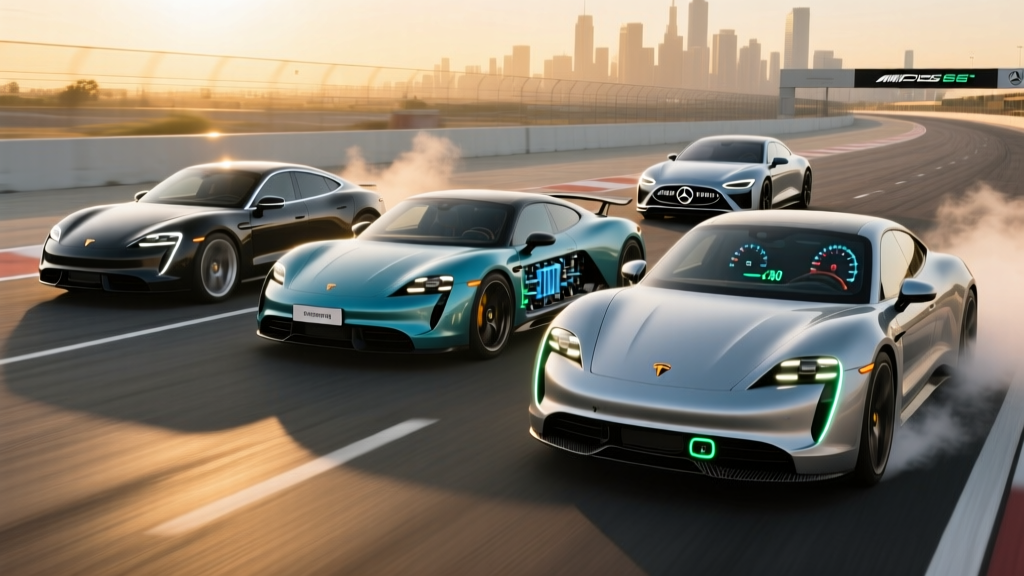
#4 — Porsche Taycan Turbo GT (with Weissach Package)
0-60 mph: 2.1 seconds | EPA Range: 269 mi | Price: $230,000
Why it made the list: The Taycan Turbo GT is Porsche's answer to the question "what if a 911 GT3 were electric and had four doors?" Its 800-volt architecture allows sustained DC charging at up to 320 kW peak — the fastest real-world charging curve in this list, with 10-80% in approximately 18 minutes at a compatible 350 kW charger. The 101.9 kWh (usable) NMC battery and dual-motor setup produce up to 1,092 HP in Launch Control mode. Where the Taycan GT excels is sustained track performance: Porsche's thermal management keeps power delivery consistent lap after lap, something the Plaid and Sapphire struggle with under repeated hard use.
Real-world caveat: EPA range of 269 miles is the lowest in this roundup. Expect ~220-230 miles on the highway at 75 mph. This is a track-day car first, road-trip car second.
Best for: Track-focused drivers who value repeatable performance and class-leading charging speed over maximum range.
Tax credit: Not eligible — exceeds sedan MSRP cap.
#5 — BMW iX M60
0-60 mph: 3.6 seconds | EPA Range: 296 mi | Price: $111,500
Why it made the list: The iX M60 is the quickest luxury SUV on this list and the most practical daily driver in the top seven. BMW's dual-motor setup produces 610 HP and 811 lb-ft of torque from a 105.2 kWh (usable) NMC battery. DC fast charging peaks at 195 kW, yielding 10-80% in roughly 31 minutes. The iX M60 also offers 35.5 cu ft of cargo space behind the rear seats — more than anything else here — plus a refined interior with BMW's iDrive 8.5 system.
Real-world caveat: Highway range in testing typically falls between 250-270 miles at 70 mph. Cold weather (below 30°F) may reduce range by 15-20%, putting winter highway range around 210-230 miles.
Best for: Families who want sports-sedan acceleration in an SUV body with genuine cargo utility.
Tax credit: Not eligible — exceeds the $80,000 SUV MSRP cap for §30D.
#6 — Hyundai Ioniq 5 N
0-60 mph: 3.25 seconds | EPA Range: 221 mi | Price: $66,100
Why it made the list: The Ioniq 5 N is the performance bargain of this group and the most engaging driver's car under $70,000. Hyundai's N division tuned the dual-motor powertrain to 641 HP (with N Grin Boost engaged for 10-second bursts) and added a simulated 8-speed dual-clutch shift feel, active sound design, and a chassis that genuinely communicates through the steering wheel. The 84 kWh (usable) NMC battery supports peak DC charging at 240 kW — 10-80% in approximately 18 minutes on a compatible 350 kW charger. It's also the only vehicle here with a simulated "N e-shift" mode that mimics gear changes for track-day entertainment.
Real-world caveat: The 221-mile EPA range is modest. Aggressive driving drops range dramatically — expect 140-160 miles during spirited canyon or track sessions. Highway cruising at 70 mph yields around 190-200 miles. Preconditioning the battery before DC fast charging is critical to hitting the 18-minute 10-80% time; without it, the charge curve tapers earlier and the session stretches past 25 minutes.
Best for: Driving enthusiasts on a relative budget who want an EV that's genuinely fun on a back road, not just quick in a straight line.
Tax credit: Not currently eligible for §30D — the Ioniq 5 N is built in South Korea and does not meet the North American final-assembly requirement. Verify current sourcing rules at IRS.gov.
#7 — Tesla Model 3 Performance (2026 Refresh)
0-60 mph: 2.9 seconds | EPA Range: 315 mi | Price: $54,990
Why it made the list: The refreshed Model 3 Performance delivers supercar-adjacent acceleration for the price of a well-optioned BMW 3 Series. Tesla's dual-motor setup produces 510 HP from a 79 kWh (usable) LFP-based pack (updated chemistry for the 2026 refresh). DC fast charging peaks at 250 kW on V3 Superchargers, with 10-80% in roughly 25 minutes. The new adaptive dampers and revised steering tune address the previous generation's ride-quality complaints.
Real-world caveat: Highway range at 75 mph typically measures 260-280 miles. LFP chemistry retains capacity well over time (often >90% after 100,000 miles), but cold-weather range loss can be more pronounced than NMC — budget for ~220 miles of highway range below freezing.
Best for: Budget-conscious buyers who want the most acceleration per dollar with access to the Supercharger network.
Tax credit: Eligibility for the $7,500 §30D credit depends on current battery-sourcing and critical-mineral requirements, which shift periodically. The Model 3's MSRP of $54,990 falls under the $55,000 sedan cap. Buyer income caps apply ($150K single / $300K joint). Check current eligibility at fueleconomy.gov before purchase.
Spec Comparison: All 7 Picks Side by Side
| Vehicle | 0-60 mph | HP | EPA Range | Battery (usable kWh) | Peak DC Charge (kW) | 10-80% Time | MSRP |
|---|---|---|---|---|---|---|---|
| Lucid Air Sapphire | 1.89s | 1,234 | 427 mi | 118 kWh NMC | 300 | ~20 min | $249,000 |
| Tesla Model S Plaid | 1.99s | 1,020 | 396 mi | 100 kWh NMC | 250 | ~25 min | $89,990 |
| Rimac Nevera | 1.74s | 1,914 | ~280 mi (est.) | 120 kWh NMC | 250 | ~22 min | ~$2,400,000 |
| Porsche Taycan Turbo GT | 2.1s | 1,092 | 269 mi | 101.9 kWh NMC | 320 | ~18 min | $230,000 |
| BMW iX M60 | 3.6s | 610 | 296 mi | 105.2 kWh NMC | 195 | ~31 min | $111,500 |
| Hyundai Ioniq 5 N | 3.25s | 641 | 221 mi | 84 kWh NMC | 240 | ~18 min | $66,100 |
| Tesla Model 3 Performance | 2.9s | 510 | 315 mi | 79 kWh LFP | 250 | ~25 min | $54,990 |
Sources: Manufacturer specifications, fueleconomy.gov for EPA data. 10-80% times assume optimal battery preconditioning and a compatible charger at or above the vehicle's peak rate.
Performance vs. Price: Which EV Gives You the Most Speed Per Dollar?
| Tier | Vehicles | Price Range | 0-60 Range | Key Trade-Off |
|---|---|---|---|---|
| Budget Performance (<$70K) |
Tesla Model 3 Performance, Hyundai Ioniq 5 N | $54,990 – $66,100 | 2.9 – 3.25s | Lower range (221-315 mi), fewer luxury features |
| Premium Performance ($80K – $120K) |
Tesla Model S Plaid, BMW iX M60 | $89,990 – $111,500 | 1.99 – 3.6s | Higher cost, no §30D credit (MSRP caps) |
| Ultra-Premium / Hypercar ($200K+) |
Lucid Air Sapphire, Porsche Taycan Turbo GT, Rimac Nevera | $230,000 – $2,400,000 | 1.74 – 2.1s | Extreme cost, limited practicality (Rimac), low range (Porsche) |
The best acceleration-per-dollar winner is the Tesla Model 3 Performance at $54,990. At 2.9 seconds to 60, it costs approximately $18,962 per second of acceleration. Compare that to the Lucid Air Sapphire at roughly $131,746 per second — the Sapphire is 1.01 seconds quicker but costs 4.5x more. For buyers optimizing value, the Model 3 Performance or Ioniq 5 N are the clear choices.
Which Electric Fastest Car Fits Your Use Case?
Decision Framework
- Choose the Tesla Model 3 Performance if: You want the most acceleration per dollar, need 300+ miles of real-world range, and value Supercharger network reliability for road trips. It's the rational performance choice.
- Choose the Hyundai Ioniq 5 N if: You prioritize driving engagement over straight-line numbers. The simulated shifts, chassis tuning, and track modes make it the most fun EV under $70K — but accept the 221-mile range limitation.
- Choose the Tesla Model S Plaid if: You want sub-2-second acceleration with four usable seats, 396 miles of EPA range, and a proven charging network. It's the best all-around hyper-sedan under $100K.
- Choose the Lucid Air Sapphire if: Money is no object and you demand the quickest production car with genuine daily-driver usability (427-mile range, four doors, real trunk).
- Choose the Porsche Taycan Turbo GT if: Track-day consistency matters more than peak 0-60 numbers. The 800V architecture and thermal management deliver repeatable performance and the fastest real-world charging in this group (~18 min 10-80%).
- Choose the BMW iX M60 if: You need SUV practicality (35.5 cu ft cargo, standard AWD) with sports-sedan acceleration. It's the family hauler that embarrasses sports cars at stoplights.
- Choose the Rimac Nevera if: You're a hypercar collector with a seven-figure budget seeking the absolute quickest road-legal vehicle ever built.
Tax Credit Reality Check
Most vehicles on this list are too expensive for the federal §30D new clean vehicle credit. Under current IRS rules, the credit is capped at vehicles with an MSRP of $55,000 for sedans and $80,000 for SUVs/trucks/vans. Buyer adjusted gross income must not exceed $150,000 (single) or $300,000 (joint). Additionally, battery components and critical minerals must meet North American sourcing thresholds that tighten annually.
Of the seven picks, only the Tesla Model 3 Performance ($54,990) falls within the sedan MSRP cap — and even then, eligibility depends on the specific battery's sourcing compliance at time of purchase. Always verify current status at fueleconomy.gov or consult a tax professional before relying on the credit in your purchase decision. The credit can be transferred to the dealer at point of sale as an instant discount, but only if all requirements are met.
Real-World Performance Notes: What the Sticker Doesn't Tell You
Acceleration figures from manufacturers are typically measured under ideal conditions: warm battery (70-80°F), prepped surface, low state of charge for weight savings, and sometimes with a 1-foot rollout subtracted. In daily driving, expect 0-60 times to be 0.2-0.5 seconds slower than claimed, depending on tire temperature, road surface, and battery state of charge.
A critical factor many buyers overlook: sustained performance. Most EVs will deliver one or two full-power launches before thermal management limits power output to protect the battery and motors. The Porsche Taycan Turbo GT is the standout here — its advanced cooling system allows repeated hard launches with minimal power degradation, making it the best choice for track-day use. The Tesla Model S Plaid and Lucid Air Sapphire, while quicker on a single run, will pull timing after 2-3 consecutive launches.
Tire wear is another hidden cost. The instant torque of a 1,000+ HP EV chews through high-performance tires at 2-3x the rate of a comparable ICE sports car. Budget $1,500-$3,000 per set for OEM-spec rubber, and expect 12,000-18,000 miles per set under mixed driving — or as little as 5,000 miles if you regularly launch the car.
Frequently Asked Questions
What is the fastest electric car you can buy in 2026?
By raw 0-60 mph time, the Rimac Nevera claims 1.74 seconds, but it's a $2.4M limited-production hypercar with only 150 units built. Among production vehicles you can actually order from a dealer, the Lucid Air Sapphire at 1.89 seconds is the quickest, followed by the Tesla Model S Plaid at 1.99 seconds.
Is the Tesla Model 3 Performance faster than a Porsche 911?
In a straight line to 60 mph, the Model 3 Performance (2.9 seconds) matches or beats a base Porsche 911 Carrera (3.4 seconds) and rivals the 911 Carrera S (2.9 seconds). However, the 911 delivers superior handling, braking, and track performance — and doesn't need to stop and charge during a canyon run.
Do fast EVs lose range when driven hard?
Yes, dramatically. Aggressive acceleration and sustained high speeds consume energy at 2-3x the rate of normal driving. In testing, the Hyundai Ioniq 5 N's 221-mile EPA range drops to roughly 140-160 miles during spirited back-road driving. The same principle applies to all EVs — the faster you go, the more kWh per mile you burn.
Which fast EV charges the quickest?
The Porsche Taycan Turbo GT, thanks to its 800-volt architecture and 320 kW peak DC charge rate, achieves a 10-80% charge in approximately 18 minutes at a compatible 350 kW charger. The Hyundai Ioniq 5 N matches that time at its 240 kW peak rate, thanks to its smaller 84 kWh battery requiring fewer total kWh to fill from 10-80%.
Are these EVs eligible for the $7,500 federal tax credit?
Only the Tesla Model 3 Performance ($54,990 MSRP) falls within the §30D sedan MSRP cap of $55,000 — and eligibility depends on battery sourcing compliance and buyer income limits. All other vehicles on this list exceed the MSRP cap and are not eligible. Always verify at IRS.gov.
What about insurance costs for these fast EVs?
High-performance EVs carry significantly higher insurance premiums than their non-performance counterparts. The Tesla Model S Plaid and Lucid Air Sapphire can cost $4,000-$7,000+ annually to insure, depending on your location, driving record, and coverage level. The Model 3 Performance is more moderate at roughly $2,200-$3,500 per year. Always get insurance quotes before purchasing.
Top Pick: Tesla Model 3 Performance
For the vast majority of shoppers searching for the electric fastest car, the Tesla Model 3 Performance at $54,990 is the answer. It delivers a 2.9-second 0-60 mph time, 315 miles of EPA range, Supercharger network access, and potential §30D tax-credit eligibility — all for the price of a mid-tier luxury sedan. The Sapphire and Plaid are quicker, but at 4.5x and 1.6x the cost respectively, the Model 3 Performance offers the most speed for the money in the EV market today.
Runner-up: Hyundai Ioniq 5 N — for buyers who value driving engagement and track fun over straight-line supremacy.