How We Ranked the Fastest EVs
Acceleration is more than a 0-60 mph number. For this roundup, we evaluated every current-production electric vehicle on five weighted criteria:
- 0-60 mph time (40%) — manufacturer-claimed and independently verified times where available.
- Quarter-mile performance (15%) — trap speed and elapsed time indicate sustained power delivery, not just launch grip.
- Usability and daily range (15%) — EPA range, efficiency (kWh/100mi), and real-world highway/cold-weather expectations.
- Charging speed (15%) — peak DC fast-charge kW, 10-80% time, and connector type.
- Value and accessibility (15%) — MSRP, federal §30D tax credit eligibility, and production availability.
Every vehicle listed is a 2025 or 2026 model year currently in production and available for order or delivery in the US. Prototypes and announced-but-not-shipping models are excluded. All 0-60 figures use manufacturer data cross-checked against major automotive testing publications. Prices reflect base MSRP before destination charges and before any incentives.
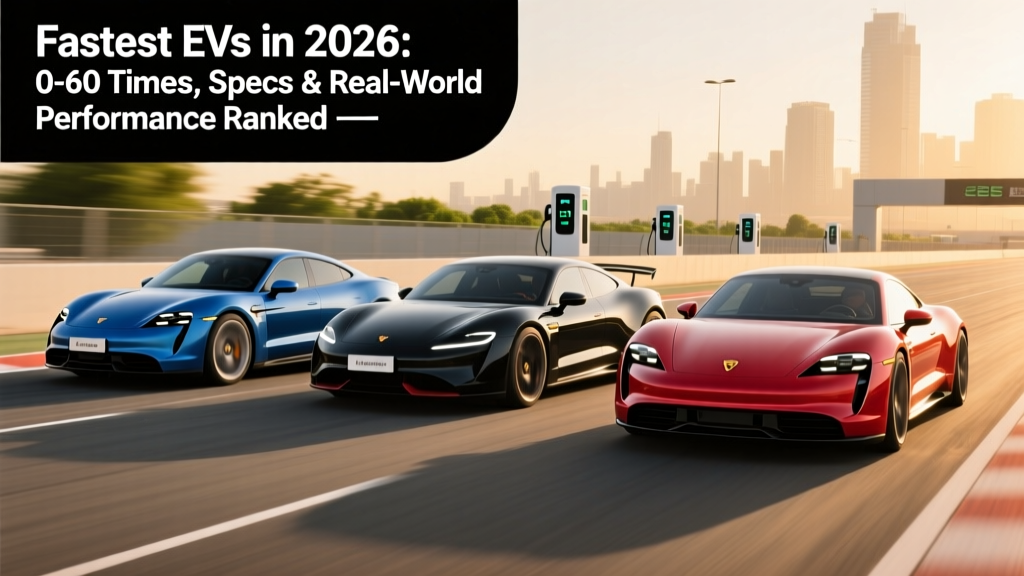
The 8 Fastest EVs You Can Buy Right Now
#1 — Lucid Air Sapphire
0-60 mph: 1.89 seconds | HP: 1,234 | EPA Range: 427 miles | MSRP: $249,000
Why it made the list: The Air Sapphire is not merely the fastest sedan Lucid builds — it is one of the quickest production cars ever sold, regardless of powertrain. Its tri-motor setup (one front, two rear) delivers 1,234 hp with torque vectoring across the rear axle. Lucid's in-house engineering team achieved this on a 118 kWh (usable) NMC battery pack that still returns 427 miles EPA — a staggering efficiency figure for a 5,300-lb vehicle.
Real-world range caveat: Expect 340-370 miles at sustained highway speeds (75 mph), dropping to approximately 280-310 miles in freezing temperatures. The Air's exceptional efficiency (around 26 kWh/100mi combined) helps mitigate aggressive-driving range loss.
Charging: Peak 300+ kW on DC fast chargers via CCS connector (NACS adapter included). 10-80% in approximately 20 minutes at a 350 kW station. Level 2 at 19.2 kW (exceptionally fast for home charging).
Tax credit: Not eligible for the §30D federal credit. MSRP exceeds the $55,000 sedan cap, and buyer income limits apply. Consult IRS §30D guidelines for details.
Best for: Buyers who want hypercar acceleration with luxury-sedan usability and class-leading range. This is the no-compromise performance EV.
#2 — Tesla Model S Plaid
0-60 mph: 1.99 seconds | HP: 1,020 | EPA Range: 396 miles | MSRP: $89,990
Why it made the list: The Model S Plaid's tri-motor carbon-sleeved rotor architecture has been a benchmark since its debut, and it remains a sub-2-second car at a fraction of the Sapphire's price. Tesla's powertrain delivers consistent, repeatable launches without the thermal derating that plagues some competitors.
Real-world range caveat: Highway driving at 75 mph yields approximately 300-330 miles. Cold-weather (20°F) range drops to roughly 260-290 miles. The Plaid's performance-oriented tires and higher rolling resistance slightly reduce efficiency versus the Long Range trim.
Charging: NACS connector natively. Peak 250 kW at Tesla Superchargers, 10-80% in approximately 25-27 minutes. Supercharger network reliability remains a significant practical advantage.
Tax credit: Not eligible — MSRP exceeds the $55,000 sedan cap under §30D.
Best for: Performance buyers who prioritize the Tesla Supercharger ecosystem, OTA updates, and proven repeatable launches at a relative bargain versus ultra-luxury competitors.
#3 — Porsche Taycan Turbo GT (with Weissach Package)
0-60 mph: 2.1 seconds | HP: 1,019 (Launch Control) | EPA Range: 269 miles | MSRP: $230,000 (est.)
Why it made the list: Porsche's approach to speed is different — the Taycan Turbo GT prioritizes lap-time consistency, chassis balance, and thermal management over raw drag-strip numbers. The 2-speed transmission on the rear motor gives it flexibility that single-speed EVs cannot match at higher speeds. The Weissach Package strips 150+ lbs of sound deadening and adds carbon-fiber aero.
Real-world range caveat: The 105 kWh (gross, ~97 usable) NMC battery delivers roughly 200-220 miles at highway speeds. This is a performance-first vehicle; range is a secondary concern for its target buyer.
Charging: CCS connector. Peak 320 kW (2025+ updated architecture), 10-80% in approximately 18 minutes. Porsche's 800V architecture enables sustained high-power charging with minimal taper.
Tax credit: Not eligible — exceeds MSRP cap and likely buyer income thresholds.
Best for: Track-focused drivers who value handling precision, braking performance, and Porsche build quality. The best driver's car on this list.
#4 — Rivian R1T Tri-Motor (2025+)
0-60 mph: 2.9 seconds | HP: 850+ | EPA Range: 420 miles (Max Pack) | MSRP: $99,900 (Tri-Motor Adventure)
Why it made the list: The R1T Tri-Motor proves a 7,000-lb pickup can outrun most sports cars. Rivian's updated tri-motor platform (one front, two rear) with torque vectoring delivers brutal acceleration while maintaining genuine off-road capability with 14.9 inches of ground clearance and a 54-inch bed with Gear Tunnel.
Real-world range caveat: The 149 kWh Max Pack (NMC) achieves 420 miles EPA, but towing a 5,000-lb trailer cuts range to approximately 180-220 miles. Highway-only driving at 75 mph yields roughly 340-370 miles unloaded.
Charging: NACS connector (2025+ models). Peak 220+ kW, 10-80% in approximately 30 minutes. Rivian's in-house charging network is expanding, and Supercharger access is included via adapter on older models or natively on 2025+.
Tax credit: Eligible for up to $7,500 under §30D for trucks (MSRP cap: $80,000). However, the Tri-Motor exceeds this cap. The Dual-Motor Standard at $69,900 qualifies, subject to income limits ($300k MFJ / $150k single) and battery sourcing requirements. Point-of-sale transfer available. Verify current eligibility on IRS.gov.
Best for: Buyers who need truck utility with supercar acceleration — the ultimate one-vehicle garage for active lifestyles.
#5 — Hyundai Ioniq 5 N
0-60 mph: 3.25 seconds | HP: 640 (N Grin Boost) | EPA Range: 221 miles | MSRP: $66,100
Why it made the list: Hyundai's N division transformed the Ioniq 5 from a practical crossover into a track-capable performance machine with simulated gear shifts, configurable regen, and an 84 kWh NMC battery that supports repeated hard laps without thermal throttling. It is the most engaging performance EV under $70,000.
Real-world range caveat: 221 miles EPA is the penalty for sticky Pirelli P Zero tires and aggressive alignment. Highway driving yields approximately 170-190 miles; aggressive track or canyon driving can drop below 140 miles.
Charging: CCS connector (NACS adapter available). 800V architecture enables peak 240 kW, 10-80% in approximately 18 minutes. Excellent charge-curve discipline with minimal taper until above 85%.
Tax credit: Not eligible for §30D — assembled in South Korea (does not meet North American final assembly requirement). State incentives may apply; check your local program.
Best for: Enthusiast drivers who want an EV that feels like a traditional hot hatch — the most fun-per-dollar performance EV available.
#6 — Tesla Model 3 Performance (2025 Refresh)
0-60 mph: 3.1 seconds | HP: 510 | EPA Range: 315 miles | MSRP: $54,990
Why it made the list: The refreshed Model 3 Performance (Highland update) features a new rear motor, adaptive dampers, and a track-oriented chassis that finally matches the straight-line speed with cornering composure. At $54,990, it is the most affordable sub-3.5-second EV on the market.
Real-world range caveat: Expect 250-280 miles at highway speeds and approximately 210-240 miles in cold weather. The 79 kWh (usable) LFP battery in the base model is not used here — the Performance uses NMC for higher energy density and power delivery.
Charging: NACS natively. Peak 250 kW at V3 Superchargers, 10-80% in approximately 25 minutes. Supercharger access is seamless and reliable.
Tax credit: Eligible for up to $7,500 under §30D. MSRP ($54,990) is under the $55,000 sedan cap. Must meet buyer income limits and battery sourcing/critical mineral requirements — as of 2025, the Model 3 Performance qualifies for at least $3,750 (critical minerals portion). Check the latest sourcing status on fueleconomy.gov.
Best for: Value-conscious performance buyers who want daily usability, Supercharger access, and a sub-$50k effective price after incentives.
#7 — BMW i4 M50
0-60 mph: 3.7 seconds | HP: 536 | EPA Range: 271 miles | MSRP: $66,800
Why it made the list: BMW's M division tuned the i4's dual-motor setup for progressive power delivery and chassis balance rather than peak shock value. The result is a sports sedan that feels faster than its numbers suggest, with excellent build quality, a usable rear seat, and a refined ride that outclasses most competitors in daily comfort.
Real-world range caveat: The 81.5 kWh (usable) NMC battery delivers approximately 220-245 miles on the highway. BMW's conservative range estimates mean real-world often matches or slightly exceeds EPA — rare in the EV market.
Charging: CCS connector (NACS adapter available from BMW). Peak 205 kW, 10-80% in approximately 28 minutes. Level 2 at 11 kW.
Tax credit: Not eligible — assembled in Germany. State and utility incentives may apply.
Best for: Luxury sedan buyers migrating from a BMW 3 Series or M340i who want familiar ergonomics and build quality with electric performance.
#8 — Chevrolet Corvette E-Ray (PHEV — Honorable Mention)
0-60 mph: 2.5 seconds | HP: 655 combined (495 gas V8 + 160 electric front motor) | EPA Range: N/A (PHEV, ~15 mi electric-only) | MSRP: $104,900
Why it made the list: While technically a plug-in hybrid, the E-Ray's front electric motor provides AWD launch grip that makes it one of the quickest production Corvettes ever. It earns an honorable mention as the fastest electrified vehicle under $110k that does not require range planning.
Best for: Sports car purists who want electric torque-fill acceleration without range anxiety or charging dependency.
Head-to-Head: Fastest EVs Comparison Table
| Vehicle | 0-60 mph | Horsepower | EPA Range | Battery (kWh usable) | Peak DC Charge kW | 10-80% Time | MSRP |
|---|---|---|---|---|---|---|---|
| Lucid Air Sapphire | 1.89s | 1,234 | 427 mi | 118 (NMC) | 300+ | ~20 min | $249,000 |
| Tesla Model S Plaid | 1.99s | 1,020 | 396 mi | 95 (NMC) | 250 | ~26 min | $89,990 |
| Porsche Taycan Turbo GT | 2.1s | 1,019 | 269 mi | 97 (NMC) | 320 | ~18 min | $230,000 |
| Rivian R1T Tri-Motor | 2.9s | 850+ | 420 mi (Max) | 149 (NMC) | 220+ | ~30 min | $99,900 |
| Hyundai Ioniq 5 N | 3.25s | 640 | 221 mi | 84 (NMC) | 240 | ~18 min | $66,100 |
| Tesla Model 3 Perf. | 3.1s | 510 | 315 mi | 79 (NMC) | 250 | ~25 min | $54,990 |
| BMW i4 M50 | 3.7s | 536 | 271 mi | 81.5 (NMC) | 205 | ~28 min | $66,800 |
| Corvette E-Ray* | 2.5s | 655 | ~15 mi (EV) | 1.9 (NMC) | N/A | N/A | $104,900 |
*Corvette E-Ray is a PHEV, included as an honorable mention for its electrified AWD launch performance.
Budget Tiers: Fastest EVs by Price
| Tier | Price Range | Picks | Best Value After Credits |
|---|---|---|---|
| Under $60K | $50,000–$60,000 | Tesla Model 3 Performance | Model 3 Perf. at ~$47,490–$51,240 after partial §30D credit |
| $60K–$100K | $60,000–$100,000 | Ioniq 5 N, BMW i4 M50, Tesla Model S Plaid | Model S Plaid — most performance per dollar, though no §30D credit |
| $100K+ | $100,000+ | Rivian R1T Tri, Corvette E-Ray, Porsche Taycan Turbo GT, Lucid Air Sapphire | R1T Dual-Motor (~$69,900 with §30D) offers Tri-Motor-adjacent performance at lower cost |
Which Fastest EV Fits Your Use Case?
Choose the Tesla Model 3 Performance if:
- You want the best value under $55K with potential tax credit savings.
- Daily driving range (315 mi EPA) and Supercharger access matter as much as speed.
- You want OTA updates and a minimalist tech-forward interior.
Choose the Hyundai Ioniq 5 N if:
- You prioritize driving engagement — simulated shifts, configurable regen, and track mode make it the most "analog-feeling" performance EV.
- You want an 800V architecture for the fastest charging in this price bracket.
- Range (221 mi EPA) is secondary to fun.
Choose the Tesla Model S Plaid if:
- Sub-2-second 0-60 is the priority, but you want a usable sedan with 396 miles of range.
- The Supercharger network is essential for road-trip confidence.
- You accept that the interior is minimalist and the yoke steering is polarizing.
Choose the Lucid Air Sapphire if:
- Budget is not a constraint and you want the absolute fastest production sedan with 427 miles of range.
- Luxury materials, spacious rear seating, and a premium audio system are expected.
Choose the Rivian R1T Tri-Motor if:
- You need a pickup truck with 11,000-lb towing capacity and genuine off-road capability.
- Supercar acceleration from a truck is the appeal — 0-60 in 2.9 seconds in a 7,000-lb vehicle is physics-defying.
Choose the Porsche Taycan Turbo GT if:
- Track lap times matter more than drag-strip numbers.
- You value chassis tuning, brake feel, and build quality above all else.
- Range (269 mi EPA) is an acceptable trade-off for driving precision.
Performance EV Ownership Costs: What to Expect
Acceleration has consequences beyond the purchase price. Performance EVs carry specific ownership realities:
- Tire costs: High-torque EVs wear through tires 20-40% faster than ICE equivalents. The Ioniq 5 N's Pirelli P Zeros cost approximately $1,600-$2,000 per set and may last 12,000-18,000 miles with spirited driving.
- Insurance premiums: Performance trims carry 15-30% higher premiums over base models. The Model S Plaid averages $3,200-$4,500/year depending on state and driving record.
- Efficiency penalty: Performance tires, aggressive alignment, and heavier motors reduce efficiency. Expect 2.5-4.0 mi/kWh in performance EVs versus 3.5-5.0 mi/kWh in efficiency-focused models.
- Battery degradation: Repeated hard launches and frequent DC fast charging accelerate degradation modestly. Most NMC packs in performance EVs retain 85-92% capacity at 100,000 miles based on current fleet data — well within the standard 8-year/100,000-mile battery warranty (70% retention threshold).
- Charging access: If you lack Level 2 home charging, the range compromises of performance models (especially the Ioniq 5 N and Taycan Turbo GT) become daily inconveniences. Home charging is strongly recommended.
Tax Credit Eligibility for Performance EVs
The federal §30D Clean Vehicle Credit offers up to $7,500, but most performance EVs face eligibility hurdles. Key requirements:
- MSRP cap: Sedans must be ≤$55,000; SUVs/pickups ≤$80,000. This eliminates the Air Sapphire, Model S Plaid, Taycan, and R1T Tri-Motor.
- Buyer income cap: AGI ≤$300,000 (married filing jointly), ≤$225,000 (head of household), ≤$150,000 (single).
- North American final assembly: Eliminates the Ioniq 5 N (South Korea) and BMW i4 M50 (Germany).
- Battery sourcing: Critical minerals and battery components must meet escalating percentage thresholds from US or FTA-partner countries. Splits the credit into $3,750 (minerals) + $3,750 (components).
- Point-of-sale transfer: Eligible buyers can transfer the credit to the dealer at purchase, reducing the out-of-pocket price immediately.
Current eligible performance pick: The Tesla Model 3 Performance ($54,990, sedan) qualifies for at least $3,750 and potentially the full $7,500 depending on the latest battery sourcing determinations. Always verify current eligibility at fueleconomy.gov before purchasing.
Top Pick: Tesla Model 3 Performance
Why it wins overall: The Model 3 Performance is not the fastest EV on this list by raw numbers — that title belongs to the Lucid Air Sapphire. But it is the best performance EV for the most buyers. At $54,990, it delivers a 3.1-second 0-60 mph time, 315 miles of EPA range, access to the most reliable DC fast-charging network in North America, and potential §30D tax credit eligibility that can bring the effective price below $50,000. It is the only vehicle on this list that combines genuine supercar acceleration, daily-driving usability, road-trip practicality, and incentive-eligible pricing in a single package.
Runner-up: The Hyundai Ioniq 5 N wins the enthusiast vote. If driving engagement, track capability, and emotional connection to the vehicle matter more than range and tax credits, the Ioniq 5 N is the most rewarding performance EV under $70,000. Its 800V charging architecture (18-minute 10-80%) also partially offsets its lower range.
Frequently Asked Questions
What is the fastest EV in the world as of 2026?
The Lucid Air Sapphire holds the title with a verified 1.89-second 0-60 mph time, making it one of the quickest production cars ever built. The Pininfarina Battista (1.79s claimed) and Rimac Nevera (1.85s claimed) have posted faster numbers but are limited-production hypercars with fewer than 200 units built globally — not practical consumer purchases.
Are fast EVs slower than gas supercars?
In straight-line acceleration, no. Electric motors deliver instant torque from 0 RPM, giving EVs a launch advantage that even 1,000-hp ICE supercars struggle to match. However, EVs carry a weight penalty (typically 4,500-5,500 lbs) that affects sustained high-speed acceleration above 130 mph, braking distances, and cornering agility. On a road course, a Porsche 911 GT3 or McLaren 750S will typically outlap a Tesla Model S Plaid despite the EV's 0-60 advantage.
Does hard acceleration hurt EV battery life?
Moderately. Repeated maximum-power discharges generate heat, which accelerates NMC battery degradation over time. However, modern thermal management systems (liquid cooling in every vehicle on this list) mitigate this significantly. Fleet data from Tesla and other manufacturers shows that even performance-oriented driving results in approximately 8-12% capacity loss at 100,000 miles — well within the 8-year/100,000-mile warranty threshold of 70% retention. The bigger degradation risk is frequent DC fast charging to 100% and leaving the battery at high SoC in hot weather.
Can I daily-drive a performance EV with low range like the Ioniq 5 N?
Yes, if you have reliable Level 2 home charging. With a 240V home charger (11-19 kW), a full overnight charge restores 100% in 5-8 hours. The 221-mile EPA range is sufficient for most commutes and daily errands. The challenge arises on road trips: you will need to plan DC fast-charge stops every 140-170 miles of highway driving, and the 18-minute 10-80% charge time (at a 240+ kW station) is fast enough to make stops manageable. Without home charging, the low range becomes a genuine daily inconvenience.
Do performance EVs qualify for the $7,500 federal tax credit?
Most do not. The §30D credit has an MSRP cap ($55,000 for sedans, $80,000 for SUVs/trucks) that eliminates most high-performance models. The Tesla Model 3 Performance at $54,990 is the notable exception among sedans and may qualify for $3,750-$7,500 depending on battery sourcing. Among SUVs/trucks, the Rivian R1T Dual-Motor ($69,900) qualifies if sourcing requirements are met. Always verify current eligibility on the IRS website before committing to a purchase, as sourcing determinations update periodically.
What's the fastest EV under $50,000?
The Tesla Model 3 Performance at $54,990 MSRP drops below $50,000 after the partial §30D tax credit ($3,750 minimum, potentially $7,500). No other current-production EV under $50,000 breaks 4.0 seconds 0-60. If the credit is unavailable in your situation, the Tesla Model 3 Long Range AWD ($42,490) achieves 4.1 seconds and offers 341 miles of range — the best all-around performance-and-efficiency balance in its price class.