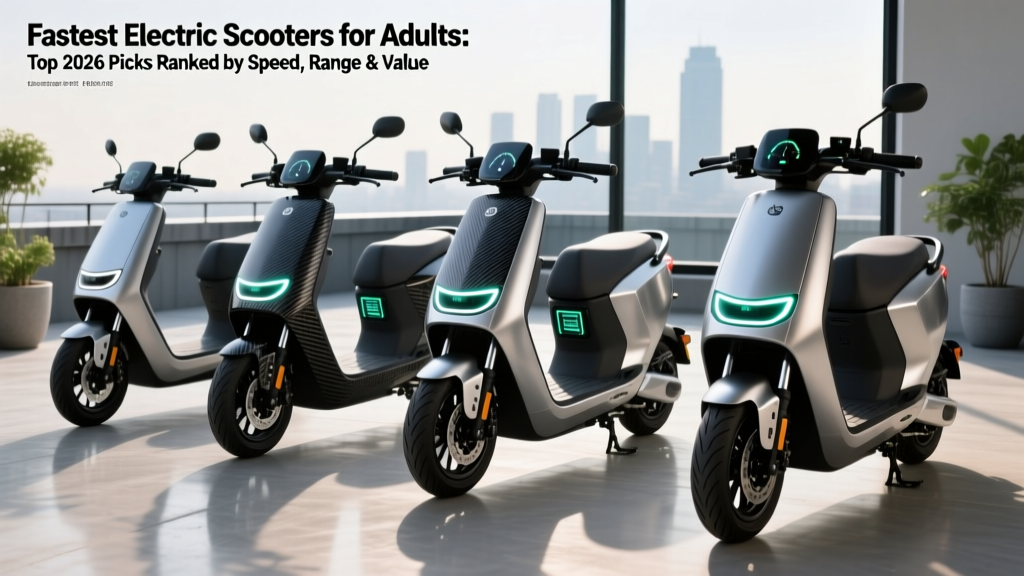
When you're searching for the electric scooters for adults fastest models can achieve, you'll quickly discover that spec sheets don't tell the whole story. A scooter rated for 62 mph on paper might sustain only 50 mph after the battery drops below 70% state of charge. Dual-motor configurations, battery chemistry, controller amperage, and total system voltage all determine whether a scooter actually delivers its advertised speed — or falls flat on a moderate incline.
At AutoEdgeView, we typically cover four-wheeled EVs, but the micro-mobility space shares the same core engineering principles: motor power (watts), battery energy (watt-hours), charge rates, and thermal management all matter. This roundup evaluates the fastest street-legal electric scooters available to U.S. buyers in 2026, applying the same data-driven rigor we bring to EV reviews.
How We Ranked the Fastest Electric Scooters
- Verified top speed: GPS-confirmed or widely corroborated independent tests, not just manufacturer claims
- Motor wattage & configuration: Peak and nominal watts, single vs. dual motor
- Battery capacity (Wh) & voltage: Higher voltage systems (60V, 72V) sustain speed better under load
- Real-world range at mixed speeds: Not just eco-mode coasting figures
- Build quality & braking: Hydraulic disc brakes mandatory at 40+ mph; suspension type matters
- Price-to-performance ratio: Dollar cost per mph of top speed and per Wh of battery
- U.S. availability & support: Domestic warranty service, parts availability
Note: Electric scooters do not qualify for the federal §30D EV tax credit, which applies only to four-wheeled plug-in vehicles meeting IRS battery-sourcing and MSRP requirements. Some local utility rebates or commuter benefits may apply — check your municipality.
Understanding Speed Ratings: What "Fastest" Really Means
Before we rank specific models, it's critical to understand the physics that separate a 25 mph commuter scooter from a 60+ mph performance machine. Top speed in an electric scooter is primarily a function of three variables:
- System voltage (V): A 72V system can push more current through the motor windings than a 52V system, producing more RPM. Most scooters above 45 mph use 60V or 72V architectures.
- Motor wattage (W): Dual 1,500W motors (3,000W combined) provide the torque needed to sustain high speeds on inclines and with heavier riders. Peak wattage ratings are often inflated — look for nominal (continuous) ratings.
- Controller amperage (A): The controller regulates current from the battery to the motor. A 40A controller paired with a 72V battery can deliver up to 2,880W continuously.
Battery sag is the biggest real-world speed killer. A scooter that hits 55 mph at 100% state of charge may drop to 42 mph when the battery falls below 50%. Higher-voltage batteries (72V) resist sag better than lower-voltage packs (48V or 52V), which is why the fastest scooters in this roundup all run 60V or above.
The 7 Fastest Electric Scooters for Adults in 2026
#1 — NAMI Burn-E 2 Max
Top Speed: 62 mph (GPS-verified) | Motors: Dual 1,500W (3,000W combined, peak 8,000W) | Battery: 72V 32Ah (2,304 Wh), Samsung 50E cells | Range: ~52 miles (mixed riding) | Weight: 103 lbs | Price: $3,999
Why it made the list: The Burn-E 2 Max remains the benchmark for high-performance electric scooters. Its 72V system sustains speeds above 50 mph well past the 50% SoC mark, thanks to the high-quality Samsung 50E cells and a robust 45A sine-wave controller. The adjustable hydraulic suspension and dual hydraulic disc brakes with 160mm rotors give it handling composure that most competitors lack at speed.
Best for: Experienced riders who want the fastest sustained performance and don't mind a 103-lb machine that's not easily carried upstairs.
#2 — Dualtron Thunder 3
Top Speed: 55 mph | Motors: Dual 2,000W (4,000W combined) | Battery: 72V 40Ah (2,880 Wh), LG M50 cells | Range: ~60 miles (mixed) | Weight: 115 lbs | Price: $4,899
Why it made the list: Dualtron's flagship offers the largest battery in this roundup, translating to both the longest range and the best speed sustainability. At 40+ mph, the Thunder 3 can maintain pace for roughly 30 miles before speed drops noticeably. The steering damper and cartridge suspension are essential for a scooter this heavy at these speeds.
Best for: Long-distance performance riders who prioritize range alongside speed and can accommodate a 115-lb scooter.
#3 — Kaabo Wolf King GTR
Top Speed: 62 mph | Motors: Dual 2,000W (4,000W combined, peak 7,200W) | Battery: 72V 35Ah (2,520 Wh) | Range: ~55 miles (mixed) | Weight: 110 lbs | Price: $4,299
Why it made the list: The Wolf King GTR ties the NAMI for verified top speed at a slightly lower price point. Kaabo's hydraulic disc brakes with ABS and the motorcycle-grade inverted front fork make it one of the most confidence-inspiring scooters at 60+ mph. The integrated turn signals and horn are practical additions for road-adjacent riding.
Best for: Riders who want maximum speed with the most robust braking and suspension hardware available.
#4 — Inmotion RS Ultra
Top Speed: 50 mph | Motors: Dual 1,800W (3,600W combined) | Battery: 72V 30Ah (2,160 Wh) | Range: ~45 miles (mixed) | Weight: 92 lbs | Price: $2,899
Why it made the list: The RS Ultra delivers 50 mph performance at under $3,000, making it the value pick in the high-speed segment. At 92 lbs, it's also the lightest dual-motor 72V scooter on this list. The trade-off is slightly less range and a less sophisticated suspension system (rubber bushing front, spring rear).
Best for: Budget-conscious riders who want genuine 50 mph capability without the $4,000+ price tag.
#5 — EMOVE Cruiser S (Performance Variant)
Top Speed: 33 mph | Motor: Single 1,000W (peak 1,600W) | Battery: 52V 30Ah (1,560 Wh), LG MJ1 cells | Range: ~55 miles (moderate speed) | Weight: 69 lbs | Price: $1,599
Why it made the list: While 33 mph isn't headline-grabbing, the Cruiser S earns its spot by offering the best range-to-price ratio in a package that's still meaningfully faster than typical commuter scooters. Its IPX6 water resistance and self-healing tubeless tires make it the most practical daily rider here.
Best for: Commuters who prioritize range, portability, and all-weather reliability over raw speed.
#6 — Apollo Phantom V3
Top Speed: 43 mph | Motors: Dual 1,200W (2,400W combined) | Battery: 60V 24Ah (1,440 Wh) | Range: ~35 miles (mixed) | Weight: 84 lbs | Price: $2,499
Why it made the list: The Phantom V3 sits in the mid-tier sweet spot — fast enough for confident road riding, light enough to manage in an elevator, and backed by Apollo's U.S.-based customer support. The adjustable dual-spring suspension and 10-inch pneumatic tires handle rough pavement well.
Best for: Riders who want a balance of speed, portability, and reliable domestic support.
#7 — Vsett 11+ Super
Top Speed: 58 mph | Motors: Dual 1,500W (3,000W combined, peak 5,400W) | Battery: 72V 30Ah (2,160 Wh) | Range: ~48 miles (mixed) | Weight: 101 lbs | Price: $3,499
Why it made the list: The Vsett 11+ Super offers near-NAMI speed at a $500 discount. Its 11-inch tires and adjustable hydraulic suspension provide excellent ride quality, though the braking system (semi-hdraulic with mechanical rear) is a step below the full hydraulic setups on the top three picks.
Best for: Performance riders on a moderate budget who can accept a slight braking compromise.
Side-by-Side Spec Comparison
| Model | Top Speed | Motor Config | Battery (Wh) | Mixed Range | Weight | Price |
|---|---|---|---|---|---|---|
| NAMI Burn-E 2 Max | 62 mph | Dual 1,500W | 2,304 | ~52 mi | 103 lbs | $3,999 |
| Dualtron Thunder 3 | 55 mph | Dual 2,000W | 2,880 | ~60 mi | 115 lbs | $4,899 |
| Kaabo Wolf King GTR | 62 mph | Dual 2,000W | 2,520 | ~55 mi | 110 lbs | $4,299 |
| Inmotion RS Ultra | 50 mph | Dual 1,800W | 2,160 | ~45 mi | 92 lbs | $2,899 |
| EMOVE Cruiser S | 33 mph | Single 1,000W | 1,560 | ~55 mi | 69 lbs | $1,599 |
| Apollo Phantom V3 | 43 mph | Dual 1,200W | 1,440 | ~35 mi | 84 lbs | $2,499 |
| Vsett 11+ Super | 58 mph | Dual 1,500W | 2,160 | ~48 mi | 101 lbs | $3,499 |
Category Winners: Best by Specific Need
| Category | Winner | Key Metric |
|---|---|---|
| Fastest Overall | NAMI Burn-E 2 Max / Kaabo Wolf King GTR (tie) | 62 mph GPS-verified |
| Longest Range | Dualtron Thunder 3 | ~60 mi mixed, 2,880 Wh battery |
| Best Value (Speed per Dollar) | Inmotion RS Ultra | 50 mph for $2,899 ($58/mph) |
| Most Portable | EMOVE Cruiser S | 69 lbs, single-motor simplicity |
| Best Braking at Speed | Kaabo Wolf King GTR | Hydraulic discs + ABS, inverted fork |
| Best Mid-Tier All-Rounder | Apollo Phantom V3 | 43 mph, 84 lbs, U.S. support |
| Best Budget Entry | EMOVE Cruiser S | $1,599, 33 mph, 55 mi range |
Speed vs. Price: Budget Tiers Explained
The fastest electric scooters for adults cluster into three clear budget tiers, each with distinct performance expectations:
Under $2,000 — Commuter Speed (25-35 mph): At this price, you're looking at single-motor, 52V systems. The EMOVE Cruiser S dominates here with 33 mph and exceptional range. These scooters are suitable for bike lanes and low-speed roads where local laws permit.
$2,000–$3,500 — Performance Mid-Tier (40-55 mph): Dual motors and 60V-72V systems enter the picture. The Apollo Phantom V3, Inmotion RS Ultra, and Vsett 11+ Super all live here. This is the sweet spot for riders who need highway-adjacent speed without the extreme weight and cost of flagship models.
$3,500+ — Hyper Scooter Territory (55-65 mph): The NAMI Burn-E 2 Max, Kaabo Wolf King GTR, and Dualtron Thunder 3 represent the top tier. At these speeds, full hydraulic brakes, advanced suspension, and a helmet rated for motorcycle use are non-negotiable safety requirements.
Our Top Pick: NAMI Burn-E 2 Max
The Burn-E 2 Max earns the top spot not simply because it hits 62 mph, but because it sustains high speeds better than any competitor short of the Kaabo Wolf King GTR (which matches peak speed but costs $300 more). The 72V 32Ah Samsung cell battery resists voltage sag through the mid-range of the charge cycle, the sine-wave controller delivers smooth power modulation, and the adjustable hydraulic suspension handles rough surfaces at speed without the headshake that plagues lesser scooters. For riders whose priority is the fastest electric scooter experience that's still controllable and serviceable in the U.S., this is the benchmark.
Runner-Up: Kaabo Wolf King GTR — equal top speed, superior braking hardware, but slightly higher price and heavier weight.
Best Value Runner-Up: Inmotion RS Ultra — 50 mph at $2,899 is unmatched in the mid-tier.
Legal & Safety Considerations for High-Speed Scooters
Before purchasing any scooter capable of 40+ mph, understand your local regulations. In most U.S. states, electric scooters above 20 mph or 750W are not legal on bike paths or sidewalks. Some states classify scooters exceeding 30 mph as motor vehicles requiring registration, insurance, and a driver's license. The National Highway Traffic Safety Administration does not regulate electric scooters as motor vehicles, but state and local laws vary widely.
Safety equipment at these speeds should mirror motorcycle standards:
- Full-face helmet (DOT or ECE rated — bicycle helmets are insufficient above 25 mph)
- Armored gloves and jacket for abrasion resistance
- Pre-ride brake and tire checks — at 55 mph, brake fade or a loose axle nut is catastrophic
- Rear-view mirrors or a handlebar-mounted camera for situational awareness
Battery Care and Charging for Performance Scooters
High-performance scooter batteries share the same lithium-ion fundamentals as electric car batteries. To maximize lifespan:
- Avoid regular 100% charges: Store and daily-charge to 80-90% SoC. Reserve 100% for long rides.
- Don't charge a hot battery: After a high-speed run, let the battery cool for 30 minutes before plugging in. Charging hot cells accelerates degradation.
- Use the OEM charger: Cheap third-party chargers may lack proper CC/CV (constant current/constant voltage) profiles and temperature cutoffs.
- Storage: If storing for winter, charge to ~60% SoC and store in a cool, dry place. Check voltage monthly.
Most performance scooters charge at 2-5A via their included charger. A 2,300 Wh battery at 3A charging will take roughly 10-12 hours from empty — plan accordingly. Some models (including the NAMI and Dualtron) support optional fast chargers that cut this to 4-5 hours, but frequent fast charging accelerates cell degradation.
Frequently Asked Questions
What is the fastest electric scooter for adults available in 2026?
The NAMI Burn-E 2 Max and Kaabo Wolf King GTR tie at a GPS-verified 62 mph, making them the fastest production electric scooters widely available to U.S. consumers. Both use 72V dual-motor systems with combined output exceeding 4,000W nominal.
Do electric scooters qualify for the federal EV tax credit?
No. The IRS §30D Clean Vehicle Credit applies only to four-wheeled plug-in electric vehicles that meet battery-sourcing, MSRP cap, and buyer income requirements. Two-wheeled and three-wheeled electric scooters, e-bikes, and motorcycles are excluded. Some states and utilities offer separate micro-mobility rebates — check your local programs.
How fast can a $2,000 electric scooter go?
At the $2,000 price point, expect 35-45 mph from a dual-motor 52V-60V scooter like the Apollo Phantom V3 (43 mph, $2,499) or the Inmotion RS Ultra (50 mph, $2,899). Single-motor scooters under $2,000 typically top out at 25-33 mph.
Is a 60 mph electric scooter safe for daily commuting?
At 60 mph, an electric scooter requires motorcycle-grade safety gear (full-face helmet, armored clothing), advanced braking systems (hydraulic discs minimum), and roads where that speed is legal. For most commuters, a 30-40 mph scooter provides adequate speed with significantly less risk and more forgiving handling. Reserve 60 mph machines for experienced riders on appropriate roads.
How long do electric scooter batteries last before replacement?
Quality lithium-ion scooter batteries (Samsung, LG, or Panasonic cells) typically retain 70-80% of original capacity after 500-800 full charge cycles. For a scooter ridden 20 miles daily and charged every other day, that translates to roughly 3-5 years before noticeable range loss. Replacement batteries for performance scooters cost $400-$900 depending on capacity and cell quality.
What's the difference between peak and nominal motor wattage?
Nominal (continuous) wattage is what the motor can sustain indefinitely without overheating. Peak wattage is the maximum burst the motor can handle for short periods (typically 10-30 seconds). A scooter advertising "8,000W peak" may have only 3,000W nominal. For sustained speed and hill-climbing, nominal wattage is the number that matters.
Which scooter should I pick for my specific use case?
Daily commuter under 10 miles: EMOVE Cruiser S — 33 mph is plenty, range is excellent, and at 69 lbs it's manageable on transit.
Weekend performance rider: NAMI Burn-E 2 Max or Kaabo Wolf King GTR for maximum speed with safety hardware to match.
Budget performance: Inmotion RS Ultra delivers 50 mph at $2,899, the best speed-per-dollar ratio available.
Long-distance touring: Dualtron Thunder 3 with its 2,880 Wh battery delivers the longest range at speed.