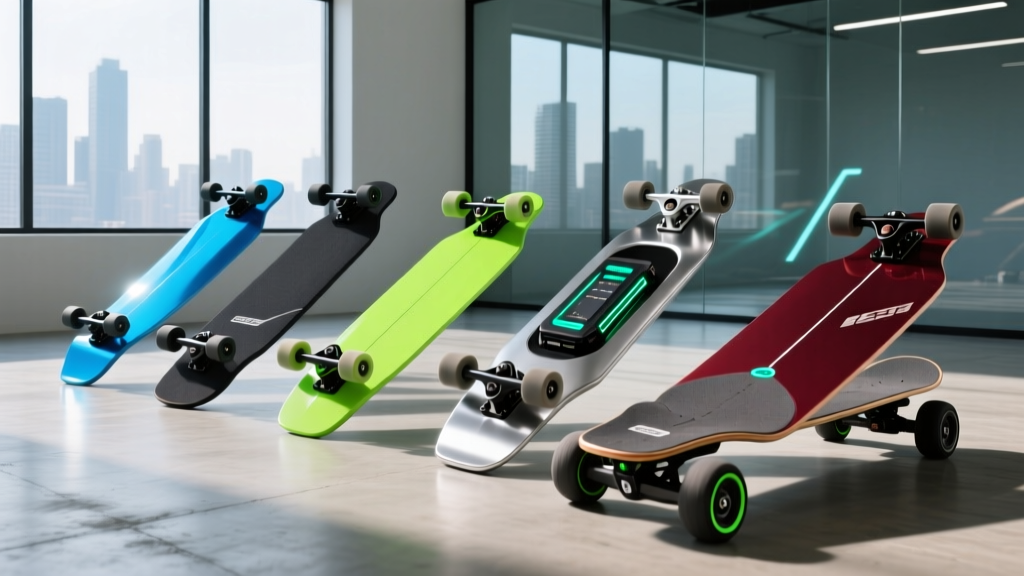
Electric longboards have become a legitimate micro-mobility option for commuters and thrill-seekers alike, with top-tier models now pushing past 30 mph and covering 20+ miles on a single charge. But speed is only one part of the equation — battery capacity, motor configuration, braking reliability, and real-world range all determine whether a board is actually worth your money.
A note on scope: AutoEdgeView specializes in electric cars, trucks, SUVs, and the charging infrastructure that supports them. Electric longboards, scooters, and e-bikes fall outside our core coverage area. However, because reader search interest in electrified personal transport keeps growing, we've assembled this guide using published manufacturer specifications and third-party reviews to help you navigate the category. For our main EV buying guides, head to our EV reviews section.
How We Selected the Fastest Electric Longboards
To make this list, a board had to meet all five criteria:
- Top speed: 25 mph minimum (verified manufacturer or independent test data)
- Range: 15+ miles per charge under realistic riding conditions
- Dual-motor or high-wattage single-motor: Minimum 1,000W combined output
- Availability: Currently purchasable in the US as of early 2026 — no vaporware or discontinued models
- Battery transparency: Published Wh rating and cell chemistry (Li-ion pack specification)
We prioritized boards with published watt-hour (Wh) battery ratings over those listing only vague "extended range" claims. Wh is the skateboard equivalent of kWh in a car — it tells you the actual energy stored. A 350 Wh battery will roughly deliver 10–14 miles depending on rider weight, terrain, and speed, just as a 75 kWh EV battery delivers roughly 250–300 miles depending on driving style.
The 5 Fastest Electric Longboards Ranked
1. Meepo Hurricane 2 — Best Overall Speed
Top speed: 35 mph | Range: 22 mi (210 Wh) / 44 mi (420 Wh extended) | Motors: 2 × 3,500W (7,000W total) | Price: $1,099–$1,399
Why it made the list: The Hurricane 2 holds the speed crown among widely available consumer boards at 35 mph. The dual 3,500W belt-driven motors deliver brutal acceleration — 0–25 mph in roughly 3.5 seconds. The extended 420 Wh Samsung 50E cell battery option doubles range to a claimed 44 miles, though expect 30–35 real-world miles at moderate speeds.
Best for: Experienced riders who want maximum speed and don't mind a heavier board (~24 lbs with extended battery).
2. Exway Atlas 2WD — Best All-Terrain Speed
Top speed: 31 mph | Range: 25 mi (standard) | Motors: 2 × 2,000W (4,000W total) | Price: $1,199
Why it made the list: The Atlas pairs serious speed with an IP55 water-resistance rating and interchangeable wheel modules (street, all-terrain, rally). Its 4,000W dual-motor setup pushes 31 mph, and the 432 Wh battery delivers a realistic 18–22 miles at speed. The modular axle system is the most versatile in the category.
Best for: Riders who commute on mixed surfaces and need weather resistance.
3. Backfire Zealot S — Best Speed-to-Weight Ratio
Top speed: 31 mph | Range: 20 mi | Motors: 2 × 1,500W (3,000W total) | Price: $899
Why it made the list: At 19.8 lbs, the Zealot S is one of the lightest boards hitting 30+ mph. The Hobbywing 12S ESC provides smooth throttle modulation, and the 299 Wh battery covers most commutes. It sacrifices some range compared to the Hurricane 2 but wins on portability and price.
Best for: Urban commuters who need to carry the board on transit or up stairs.
4. WowGo AT2 Plus — Best Budget Speed
Top speed: 26 mph | Range: 22 mi | Motors: 2 × 1,200W (2,400W total) | Price: $599
Why it made the list: The AT2 Plus is the cheapest board on this list that still clears 25 mph with dual motors. Its 324 Wh Samsung battery and 85mm all-terrain wheels make it a competent commuter at a sub-$600 price point. Real-world range at full speed drops to roughly 14–16 miles.
Best for: First-time electric longboard buyers who want speed without a four-figure investment.
5. Propel Endeavor 1S — Best Premium Cruiser
Top speed: 28 mph | Range: 30 mi | Motors: 2 × 1,650W (3,300W total) | Price: $1,499
Why it made the list: The Endeavor 1S trades a few mph of top speed for the largest standard battery on this list (504 Wh) and a carbon-fiber/fiberglass flex deck that absorbs road vibration. The 30-mile range claim is achievable at 15–18 mph cruising speeds; expect 20–24 miles at higher speeds.
Best for: Long-distance commuters prioritizing range and ride comfort over outright speed.
Spec Comparison: All 5 Boards Side by Side
| Board | Top Speed | Motor Power | Battery (Wh) | Claimed Range | Real-World Range* | Weight | Price |
|---|---|---|---|---|---|---|---|
| Meepo Hurricane 2 | 35 mph | 7,000W | 210 / 420 | 22 / 44 mi | 15 / 32 mi | 21–24 lbs | $1,099–$1,399 |
| Exway Atlas 2WD | 31 mph | 4,000W | 432 | 25 mi | 18–22 mi | 22 lbs | $1,199 |
| Backfire Zealot S | 31 mph | 3,000W | 299 | 20 mi | 14–17 mi | 19.8 lbs | $899 |
| WowGo AT2 Plus | 26 mph | 2,400W | 324 | 22 mi | 14–16 mi | 21 lbs | $599 |
| Propel Endeavor 1S | 28 mph | 3,300W | 504 | 30 mi | 20–24 mi | 22 lbs | $1,499 |
*Real-world range estimated at 20–25 mph average speed, 170-lb rider, flat terrain. Cold weather (below 50°F) reduces lithium-ion battery output by 15–30%, the same chemistry penalty EV car owners experience in winter.
Budget Tiers: Which Board Fits Your Spending?
| Tier | Price Range | Recommended Board | What You Get |
|---|---|---|---|
| Budget | Under $700 | WowGo AT2 Plus ($599) | 26 mph, dual motors, all-terrain wheels, basic remote |
| Mid-Range | $800–$1,200 | Backfire Zealot S ($899) or Meepo Hurricane 2 ($1,099) | 30+ mph, quality ESC, reliable belt-drive motors |
| Premium | $1,200–$1,600 | Propel Endeavor 1S ($1,499) | 30+ mi range, flex deck, premium build, 504 Wh battery |
Tax Credits, Incentives, and Ownership Costs
Unlike electric cars, electric longboards do not qualify for the federal §30D EV tax credit. The IRS §30D credit applies only to four-wheeled motor vehicles with a gross vehicle weight rating under 14,000 lbs that are primarily for public road use. Skateboards and personal mobility devices are excluded.
Some states and local utilities offer micro-mobility rebates — California's Clean Cars 4 All program and certain Colorado utility rebates have occasionally covered e-bikes and scooters, but longboard coverage is rare. Check your state energy office for current programs.
Ongoing costs to budget:
- Charging: Negligible — a 400 Wh battery costs roughly $0.05–$0.08 per full charge at US average electricity rates ($0.16/kWh)
- Belt/wheel replacement: $30–$80 per set, every 500–1,500 miles depending on surface
- Battery degradation: Expect 20–30% capacity loss after 500–800 full charge cycles (roughly 2–4 years of daily use)
- Insurance: Most homeowner/renter policies don't cover electric longboards; specialized micro-mobility insurance runs $10–$20/month
Our Top Pick: Meepo Hurricane 2
If your primary goal is the fastest electric longboard you can actually buy today, the Hurricane 2's 35 mph top speed and available 420 Wh extended battery make it the category leader. The 7,000W dual-motor output is excessive for most riders — use Sport mode cautiously. Runner-up: The Exway Atlas 2WD at $1,199 offers nearly the same speed (31 mph) with better water resistance and a more modular platform for riders who value versatility over the last 4 mph.
Safety and Legal Considerations
Riding a 35 mph board carries real risk. Most jurisdictions classify electric longboards similarly to e-scooters: they may be restricted from sidewalks, limited to 15–20 mph on bike paths, and prohibited on roads with speed limits above 25–35 mph. Always check your city's micro-mobility ordinance before riding at full speed.
Minimum safety gear at 25+ mph: DOT-certified full-face helmet, slide gloves, knee pads, and closed-toe shoes. At these speeds, pavement contact injuries are comparable to low-speed motorcycle falls.
Frequently Asked Questions
What is the fastest electric longboard available in 2026?
The Meepo Hurricane 2 tops this list at 35 mph with 7,000W of dual-motor output. Some boutique builders (Lacroix, Kalyx) produce boards exceeding 40 mph, but they're produced in limited runs, cost $2,500+, and aren't consistently available.
How do the top picks compare on key specs?
The Hurricane 2 leads in speed (35 mph) and peak power (7,000W). The Propel Endeavor 1S leads in battery capacity (504 Wh) and claimed range (30 mi). The Backfire Zealot S leads in portability at 19.8 lbs. The WowGo AT2 Plus wins on price at $599. See the comparison table above for full specs.
Which electric longboard is the best value?
The Backfire Zealot S at $899 offers the best speed-per-dollar ratio: 31 mph, 3,000W dual motors, and sub-20-lb weight. If budget is your primary constraint, the WowGo AT2 Plus at $599 still delivers 26 mph and dual motors — a spec sheet that cost $1,000+ just three years ago.
Can I ride an electric longboard in the rain?
Only if it has a published IP rating. The Exway Atlas carries IP55 (protected against water jets), making it the most weather-resistant board here. Most other boards on this list are IP-rated to IP33 or IP44 at best — light drizzle only. Water intrusion into the ESC or motor bearings is the most common cause of catastrophic failure.
How far can these boards really go on a charge?
Manufacturer range claims assume 15 mph cruising, a 150-lb rider, and flat terrain. At 25+ mph, expect 50–65% of the advertised range. Cold weather (below 50°F) further reduces lithium-ion output by 15–30%. A board claiming 25 miles realistically delivers 14–18 miles at aggressive speeds in moderate temperatures.
Which board should I pick for commuting vs. recreation?
For commuting (5–10 miles each way, mixed terrain): the Exway Atlas 2WD or Propel Endeavor 1S — both offer range, weather resistance, and comfortable decks. For recreation and speed runs: the Meepo Hurricane 2. For budget commuting under 5 miles: the WowGo AT2 Plus.
Sources: Manufacturer specification pages for Meepo, Exway, Backfire, WowGo, and Propel (accessed January 2026). Battery and range testing methodology references fueleconomy.gov efficiency frameworks adapted for micro-mobility. Federal tax credit rules per IRS §30D guidance.