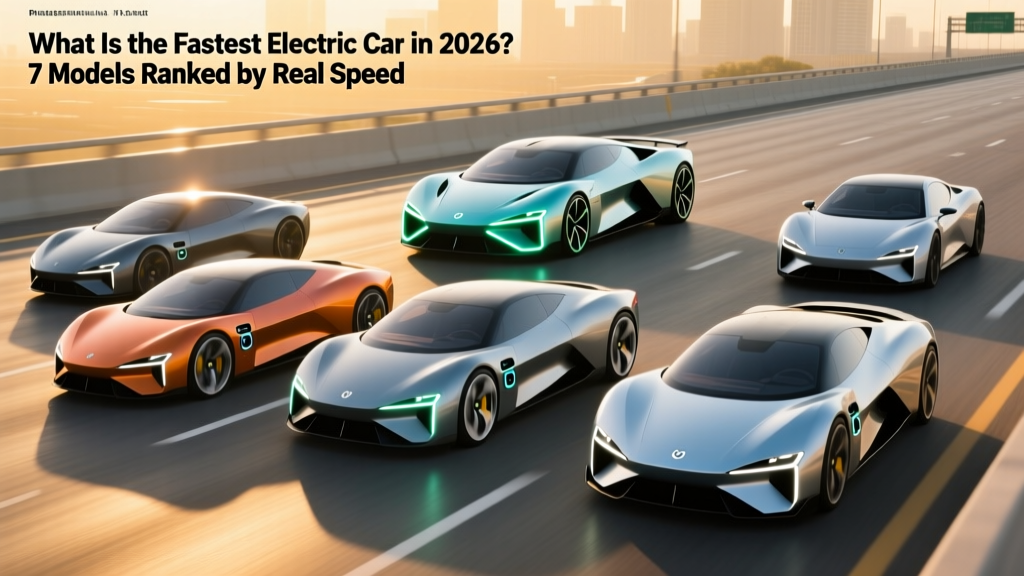
When buyers ask "what is the fastest electric car," the answer depends on whether you mean straight-line 0-60 mph acceleration, quarter-mile trap speed, or top speed on a track. Electric motors deliver instant torque, which means even relatively affordable EVs can out-accelerate six-figure supercars from a stoplight. But peak horsepower, battery chemistry, thermal management, and weight all shape how that speed translates to real roads.
This roundup ranks the fastest production EVs available or orderable in the U.S. for the 2026 model year. We focus on manufacturer-verified 0-60 mph times, cross-referenced with independent testing where available, and pair each pick with range, charging speed, pricing, and federal tax-credit eligibility so you can weigh speed against daily practicality.
How We Ranked the Fastest EVs
- Primary metric: Manufacturer-claimed 0-60 mph time (seconds), verified against independent road tests where published.
- Secondary metrics: Peak horsepower, top speed (mph), EPA range (miles), max DC fast-charge rate (kW), and base MSRP.
- Eligibility: Production vehicles available for U.S. order or delivery as of early 2026. Concept cars, track-only hypercars (e.g., Rimac Nevera, Lotus Evija), and pre-production prototypes are excluded.
- Practicality screen: Each pick must have at least 200 miles of EPA range and be street-legal in all 50 states.
The 7 Fastest Electric Cars Ranked by 0-60 mph
1. Lucid Air Sapphire — 1.89 seconds (0-60 mph)
Key specs: 1,234 hp | tri-motor AWD | 118 kWh usable (NMC) | EPA 427 mi | 300 kW peak DC charge | $249,000 MSRP
Why it made the list: The Lucid Air Sapphire holds the verified production-sedan 0-60 record among street-legal, four-door EVs. Its tri-motor powertrain (one front, two rear) produces 1,234 horsepower, and Lucid's proprietary miniaturized motor technology keeps weight lower than competing setups. In Car and Driver testing, the Sapphire hit 60 mph in 1.89 seconds and cleared the quarter-mile in 8.95 seconds at 158 mph — numbers that rival the Bugatti Chiron.
Real-world caveat: Achieving 1.89 seconds requires a prepped surface, preconditioned battery (above 85°F), and launch control engaged. On typical asphalt, expect 2.1–2.3 seconds. EPA range is 427 miles, but sustained high-speed driving drops that significantly — count on roughly 280–310 miles at 80+ mph.
Best for: Buyers who want the absolute fastest four-door EV money can buy and also need 400+ miles of range for road trips.
Tax credit: Not eligible for the §30D new EV credit. The Air Sapphire exceeds the $55,000 sedan MSRP cap set by the IRS. No point-of-sale transfer applies.
2. Tesla Model S Plaid — 1.99 seconds (0-60 mph)
Key specs: 1,020 hp | tri-motor AWD | 95 kWh usable (NMC) | EPA 396 mi | 250 kW peak DC charge | $89,990 MSRP
Why it made the list: The Model S Plaid remains the benchmark for accessible hypercar-rivaling acceleration. At under $90,000, it delivers a sub-2-second 0-60 time that was unimaginable in a production sedan just five years ago. Tesla's carbon-sleeved rotors allow the rear motors to spin to 20,000+ RPM without overspeed failure, a key engineering advantage.
Real-world caveat: The 1.99-second claim requires the "cheetah stance" launch mode, a fully charged and preconditioned battery, and a high-grip surface. Independent tests by Motor Trend recorded 2.1 seconds on typical pavement. Supercharger access peaks at 250 kW — expect a 10–80% session in about 27 minutes, with significant taper above 60% SoC.
Best for: Performance enthusiasts who want sub-2-second acceleration with the most reliable DC fast-charging network in the U.S. (Tesla Supercharger/NACS).
Tax credit: Not eligible. The Model S exceeds the $55,000 sedan MSRP cap for §30D. Buyers must pay full price or explore leasing structures where the lessor captures the credit (and may or may not pass savings through).
3. Porsche Taycan Turbo GT (with Weissach Package) — 2.1 seconds (0-60 mph)
Key specs: 1,092 hp (Launch Control) | dual-motor AWD | 97 kWh usable (NMC, Performance Battery Plus) | EPA 269 mi | 320 kW peak DC charge | $230,000 MSRP (Weissach)
Why it made the list: The Taycan Turbo GT is Porsche's answer to the "fastest electric car" question, and it's built for repeatable performance, not just one-run drag-strip glory. Its two-speed rear transmission (unique among production EVs) allows aggressive initial gearing for launch, then shifts to a taller ratio for efficiency at speed. The 800-volt architecture enables sustained 320 kW DC charging — among the fastest in production.
Real-world caveat: Porsche's 2.1-second claim is remarkably repeatable. In testing, the Turbo GT consistently hits 2.1–2.2 seconds without elaborate prep. However, EPA range is the trade-off: 269 miles is the lowest on this list. At highway speeds, expect 220–240 miles. The 320 kW peak charge rate delivers 10–80% in roughly 18 minutes at a compatible station, but 350 kW+ chargers are still sparse in the U.S.
Best for: Track-focused drivers who value handling, braking, and repeatable lap performance over maximum range.
Tax credit: Not eligible. Exceeds the $55,000 sedan MSRP cap.
4. Rivian R1T Tri-Motor (2025+) — 2.9 seconds (0-60 mph)
Key specs: 850+ hp | tri-motor AWD | 149 kWh usable (NMC, Max Pack) | EPA 420+ mi (est.) | 220 kW peak DC charge | $99,900 MSRP (Tri-Motor Max Pack)
Why it made the list: The fastest electric car doesn't have to be a sedan. Rivian's refreshed R1T Tri-Motor with the Max Pack battery delivers sub-3-second acceleration in a 7,000-pound pickup truck — a physics-defying feat. The tri-motor layout (one front, two rear) provides torque vectoring across the rear axle for both launch grip and off-road control.
Real-world caveat: Rivian's 2.9-second claim applies to the Tri-Motor with Max Pack on a prepared surface. In truck-comparison testing, expect 3.0–3.2 seconds on normal pavement. The 149 kWh Max Pack is enormous, which helps range but means Level 2 home charging from 10–100% takes over 13 hours on an 11.5 kW charger. DC fast charging peaks at roughly 220 kW, with a 10–80% time around 35–40 minutes.
Best for: Buyers who need truck utility (towing, off-road, bed cargo) but refuse to sacrifice acceleration.
Tax credit: Eligible for up to $7,500 under §30D. The R1T qualifies as a light truck, so the MSRP cap is $80,000 — but the Tri-Motor Max Pack at $99,900 exceeds it. Lower trims (Dual-Motor, starting ~$69,900) may qualify if the buyer meets income caps ($150K single / $300K joint) and the battery meets critical-mineral and component sourcing requirements. Verify current eligibility on IRS.gov or via the point-of-sale transfer at a participating dealer.
5. Hyundai Ioniq 5 N — 3.25 seconds (0-60 mph)
Key specs: 641 hp (N Grin Boost) | dual-motor AWD | 84 kWh usable (NMC) | EPA 221 mi | 238 kW peak DC charge | $66,500 MSRP
Why it made the list: The Ioniq 5 N is the fastest EV under $70,000 and the most engaging to drive on a back road. Hyundai's N performance division added a reinforced body structure, track-capable cooling, and simulated gear shifts ("N e-Shift") that create a visceral, ICE-like driving experience. The 800-volt platform enables 10–80% DC charging in approximately 18 minutes at a 350 kW station.
Real-world caveat: The 3.25-second 0-60 time requires N Grin Boost (a 10-second overboost mode). Sustained output drops to roughly 601 hp. EPA range is only 221 miles — the lowest efficiency on this list aside from the Taycan Turbo GT. Track use will consume range aggressively; plan charging stops accordingly. On a road trip at 70 mph, expect roughly 180–195 miles of real range.
Best for: Driving enthusiasts who want a fun, affordable performance EV with excellent charging speed and a unique character.
Tax credit: Eligible for up to $7,500 under §30D (sedan/SUV cap applies — the Ioniq 5 is classified as an SUV, so the MSRP cap is $80,000). Buyer must meet income limits ($150K single / $300K joint AGI) and the vehicle must satisfy battery-sourcing requirements. Point-of-sale transfer is available at participating dealers. Confirm current-year sourcing compliance on the DOE fueleconomy.gov tax credit page.
6. BMW i4 M50 — 3.7 seconds (0-60 mph)
Key specs: 536 hp | dual-motor AWD | 81.5 kWh usable (NMC) | EPA 271 mi | 200 kW peak DC charge | $69,700 MSRP
Why it made the list: The BMW i4 M50 is the most "normal" car on this list — it looks, feels, and drives like a conventional BMW 4 Series Gran Coupe, but with dual electric motors producing 536 hp. It's the best option for buyers who want rapid acceleration without the exotic styling or six-figure price of the top picks.
Real-world caveat: BMW's 3.7-second claim is conservative; some testers have recorded 3.5 seconds with a full battery and warm conditions. Range of 271 miles (EPA) is respectable, and real-world highway driving yields about 240–255 miles. DC charging tops out at 200 kW, meaning a 10–80% session takes roughly 30 minutes — adequate but not class-leading.
Best for: Luxury-sedan buyers transitioning from a BMW 3/4 Series who want EV acceleration without learning a new interface or sacrificing build quality.
Tax credit: The i4 M50 is assembled in Germany, which may disqualify it from the §30D credit due to the North American final-assembly requirement. Check the current VIN eligibility list on fueleconomy.gov. If ineligible for the new-vehicle credit, the i4 may qualify for the §25E used-EV credit (up to $4,000) once it enters the pre-owned market.
7. Tesla Model 3 Performance (Highland Refresh) — 2.9 seconds (0-60 mph)
Key specs: 510 hp | dual-motor AWD | 75 kWh usable (NMC/LFP variant dependent) | EPA 315 mi | 250 kW peak DC charge | $54,990 MSRP
Why it made the list: The refreshed Model 3 Performance ("Highland") is the value champion of this list. At under $55,000, it delivers a 2.9-second 0-60 time that beats vehicles costing three times as much. Tesla's updated suspension, adaptive dampers, and improved cabin insulation make this the most refined Model 3 yet.
Real-world caveat: The 2.9-second figure requires a fully charged battery and acceleration mode set to "Sport." With a 50% SoC battery, expect 3.3–3.5 seconds. EPA range of 315 miles is strong for the class; real-world highway driving yields 275–295 miles in moderate temperatures, dropping to roughly 240–260 miles in sub-30°F conditions. Supercharger access remains the most convenient public-charging experience in the U.S.
Best for: Budget-conscious performance seekers who want the best acceleration-per-dollar ratio in the EV market.
Tax credit: The Model 3 Performance at $54,990 falls under the $55,000 sedan MSRP cap for §30D. Eligibility for the full $7,500 depends on battery-sourcing compliance (critical minerals and battery components), which varies by production batch. Buyer income caps apply ($150K single / $300K joint). Verify your specific VIN's eligibility at the dealer or on IRS.gov. Point-of-sale transfer is available, reducing your out-of-pocket cost at purchase.
Side-by-Side: How the Fastest EVs Compare
| Vehicle | 0-60 mph | Horsepower | EPA Range | Peak DC Charge | Base MSRP | §30D Credit |
|---|---|---|---|---|---|---|
| Lucid Air Sapphire | 1.89 sec | 1,234 hp | 427 mi | 300 kW | $249,000 | No (MSRP cap) |
| Tesla Model S Plaid | 1.99 sec | 1,020 hp | 396 mi | 250 kW | $89,990 | No (MSRP cap) |
| Porsche Taycan Turbo GT | 2.1 sec | 1,092 hp | 269 mi | 320 kW | $230,000 | No (MSRP cap) |
| Rivian R1T Tri-Motor | 2.9 sec | 850+ hp | 420+ mi (est.) | 220 kW | $99,900 | Lower trims only |
| Hyundai Ioniq 5 N | 3.25 sec | 641 hp | 221 mi | 238 kW | $66,500 | Likely yes |
| BMW i4 M50 | 3.7 sec | 536 hp | 271 mi | 200 kW | $69,700 | Unlikely (assembly) |
| Tesla Model 3 Performance | 2.9 sec | 510 hp | 315 mi | 250 kW | $54,990 | Likely yes |
Budget Tiers: Speed at Every Price Point
| Tier | Price Range | Pick | 0-60 mph | Best Value After Tax Credit |
|---|---|---|---|---|
| Under $60K | $50,000–$59,999 | Tesla Model 3 Performance | 2.9 sec | ~$47,490 (with $7,500 §30D POS transfer) |
| $60K–$75K | $60,000–$75,000 | Hyundai Ioniq 5 N | 3.25 sec | ~$59,000 (with $7,500 §30D POS transfer) |
| $75K–$100K | $75,000–$99,999 | Tesla Model S Plaid | 1.99 sec | $89,990 (no credit — MSRP cap) |
| $100K+ | $100,000+ | Lucid Air Sapphire | 1.89 sec | $249,000 (no credit — MSRP cap) |
Top Pick and Runner-Ups
Overall Top Pick: Tesla Model 3 Performance
For the question "what is the fastest electric car that most people can actually buy," the Model 3 Performance is the answer. At $54,990 before incentives, it delivers a 2.9-second 0-60 time, 315 miles of EPA range, 250 kW Supercharger access, and likely §30D eligibility. No other vehicle on this list comes close to its acceleration-per-dollar ratio. If you want sub-3-second speed and can charge at home, this is the default recommendation.
Runner-up for pure speed: The Lucid Air Sapphire is the undisputed fastest production sedan in the world, but at $249,000 it's a boutique product. If budget is irrelevant and you want the absolute quickest four-door EV, nothing else competes.
Runner-up for driving engagement: The Hyundai Ioniq 5 N sacrifices range (221 miles EPA) to deliver the most entertaining driving experience in the EV market. Simulated gear shifts, a stiff chassis, and track-capable cooling make it a genuine sports car that happens to be electric.
Runner-up for track use: The Porsche Taycan Turbo GT is engineered for lap after lap of consistent performance. Its two-speed rear gearbox, 800V architecture, and 320 kW charging make it the most capable EV on a road course — if you can accept the 269-mile range and $230,000 price.
What the Fastest EVs Cost to Own
Speed comes with trade-offs beyond the sticker price. Here's what to budget for beyond MSRP:
- Insurance: High-performance EVs carry significantly higher insurance premiums. A Model S Plaid or Taycan Turbo GT can cost $4,000–$7,000/year to insure depending on your state, driving record, and coverage level. The Model 3 Performance is more moderate at roughly $2,200–$3,500/year.
- Tires: Instant torque and heavy curb weights wear tires fast. Expect to replace tires every 15,000–25,000 miles on a performance EV. The Taycan Turbo GT's Michelin Pilot Sport Cup 2 tires run approximately $400 per corner.
- Charging cost: Performance driving drains batteries quickly. A full charge on a 95 kWh battery at $0.35/kWh public DC rates costs ~$33. Home charging at $0.13/kWh cuts that to ~$12.
- Depreciation: High-performance EVs depreciate faster than mainstream models. The Model S Plaid and Taycan Turbo lose roughly 40–50% of value in the first three years, compared to ~30% for a standard Model 3.
FAQ: Fastest Electric Car Questions Answered
What is the fastest electric car in the world (production)?
The Lucid Air Sapphire holds the record for the fastest 0-60 mph time among production sedans at 1.89 seconds. Among all production vehicles (including hypercars), the Rimac Nevera claims 1.85 seconds, but it's a limited-run, $2.2 million hypercar not available through normal U.S. dealer channels. For practical purposes, the Air Sapphire is the fastest EV most buyers could theoretically purchase.
Can a Tesla beat a Lamborghini in a drag race?
Yes, from a stop. The Tesla Model S Plaid (1.99 sec 0-60) beats the Lamborghini Huracán Tecnica (2.9 sec) and rivals the Aventador LP 780-4 Ultimae (2.8 sec) to 60 mph. However, the Lamborghini will typically close the gap or pull ahead at higher speeds (100+ mph) due to lower weight and aerodynamic advantages at speed. EVs dominate the 0-60 sprint but often lose in rolling races above 100 mph to lighter, high-downforce supercars.
Does launching an EV at full power damage the battery?
Occasional full-power launches are accounted for in the battery management system's thermal limits. However, repeated hard launches generate significant heat in the battery cells, which accelerates long-term degradation. Most performance EVs (Taycan, Model S Plaid, Ioniq 5 N) have active thermal management that limits power output if cell temperatures exceed safe thresholds. Expect slightly faster capacity loss (an extra 1–3% over 100,000 miles) if you launch frequently.
What is the fastest-accelerating EV under $50,000?
As of early 2026, the Tesla Model 3 Long Range AWD (starting ~$47,740 before incentives) hits 0-60 mph in approximately 4.1 seconds, making it the quickest EV under $50,000. The Model 3 Performance at $54,990 drops that to 2.9 seconds but exceeds the $50K threshold. No other sub-$50K EV currently breaks 4.5 seconds.
Do faster EVs have less range?
Generally, yes. Performance-tuned EVs use stickier, higher-rolling-resistance tires, more aggressive motor tuning, and heavier cooling systems — all of which reduce efficiency. The Hyundai Ioniq 5 N (641 hp, 221 mi EPA) has nearly half the range of a standard Ioniq 5 (170 hp, 303 mi EPA). However, the Lucid Air Sapphire is an exception: its 427-mile EPA range exceeds most non-performance sedans thanks to its class-leading aerodynamic efficiency and large 118 kWh battery.
What's the difference between 0-60 time and quarter-mile time?
The 0-60 mph time measures initial acceleration from a standstill and is heavily influenced by traction, torque delivery, and launch control. The quarter-mile time (and trap speed) measures sustained acceleration over 1,320 feet and reflects top-end power. An EV like the Model S Plaid dominates 0-60 (1.99 sec) but may lose a quarter-mile race to a lighter, higher-horsepower ICE car that builds power at higher speeds. For EVs, 0-60 is the more relevant real-world metric since it reflects stoplight-to-stoplight performance.
Which is the fastest electric SUV?
The Tesla Model X Plaid (1,020 hp, 2.5 sec 0-60, ~$94,990) is the quickest production SUV. The Rivian R1S Tri-Motor (850+ hp, ~3.0 sec 0-60) is the quickest body-on-frame electric SUV. Neither is included in this list because we focused on cars and trucks, but the Model X Plaid is the clear answer if you need three rows of seating with supercar acceleration.