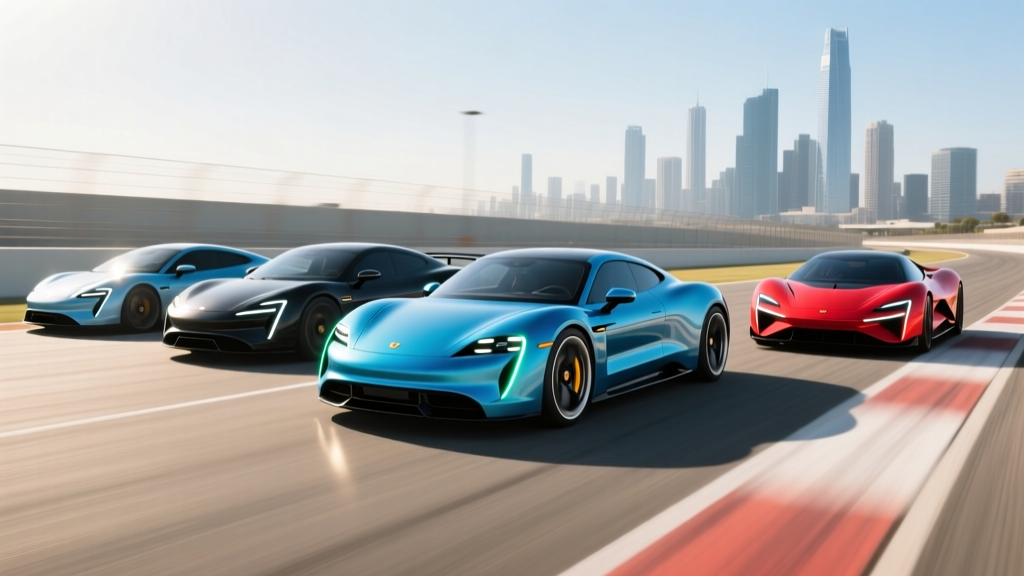
The search for the fastest electric car isn't just about bragging rights — instant torque from electric motors makes EVs uniquely capable at the drag strip and the stoplight alike. But straight-line speed alone doesn't make a great purchase. A 1.99-second hypercar that can't use public chargers is a museum piece, not a daily driver.
We've ranked seven of the quickest production EVs you can actually buy or order in 2026, balancing verified 0-60 mph acceleration with real-world usability: EPA range, DC fast-charging speed, pricing, and federal tax credit eligibility. Every pick below is a current, street-legal production model — no vaporware, no track-only concepts.
How We Ranked the Fastest EVs
- Primary metric: Manufacturer-verified or independently tested 0-60 mph time (seconds).
- Usability filters: Minimum 200 miles EPA range, DC fast-charging capability, and street-legal production status for the 2025–2026 model year.
- Tiebreakers: When 0-60 times match, we prioritize EPA range, then base MSRP, then charging speed.
- Sources: EPA fueleconomy.gov, manufacturer pressrooms, and instrumented testing from established automotive media.
The 7 Fastest Electric Cars of 2026, Ranked
#1 — Rimac Nevera
0-60 mph: 1.85 seconds | Power: 1,914 HP | EPA Range: ~287 mi (WLTP 340 mi) | Battery: 120 kWh NMC | Base Price: ~$2,400,000
Why it made the list: The Nevera holds multiple verified production-car acceleration records. Quad independent motors with torque vectoring deliver not just peak power but surgically precise traction — the limiting factor in sub-2-second runs. Top speed: 258 mph.
Best for: Hypercar collectors who want the absolute fastest production EV ever built, regardless of price. Limited to 150 units worldwide.
Tax credit: Not eligible — far exceeds the §30D MSRP cap of $55,000 for sedans.
Real-world caveat: Range drops sharply under hard driving; expect ~150–180 miles at track pace. DC fast charging peaks at 500 kW, but infrastructure that fast is rare in the US.
#2 — Lotus Evija
0-60 mph: ~1.99 seconds (claimed, under 2.0) | Power: 2,012 HP | WLTP Range: ~217 mi (no EPA rating yet) | Battery: 70 kWh (usable) | Base Price: ~$2,300,000
Why it made the list: Lotus's all-electric hypercar is the highest-power production EV ever sold. Five drive modes, including a 2,012-HP "Omega" mode, push the physics envelope. Carbon-fiber monocoque keeps weight (relatively) manageable at ~4,160 lbs.
Best for: Track-day hypercar buyers who want Lotus chassis dynamics with electric powertrain response.
Tax credit: Not eligible — MSRP cap exceeded.
Real-world caveat: Limited production (130 units). 350 kW DC fast charging claimed; real-world 10-80% times pending independent verification. No EPA testing published as of early 2026.
#3 — Tesla Model S Plaid
0-60 mph: 1.99 seconds | Power: 1,020 HP | EPA Range: 359 mi | Battery: ~100 kWh NMC | Base MSRP: $89,990
Why it made the list: The Model S Plaid is the cheapest way to hit sub-2-second 0-60 times in a four-door, five-seat sedan. Tri-motor AWD with torque vectoring, plus Tesla's Supercharger network (17,000+ US stalls), makes it genuinely usable as a daily and road-trip car.
Best for: Performance sedan buyers who need real-world range, Supercharger access, and a back seat. The best value in the sub-2-second club.
Tax credit: Not eligible for new — exceeds the §30D MSRP cap of $55,000 for sedans. May qualify for the used EV credit (up to $4,000) if purchased pre-owned under $25,000 and buyer income qualifies.
Real-world caveat: Expect ~280–310 miles on highway road trips at 75 mph; cold weather (below 32°F) can reduce range 15–25%. Peak DC charge rate is 250 kW; 10-80% takes approximately 27 minutes at a V3 Supercharger.
#4 — Lucid Air Sapphire
0-60 mph: 1.99 seconds | Power: 1,234 HP | EPA Range: 427 mi | Battery: 118 kWh NMC | Base MSRP: $249,000
Why it made the list: The Sapphire matches the Model S Plaid's 0-60 while delivering the longest EPA range of any performance EV — 427 miles. Lucid's miniaturized motors and 900V+ architecture also enable exceptional efficiency at 4.4 kWh/mi (combined).
Best for: Luxury sedan buyers who want hypercar acceleration without range compromise. Ideal for long-distance driving between Los Angeles and San Francisco or New York and Washington, D.C. without a charge stop.
Tax credit: Not eligible — far exceeds the $55,000 sedan MSRP cap under §30D.
Real-world caveat: Highway range at 75 mph still exceeds 350 miles in moderate temperatures. DC fast charging peaks at 300+ kW; 10-80% in approximately 15–17 minutes on compatible 350 kW stations. Charging infrastructure at that power level remains limited outside major metro corridors.
#5 — Pininfarina Battista
0-60 mph: 1.79 seconds (verified by manufacturer testing) | Power: 1,900 HP | WLTP Range: ~310 mi | Battery: 120 kWh NMC (Rimac-supplied) | Base Price: ~$2,800,000
Why it made the list: Shares the Nevera's powertrain but wrapped in Pininfarina coachwork. The Battista's claimed 0-60 is marginally quicker than the Nevera's in certain configurations, though independent verification varies. Limited to 150 units.
Best for: Design-focused collectors who want Rimac-level performance with Italian styling heritage.
Tax credit: Not eligible.
Real-world caveat: No EPA rating; WLTP figures typically overstate range by 10–15% vs. US testing. DC fast charging at up to 250 kW; 20-80% in approximately 18 minutes per manufacturer claims.
#6 — Porsche Taycan Turbo GT (with Weissach Package)
0-60 mph: 2.1 seconds | Power: 1,019 HP (1,092 HP with Launch Control) | EPA Range: 269 mi | Battery: 105 kWh NMC (Performance Battery Plus) | Base MSRP: ~$230,000
Why it made the list: The Taycan Turbo GT is the fastest-accelerating Porsche production car ever — and the fastest EV to lap the Nürburgring Nordschleife (7:07.55). The Weissach Package strips 157 lbs for track focus. Porsche's 800V architecture enables repeatable performance without heat-induced power derating.
Best for: Track enthusiasts who value chassis dynamics, braking, and lap-time consistency over straight-line-only metrics. The driver's car of the fast-EV world.
Tax credit: Not eligible — exceeds $55,000 sedan MSRP cap.
Real-world caveat: EPA range of 269 miles is modest; expect ~210–230 miles highway. DC fast charging peaks at 320 kW (2025+ update); 10-80% in approximately 18 minutes at a 350 kW station. Charge curve stays flat longer than most competitors — a real advantage on road trips.
#7 — Tesla Model 3 Performance
0-60 mph: 2.9 seconds | Power: 510 HP | EPA Range: 315 mi | Battery: ~79 kWh NMC | Base MSRP: $54,990
Why it made the list: The Model 3 Performance is the most accessible car on this list — and the only one that can qualify for a federal tax credit (details below). It delivers sports-car acceleration at a price below many luxury crossovers.
Best for: Driving enthusiasts on a budget who want sub-3-second acceleration, Supercharger access, and daily-driver practicality. The best value proposition in fast EVs.
Tax credit: Potentially eligible for the full $7,500 §30D credit, depending on battery sourcing compliance, buyer income caps ($150K single / $300K joint), and point-of-sale transfer rules. The $54,990 MSRP sits under the $55,000 sedan cap. Verify current eligibility at irs.gov before purchasing.
Real-world caveat: Expect ~250–270 miles highway at 75 mph. DC fast charging peaks at 250 kW; 10-80% in approximately 25 minutes at a V3 Supercharger. Adaptive suspension (new for this generation) significantly improves ride quality over the prior Model 3 Performance.
Side-by-Side: How the Fastest EVs Compare
| Model | 0-60 mph | HP | EPA Range | Peak DC kW | 10-80% Charge | Base MSRP |
|---|---|---|---|---|---|---|
| Rimac Nevera | 1.85 s | 1,914 | ~287 mi | 500 kW | ~19 min | $2,400,000 |
| Lotus Evija | ~1.99 s | 2,012 | N/A (WLTP 217) | 350 kW | TBD | $2,300,000 |
| Tesla Model S Plaid | 1.99 s | 1,020 | 359 mi | 250 kW | ~27 min | $89,990 |
| Lucid Air Sapphire | 1.99 s | 1,234 | 427 mi | 300+ kW | ~15-17 min | $249,000 |
| Pininfarina Battista | 1.79 s | 1,900 | N/A (WLTP 310) | 250 kW | ~18 min | $2,800,000 |
| Porsche Taycan Turbo GT | 2.1 s | 1,019 | 269 mi | 320 kW | ~18 min | $230,000 |
| Tesla Model 3 Performance | 2.9 s | 510 | 315 mi | 250 kW | ~25 min | $54,990 |
Budget Tiers: Which Fast EV Fits Your Wallet?
| Tier | Price Range | Picks | Best For |
|---|---|---|---|
| Accessible Performance | Under $60K | Tesla Model 3 Performance | Daily drivers wanting sports-car speed with tax-credit potential |
| Premium Performance | $80K–$250K | Tesla Model S Plaid, Porsche Taycan Turbo GT, Lucid Air Sapphire | Luxury sedan buyers seeking hypercar acceleration with usable range and charging |
| Hypercar Elite | $2M+ | Rimac Nevera, Lotus Evija, Pininfarina Battista | Collectors and track enthusiasts with no budget constraint |
Best Value After Tax Credits
Federal EV tax credit eligibility under IRS §30D has strict rules for 2026:
- MSRP cap: $55,000 for sedans; $80,000 for SUVs, vans, and trucks.
- Buyer income cap: $150,000 single / $225,000 head of household / $300,000 married filing jointly (modified AGI).
- Battery sourcing: Critical minerals and battery components must meet escalating domestic-sourcing thresholds that tighten annually.
- Point-of-sale transfer: Eligible buyers can transfer the credit to the dealer for an immediate price reduction at purchase.
Of the seven fastest EVs on this list, only the Tesla Model 3 Performance falls under the $55,000 sedan MSRP cap. If you meet the income requirements and the vehicle's battery components satisfy current-year sourcing rules, the $7,500 credit effectively brings the price to approximately $47,490 — making a 2.9-second, 315-mile EV cheaper than many gas-powered sports cars.
The Tesla Model S Plaid ($89,990) exceeds the sedan cap. The Porsche Taycan Turbo GT and Lucid Air Sapphire are far above any cap. The three hypercars are in a financial stratosphere where tax credits are irrelevant.
Always verify current-year eligibility on the IRS clean vehicle credit page and consult a tax professional before relying on credit availability. Battery sourcing compliance lists change throughout the year.
Category Winners: Beyond 0-60
🏆 Longest Range
Lucid Air Sapphire — 427 miles EPA. No other performance EV comes close. The standard Lucid Air Grand Touring reaches 516 miles, but the Sapphire's tri-motor setup trades some efficiency for 1,234 HP and still delivers class-leading distance.
🏆 Fastest Charging
Porsche Taycan Turbo GT — 320 kW peak. Porsche's 800V architecture and updated battery allow sustained high-power charging with a remarkably flat charge curve. Real-world 10-80% in ~18 minutes on a 350 kW station beats most competitors, even those with higher peak kW claims that taper quickly.
🏆 Best Track Car
Porsche Taycan Turbo GT (Weissach). The Nürburgring record speaks for itself. Thermal management allows repeated hard laps without power derating — a persistent weakness in many fast EVs, including the Model S Plaid under sustained track use.
🏆 Best Daily Driver
Tesla Model 3 Performance. At $54,990, with 315 miles of range, Supercharger access, and a refined adaptive suspension, it's the only sub-3-second car on this list you can drive to work every day without thinking twice about charging logistics.
🏆 Best Road-Trip EV
Lucid Air Sapphire. 427 miles of range means you can skip most charging stops entirely on trips under 400 miles. When you do stop, 300+ kW charging gets you back on the road fast — if you can find a compatible station.
🏆 Absolute Quickest
Pininfarina Battista — 1.79 seconds. Marginally quicker than the Rimac Nevera despite sharing its powertrain, likely due to weight distribution and calibration differences. But at $2.8 million, this is a record for collectors, not commuters.
Top Pick and Runner-Ups
🥇 Top Pick: Tesla Model S Plaid
The Model S Plaid earns our top overall pick because it sits at the intersection of extreme performance and genuine usability. At 1.99 seconds to 60 mph, it matches the Lucid Air Sapphire and trades blows with hypercars costing 25× more. Meanwhile, it offers 359 miles of EPA range, access to the most reliable DC fast-charging network in North America (Tesla Superchargers, now also open to NACS-equipped non-Tesla EVs), a practical five-seat interior, and a sub-$90K price.
No, it doesn't qualify for the new-vehicle tax credit. And yes, its charge curve tapers noticeably above 80% SoC. But for the buyer who wants the fastest electric car that's also a realistic daily and road-trip vehicle, the Plaid is the answer.
Runner-Up (Best Value): Tesla Model 3 Performance — the only pick here that can qualify for the $7,500 federal credit, dropping its effective price below $48K for a 2.9-second EV.
Runner-Up (Best Luxury/Range): Lucid Air Sapphire — if budget allows, 427 miles of range with 1,234 HP is an engineering achievement no other automaker has matched.
Runner-Up (Best Driver's Car): Porsche Taycan Turbo GT — for those who value lap times, braking feel, and chassis feedback over raw 0-60 numbers.
What About the Fastest Electric SUVs?
This list focuses on the fastest electric car models — sedans and hypercars. If you need SUV practicality, the quickest options as of 2026 include:
- Tesla Model X Plaid: 2.5 seconds, 311 mi EPA, $94,990 (not tax-credit eligible; $80K SUV cap)
- Rivian R1S Tri-Motor: ~2.9 seconds, ~350 mi EPA, $99,900 (not tax-credit eligible)
- Lotus Eletre R: ~2.95 seconds, ~304 mi WLTP, pricing from ~$120,000+ (not tax-credit eligible)
The $80,000 MSRP cap for SUVs under §30D means fewer fast electric SUVs qualify for the credit. The Tesla Model Y Performance (3.5 seconds, ~$54K) remains the most accessible fast electric SUV with potential credit eligibility.
Frequently Asked Questions
What is the fastest electric car you can buy in 2026?
The Pininfarina Battista claims the quickest 0-60 time at 1.79 seconds, followed closely by the Rimac Nevera at 1.85 seconds. However, both are limited-production hypercars priced above $2 million. The fastest electric car you can buy at a traditional dealership is the Tesla Model S Plaid at 1.99 seconds for $89,990.
Why are electric cars faster than gas cars at acceleration?
Electric motors deliver maximum torque from zero RPM — there's no need to build revs, wait for turbo spool-up, or shift through gears. This instant torque delivery, combined with all-wheel-drive traction from multiple motors, allows EVs to launch harder than internal-combustion cars of similar power. However, gas-powered supercars often surpass EVs at top speed (150+ mph) because electric motors lose efficiency at very high RPM, and battery weight works against sustained high-speed performance.
Does the fastest 0-60 time matter for daily driving?
Rarely. A 2-second 0-60 time is a technical achievement, but the difference between 2.0 and 3.0 seconds is imperceptible in normal traffic. What matters more for daily use is 0-30 mph responsiveness (stoplight-to-stoplight), passing acceleration at 45-70 mph, and throttle modulation smoothness. All seven EVs on this list excel in those metrics. The real differentiators for ownership are range, charging speed, ride quality, and service network access.
Which fast EV qualifies for the $7,500 federal tax credit?
Only the Tesla Model 3 Performance ($54,990 MSRP) falls under the §30D sedan cap of $55,000. Eligibility also depends on buyer income (under $150K single / $300K joint), battery component and critical-mineral sourcing compliance, and point-of-sale transfer rules. Always check the fueleconomy.gov tax credit page and irs.gov for the most current eligibility lists before purchasing.
How does cold weather affect performance EV range?
All EVs lose range in cold weather due to increased battery internal resistance and cabin heating demands. Expect 15–30% range reduction below freezing (32°F), with the worst losses below 20°F. Performance EVs with larger batteries (Lucid Air Sapphire's 118 kWh, Model S Plaid's ~100 kWh) retain more absolute range in cold conditions than smaller-battery vehicles. Preconditioning the battery while plugged in — a feature all picks on this list support — mitigates both range loss and charging speed reduction.
Can fast EVs maintain performance on a track?
This is where the Porsche Taycan Turbo GT distinguishes itself. Its 800V architecture and advanced thermal management system allow repeated high-power laps without the power derating that affects most EVs (including the Model S Plaid) under sustained track use. Battery temperature is the limiting factor: once cells exceed ~50°C (122°F), the battery management system reduces power output to prevent damage. If track days are a priority, thermal management specs matter as much as peak HP.
What's the difference between kW and kWh in these specs?
kWh (kilowatt-hours) measures battery capacity — the size of the "fuel tank." A 100 kWh battery stores more energy than a 79 kWh battery, generally enabling longer range. kW (kilowatts) measures power flow — how fast energy is delivered (motor output) or received (charging rate). A 250 kW DC fast charger delivers energy faster than a 150 kW charger, reducing charge time. Peak motor kW determines acceleration; peak charging kW determines how fast you can replenish the battery.