Can You Use an Electric Truck on a Farm? The Short Answer
Yes — but with caveats that depend entirely on your operation. For farms with predictable daily routes under 150 miles, access to 240V Level 2 charging at the barn or shop, and a need for jobsite power tools, a battery-electric truck like the Ford F-150 Lightning or Rivian R1T can outperform a diesel in torque, eliminate fuel costs, and power equipment via Vehicle-to-Load (V2L). For long-haul grain runs exceeding 250 miles, heavy towing over 8,000 lbs on a regular basis, or operations in remote areas with no charging infrastructure, a hybrid or diesel truck remains the more practical choice in 2026. The decision comes down to your daily mileage, towing demands, and whether you can install a Level 2 charger on-site.
Why Farms Are Considering Electric Trucks in 2026
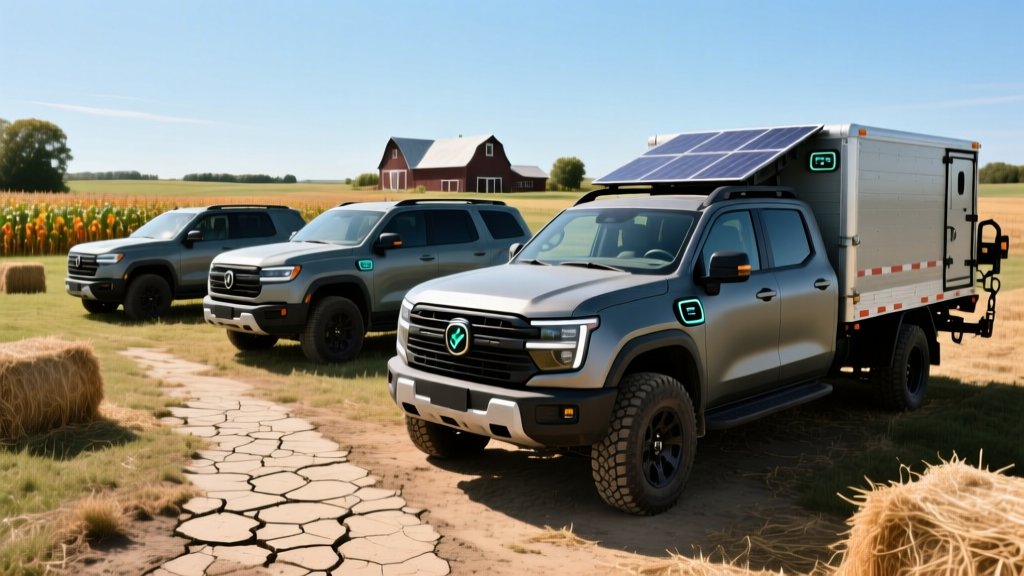
Agricultural operations are uniquely positioned to benefit from electric pickup trucks — and uniquely challenged by them. On the benefit side, farms typically operate from a home base, meaning overnight charging is feasible without relying on public networks. Daily routes are often predictable: checking fences, hauling feed, running to the co-op, moving equipment between fields. The instant torque of an electric powertrain (the Ford F-150 Lightning delivers 563 lb-ft from 0 RPM) is ideal for pulling heavy loads from a standstill, whether that's a loaded trailer or a stuck piece of equipment.
The onboard power capability is where farm-specific value really emerges. The F-150 Lightning's Pro Power Onboard system offers up to 9.6 kW of continuous export power — enough to simultaneously run a welder, circular saw, and work lights at a remote jobsite without a generator. The Rivian R1T offers a similar feature with up to 3.6 kW of V2L output through its bed and cabin outlets. For operations that currently spend $15–30/day on generator fuel, the EV becomes a mobile power station that costs pennies per hour to operate.
On the challenge side: towing an 8,000+ lb trailer cuts EV range by 40–55%, cold winters in the upper Midwest and Plains states reduce battery efficiency by 20–30%, and upfront purchase prices remain $10,000–$20,000 higher than comparable gas trucks before incentives. Let's break down the numbers.
The Contenders: Spec Comparison for Farm Duty
Here's how the leading electric trucks stack up for agricultural use cases. All figures reflect 2026 model-year EPA data and manufacturer specifications.
| Spec | Ford F-150 Lightning (Ext. Range) | Rivian R1T (Max Pack) | Chevy Silverado EV (4WT) |
|---|---|---|---|
| EPA Range | 320 miles | 410 miles | 492 miles |
| Real-World Range (highway/load)* | ~240–270 mi | ~310–350 mi | ~370–420 mi |
| Range Towing 7,500 lbs | ~140–170 mi | ~180–220 mi | ~220–260 mi |
| Battery Capacity (usable) | 131 kWh (NMC) | 149 kWh (NMC) | 200+ kWh (NMC) |
| Horsepower / Torque | 580 hp / 775 lb-ft | 1,025 hp / 1,198 lb-ft | 510 hp / 615 lb-ft |
| 0–60 mph | 3.8 sec | 2.9 sec (Tri-Motor) | ~4.5 sec |
| Max Towing Capacity | 10,000 lbs | 11,000 lbs | 10,000 lbs |
| Max Payload | 2,235 lbs | 1,764 lbs | 1,800 lbs |
| Peak DC Fast Charge | ~190 kW | ~220 kW | ~350 kW |
| 10–80% DC Charge Time | ~41 min | ~35 min | ~20 min |
| Level 2 Home Charge Rate | 19.2 kW (80A) | 11.5 kW (48A) | 11.5 kW (48A) |
| V2L / Pro Power Output | 9.6 kW | 3.6 kW | Up to 9.6 kW (V2H capable) |
| Bed Length | 5.5 ft | 4.5 ft (w/ Gear Tunnel) | 5.5 ft (Multipro Tailgate) |
| Base MSRP (2026) | $72,090 (Lariat ER) | $89,900 (Max Pack) | $73,800 (4WT) |
| Battery Warranty | 8 yr / 100,000 mi | 8 yr / 175,000 mi | 8 yr / 100,000 mi |
*Real-world range reflects mixed highway driving at 65–75 mph in moderate temperatures. Cold weather (below 30°F) reduces these figures by an additional 15–30%. Towing range assumes a 7,500 lb enclosed trailer at highway speeds.
EV vs. Gas Truck: The Real Farm Cost Breakdown
The sticker price of an electric truck is higher, but the total cost of ownership tells a different story — especially for operations with high idle times, short repetitive routes, and access to cheap electricity. Here's a 5-year comparison based on 15,000 miles/year, $3.50/gallon regular unleaded, and $0.13/kWh residential electricity (national average; many rural co-ops offer lower agricultural rates).
| Cost Category (5 Years) | Ford F-150 Lightning (ER) | Ford F-150 Gas (3.5L EcoBoost, 4WD) |
|---|---|---|
| Purchase Price (MSRP) | $72,090 | $58,495 |
| Federal Tax Credit (§30D)** | –$7,500 (if eligible) | |
| Effective Purchase Price | $64,590 | $58,495 |
| Fuel / Electricity (75,000 mi) | $3,900 | $13,125 |
| Maintenance (oil, filters, brakes) | $1,200 | $4,500 |
| Insurance (avg, 5 yr) | $11,500 | $8,750 |
| Estimated Depreciation | $28,000 | $22,000 |
| Total 5-Year Cost | $109,190 | $106,870 |
Key takeaway: At 15,000 miles/year, the Lightning breaks even with the gas F-150 around year 5 when the full §30D credit applies. At 20,000+ miles/year or with higher annual mileage, the EV pulls ahead due to dramatically lower fuel and maintenance costs. The savings widen further if your rural electric co-op offers off-peak agricultural charging rates (some as low as $0.06–0.08/kWh).
**The IRS §30D clean vehicle credit has income caps ($150K single / $300K joint), MSRP caps ($80K for trucks), and battery-sourcing requirements that change annually. Always verify current-year eligibility with a tax professional. The credit can be transferred to the dealer at point of sale as of 2024 onward.
Real-World Farm Charging: What You Actually Need
Home-base charging is the backbone of farm EV ownership, and this is where agricultural operations have a structural advantage. Most farms already have 240V electrical service for welders, grain dryers, or workshop equipment — the same infrastructure needed for a Level 2 charger.
Level 2 Charging on the Farm: What to Expect
Ford F-150 Lightning (19.2 kW onboard charger): A full 0–100% charge takes roughly 8 hours on a 80-amp Level 2 station. That's 320 miles of range restored overnight. Expect to pay $1,800–$3,500 for a hardwired 80A unit plus electrician installation, assuming your panel has capacity.
Rivian R1T (11.5 kW onboard charger): A full charge on a 48-amp Level 2 takes approximately 13 hours for the Max Pack battery. A 48A charger install typically runs $800–$1,500 for equipment and $1,200–$2,500 for electrician labor.
Panel upgrade gotcha: If your barn or shop is on a 100-amp sub-panel that's already near capacity, you'll need a panel upgrade ($2,000–$5,000) or a smart load-management system that throttles charging when other equipment draws power. Consult a licensed electrician familiar with agricultural electrical codes.
For DC fast charging during the workday, rural coverage has improved but remains uneven. EPA and DOE data shows that as of late 2025, roughly 65% of U.S. counties have at least one public DC fast charger, but many agricultural regions in the Great Plains and rural Southeast still have 50+ mile gaps between stations. If your operation requires mid-day fast charging, map your routes against the Tesla Supercharger network (now open to NACS-equipped Ford and GM trucks), Electrify America, and EVgo locations before committing.
Common Farm EV Myths — Addressed with Data
| Myth | Fact |
|---|---|
| "EVs can't tow anything useful." | The F-150 Lightning tows 10,000 lbs and the R1T tows 11,000 lbs — comparable to half-ton gas trucks. The limitation isn't capability, it's range: expect a 40–55% range reduction at max tow. |
| "Batteries won't last in farm conditions." | Modern NMC and LFP battery packs are sealed to IP67+ standards (submersible). Ford, Rivian, and GM all warranty their batteries for 8 years with a minimum 70% capacity retention threshold. NHTSA data shows no systemic battery failure patterns in current-generation EV trucks. |
| "You'll be stranded in the field with no power." | With a Level 2 charger at home base and a daily route under 150 miles, range is a non-issue. The Lightning's 131 kWh battery holds more energy than 3.8 gallons of diesel — enough to power a typical farm shop for hours via V2L. |
| "Cold winters kill EV range completely." | Cold weather (10–30°F) reduces range by 20–30% due to battery chemistry and cabin heating demands. A 320-mile Lightning drops to ~220–250 miles in January. For a 50-mile daily route, this is irrelevant. For a 200-mile run, it requires planning. |
| "Electricity isn't cheaper than diesel." | At $0.13/kWh national average, the Lightning costs ~$0.04–0.05/mile to "fuel." A diesel F-250 at 15 MPG and $3.80/gallon costs ~$0.25/mile. Even at higher rural commercial rates, electricity wins on a per-mile basis. |
Who Should (and Shouldn't) Go Electric on the Farm
Farm EV Decision Framework
Choose an electric truck if:
- Your typical daily driving is under 150 miles round-trip from home base
- You can install a 240V Level 2 charger at your barn, shop, or residence
- You regularly need portable power for tools, welders, or lighting in the field
- You want to eliminate idle fuel burn (EVs use zero energy when stationary)
- Your towing needs are moderate (under 7,500 lbs) or infrequent at max capacity
- You qualify for the §30D federal tax credit and/or your state offers additional incentives
Stick with gas, diesel, or a PHEV if:
- You regularly drive 250+ miles in a day with no time for a 30-minute charge stop
- You tow 8,000+ lbs on most days and need the full EPA range as your safety margin
- Your operation is in a remote area with no DC fast charging within 50+ miles
- You operate in extreme cold (below 0°F) for extended periods and can't precondition indoors
- Your budget can't absorb the higher upfront cost, even with incentives factored in
First-Time Farm EV Buyer: What to Know Before You Sign
If you're seriously considering an electric truck for agricultural use, here's the due-diligence checklist that separates informed buyers from regretful ones:
- Audit your daily mileage. Use your phone's GPS history or a simple odometer log for two weeks. If 95% of your days fall under 150 miles, an EV works. If you have 10 days a month exceeding 250 miles, plan for those specifically — they may require a mid-day DC fast charge or a second vehicle.
- Get an electrical assessment. Before ordering a truck, have a licensed electrician evaluate your barn or shop panel. An 80A charger requires a 100A circuit, which means a 200A panel minimum with available capacity. Budget $2,000–$6,000 for installation depending on complexity and distance from panel to charger location.
- Check §30D eligibility carefully. The IRS clean vehicle credit has specific rules around battery critical-mineral sourcing, buyer income limits, and vehicle MSRP caps that change year to year. The $80K MSRP cap for trucks means some fully-loaded trims may not qualify. Verify with your dealer and a tax professional before relying on the credit in your budget.
- Test your specific towing scenario. Ask the dealer for a demo tow with a trailer similar to yours. Monitor the energy consumption readout (kWh/mile) during the test. This real-world data — not the EPA sticker — will tell you your actual towing range.
- Factor in insurance. EV trucks currently carry 15–25% higher insurance premiums than gas equivalents due to higher repair costs and parts pricing. Get quotes from your provider before committing.
- Explore agricultural electricity rates. Many rural electric cooperatives offer special EV or agricultural time-of-use rates that can drop your charging cost to $0.05–0.08/kWh during overnight hours. Contact your co-op before installing your charger.
Frequently Asked Questions
Can I charge an electric truck from a standard barn outlet?
Yes, but slowly. A standard 120V (Level 1) outlet delivers about 1.4 kW — roughly 3–4 miles of range per hour of charging. That's ~40 miles overnight. It works as a supplement for low-mileage days, but a 240V Level 2 charger is essential for reliable daily farm use. Never use an extension cord for Level 1 EV charging; the sustained draw can overheat undersized cords.
How long will the battery last before needing replacement?
Current-generation NMC batteries in the F-150 Lightning and R1T are designed for 200,000+ miles with gradual degradation. Expect roughly 10–15% capacity loss over 8 years / 100,000 miles under normal use. All three manufacturers warranty the battery to retain at least 70% of original capacity for 8 years. Full battery replacement costs, if ever needed outside warranty, currently range from $15,000–$25,000 depending on pack size — though industry-wide price declines are expected to reduce this by the 2030s.
Does the V2L / Pro Power Onboard really replace a generator?
For most farm applications, yes. The F-150 Lightning's 9.6 kW Pro Power Onboard can run a MIG welder (~3–4 kW), a 7.25" circular saw (~1.8 kW), and LED work lights simultaneously without issue. You're limited by the truck's total battery capacity (131 kWh), which means roughly 13–14 hours of continuous 9.6 kW draw — far more than a single workday requires. The trade-off is that heavy V2L use reduces your driving range for the trip home.
What about using an electric truck in dusty, muddy, or wet conditions?
EV truck battery packs are sealed to IP67 or better, meaning they can withstand temporary submersion. Dust, mud, and rain are not concerns for the powertrain. The Rivian R1T's quad-motor system and the Lightning's dual-motor AWD provide excellent traction in mud and loose surfaces. Underbody armor is available on most trims for rocky or rutted farm roads.
Are there any electric trucks better suited for heavy-duty farm work (F-250/F-350 class)?
As of 2026, the heavy-duty electric truck segment is still emerging. The Ford F-150 Lightning, Chevy Silverado EV, and Rivian R1T are all half-ton-class vehicles. For true heavy-duty needs (15,000+ lb towing, commercial-grade daily hauling), diesel remains the practical choice until HD electric platforms from Ford, GM, and Ram reach production. Fleets should monitor announcements but plan purchases around currently-available, proven platforms.