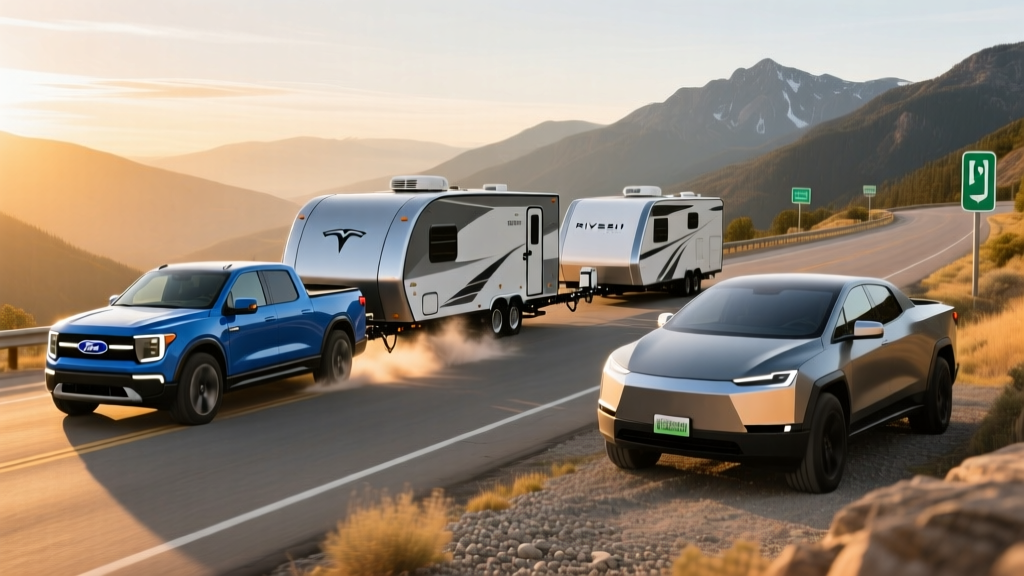
Can you tow a travel trailer with an electric vehicle in 2026? Yes — but expect your EV's range to drop 40–55% when towing a loaded travel trailer at highway speeds. A Rivian R1T with an EPA-estimated 352-mile range typically delivers 160–200 real-world towing miles. The Ford F-150 Lightning (extended-range, ~320 mi EPA) averages 150–185 towing miles. Plan charging stops every 120–150 miles, budget 25–45 minutes per DC fast-charge session, and verify your home charger can replenish a depleted pack overnight (a 130 kWh pack at 11.5 kW takes ~11 hours). Towing with an EV is viable for regional trips with planned routes, but cross-country towing still demands meticulous logistics.
The Physics of Towing With an Electric Truck
Electric trucks produce instant torque and heavy payloads — ideal for getting a trailer moving. But aerodynamic drag and rolling resistance don't care about your powertrain. A typical 5,000-lb travel trailer (24–28 ft) roughly doubles the combined vehicle frontal area and weight, forcing the truck to consume energy at 2–2.5× its solo rate.
Here's what that looks like in hard numbers:
| Metric | EV Truck (Rivian R1T Tri-Motor, 141 kWh) | Gas Truck (Ford F-150 3.5L EcoBoost, 36 gal) |
|---|---|---|
| Solo efficiency | ~2.0 mi/kWh (73 MPGe) | ~18 MPG combined |
| Towing efficiency (5,000-lb trailer) | ~0.9–1.1 mi/kWh | ~8–10 MPG |
| Real-world towing range | ~155–185 miles | ~290–360 miles |
| Energy cost per towing mile | ~$0.18–$0.35 (varies by charging source) | ~$0.38–$0.50 (at $3.80/gal) |
| Refuel/recharge time | 25–45 min (10–80% at 150–200 kW) | 5–8 min |
The gas truck wins on raw towing range and refueling speed. The EV truck wins on per-mile energy cost (if charging at home or at reasonably priced public stations) and eliminates tailpipe emissions at the tow site — meaningful for campgrounds with idle-restriction policies.
2026 Electric Trucks Ranked for Travel Trailer Duty
Not all EV trucks are equal when a hitch is involved. Here's how the major players stack up for towing a 4,500–7,000 lb travel trailer, based on manufacturer specs and aggregated real-world towing data from owner communities.
| Vehicle | Battery (kWh usable) | Max Tow Rating | EPA Range | Est. Towing Range | Peak DC Charge (kW) | 10–80% Time | Starting MSRP |
|---|---|---|---|---|---|---|---|
| Rivian R1T Tri-Motor Max | 141 (NMC) | 11,000 lb | 352 mi | 160–200 mi | 200+ (CCS via adapter, NACS native) | ~28 min | $99,900 |
| Ford F-150 Lightning Ext. Range | 131 (NMC) | 10,000 lb | 320 mi | 150–185 mi | 150 (CCS) | ~41 min | $72,990 |
| Chevrolet Silverado EV 4WT | 200+ (NMC, Ultium) | 10,000 lb | 400 mi (est. WT) | 180–230 mi | 350 (NACS/CCS) | ~20 min (est.) | $74,800 (est.) |
| Tesla Cybertruck AWD | 123 (NMC, structural) | 11,000 lb | 340 mi | 155–190 mi | 250 (NACS, Supercharger) | ~22 min | $79,990 |
| GMC Sierra EV Denali Edition 1 | 200+ (NMC, Ultium) | 10,000 lb | 400 mi (est.) | 185–230 mi | 350 (NACS/CCS) | ~20 min (est.) | $99,495 (est.) |
Real-World Towing Range Reality Check: EPA range figures are measured under controlled, solo-driving conditions. When towing a 5,000-lb travel trailer at 65 mph on flat terrain in 70°F weather, expect 45–55% of the EPA sticker. Add headwinds, elevation gain, or temperatures below 40°F, and that drops further to 35–45%. Always plan your route assuming worst-case consumption.
Charging Logistics: The Real Bottleneck for EV Towing
The truck's range is only half the equation. The charging network's ability to accommodate a truck-plus-trailer combination determines whether your trip is feasible.
DC Fast Charging With a Trailer Attached
Most DC fast-charging stations are designed for passenger vehicles. Pulling through with a 25-foot travel trailer in tow presents real challenges:
- Pull-through availability: Electrify America, Tesla Superchargers (V4 stalls in select locations), and some EVgo stations now offer pull-through or oversized-vehicle stalls, but they represent roughly 15–25% of total public fast-charging infrastructure as of early 2026. Apps like PlugShare and A Better Routeplanner (ABRP) now flag trailer-friendly stations.
- Cable reach: If you must unhitch or position awkwardly, CCS and NACS cables (typically 6–10 ft) may not reach. Tesla's V4 Supercharger cables are longer (~12 ft), easing this issue.
- Charge speed taper: Towing depletes the battery deeply, meaning you arrive at chargers at low State of Charge (SoC) — which is actually ideal for fast charging, as peak kW is sustained longer from 10–60% before tapering sharply above 80%.
Charging Levels for Towing Owners
| Level | Power (kW) | Miles of Tow Range Added per Hour | Typical Use Case |
|---|---|---|---|
| Level 1 (120V outlet) | 1.0–1.4 kW | ~1–1.5 tow miles/hr | Emergency only — impractical for towing owners |
| Level 2 (240V, 48A home) | 11.5 kW | ~11–13 tow miles/hr | Overnight recharge after day trips; full pack in 10–14 hrs |
| Level 2 (240V, 80A home) | 19.2 kW | ~19–22 tow miles/hr | Faster overnight; requires 100A dedicated circuit |
| DC Fast (150 kW) | 150 kW peak | ~90–100 tow miles in 25 min | En-route charging on highway corridors |
| DC Fast (350 kW) | 350 kW peak | ~120–140 tow miles in 20 min | Ultium-platform trucks; limited station availability |
kW vs kWh reminder: kW (kilowatts) is the rate of energy flow — how fast you're charging. kWh (kilowatt-hours) is the total energy stored — your battery's tank size. A 141 kWh battery charged at 11.5 kW takes roughly 12 hours from empty. That same battery at 150 kW DC gains ~85 kWh in 35 minutes (accounting for taper).
Total Cost of Towing: EV vs Gas Truck, 5-Year Breakdown
Towing is where EVs reveal both their cost advantages and their financial risks. Here's a realistic 5-year ownership comparison assuming 12,000 miles/year total driving, with 3,000 of those miles spent towing a 5,000-lb travel trailer.
| Cost Category | Rivian R1T Tri-Motor Max (EV) | Ford F-150 3.5L EcoBoost (Gas) |
|---|---|---|
| Purchase price (MSRP) | $99,900 | $62,500 |
| Federal §30D tax credit (2026 rules) | $0 (MSRP exceeds $80,000 truck cap) | $0 (not a qualifying EV/PHEV) |
| Energy/fuel cost (5 yrs, 60k total mi, 15k towing mi) | $8,100–$12,600 (home + public mix) | $14,250–$18,000 (gas at $3.80/gal avg) |
| Maintenance (5 yrs) | $1,800–$2,500 (tires, cabin filter, fluid top-offs) | $4,500–$6,000 (oil, filters, brakes, transmission) |
| Insurance (5 yrs avg) | $12,000–$16,000 | $7,500–$10,000 |
| Depreciation (est. 5-yr) | ~45–55% ($45,000–$55,000) | ~40–50% ($25,000–$31,250) |
| Estimated 5-yr total cost | $168,800–$202,000 | $113,750–$146,750 |
The EV truck costs substantially more over 5 years, driven primarily by the higher purchase price and steeper insurance premiums. Energy savings ($3,000–$8,000 over five years) and lower maintenance partially offset this, but they don't close the gap against a comparably equipped gas truck.
When does EV towing make financial sense? If you're already buying a premium truck (the Rivian or Cybertruck buyer isn't cross-shopping a base F-150 XLT), if you tow fewer than 2,000 miles/year, and if you charge predominantly at home on a Time-of-Use plan averaging $0.10–$0.14/kWh. Under those conditions, the energy-cost delta narrows and the EV's lower maintenance and campground-friendly silence become meaningful lifestyle advantages.
Tax Credits and Incentives for EV Trucks in 2026
Federal EV tax credit rules under IRS §30D apply specific caps that affect truck buyers:
- MSRP cap for trucks/vans/SUVs: $80,000. Trucks priced above this (Rivian R1T Max, Cybertruck, GMC Sierra EV Denali) do not qualify.
- Buyer income limits: $150,000 single / $300,000 joint modified AGI.
- Battery sourcing requirements: Critical minerals and battery component phase-in thresholds increase annually. For 2026, a significant percentage of battery components must be manufactured or assembled in North America, and critical minerals must be sourced from the US or FTA partners. Verify current-year compliance on fueleconomy.gov.
- Point-of-sale transfer: Eligible buyers can transfer the credit to the dealer at purchase, reducing the out-of-pocket price rather than waiting for a tax refund.
The Ford F-150 Lightning in lower trims (Pro, XLT under $80,000 MSRP) may qualify for up to $7,500, depending on battery sourcing compliance and buyer income. Always confirm with your tax professional and the IRS's official vehicle eligibility list before purchase.
Common Misconceptions About EV Travel Trailer Towing
| Myth | Fact |
|---|---|
| "EVs can't tow — they'll run out of charge in 50 miles." | Modern EV trucks with 130+ kWh packs deliver 150–230 real-world towing miles. That's enough for most regional campground trips with one planned charge stop. |
| "You can't charge with a trailer attached." | Pull-through charging stalls are expanding. Many owners do unhitch at campgrounds and charge overnight on Level 2 (30A or 50A campground outlets via adapter). |
| "Towing destroys the battery." | Towing increases cycle count and thermal load, but modern thermal management systems (liquid cooling) keep cells within safe operating temperatures. Battery degradation from towing is marginal vs. normal use — expect ~2–3% additional capacity loss over 100,000 miles of regular towing. |
| "EVs are too heavy to tow safely." | EV trucks are heavier than gas counterparts (R1T: ~7,150 lb vs F-150 gas: ~5,000 lb), which actually improves trailer stability in crosswinds. The concern is payload capacity — verify your truck's GVWR and tongue-weight limits. |
| "Regenerative braking handles trailer braking." | Regen only acts on the truck's axles. A travel trailer over 3,000 lb requires its own electric or surge brakes, legally mandated in most states. Integrated trailer brake controllers are standard on most EV trucks. |
First-Time EV Towing Buyer Checklist
If you're considering an electric truck specifically for travel trailer use, work through this decision framework before committing:
Choose an EV truck for towing IF:
- You tow fewer than 4,000 miles/year and your typical trip is under 250 miles one-way.
- You have Level 2 home charging (240V, 48A minimum) and can fully recharge overnight between trips.
- Your campground destination offers 30A or 50A shore power for overnight trickle charging.
- You're already shopping in the $70,000+ truck segment and value instant torque, quiet operation, and V2L (vehicle-to-load) capability for powering campsite appliances.
- You've mapped your most common towing routes and confirmed DC fast-charger availability at 120-mile intervals with pull-through or trailer-friendly access.
Stick with a gas or diesel truck for towing IF:
- You regularly tow over 300 miles one-way through rural areas with sparse charging infrastructure.
- You tow in extreme cold (below 20°F), where battery range can drop an additional 15–25% beyond the towing penalty.
- You boondock (dry camp) frequently with no shore power and need the truck to recharge from a generator or solar setup — not yet practical for 130+ kWh packs.
- Your budget is under $60,000 and you need maximum towing range per dollar.
- You tow heavy fifth-wheel trailers over 8,000 lb — current EV trucks are rated for this, but real-world range drops to 100–130 miles, making logistics impractical.
What About the "EV Travel Trailer" Itself?
A growing category of trailers — the electric travel trailer — features onboard battery packs and electric motors on the trailer axle. Brands like Lightship (formerly Aero), Airstream (eStream concept), and Pebble have announced or begun delivering trailers with 40–80 kWh battery packs that provide propulsion assist, reducing the tow vehicle's energy consumption by an estimated 20–35%.
These trailers also offer off-grid power (V2L from the trailer itself), self-propelled maneuvering at the campsite, and solar-panel integration. As of 2026, the Lightship L1 (starting ~$75,000, 80 kWh pack, ~25 ft) is among the first to market. Expect wider availability and lower pricing by 2028–2029 as battery costs decline.
Battery Health, Warranty, and Long-Term Towing Durability
Towing places sustained high-current demands on an EV's battery pack. Here's what that means for longevity:
- Thermal management: All major EV trucks use active liquid cooling. During sustained towing, the system cycles coolant to keep cell temperatures between 25–40°C. This prevents accelerated degradation.
- Degradation data: NMC batteries in current EV trucks show ~8–12% capacity loss over 100,000 miles under normal use. Regular towing may add 2–4 percentage points to that figure over the same distance, based on early fleet data from commercial EV truck operators.
- Warranty coverage: Federal law mandates 8-year/100,000-mile battery warranties for EVs. Most manufacturers guarantee 70% capacity retention at that threshold. Rivian, Ford, and GM all comply with this standard. Verify specific terms at purchase — some exclude "commercial use" if you're towing for business.
- Replacement cost: Out-of-warranty battery pack replacement for a 130–200 kWh truck pack currently ranges from $18,000 to $35,000 including labor. Prices are declining ~8–10% annually as cell costs fall.
For context, a gas truck's transmission and engine rebuild costs at 150,000+ miles can reach $5,000–$10,000 — and those failures are more sudden and catastrophic than gradual battery degradation.
Frequently Asked Questions
Can I tow a 7,000-lb travel trailer with an electric truck?
Yes. The Rivian R1T (11,000-lb rating), Ford F-150 Lightning (10,000-lb), Tesla Cybertruck (11,000-lb), and Chevrolet Silverado EV (10,000-lb) all exceed 7,000-lb tow ratings. However, real-world range at that weight drops to roughly 120–170 miles depending on conditions. Plan routes accordingly.
How do I charge my EV truck at a campground?
Most campgrounds offer 30A (120V) or 50A (240V) shore-power outlets. With a proper adapter (NEMA 14-50 to your truck's mobile connector), a 50A/240V outlet delivers ~9.6–11.5 kW — enough to add 10–13 towing miles per hour, or fully recharge a depleted pack in 12–14 hours overnight. Always confirm outlet condition and amperage with campground staff before relying on it.
Does cold weather make EV towing impractical?
Cold weather compounds the towing range penalty. At 20°F, expect an additional 15–25% range reduction beyond the 45–55% towing loss — meaning your 350-mile EPA truck might deliver only 100–130 towing miles in freezing conditions. Preconditioning the battery (warming it to optimal temperature via the truck's app before departure) recovers ~5–10% of that loss. For winter towing in northern states, a gas truck remains the more predictable choice.
Will towing void my EV battery warranty?
No, as long as you stay within the manufacturer's published tow rating and use the integrated trailer brake controller. Towing is a normal, warrantied use case. However, if you modify the truck's software to exceed rated tow limits or disable thermal management, warranty claims may be denied.
What's the best EV truck for towing a travel trailer in 2026?
For maximum range and towing capability, the Rivian R1T Tri-Motor Max and the Chevrolet Silverado EV (with its 200+ kWh Ultium pack) lead the pack. For value, the Ford F-150 Lightning Extended Range offers strong towing capacity at a lower MSRP and may qualify for the §30D credit in eligible trims. For Supercharger network access, the Tesla Cybertruck is the only option — though its bed size and stainless-steel body limit practical utility for some camping setups.