Can an EV Tow a Trailer? The Short Answer
Yes — but with major caveats. The best electric trucks and SUVs on the market in 2026 can tow between 5,000 and 12,500 pounds, rivaling many gas trucks on paper. However, towing a trailer cuts real-world EV range by 40–60% compared to the EPA sticker, meaning a truck rated for 320 miles may deliver only 130–180 miles under load. If you tow frequently or over long distances, you need a plan for DC fast charging along your route, a truck with a large battery (130+ kWh), and realistic expectations about efficiency. For occasional light trailer use — a small boat, bike rack, or utility trailer under 3,000 lbs — most electric SUVs handle the job with modest range impact.
2026 EV Towing Capacity: Model-by-Model Breakdown
Not all EVs are built for towing, and manufacturer ratings vary wildly. Here's what's actually available for the 2026 model year, sorted by maximum towing capacity. These figures represent the manufacturer's official maximum when properly equipped with a tow package.
| Vehicle | Max Tow Rating (lbs) | Battery (kWh usable) | EPA Range (mi) | Est. Range Towing (mi) | Base MSRP (tow-equipped) |
|---|---|---|---|---|---|
| Rivian R1T Tri Motor | 11,000 | 141 (NMC) | 328 | 130–175 | $99,900 |
| Chevrolet Silverado EV 4WT | 12,500 | 200 (NMC) | 492 (work truck config) | 200–280 | $74,800 |
| Ford F-150 Lightning (Ext. Range) | 10,000 | 131 (NMC) | 320 | 130–180 | $69,995 |
| Tesla Cybertruck AWD | 11,000 | 123 (NMC) | 340 | 140–190 | $79,990 |
| GMC Sierra EV Denali | 12,200 | 200 (NMC) | 440 | 180–260 | $97,400 |
| Hyundai Ioniq 5 (tow pkg) | 2,300 | 84 (NMC) | 305 | 180–210 | $52,600 |
| Kia EV9 GT-Line AWD | 5,000 | 99.8 (NMC) | 270 | 140–170 | $66,900 |
| Volkswagen ID.4 AWD | 2,700 | 82 (NMC) | 275 | 165–195 | $49,995 |
Key takeaway: The Chevy Silverado EV and GMC Sierra EV benefit from massive 200 kWh battery packs that absorb the range penalty of towing better than anything else in the segment. The Ford F-150 Lightning remains the value leader for serious towing, though its 131 kWh pack limits range under load. Compact crossovers like the ID.4 and Ioniq 5 are fine for bike racks and small utility trailers, but aren't suited for campers or horse trailers.
The Range Penalty: What Towing an EV Trailer Actually Does to Your Miles
This is the single biggest shock for first-time EV towers. The EPA range sticker assumes flat terrain, moderate speeds, and no trailer. Add a trailer — especially a boxy, heavy travel trailer or camper — and aerodynamic drag plus rolling resistance crush efficiency.
Real-World Range Math While Towing
Scenario: Ford F-150 Lightning Extended Range, towing a 5,000 lb enclosed cargo trailer at 65 mph on flat interstate, 70°F.
- EPA rated efficiency (no trailer): ~2.0 mi/kWh
- Observed efficiency (towing): ~0.9–1.1 mi/kWh
- Usable battery: 131 kWh
- Real-world towing range: ~120–145 miles (before hitting a 10% reserve buffer)
Add mountain grades, headwinds, or cold weather and that number drops to 100–120 miles between charges.
Why is the penalty so severe? Towing roughly doubles the energy required per mile. A 5,000 lb trailer adds weight the motors must accelerate, but more critically, it destroys the EV's aerodynamic profile. Electric trucks already have the brick-like drag coefficient of a pickup; a tall travel trailer behind it creates a turbulent wake that compounds the problem. At highway speeds, aerodynamic drag accounts for over 60% of energy consumption — trailer or not — and a trailer makes it worse.
For comparison, a gas Ford F-150 with the 3.5L EcoBoost V6 and a 36-gallon tank sees its fuel economy drop from ~20 MPG combined to roughly 9–11 MPG while towing. That cuts its ~450-mile range to about 325–395 miles. The gas truck retains a meaningful range advantage under load, though the gap narrows on shorter hauls where charging isn't required.
EV vs Gas Truck: Towing Cost Comparison
If you can charge at home and your tow trips are within range (or you have time to fast-charge), the fuel savings are significant. Here's a head-to-head look at a 200-mile round trip towing a 5,000 lb trailer.
| Cost Factor | Ford F-150 Lightning (Ext. Range) | Ford F-150 3.5L EcoBoost (Gas) |
|---|---|---|
| Efficiency while towing | ~1.0 mi/kWh (100 kWh used) | ~10 MPG (20 gallons used) |
| Home charging cost ($0.14/kWh avg) | $14.00 | N/A |
| DC fast charging cost ($0.40/kWh avg) | $40.00 (if en-route charge needed) | N/A |
| Gasoline cost ($3.40/gal avg) | N/A | $68.00 |
| Total energy cost (200 mi tow) | $14–$40 | $68 |
| Charging/fueling stops needed | 1–2 DC fast stops (30–50 min total) | 0 (450+ mi range on tank) |
The Lightning saves $28–$54 per trip on energy costs if you can charge at home. But you're trading dollars for time: a 200-mile tow trip that takes 3 hours in a gas truck may take 4+ hours in the Lightning due to one or two 20–30 minute DC fast charging stops. The Lightning's peak charge rate of ~210 kW (10–80% in roughly 40 minutes on a 350 kW CCS station) is respectable but not class-leading.
Over a year of weekend towing (say, 25 trips of 200 miles each), the Lightning saves roughly $700–$1,350 in fuel — meaningful, but it won't offset the higher purchase price quickly if you only tow occasionally.
Charging Logistics: The Real Bottleneck of EV Towing
Towing exposes the weakest link in EV ownership: public DC fast charging infrastructure. Here's what you need to plan for.
Connector Compatibility Matters
As of 2026, the EV charging landscape has largely consolidated around NACS (Tesla's connector, now adopted by Ford, GM, Rivian, and most others) and CCS1 (used by Hyundai, Kia, Volkswagen, and legacy models). If you're buying a Ford, GM, or Rivian truck, you'll charge on Tesla Superchargers via the NACS port — a significant advantage for towing, as the Supercharger network remains the most reliable and widespread DC fast network in North America, with over 25,000 stalls.
If you're in a Hyundai Ioniq 5 or Kia EV9, you'll rely on Electrify America, EVgo, and other CCS networks, which have improved reliability but still trail Superchargers in rural coverage — exactly where you're most likely to be towing.
The Pull-Through Problem
Most DC fast charging stations are designed for passenger cars, not trucks with trailers attached. You cannot easily back a trailer into a standard charging stall, and many stations lack pull-through lanes. As of early 2026, Tesla has opened a limited number of Supercharger pull-through sites specifically for trucks and trailers, and Electrify America has added some pull-through stalls at travel-center locations. But availability is sparse.
Practical workaround: Many EV truck owners unhitch the trailer in a parking lot, drive to the charger, and walk back. It's a hassle, and it adds 15–20 minutes to every stop. If you tow frequently, prioritize routes with known pull-through chargers or plan around locations where unhitching is feasible.
What About Payload, Tongue Weight, and the Battery?
Towing capacity is only half the equation. Payload capacity — the total weight of passengers, cargo, and tongue weight the truck can carry — is where many EV trucks run into trouble.
Electric trucks carry enormous battery packs. The F-150 Lightning's 131 kWh pack alone weighs roughly 1,800 lbs. That eats into payload. The Lightning Extended Range has a payload rating of about 1,800–2,200 lbs depending on trim. A 5,000 lb trailer typically generates 500–700 lbs of tongue weight, leaving 1,100–1,700 lbs for passengers and bed cargo — adequate for most uses but tighter than a comparably equipped gas F-150.
The Silverado EV and Sierra EV, with their 200 kWh packs, are even heavier, though GM has engineered higher GVWR ratings to compensate. Always check the door-jamb sticker for your specific truck's payload rating before loading up.
Does Towing Accelerate Battery Degradation?
Towing draws high sustained current from the battery, which generates heat. However, modern EV trucks use active liquid thermal management that keeps battery temperatures in check even under heavy load. Based on data from early F-150 Lightning and Rivian R1T owners, there's no evidence that periodic towing causes measurable additional degradation beyond normal use. Most manufacturers warranty the battery for 8 years/100,000 miles with a capacity retention threshold of 70% (per fueleconomy.gov and manufacturer documentation). Rivian and GM both offer 8-year/100,000-mile battery warranties.
Tax Credits and Incentives for Tow-Capable EVs
The federal §30D tax credit offers up to $7,500 for qualifying new EVs, but the rules are complex and several tow-capable models have lost eligibility due to battery sourcing requirements that tightened through 2025–2026. Key constraints per the IRS:
- MSRP caps: Trucks, vans, and SUVs must have an MSRP of $80,000 or less; sedans $55,000 or less
- Buyer income limits: AGI must not exceed $300,000 (joint), $225,000 (head of household), or $150,000 (single)
- Battery sourcing: Critical minerals and battery components must meet escalating domestic/free-trade-partner thresholds — this has disqualified several models
- Point-of-sale transfer: You can transfer the credit to the dealer for an immediate price reduction at purchase
As of 2026, the F-150 Lightning (certain trims) and some Rivian R1T configurations still qualify for partial or full credits, but the Cybertruck and Silverado EV eligibility varies by battery pack and sourcing. Always verify current eligibility on the IRS clean vehicle credit page before purchasing — rules change frequently.
Decision Framework: Should You Tow With an EV?
Choose an EV Truck/SUV for Towing If:
- You tow less than 10 times per year and most trips are under 150 miles round-trip
- You have reliable Level 2 home charging (240V, 40–80A circuit) and can wake up to a full battery every morning
- Your typical trailer is under 5,000 lbs (utility trailer, small boat, bike rack, jet skis)
- You value instant torque for low-speed trailer maneuvering and hill starts — EVs excel here with no turbo lag or gear hunting
- You want a truck that also serves as a daily driver with $0.04–$0.06/mile fueling cost when not towing
Stick With a Gas or Diesel Truck If:
- You tow frequently (weekly or more) and regularly exceed 200 miles per trip
- You tow heavy loads (7,000+ lbs) over mountain passes or in extreme cold
- Your routes lack reliable DC fast charging infrastructure
- You need maximum payload and can't afford the battery-weight penalty
- You tow in remote areas — national forests, rural ranch land, off-grid campsites — where charging doesn't exist
Consider a PHEV Truck as a Middle Ground
The upcoming Ram Ramcharger (EREV — extended-range electric vehicle) and similar plug-in hybrid trucks offer 140+ miles of electric-only range for daily driving with a gas engine that kicks in for long tows, eliminating range anxiety entirely. If your use case is "commute electric, tow gas," watch this segment closely.
Common EV Towing Myths, Addressed
| Myth | Fact |
|---|---|
| "EVs can't tow at all." | Modern EV trucks tow 10,000–12,500 lbs — comparable to half-ton gas trucks. The limitation is range, not capability. |
| "Towing will destroy the battery." | Thermal management systems keep batteries within safe temps. No evidence of accelerated degradation from towing in real-world data. |
| "You can't charge with a trailer attached." | Pull-through chargers exist and are expanding. Unhitching is annoying but workable at most locations. |
| "EV trucks have worse torque for towing." | Electric motors deliver peak torque at 0 RPM. An F-150 Lightning produces 775 lb-ft instantly — no gas half-ton matches that off the line. |
| "Regenerative braking doesn't work with a trailer." | Regen still functions, but the trailer's momentum limits its effectiveness. Use the integrated brake controller for trailer brakes on descents. |
Frequently Asked Questions
What's the best EV for towing a travel trailer?
For travel trailers in the 5,000–8,000 lb range, the Chevrolet Silverado EV or GMC Sierra EV (with 200 kWh batteries) offer the best real-world towing range at 180–280 miles — enough for many campground trips with one charging stop. For heavier travel trailers, the Rivian R1T Tri Motor and Tesla Cybertruck provide strong tow ratings but expect to stop every 130–170 miles.
Can I tow a camper with a Tesla Model Y or Model X?
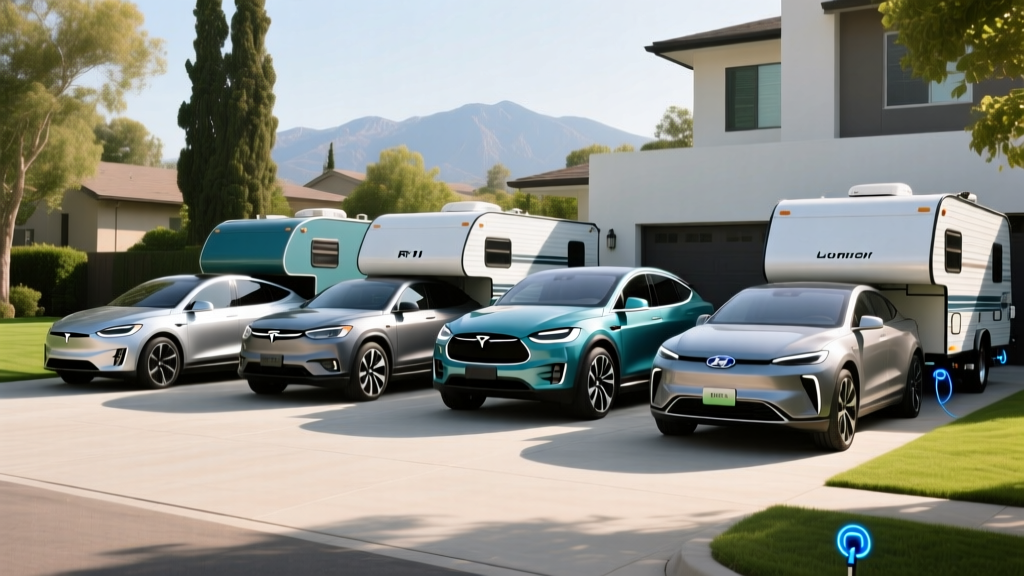
The Model Y has a 3,500 lb tow rating (in markets where a tow hitch is offered), and the Model X can tow up to 5,000 lbs. These work for pop-up campers and teardrop trailers but are not suited for hard-sided travel trailers. Real-world towing range in a Model X drops to roughly 120–150 miles with a 4,000 lb load.
Does towing void my EV warranty?
No. Towing within the manufacturer's rated capacity is a normal use case and does not void the battery, powertrain, or vehicle warranty. Exceeding the rated tow capacity, however, could give the manufacturer grounds to deny a powertrain claim.
How much does it cost to install a home charger for my EV truck?
A Level 2 home charger (240V, 48A) typically costs $500–$800 for the unit and $800–$2,500 for professional installation, depending on panel proximity and whether your electrical panel needs an upgrade. Total: $1,300–$3,300. For EV trucks with large batteries (130+ kWh), a 48A charger adds roughly 30–35 miles of range per hour, meaning a full charge from 10–100% takes 10–12 hours overnight — fine for next-day towing.
Can I use a weight-distribution hitch with an EV truck?
Yes, and you should for any trailer over 5,000 lbs. Weight-distribution hitches improve stability and steering feel regardless of powertrain. Check your EV's owner manual for specific hitch receiver ratings and ensure the hitch is rated for the trailer's GVWR.