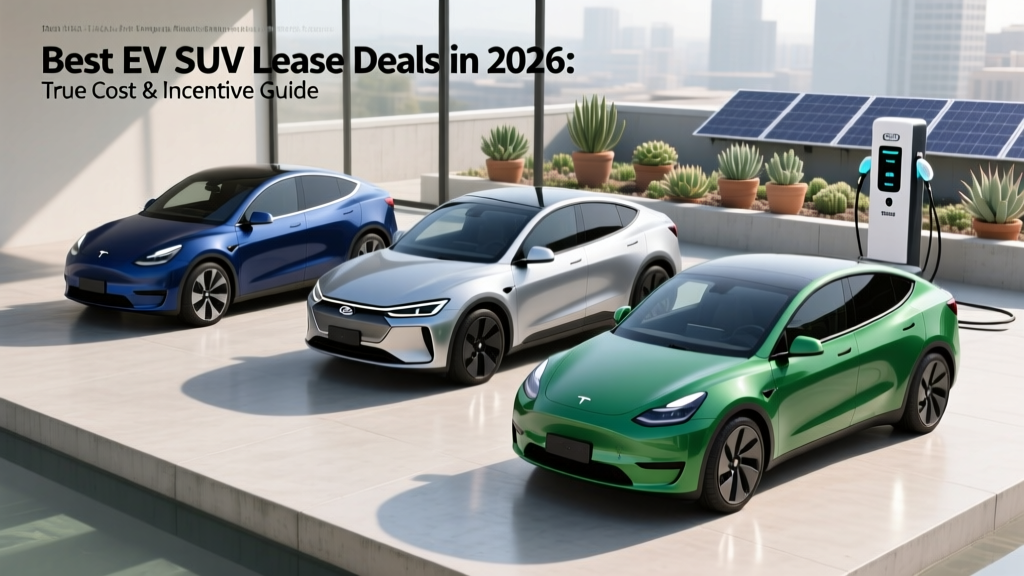
If you've been browsing manufacturer websites lately, you've likely noticed a trend: EV SUV lease deals are dominating homepage banners. Automakers are aggressively subsidizing leases on electric SUVs to move metal in a market where outright purchases still carry sticker shock. But a low monthly payment only tells part of the story. To know whether a lease actually saves you money — or just defers the real costs — you need a full picture of ownership economics, from electricity and insurance to depreciation and tax-credit eligibility.
This guide walks through the actual numbers behind today's most popular electric SUV leases. We'll cover the 5-year total cost of ownership, the current federal tax credit rules under IRS §30D, fuel and maintenance savings, the insurance premium reality, and how EV SUVs hold their value at trade-in time.
How Much Does It Really Cost to Own an EV SUV Over 5 Years?
The monthly lease payment is just one line item. A realistic 5-year cost analysis must include energy, insurance, maintenance, and the vehicle's residual value. Below is a representative breakdown for a midsize electric SUV in the $45,000–$55,000 MSRP range — think Hyundai Ioniq 5, Tesla Model Y, or Ford Mustang Mach-E territory — compared to a similarly priced gas-powered compact SUV averaging 28 MPG combined.
| Category | EV SUV (Leased/Purchased) | Gas SUV (28 MPG Combined) |
|---|---|---|
| Vehicle acquisition (5-yr net) | $22,000–$28,000 | $20,000–$25,000 |
| Fuel / electricity | $3,750–$5,250 | $9,375–$11,250 |
| Insurance (5 years) | $9,500–$12,500 | $7,000–$9,500 |
| Maintenance & repairs | $1,200–$1,800 | $3,500–$5,000 |
| Taxes, registration, fees | $1,500–$2,500 | $1,500–$2,500 |
| Depreciation (if purchased) | 45–55% over 5 years | 35–45% over 5 years |
| Estimated 5-year total | $37,950–$50,050 | $41,375–$53,250 |
The EV SUV wins on fuel and maintenance by a wide margin but gives back some ground on insurance and depreciation. Whether the math works in your favor depends heavily on your local electricity rates, driving habits, and which incentives you qualify for.
Federal Tax Credit: Do You Qualify Under Current §30D Rules?
The federal EV tax credit under IRS §30D remains a powerful lever — up to $7,500 — but eligibility in 2026 is anything but automatic. Congress tightened the rules significantly, and the requirements now stack in ways that disqualify many otherwise eligible vehicles and buyers.
§30D Eligibility Checklist (2026 Rules)
- Buyer income caps: Modified AGI must not exceed $300,000 (joint filers), $225,000 (head of household), or $150,000 (single filers).
- MSRP caps: Vans, SUVs, and pickup trucks must have an MSRP at or below $80,000. Sedans and other vehicles: $55,000 cap.
- Battery component sourcing: A percentage of battery components must be manufactured or assembled in North America. The threshold increases annually — in 2026, 90% of components must qualify.
- Critical minerals requirement: A percentage of critical minerals must be sourced from the U.S. or a free-trade-agreement country. The 2026 threshold is 80%.
- Foreign entity of concern (FEOC) exclusion: Vehicles with battery components or critical minerals from a FEOC (primarily China, Russia, North Korea, Iran) are disqualified entirely.
- Point-of-sale transfer: As of 2024, buyers can transfer the credit to the dealer at purchase, receiving it as an immediate price reduction rather than waiting to claim it on their tax return.
- Lease loophole: Vehicles leased (not purchased) may qualify for the commercial clean vehicle credit (§45W) regardless of sourcing or MSRP rules, passed through as a "lease cash" incentive by the automaker. This is why EV SUV lease deals often look more attractive than purchase offers.
The lease structure is critical to understand. When you lease, the automaker — not you — is technically the vehicle's owner. Many manufacturers receive the $7,500 commercial credit on leased vehicles and pass it through as a capitalized-cost reduction, lowering your monthly payment. This sidesteps the battery-sourcing, MSRP, and income restrictions that apply to purchases. Always verify with the dealer whether the advertised lease incentive includes the federal credit pass-through.
State, Local, and Utility Incentives
Beyond the federal credit, many states and utilities offer additional rebates. California's CVRP, Colorado's innovative motor vehicle credit, New York's Drive Clean Rebate, and various utility-company EV rebates (often $500–$1,500 for home charger installation) can stack on top. These vary enormously by ZIP code and change frequently. Check your state energy office and local utility provider for current programs, or use the AFDC incentives database as a starting point. Always confirm amounts with official sources before relying on them in your budget.
Charging vs. Gas: The Per-Mile Cost Math
The single biggest operating-cost advantage of an EV SUV is energy. But the savings depend entirely on where and how you charge. Let's run concrete numbers.
Cost Per Mile: EV SUV vs. Gas SUV
| Scenario | Cost per kWh / Gallon | Efficiency | Cost per Mile |
|---|---|---|---|
| Home Level 2 (national avg electricity) | $0.16/kWh | 3.2 miles/kWh (95 MPGe) | $0.050 |
| Home Level 2 (California avg) | $0.27/kWh | 3.2 miles/kWh | $0.084 |
| Public DC fast charging (avg) | $0.40/kWh | 3.2 miles/kWh | $0.125 |
| Gas SUV (national avg $3.35/gal) | $3.35/gal | 28 MPG | $0.120 |
| Gas SUV ($4.00/gal — West Coast) | $4.00/gal | 28 MPG | $0.143 |
At home on the national average electricity rate, an EV SUV costs roughly $0.05 per mile to fuel — less than half what a 28-MPG gas SUV costs at $3.35/gallon. Over 15,000 miles per year, that's a savings of about $1,050 annually.
However, if you rely heavily on public DC fast chargers at $0.40/kWh or more, your per-mile cost actually exceeds the gas SUV at national average fuel prices. This is why home charging access is the single most important variable in EV ownership economics. If you can install a Level 2 charger at home — typically $500–$2,000 installed depending on your electrical panel — the fuel savings are substantial and consistent. If you're dependent on public charging, the cost advantage narrows or disappears entirely.
For a concrete example: a 2026 Hyundai Ioniq 5 with an 84 kWh usable battery (NMC chemistry) and an EPA-estimated 305 miles of range will consume roughly 3.2 miles per kWh in mixed driving. Expect closer to 2.7–2.9 miles/kWh in sustained highway driving at 75+ mph, and 20–30% range reduction in sub-freezing temperatures due to battery-heating energy demands and reduced regenerative braking efficiency.
Maintenance Savings: Fewer Parts, Fewer Visits
EVs have a fraction of the moving parts found in internal-combustion vehicles. No engine oil, no transmission fluid, no spark plugs, no timing belt, no exhaust system. The maintenance savings are real and measurable.
| Service Item | EV SUV | Gas SUV |
|---|---|---|
| Oil changes | None — $0 | 7–10 changes — $350–$800 |
| Brake pads | Minimal wear (regen braking) — $0–$200 | 1–2 replacements — $400–$800 |
| Transmission fluid | None (single-speed reduction gear) | $150–$300 |
| Coolant / engine services | Battery thermal system coolant — $100–$200 | Engine coolant, belts, hoses — $300–$600 |
| Tire rotation & replacement | Heavier vehicle + instant torque = faster wear — $1,200–$2,000 | $800–$1,400 |
| Cabin air filter, wipers, misc. | $200–$400 | $200–$400 |
| 5-year total (est.) | $1,500–$2,800 | $2,200–$4,300 |
The caveat: EV tires. Electric SUVs are heavy — a Tesla Model Y weighs roughly 4,400 lbs — and electric motors deliver instant torque from zero RPM. This combination accelerates tire wear by 20–30% compared to equivalent gas vehicles. Budget for tire replacement at 30,000–40,000 miles rather than the 50,000–60,000 miles typical for ICE vehicles. EV-specific tires (like the Michelin e.Primacy or Hankook iON) are engineered for lower rolling resistance and noise reduction but carry a price premium of $200–$400 per set.
Regenerative braking is the unsung maintenance hero. Because the electric motor handles most deceleration, the friction brakes are used far less frequently. Many EV owners report original brake pads at 80,000+ miles with significant life remaining.
Insurance: The Cost That Catches EV Buyers Off Guard
Here's where the EV ownership story gets less rosy. Insurance premiums for electric SUVs are typically 15–30% higher than for comparable gas-powered vehicles. According to industry data, the average annual premium for a midsize EV SUV runs $1,900–$2,500, compared to $1,400–$1,900 for a similarly priced gas SUV.
Several factors drive the premium:
- Higher repair costs: EV battery packs are expensive to replace if damaged. Even minor collision damage near the battery enclosure can trigger a total battery replacement costing $10,000–$20,000.
- Specialized labor: High-voltage system repairs require certified technicians, and fewer shops have this capability.
- Higher vehicle MSRP: Even after incentives, EV SUVs tend to have higher base prices, which insurers use to calculate comprehensive and collision coverage.
- Total-loss thresholds: Insurers are more likely to declare an EV a total loss after battery-adjacent damage because the replacement cost pushes repair estimates past the vehicle's actual cash value.
Before signing any lease, get an insurance quote for the exact trim and ZIP code. The difference between a $170/month and a $220/month premium adds up to $3,000 over five years — enough to erase much of your fuel savings. Some insurers (Geico, Progressive, State Farm) now offer EV-specific discounts, and bundling with home insurance can help.
Depreciation and Resale Value: The Honest Picture
EV depreciation has been a moving target. In 2023–2024, used EV values dropped sharply — partly due to Tesla's aggressive new-vehicle price cuts cascading through the used market, partly due to early-adopter lease returns flooding supply. By 2026, the market has stabilized somewhat, but EVs still depreciate faster on average than their gas counterparts.
Current 5-year depreciation estimates for midsize electric SUVs:
- Tesla Model Y: ~45–50% depreciation over 5 years (better than average for EVs, aided by Supercharger network access and strong brand demand)
- Hyundai Ioniq 5 / Kia EV6: ~50–55% depreciation (strong products but newer nameplates with less established resale track records)
- Ford Mustang Mach-E: ~50–55% depreciation
- Comparable gas SUV (Toyota RAV4, Honda CR-V): ~35–40% depreciation
This depreciation gap matters most if you purchase outright. With a lease, the residual value is the leasing company's problem — you're only paying for the depreciation during the lease term, which is locked in at signing. This is precisely why aggressive EV SUV lease deals exist: automakers set optimistic residuals and subsidize the money factor to make monthly payments competitive, knowing the federal lease credit pass-through helps offset their cost.
If you plan to keep the vehicle beyond the lease or buy it out at lease-end, factor in the steeper depreciation curve. Battery health is the wildcard — a vehicle with documented battery State of Health (SoH) above 90% at 60,000 miles will command a premium over one with unknown battery condition.
Putting It Together: When Does an EV SUV Lease Make Financial Sense?
Choose an EV SUV Lease If:
- You can charge at home (Level 2 access is the single biggest cost variable)
- You drive 10,000–15,000 miles per year (high mileage = bigger fuel savings, but watch lease mileage limits)
- Your state offers additional EV rebates or HOV-lane access
- You want to avoid long-term depreciation risk on rapidly evolving battery technology
- The lease includes the $7,500 federal credit pass-through as a cap-cost reduction
Reconsider If:
- You rely entirely on public DC fast charging (your per-mile fuel cost may exceed gas)
- Your insurance quotes come back $500+ higher than your current vehicle
- You drive fewer than 8,000 miles per year (fuel savings won't offset the premium)
- You plan to keep the vehicle 8+ years (purchase with the tax credit may be better long-term)
The smartest approach: treat the lease as a 36-month, low-commitment way to access current EV technology while the charging infrastructure and battery chemistry landscape continues to evolve. Lock in the federal credit pass-through, charge at home, and budget for the insurance premium. If solid-state batteries or next-generation platforms arrive by 2028–2029, you'll be free to upgrade without worrying about trading in a depreciated asset.
Frequently Asked Questions
How much does it really cost to own an EV SUV over 5 years?
For a midsize EV SUV in the $45,000–$55,000 range, expect a 5-year total cost of ownership between roughly $38,000 and $50,000, depending on your electricity rates, insurance premiums, and whether you purchase or lease. This compares to $41,000–$53,000 for a similarly priced gas SUV. The EV typically wins on fuel and maintenance but costs more for insurance and depreciation.
Do I qualify for the $7,500 federal EV tax credit?
Eligibility under IRS §30D depends on your income (under $300,000 for joint filers), the vehicle's MSRP (under $80,000 for SUVs), and stringent battery-sourcing requirements that change annually. Many vehicles that previously qualified no longer do due to FEOC restrictions on battery components and critical minerals. However, if you lease rather than purchase, the automaker may receive a $7,500 commercial credit under §45W and pass it to you as a lease incentive — bypassing the purchase-credit restrictions entirely. Always verify current rules at IRS.gov.
How much do I save on fuel and maintenance with an EV SUV?
With home charging at the national average electricity rate (~$0.16/kWh), expect to save roughly $1,000–$1,500 per year on fuel compared to a 28-MPG gas SUV. Maintenance savings run $500–$1,000 per year thanks to eliminated oil changes, reduced brake wear from regenerative braking, and fewer mechanical systems. Over 5 years, combined fuel and maintenance savings typically total $7,500–$12,500.
Are EVs more expensive to insure?
Yes — typically 15–30% more expensive than comparable gas vehicles. Higher repair costs (especially battery replacement after collision damage), specialized labor requirements, and higher vehicle MSRPs all contribute. Get an insurance quote before committing to any EV lease or purchase. The premium difference can range from $300 to $800+ per year depending on the model, your driving record, and your ZIP code.
How well do EV SUVs hold their value?
EV SUVs currently depreciate faster than comparable gas SUVs — roughly 45–55% over 5 years versus 35–40% for popular gas models like the Toyota RAV4. The EV market is still maturing, and rapid technology advances plus aggressive new-vehicle pricing have compressed used values. This depreciation gap is a key reason leasing is popular for EVs: it transfers the residual-value risk to the leasing company. Battery State of Health documentation at trade-in time can positively influence resale value.
Why are EV SUV lease deals often better than purchase deals?
When you lease, the vehicle is technically owned by the leasing company, which may qualify for the $7,500 commercial clean vehicle credit (§45W) without the battery-sourcing, MSRP, and income restrictions that apply to the §30D purchase credit. Automakers often pass this credit through as a capitalized-cost reduction, directly lowering your monthly payment. This "lease loophole" makes monthly payments on EV SUVs more competitive than the purchase math would suggest.
What happens if the battery degrades during my lease?
Standard EV leases are typically 36 months / 36,000 miles — well within the federal battery warranty requirement of 8 years / 100,000 miles. You're extremely unlikely to experience meaningful battery degradation during a standard lease term. If you buy out the lease, the remaining factory battery warranty transfers to you. Most modern NMC and LFP battery packs retain 90%+ capacity at 60,000 miles under normal use conditions.