Can You Tow an RV Trailer With an EV?
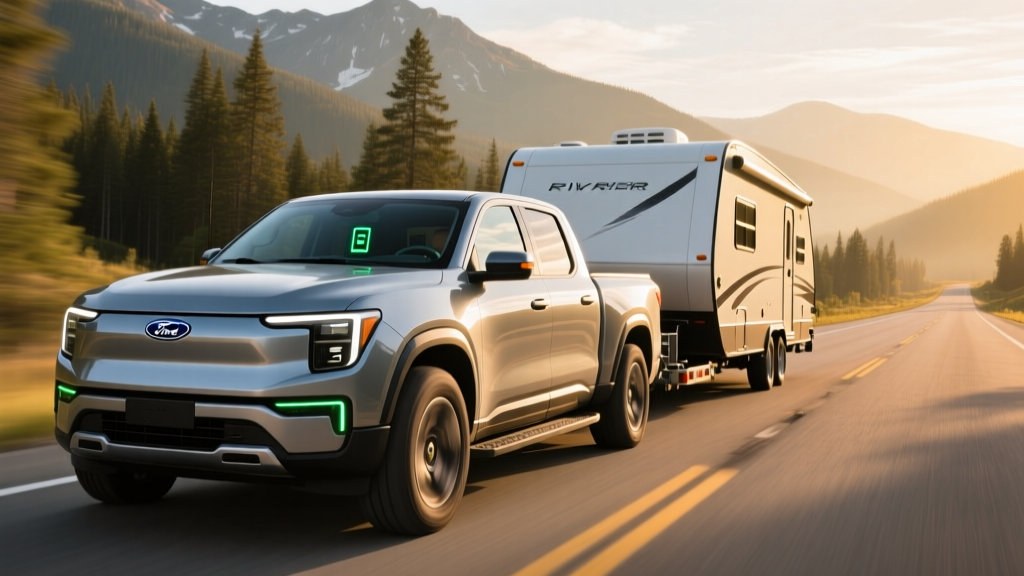
Yes, but expect 35–55% range reduction when towing a travel trailer with an electric pickup. A truck rated for 320 miles EPA may deliver just 140–190 miles while pulling a 5,000-lb RV trailer. The good news: towing energy cost runs $0.08–$0.14 per mile on home electricity versus $0.22–$0.35 per mile for diesel or gas trucks. If your trips are under 200 miles between charging stops and you can charge at home or at campgrounds with 240V/50A service, EV towing is practical today. For cross-country RV trips exceeding 300 miles between chargers, a diesel or heavy-duty gas truck remains the more realistic choice in 2026.
How Towing an RV Trailer Affects EV Range
Every electric truck on the market loses significant range under tow load, and the physics are unforgiving. Aerodynamic drag increases roughly with the square of speed, and a boxy travel trailer creates a massive low-pressure wake behind the tow vehicle. Combined with the added rolling resistance of 3,000–7,000 lbs of trailer weight, the energy draw per mile roughly doubles compared to unloaded driving.
Here's what real-world testing and owner data show for popular electric trucks towing mid-size RV trailers (4,500–6,000 lbs):
| Electric Truck (2025–2026) | Battery (kWh Usable) | EPA Range (Unloaded) | Est. Range Towing 5,000-lb Trailer | Max Tow Rating |
|---|---|---|---|---|
| Ford F-150 Lightning (Extended Range) | 131 kWh (NMC) | 320 mi | ~150–180 mi | 10,000 lbs |
| Rivian R1T (Dual-Motor Max Pack) | 141 kWh (NMC) | 410 mi | ~200–240 mi | 11,000 lbs |
| Chevrolet Silverado EV (4WT) | 200 kWh (NMC) | 440 mi | ~220–270 mi | 12,500 lbs |
| Tesla Cybertruck (AWD) | 123 kWh (NMC) | 340 mi | ~160–195 mi | 11,000 lbs |
For comparison, a Ford F-250 6.7L Power Stroke diesel towing the same 5,000-lb trailer typically achieves 10–13 MPG, giving an effective range of 330–430 miles on a 34-gallon tank. A gas-powered Ram 1500 with the 5.7L HEMI manages around 9–11 MPG under tow, or roughly 230–290 miles per tank.
Real-world towing range caveat: EPA range figures are measured unloaded under mixed driving conditions. When towing an RV trailer at highway speeds (65–75 mph), expect 40–55% range loss. In cold weather (below 35°F), add another 10–15% loss due to battery chemistry limitations and cabin heating. Mountain grades can temporarily slash efficiency by 60%+ on steep climbs, though regenerative braking recovers some energy on descents.
Cost Breakdown: EV Towing vs. Gas and Diesel
The economics of towing with an EV depend heavily on your electricity source. Home charging at residential rates makes EV towing dramatically cheaper per mile than any fossil fuel. Public DC fast charging at $0.35–$0.55/kWh narrows the gap considerably.
| Cost Factor | EV Truck (Home L2 Charging) | EV Truck (Public DCFC) | Gas Truck (15 MPG Combined) | Diesel HD Truck (12 MPG Towing) |
|---|---|---|---|---|
| Energy cost per mile (towing) | $0.08–$0.12 | $0.25–$0.40 | $0.22–$0.30 | $0.30–$0.42 |
| Energy cost per mile (unloaded) | $0.03–$0.05 | $0.10–$0.18 | $0.14–$0.18 | $0.18–$0.25 |
| Annual maintenance (est.) | $300–$500 | $900–$1,400 | $800–$1,200 | $1,000–$1,600 |
| 5-year fuel/energy (12k mi/yr, 20% towing) | $3,200–$5,500 | $8,500–$13,000 | $10,500–$14,000 | $13,000–$18,000 |
| Upfront vehicle cost (base MSRP) | $55,000–$100,000 | — | $38,000–$65,000 | $52,000–$80,000 |
Over five years of mixed use (daily driving plus 10–15 weekend RV trips per year), an EV truck charged primarily at home can save $5,000–$10,000 in energy and maintenance costs compared to a gas equivalent. However, the higher purchase price of electric trucks — and potential battery out-of-warranty replacement costs of $15,000–$25,000 — must factor into your total cost of ownership calculation.
Charging an EV While Towing: The Real Bottleneck
The most significant practical limitation of EV RV trailer towing isn't range — it's charging infrastructure. Most DC fast charging stations are not designed for vehicles with trailers attached. Here's what you'll encounter:
- Stall layout: Typical Electrify America, EVgo, and Tesla Supercharger stalls require you to pull through or back in. A 20–25 ft travel trailer makes most standard stalls inaccessible without unhitching.
- Pull-through chargers: A growing number of stations now offer pull-through DCFC stalls designed for trucks with trailers. Tesla has added pull-through Superchargers at select travel corridors, and Electrify America has deployed them at major truck stops. As of early 2026, pull-through availability remains limited — plan routes using PlugShare or A Better Routeplanner with the "towing" filter.
- Charging speed under tow conditions: Towing doesn't change the vehicle's peak charge rate (e.g., the F-150 Lightning peaks at ~210 kW DC, the Silverado EV at ~350 kW), but the battery arrives at the charger hotter after sustained high-load driving. Thermal management may limit initial charge speeds until the pack cools, adding 3–5 minutes to a 10–80% session.
- Campground charging: Most RV campgrounds offer 240V/50A or 240V/30A shore power. At 50A (12 kW), you'll add roughly 30–40 miles of towing range per hour of charging — enough to fully recharge overnight for a next-day departure. At 30A (7.2 kW), expect 18–24 miles per hour.
| Charging Method | Power (kW) | Miles of Tow Range Added per Hour | Full Charge Time (from 10%) |
|---|---|---|---|
| Level 1 (120V household) | 1.4 kW | 3–5 mi | 80–100+ hours |
| Level 2 (240V/30A campground) | 7.2 kW | 18–24 mi | 16–20 hours |
| Level 2 (240V/50A campground) | 12 kW | 30–40 mi | 10–13 hours |
| Level 2 (home wall connector, 48A) | 11.5 kW | 28–38 mi | 11–14 hours |
| DC Fast Charge (150 kW station) | 150 kW peak | N/A (session-based) | 10–80% in ~35–45 min |
| DC Fast Charge (350 kW station) | 350 kW peak | N/A (session-based) | 10–80% in ~18–25 min |
Common Misconceptions About EV RV Trailer Towing
| Myth | Fact |
|---|---|
| "EVs can't tow heavy trailers." | Modern electric trucks have tow ratings of 10,000–12,500 lbs, competitive with half-ton gas trucks. Instant torque actually provides strong low-speed trailer control. |
| "You'll be stranded with no chargers." | With route planning tools and pull-through DCFC expansion, most interstate RV corridors are covered. The real gap is rural and national park access. |
| "Towing will destroy the battery." | High-load towing generates heat, but liquid-cooled battery packs with active thermal management handle sustained loads. Degradation from occasional towing is minimal — expect <2% additional capacity loss over 100,000 miles of mixed use. |
| "EVs are always cheaper to tow with." | Only if you charge at home. Exclusive reliance on public DCFC at $0.40–$0.55/kWh can make EV towing more expensive per mile than a fuel-efficient diesel. |
| "You need a special EV-specific trailer." | Any standard travel trailer within the truck's tow rating works. However, lighter trailers with lower frontal area significantly improve range. |
What First-Time EV RV Buyers Need to Know
If you're considering an electric truck specifically for RV trailer towing, these ownership realities will shape your experience more than any spec sheet:
Home charging is nearly mandatory. Without a Level 2 home charger (240V/48A minimum), the logistics of keeping a large battery pack charged for towing become burdensome. Budget $800–$2,500 for a quality Level 2 wall connector and professional installation. If your home electrical panel is maxed out at 100A, a panel upgrade to 200A can add $1,500–$4,000. Always consult a licensed electrician for final specs.
Trailer weight matters more than you think. Every 1,000 lbs of additional trailer weight costs roughly 15–25 miles of EV range at highway speeds. A 3,500-lb teardrop or pop-up camper might leave you with 220+ miles of range; a 7,000-lb bunkhouse could drop you below 130 miles. Choose the lightest trailer that meets your needs.
Plan for charge-curve taper. DC fast charging speeds peak between 10–40% state of charge (SoC) and taper significantly above 80%. When towing, plan to charge from 15% to 75% — the fastest portion of the curve — rather than waiting for a full charge. This typically takes 20–35 minutes at a 150–350 kW station.
Federal tax credit eligibility varies. Under current IRS §30D rules, new EV trucks may qualify for up to $7,500 in federal tax credits, but eligibility depends on MSRP caps ($80,000 for trucks/vans/SUVs), buyer income limits ($300,000 joint / $150,000 single), battery component sourcing requirements, and critical mineral thresholds. The credit can now be transferred to the dealer at point of sale as a purchase-price reduction. Verify current-year eligibility on the IRS website and consult a tax professional.
Decision Framework: Should You Tow Your RV Trailer With an EV?
Choose an Electric Truck for RV Towing If:
- Your typical RV trips are under 200 miles one-way (or you can charge at your destination campground)
- You have home Level 2 charging access with a 240V/48A+ circuit
- You tow 10 or fewer times per year and use the truck as a daily driver the rest of the time
- You value the quiet, vibration-free towing experience and instant torque for trailer maneuvering
- Your trailer weighs under 6,000 lbs loaded
- You want to reduce per-mile energy costs and eliminate oil changes, transmission fluid, and emissions system maintenance
Stick With Gas or Diesel for RV Towing If:
- You regularly tow 300+ miles between stops on routes with sparse DCFC coverage
- Your loaded trailer exceeds 7,000 lbs (heavy fifth-wheels or large travel trailers)
- You frequently tow in extreme cold (below 20°F) where range loss compounds to 55–65%
- You cannot install home Level 2 charging
- You need maximum range certainty without route-planning overhead
- Your budget is under $50,000 total for the tow vehicle
Best Electric Trucks for RV Trailer Towing in 2026
Best overall for towing range: The Chevrolet Silverado EV 4WT with its 200 kWh Ultium battery delivers the longest estimated towing range of any production electric truck, reaching approximately 220–270 miles with a 5,000-lb trailer. Peak DC charging at ~350 kW means 10–80% in roughly 20 minutes at compatible stations. Starting MSRP is around $72,000 for the Work Truck trim.
Best value for moderate towing: The Ford F-150 Lightning Extended Range remains the most accessible full-size electric truck, starting near $60,000 before incentives. Its 131 kWh pack yields roughly 150–180 miles of towing range — sufficient for regional trips. The onboard Pro Power Onboard system (up to 9.6 kW) can power campground appliances or serve as a backup generator, a genuine advantage for RV use.
Best for adventure-oriented towing: The Rivian R1T Max Pack combines 410 miles of EPA range (unloaded), 11,000-lb tow rating, and a built-in air compressor with camp kitchen options. Its 141 kWh battery yields an estimated 200–240 towing miles. Starting around $87,000, it's the premium choice for overlanding-style RV trips.
Frequently Asked Questions
Do I need a weight-distribution hitch for EV truck towing?
Yes, for any trailer over 5,000 lbs. Weight-distribution hitches improve stability and braking performance regardless of tow vehicle powertrain. Electric trucks are often heavier than gas equivalents (the F-150 Lightning weighs ~6,500 lbs unloaded), which can improve trailer stability, but proper hitch setup remains essential for safety.
Can I charge my EV truck at an RV campground?
Most campgrounds with 240V/50A shore power pedestals can charge an EV truck using a mobile connector with a NEMA 14-50 adapter. At 12 kW, you'll gain roughly 30–40 miles of towing range per hour — enough for a full overnight charge. Confirm with the campground before booking that EV charging on the shore power pedestal is permitted, as some parks restrict this to avoid overloading their electrical infrastructure.
Does regenerative braking help when towing downhill?
Significantly. On sustained mountain descents, regenerative braking can recover 15–30% of the energy spent climbing. Some EV trucks offer enhanced trailer brake integration that blends regen with the trailer's electric brakes. The F-150 Lightning and Silverado EV both support integrated trailer brake controllers with regen blending.
Will towing void my EV battery warranty?
No. Towing within the manufacturer's published tow rating is a normal use case covered under the standard battery warranty. Federal law mandates a minimum 8-year/100,000-mile battery warranty for EVs, and most manufacturers warrant against capacity loss below 60–70% of original capacity during that period. Check your specific vehicle's warranty documentation — fueleconomy.gov lists warranty details by model.
Are there EV-specific RV trailers?
A few manufacturers have announced trailers with integrated batteries and solar panels that can extend tow-vehicle range or power the trailer independently. The Lightship L1 and Airstream e-trailer concept are the most notable. As of 2026, these remain either limited-production or pre-order items. Standard travel trailers from established brands (Airstream, Jayco, Grand Design, Forest River) work perfectly with electric trucks — focus on minimizing weight and frontal area rather than waiting for specialized EV trailers.
How does cold weather affect EV towing range?
Cold temperatures reduce battery efficiency and increase cabin heating demand. At 20°F, expect an additional 10–15% range loss on top of the 40–55% towing penalty, bringing total effective range down to roughly 100–150 miles for a truck rated at 320 miles EPA. Preconditioning the battery before departure (available on all current electric trucks) mitigates some of this loss by warming the pack to optimal operating temperature while still plugged in.