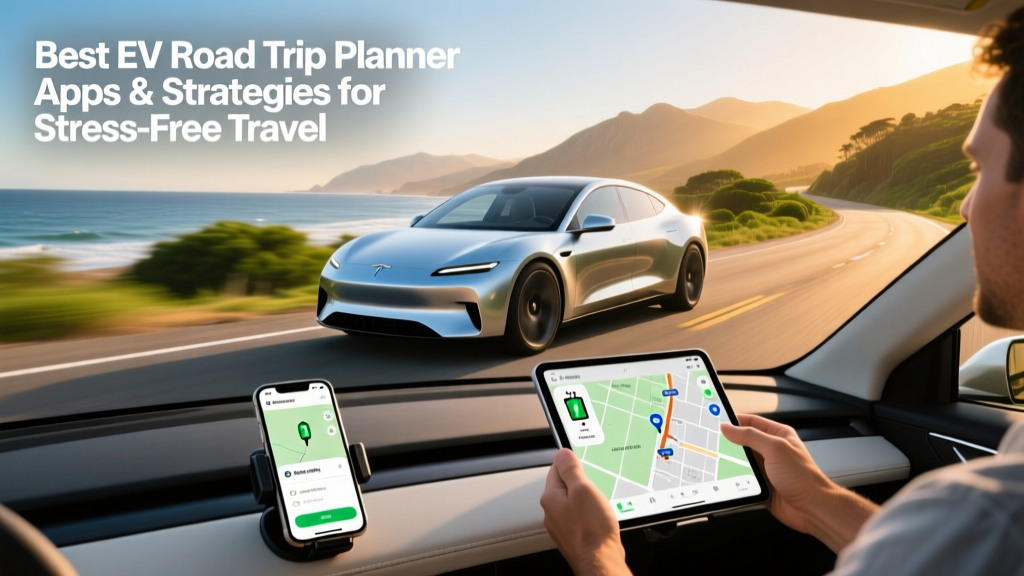
The best EV road trip planner isn't a single app—it's a combination of route-mapping software, real-time charger data, and a basic understanding of your vehicle's charging curve. For most drivers in 2026, A Better Routeplanner (ABRP) remains the most customizable EV road trip planner available, while built-in navigation systems from Tesla, Rivian, and Hyundai/Kia now rival third-party tools by integrating live battery state-of-charge (SoC) data with DC fast-charger availability.
Quick Answer: Which EV Road Trip Planner Should You Use?
- Best overall: A Better Routeplanner (ABRP) — supports 400+ EV models, factors in elevation, temperature, and real-time charger status
- Best for Tesla owners: Built-in Tesla navigation with Supercharger routing — no setup required, preconditions battery automatically
- Best for non-Tesla NACS vehicles: PlugShare + ABRP combo — PlugShare for charger reliability reviews, ABRP for route optimization
- Best built-in (non-Tesla): Hyundai/Kia EV route planner (2025+ models) — integrates battery preconditioning and 800V charging curve data
Why a Dedicated EV Road Trip Planner Matters
Unlike a gas car, where any station works and a fill-up takes five minutes, an EV road trip requires matching your vehicle's connector type (NACS, CCS, or CHAdeMO), its peak charge rate (anywhere from 50 kW on older models to 350 kW on 800V architectures), and the realistic charging curve—not just the advertised peak kW.
Here's the core problem: a vehicle rated for 250 kW peak charging doesn't sustain that rate. Most EVs hit peak speed between 10-30% SoC, then taper significantly. A 2026 Hyundai Ioniq 5 with its 84 kWh battery and 800V architecture peaks around 240 kW and charges 10-80% in approximately 18 minutes under ideal conditions. But a 2026 Chevrolet Equinox EV with a 85 kWh NMC battery peaks at roughly 150 kW and needs about 30 minutes for the same 10-80% session. A generic map app won't tell you this. A proper EV road trip planner will.
| Factor | 2026 Tesla Model Y LR (AWD) | 2026 Toyota RAV4 (Gas AWD) |
|---|---|---|
| EPA Range / Tank Range | 320 mi (EPA) / ~270 mi real-world highway | 385 mi (14.5 gal × 27 mpg combined) |
| Stops Required (One-Way) | 0 (within real-world range) or 1 short stop | 0 (full tank sufficient) |
| Energy/Fuel Cost (One-Way) | ~$12-18 (Supercharger at $0.35/kWh avg) | ~$38-45 (gas at $3.80/gal avg) |
| Total Stop Time | 0-20 min (if a charge is needed) | 5-10 min |
| Round-Trip Energy Cost | ~$24-36 | ~$76-90 |
The EV saves $40-55 on a round-trip LA-Vegas drive, but only if you plan around actual highway range (which drops 15-20% from EPA sticker at sustained 70-80 mph speeds) and charger availability.
Top EV Road Trip Planner Tools Compared
1. A Better Routeplanner (ABRP)
ABRP is the gold standard for route planning across all EV brands. You input your exact vehicle model and year, starting SoC, destination, and it calculates optimal charge stops based on your car's specific charge curve. It factors in elevation gain (critical for mountain routes like I-70 over the Rockies), ambient temperature (cold weather can reduce range 20-30%), and driving speed.
Key advantage: ABRP tells you to charge to 60% at one stop and skip to the next station rather than waiting for 80%—because charging from 60-80% can take as long as 10-80% due to taper. This is the single biggest time-saving insight most new EV road-trippers miss.
Cost: Free basic version; $4.99/month or $49.99/year for live data integration (OBD-II dongle or vehicle API connection for real-time SoC).
2. PlugShare
PlugShare isn't a route optimizer—it's a charger database with user reviews. Before any road trip, cross-reference your planned stops on PlugShare to see recent check-in reports. A station showing multiple "charger down" reports in the past week is a stop you should skip. PlugShare covers all networks: Tesla Superchargers, Electrify America, EVgo, ChargePoint, and independent operators.
Cost: Free.
3. Built-In Vehicle Navigation
As of 2026, most new EVs include native route planning that accounts for battery state. Tesla's system remains the benchmark, automatically routing through Superchargers and preconditioning the battery for optimal charge speed as you approach. Rivian's Adventure Network planner integrates with its R1T and R1S models. Hyundai and Kia's latest EV route planners (available on 2025+ Ioniq 5, Ioniq 6, EV6, and EV9 models) now factor in the vehicle's 800V charge curve and can precondition the battery when a DC fast charger is set as the next destination.
4. Google Maps / Apple Maps
Both now include EV-aware routing, but they lack the granular charge-curve modeling of ABRP. Google Maps lets you set your EV model and will suggest charge stops, but it tends to be conservative—often adding stops you don't need. Use these as a backup, not a primary planner.
Real-World Charging Strategy: How to Minimize Stop Time
The biggest mistake first-time EV road-trippers make is charging to 80% or higher at every stop. Here's why that wastes time:
A typical DC fast-charging session on a 2026 model with NMC chemistry follows this pattern:
- 10-30% SoC: Near-peak charge rate (e.g., 200-240 kW on an 800V vehicle)
- 30-50% SoC: Slightly reduced (e.g., 150-180 kW)
- 50-70% SoC: Moderate taper (e.g., 80-120 kW)
- 70-80% SoC: Significant taper (e.g., 40-70 kW)
- 80-100% SoC: Very slow (e.g., 10-30 kW)—this last 20% can take as long as the first 60%
Charge Stop Decision Framework
- If your next stop is within 100 miles → charge to 50-60% and go. You'll save 10-15 minutes vs. waiting for 80%.
- If your next stop is 150+ miles away → charge to 75-80%, then accept the taper. Factor in 25-35 minutes total.
- If it's your final destination and you'll charge overnight → charge only enough to reach it with a 10-15% buffer. Charge to 100% on Level 2 at your hotel or home.
- If temperatures are below 32°F → add 20-25% to your range buffer. Cold reduces both range and charge speed. Ensure your planner accounts for temperature.
Cost Breakdown: EV Road Trips vs Gas Road Trips
| Expense | Average EV (300-mi range, 3.5 mi/kWh) | Average Gas Car (28 MPG combined) |
|---|---|---|
| Energy/Fuel | $100-140 (mix of DC fast & Level 2 at $0.30-0.45/kWh avg) | $135-155 (at $3.80/gal avg) |
| Maintenance (oil, filters per 1,000 mi) | $0 | $15-25 (pro-rated) |
| Tolls/Parking | Same | Same |
| Total Energy + Maint. | $100-140 | $150-180 |
The EV advantage on road trips is modest—roughly $20-50 saved per 1,000 miles—because DC fast charging is significantly more expensive than home Level 2 charging. The real savings come during daily driving when you charge at home at $0.12-0.18/kWh (depending on your utility), bringing per-mile cost down to $0.04-0.06 versus $0.13-0.16 for gas.
For a full EV efficiency comparison by model, the Department of Energy's fueleconomy.gov site provides MPGe and kWh/100mi figures for every EPA-rated EV.
Common EV Road Trip Misconceptions
| Myth | Fact |
|---|---|
| "You'll be stranded—chargers are everywhere broken." | Reliability varies by network. Tesla Superchargers consistently report 97%+ uptime. Electrify America and EVgo have improved significantly since 2024, now averaging 90-94% uptime. Always check PlugShare for recent station reports before relying on a single charger in a rural area. |
| "EV road trips take twice as long." | On a 500-mile trip with a 300-mile-range EV, you'll add one 20-minute charge stop. That's 20 minutes vs. zero for gas—but you're also saving $25-40 on fuel. On trips under 250 miles (the majority of US road trips), most modern EVs require zero stops. |
| "You can't road-trip in winter." | Cold weather reduces range 20-30% and slows charging. A 300-mile EPA EV becomes a ~220-240-mile EV at 20°F. Plan for this with your EV road trip planner by setting a cold-weather buffer. Vehicles with heat pumps (standard on most 2024+ EVs) lose less range than older resistive-heater models. |
| "All chargers work with all EVs." | As of 2026, the industry has largely converged on NACS (Tesla's connector, now adopted by Ford, GM, Rivian, Hyundai/Kia, and others). However, some 2022-2024 models still have CCS1 ports and may need an adapter. CHAdeMO is effectively discontinued on new vehicles. Always confirm connector compatibility in your planner. |
Connector Compatibility: What Works Where in 2026
Understanding your vehicle's charge port is critical for road trip planning:
- NACS (North American Charging Standard): Native on all Tesla vehicles and 2025+ models from Ford (F-150 Lightning, Mustang Mach-E), GM (Equinox EV, Blazer EV, Silverado EV), Rivian, Hyundai (Ioniq 5/6/9 from 2025+), Kia (EV6/EV9 from 2025+). Access to Tesla Supercharger network (17,000+ stalls in North America) plus all NACS-equipped third-party stations.
- CCS1 (Combined Charging System): Found on 2022-2024 models from GM, Ford, VW, BMW, and others. Still compatible with Electrify America, EVgo, and ChargePoint DC stations. Many automakers offer NACS adapters for CCS-equipped vehicles—check with your dealer.
- CHAdeMO: Legacy connector on Nissan Leaf (through 2025 final model year) and older Mitsubishi models. Charging infrastructure is shrinking. Plan trips carefully and carry a backup plan.
First-Time EV Road Trip Checklist
Before you leave, work through this practical list:
- Set your EV road trip planner to your exact vehicle model, year, and trim. Range and charge speed vary significantly even within a model line (e.g., 2026 Ioniq 5 Standard Range: 290 mi EPA / ~150 kW peak; Long Range AWD: 320 mi EPA / ~240 kW peak).
- Verify charger stops have recent positive check-ins on PlugShare. Flag any station with two or more "charger broken" reports in the past 14 days.
- Download the charging network apps for your route. You'll need accounts (and possibly payment methods) for Tesla (if non-Tesla using Superchargers via NACS), Electrify America, EVgo, and ChargePoint. Pre-register to avoid fumbling at the charger.
- Plan for a 15-20% range buffer at each stop. Don't arrive at a charger with 2% remaining. If your planner says you'll arrive at 10%, treat that as your minimum—drive slower if needed to preserve buffer.
- Bring your mobile connector and a NACS or CCS adapter if applicable. Level 1 (120V) charging from a standard outlet adds roughly 3-5 miles per hour—enough for overnight recovery at a hotel if DC chargers fail.
- Check weather along your route. If temperatures will drop below freezing, precondition your battery before each charge stop (most EVs do this automatically when a charger is set as the navigation destination).
When an EV Road Trip Doesn't Make Sense (Yet)
Honesty matters. There are scenarios where a gas car or hybrid remains the better road-trip choice in 2026:
- Remote routes with no DC charging: If your trip involves 200+ mile stretches through areas like rural Nevada, northern Maine, or parts of the Dakotas, a PHEV (plug-in hybrid) like the 2026 Toyota RAV4 Prime (42 mi electric-only, 38 mpg gas) or a conventional hybrid eliminates range risk entirely.
- Towing: EV range drops 40-50% when towing near max capacity. A 320-mile EV becomes a 160-190-mile EV towing a 3,000-lb trailer. Charge stops double or triple. Gas trucks still hold an advantage here.
- Extreme cold below 0°F: Range loss can exceed 30%, and charge speeds slow dramatically. If you're driving through Montana in January, a hybrid provides a safer margin.
- Apartment dwellers without home charging: If you can't charge at home and rely entirely on public infrastructure, road trips compound the inconvenience. Consider whether a PHEV's flexibility better suits your lifestyle.
Frequently Asked Questions
Is ABRP worth paying for, or is the free version enough?
The free version of A Better Routeplanner handles route planning and charge-stop estimation well. The paid tier ($4.99/month) adds live SoC integration via OBD-II or vehicle API, which eliminates manual battery-percentage input and adjusts the route in real time. If you road-trip more than twice a year, the live data feature is worth it for the accuracy improvement alone.
How accurate are EV road trip planners for estimating charge time?
Most planners are accurate within 3-5 minutes on a 20-minute charge stop, assuming normal conditions. Variables that throw off estimates include: extreme temperatures (planners may underestimate cold-weather taper), charger power-sharing (some stations split kW between two stalls), and battery age (a degraded battery charges slightly differently). Always add a 5-minute buffer to planner estimates on tight schedules.
Can I use Tesla Superchargers with a non-Tesla EV?
Yes—as of 2026, Tesla has opened a significant portion of its Supercharger network to non-Tesla NACS-equipped vehicles. Ford, GM, Rivian, and Hyundai/Kia EVs with native NACS ports can access Superchargers directly. CCS-equipped vehicles may need a Tesla-approved NACS adapter. Use the Tesla app or your vehicle's built-in navigation to confirm which Supercharger stalls are open to non-Tesla vehicles at your planned stops. The Tesla non-Tesla Supercharger page lists compatible vehicles and adapter requirements.
What's the cheapest way to charge on a road trip?
Level 2 chargers at hotels, campgrounds, and some retail locations are often free or cost $0.15-0.25/kWh—significantly less than DC fast chargers at $0.30-0.50/kWh. If you're stopping overnight, prioritize lodging with Level 2 charging. A full overnight charge on Level 2 (7-11 kW) adds 150-250 miles, enough for most next-day driving. PlugShare's filter for "lodging with charging" is invaluable for this.
How does towing affect EV road trip planning?
Towing near an EV's maximum capacity reduces real-world range by roughly 40-50%. A 2026 Ford F-150 Lightning with an EPA range of 320 miles will deliver approximately 160-200 miles when towing a 5,000-lb trailer at highway speeds. Your EV road trip planner must be set to the towing profile (ABRP supports this) to generate realistic charge stops. Plan for charge stops every 120-150 miles when towing.
For the latest federal EV tax credit rules under IRS §30D—which can offset up to $7,500 of a new EV purchase if you meet income, MSRP, and battery-sourcing requirements—consult the IRS directly or a tax professional, as eligibility criteria continue to evolve.