The Short Answer on EV History
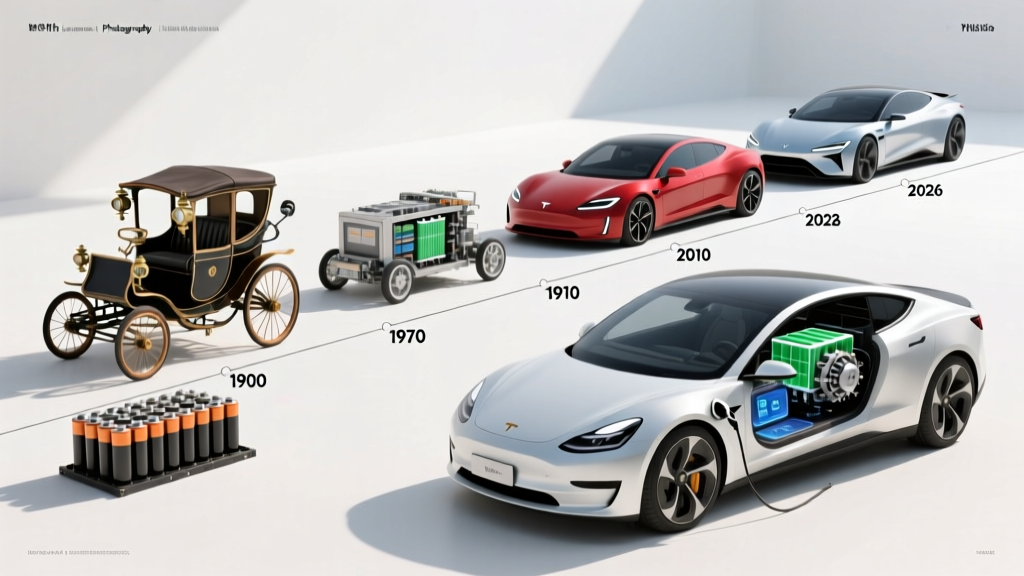
Electric vehicles aren't new — they dominated roads in the early 1900s before cheap gasoline and the electric starter killed them. The modern EV era began with the Tesla Roadster in 2008 (244-mile range), accelerated with the Nissan Leaf in 2010 (73 miles, dropping below $30k), and reached mainstream parity around 2023-2025 when average EVs hit 250-350 miles of EPA range, 150-350 kW DC fast charging, and sticker prices that overlap with gas cars once the federal §30D tax credit (up to $7,500) is applied. Understanding this ev history timeline matters for buyers today because it explains why battery warranties run 8 years/100,000 miles, why NACS beat CCS, and why 2026 is the first year where used-EV selection is genuinely broad.
The EV History Timeline in Six Eras
The story of electric cars is really three stories stacked on top of each other: early dominance, near-extinction, and a lithium-ion resurrection. Here's how each era shapes what you can buy in 2026.
1834–1912: The First Electric Era
The first crude electric carriage was built around 1834 by Thomas Davenport, and by 1900 roughly 28% of the 4,192 cars produced in the U.S. were electric, outselling gasoline vehicles. Detroit Electric, Baker Electric, and Columbia were household names. Electric cars were quiet, didn't require hand-cranking, and were marketed heavily to women. Their fatal flaw: a 30-50 mile range and no fast way to recharge outside city centers.
1912–1990: The Gasoline Century
Cadillac's electric starter (1912), Henry Ford's Model T ($650 vs. $1,750 for a Detroit Electric), and Texas crude oil buried the EV for 75+ years. The only notable revivals were niche: the 1970s energy-crisis experiments (CitiCar, Lunar Rover), and California's 1990s ZEV-mandate cars like the GM EV1 — famously recalled and crushed, a story told in the 2006 documentary Who Killed the Electric Car?.
1996–2008: Lithium-Ion Arrives
The Toyota RAV4 EV (1997, 95-mile range, NiMH battery) and Honda EV Plus proved EVs could be practical. The real inflection: Tesla's 2008 Roadster used lithium-ion laptop cells to hit 244 miles — a number that made every automaker pay attention.
2010–2018: The Modern EV Is Born
The 2010 Nissan Leaf (24 kWh, 73-mile EPA range, ~$32,780 before incentives) and Chevy Volt (PHEV, 35-mile electric range) created the template. By 2017, the Chevy Bolt offered 238 miles for $36,620 — the first affordable long-range EV. Tesla's Model S (2012) and Model 3 (2017, from $35,000 promised) proved EVs could be desirable, not just dutiful.
2019–2024: The Platform Wars and Tax-Credit Boom
Hyundai's E-GMP (Ioniq 5, Kia EV6), VW's MEB (ID.4), GM's Ultium, and Ford's GE1 platforms delivered 800V architectures and 10-80% DC charging in 18-25 minutes. The Inflation Reduction Act of 2022 reshuffled incentives with the §30D credit's MSRP caps ($55k cars / $80k SUVs and trucks), buyer income limits, and critical-mineral sourcing rules. Tesla's NACS connector became the de facto North American standard by late 2023 when Ford, GM, Rivian, Volvo, and others adopted it.
2025–2026: The Mainstream Era
Average new-EV transaction prices have fallen into the mid-$40k range; EPA ranges of 280-340 miles are common in mainstream crossovers (Hyundai Ioniq 5, Tesla Model Y, Chevy Equinox EV, Honda Prologue). LFP (lithium iron phosphate) batteries now power base trims of the Model 3 and others, trading some energy density for lower cost, longer cycle life, and no cobalt. Level 4 robotaxis (Waymo) operate in Phoenix, San Francisco, Los Angeles, and Austin, while consumer driver-assist systems remain SAE Level 2.
What the EV History Timeline Means for 2026 Buyers
History isn't trivia — it predicts what you'll actually own. Three direct implications:
- Battery longevity is proven, not promised. Early Leaf packs degraded badly because they lacked thermal management. Modern liquid-cooled packs (Tesla, Hyundai E-GMP, GM Ultium) routinely retain 85-92% capacity after 100,000 miles, per long-term fleet data.
- Charging networks matured in waves. Tesla's Supercharger network (now open to NACS-equipped non-Teslas) is the most reliable; Electrify America, EVgo, and ChargePoint have improved uptime since 2023's NEVI-funded reliability mandates.
- The used market is finally viable. 2019-2023 EVs are coming off leases with 70-85% state-of-health, often still under the 8-year/100,000-mile battery warranty — a historically unique buyer opportunity.
EV vs Gas vs Hybrid: A Cost Comparison Using 2026 Numbers
The reason the ev history timeline matters today is that for the first time, the math genuinely competes across three powertrains. Below is a 5-year/75,000-mile comparison using a mainstream crossover in each category: the 2026 Hyundai Ioniq 5 (BEV), 2026 Toyota RAV4 Hybrid (HEV), and 2026 Toyota RAV4 AWD (gas).
| Category | 2026 Ioniq 5 SE (BEV) | 2026 RAV4 Hybrid (HEV) | 2026 RAV4 AWD (Gas) |
|---|---|---|---|
| Base MSRP | $42,600 | $34,500 | $32,350 |
| Federal tax credit (§30D) | Up to $7,500* | $0 | $0 |
| Effective purchase | ~$35,100 | $34,500 | $32,350 |
| EPA efficiency | 114 MPGe (30 kWh/100mi) | 39 MPG combined | 28 MPG combined |
| Energy cost (75k mi) | ~$2,925 (home L2 @ $0.13/kWh) | ~$6,410 ($3.35/gal) | ~$8,946 ($3.35/gal) |
| Maintenance (75k mi) | ~$1,200 | ~$3,100 | ~$3,800 |
| 5-year total cost | ~$39,225 | ~$44,010 | ~$45,096 |
*§30D eligibility depends on buyer AGI (≤$150k single / $300k MFJ), MSRP caps, and battery-sourcing rules per IRS guidelines. Always verify before purchase; point-of-sale transfer is available at participating dealers.
The EV wins on 5-year cost by roughly $5,000-$6,000 versus gas, but only if you can charge at home at residential rates. Public DC fast charging at $0.40-$0.55/kWh erases most of that advantage — a reality often omitted from marketing.
Real-World Ownership Considerations (That History Teaches)
Every era of EV history left a lesson. Here are the ones 2026 buyers must actually plan around:
Home Charging Is the Make-or-Break Variable
A Level 2 home charger (240V, 32-48A, 7.7-11.5 kW) adds 25-44 miles of range per hour and is the single biggest predictor of EV satisfaction. Installation runs $800-$2,500 for a straightforward panel-to-garage run; add $1,500-$3,500 if your home needs a 200A service upgrade. Renters and condo dwellers should seriously consider a PHEV (Toyota RAV4 Prime, Chrysler Pacifica Hybrid) instead of a BEV.
Cold Climate? Expect 20-35% Range Loss
Historically, cold weather crippled early EVs. Modern heat pumps (standard on Ioniq 5, Model Y, many 2025+ EVs) cut that loss to ~20-25%, but a 310-mile EPA EV still delivers roughly 220-240 miles at 20°F. If you live in the Upper Midwest or Northeast and regularly drive 200+ miles in winter, spec a 320+ mile EPA vehicle or plan charging stops.
The Highway Range Caveat
EPA range is a blended cycle. At 75 mph on flat interstate, expect 85-90% of sticker; at 80+ mph or into headwinds, 75-80%. A 300-mile EPA EV typically delivers 240-260 highway miles — adequate for most trips, tight for the Idaho-to-Montana corridors.
DC Fast Charging Isn't Linear
Peak kW is a headline, not an average. A 350-kW-capable Ioniq 5 sustains ~220 kW from 10-55% SoC, then tapers to ~120 kW through 80% and ~50 kW above 90%. Real 10-80% time: ~18 minutes. Road-trip planning must use the curve, not the peak.
Common EV Misconceptions — Then and Now
| Myth | Fact (with data) |
|---|---|
| "EV batteries need replacing every 5 years." | Federally mandated warranty is 8 years/100,000 miles at ≥70% capacity. Tesla fleet data shows ~12% average degradation at 150,000 miles. |
| "EVs are worse for the environment." | Even on coal-heavy grids, lifecycle emissions are 50-70% lower than gas per EPA analysis; the grid has been decarbonizing steadily since 2010. |
| "Charging takes hours." | Level 2 home charging overnight covers 95% of daily needs. Modern DC fast charging adds 180-220 miles in 18-25 minutes on a 150-350 kW station. |
| "EVs can't tow." | F-150 Lightning tows 7,700-10,000 lbs; Rivian R1T tows 11,000 lbs. But towing cuts range 40-55% — plan accordingly. |
| "Autopilot / FSD is self-driving." | All consumer systems (Tesla FSD Supervised, GM Super Cruise, Ford BlueCruise) are SAE Level 2. The driver must remain attentive. Only Waymo/Zoox services are Level 4. |
First-Time EV Buyer Decision Framework
If X, Then Y
- If you have a garage/driveway + daily commute under 80 miles → BEV with 250+ EPA miles (Ioniq 5, Model Y, Equinox EV). Install a 48A Level 2 charger.
- If you rent or live in a condo without charging access → PHEV (RAV4 Prime, Wrangler 4xe, Pacifica Hybrid) or wait until workplace/public charging is reliable in your area.
- If you drive 300+ miles weekly in rural areas → HEV (RAV4 Hybrid, Camry Hybrid) still wins on convenience; BEV works only if you accept DC charging stops every ~180 miles.
- If you live in a cold climate (below 20°F regularly) → Choose an EV with a heat pump AND 320+ EPA miles, or keep a gas backup for winter road trips.
- If you want lowest 5-year cost → BEV + home L2 + §30D credit eligibility is the clear winner, saving ~$5,000-$8,000 vs. gas over 75,000 miles.
- If you're buying used → 2020-2023 Model 3, Ioniq 5, or Bolt EUV under 60k miles still carry battery warranty and are historically great value.
What 2026 Buyers Should Know Before Signing
- Verify §30D eligibility yourself — don't rely on the dealer. Check VIN battery-sourcing via the IRS portal and confirm your AGI qualifies.
- Get a home-charging quote before purchase. A licensed electrician should assess panel capacity (200A service is ideal; 100A may require an upgrade or a smart load-management charger like Emporia or Wallbox).
- Test-charge before you buy. Visit your nearest public DC fast station on the network you'll rely on; real-world reliability varies by region.
- Insurance is typically 10-20% higher for EVs vs. comparable gas cars — get a quote before committing.
- Depreciation has normalized. 2023-2024 saw steep EV price cuts and used-value drops; 2025-2026 models are stabilizing as incentives and pricing align.
Frequently Asked Questions
When did EVs first outsell gas cars?
Around 1900 in the U.S., electric vehicles accounted for roughly 28% of car production and briefly outsold gasoline vehicles in urban markets. They lost that lead by 1915 due to cheap Texas oil, the electric starter, and Ford's Model T production scale.
What killed the first generation of modern EVs in the 2000s?
Primarily battery chemistry. NiMH and early lead-acid packs were heavy and range-limited (60-100 miles). The shift to lithium-ion (Tesla Roadster, 2008) is the single biggest technical reason the current EV era exists. See fueleconomy.gov's EV history overview for context.
Are 2026 EVs actually cheaper to own than gas cars?
Yes, on a 5-year total-cost basis, assuming home charging, §30D eligibility, and average mileage. The breakeven versus a comparably priced gas car typically arrives around year 3-4. Without home charging or the tax credit, a hybrid is usually the more economical pick.
Will solid-state batteries make today's EVs obsolete?
Solid-state is in limited production (Toyota has announced small-scale rollout for 2027-2028), but widespread, affordable deployment is likely 2030+. Current NMC and LFP packs are mature, well-warrantied, and not a dead-end purchase in 2026.
Is it smarter to buy new or used in 2026?
New gets the full §30D credit (up to $7,500) and latest efficiency; used EVs qualify for a separate used-clean-vehicle credit (30% of sale price, max $4,000, on vehicles ≤$25,000). A 2-3 year old EV with remaining battery warranty is historically one of the best value plays in the current market.