The Short Answer on Electric Kayaking With an EV
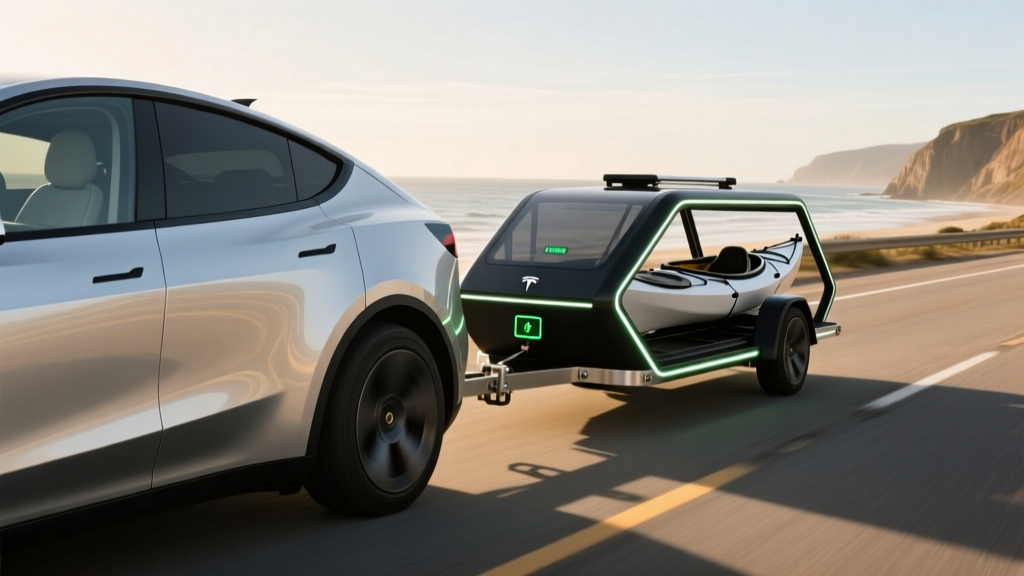
If you're hauling electric kayaks (motorized e-kayaks with trolling motors or pedal drives weighing 80–150 lbs each) to the water, any compact SUV EV with a roof rack or small hitch can handle one or two. If you're towing a kayak trailer loaded with 2–4 electric kayaks (total trailer weight 800–1,800 lbs), you need an EV rated for at least 2,000 lbs of towing — and you should expect a 25–45% reduction in real-world range depending on speed, terrain, and wind. The best EVs for electric kayaking trips in 2026 include the Rivian R1S (up to 7,700-lb tow rating), Tesla Model Y (3,500 lbs), Hyundai Ioniq 5 (2,300 lbs with tow package), and Ford F-150 Lightning (7,700–10,000 lbs).
Why Electric Kayaking Changes Your EV Transport Math
Traditional sit-on-top kayaks weigh 40–70 lbs. Modern electric kayaks — equipped with integrated trolling motors, lithium battery packs, and pedal-assist drives from brands like Hobie, Old Town, and NuCanoe — typically weigh 85 to 160 lbs each. That extra 50–90 lbs per boat adds up fast when you're stacking two or three on a roof rack or loading a trailer.
Here's the practical breakdown:
- One electric kayak on a roof rack: Adds ~120 lbs plus rack hardware (~40 lbs). Negligible range impact (2–5% loss from weight and aero drag at highway speed).
- Two electric kayaks on roof: ~280 lbs total with crossbars. Expect 5–10% range reduction. Most EV roof-rack limits are 150–165 lbs dynamic (moving vehicle), so verify your specific model.
- Kayak trailer with 2–3 e-kayaks: Trailer (300–500 lbs) plus kayaks (250–480 lbs) plus gear = 800–1,500 lbs. This is where towing capacity and range loss become serious planning factors.
How Towing a Kayak Trailer Affects EV Range: Real Numbers
Towing is the single biggest range killer for any EV. Unlike a gas truck that loses MPG proportionally, an EV's efficiency drops sharply because regenerative braking recovers far less energy at sustained highway towing speeds, and aerodynamic drag from a trailer is brutal above 55 mph.
| Vehicle (2026 Model Year) | EPA Range (No Trailer) | Estimated Towing Range | Range Loss | MPGe / Efficiency Hit |
|---|---|---|---|---|
| Rivian R1S (Dual-Motor, 149 kWh Max Pack) | 410 mi | ~225–260 mi | 37–45% | ~1.8–2.1 kWh/mi |
| Tesla Model Y Long Range AWD | 320 mi | ~185–220 mi | 31–42% | ~1.6–1.9 kWh/mi |
| Hyundai Ioniq 5 (AWD, 84 kWh) | 290 mi | ~175–210 mi | 28–40% | ~1.5–1.8 kWh/mi |
| Ford F-150 Lightning (Ext. Range, 131 kWh) | 320 mi | ~170–210 mi | 34–47% | ~2.2–2.6 kWh/mi |
| VW ID.4 (AWD, 82 kWh) | 275 mi | ~160–195 mi | 29–42% | ~1.5–1.7 kWh/mi |
Key insight: A 200-mile lake trip that's easy without a trailer may require a DC fast-charging stop on the return leg when towing. Plan for it. Use fueleconomy.gov to check your specific model's combined kWh/100mi rating, then add 50–80% to that figure for towing estimates.
Real-World Towing Range Expectations
EPA range figures assume no trailer, mixed driving, and moderate temperatures. When towing a kayak trailer:
- Highway towing at 65 mph: Expect 30–45% range loss
- Back roads at 45 mph: Expect 20–30% range loss (lower aero drag)
- Cold weather (below 40°F) + towing: Stack penalties — expect 40–55% total range loss
- Return trip downhill to water: Regen helps on descents but doesn't offset the outbound climb
EV Towing Capacity vs. Your Kayak Load: What You Actually Need
Most electric kayakers fall into one of three scenarios. Match yours to the right vehicle class:
| Scenario | Total Load | Min. Tow Rating Needed | Battery Size Recommendation | Example EVs (2026) |
|---|---|---|---|---|
| Solo paddler, 1 e-kayak on roof rack | ~160 lbs (kayak + rack) | No tow rating needed | Any (75+ kWh preferred for range buffer) | Tesla Model Y, Ioniq 5, VW ID.4, Chevy Equinox EV |
| Couple, 2 e-kayaks on light trailer | ~900–1,200 lbs | 1,500 lbs minimum | 84+ kWh usable | Ioniq 5 (tow pkg), Model Y, ID.4 (tow pkg) |
| Family/group, 3–4 e-kayaks on trailer | ~1,500–2,200 lbs | 2,500+ lbs | 100+ kWh usable | Rivian R1S/R1T, F-150 Lightning, Kia EV9 (tow pkg) |
Critical check: Many EVs require a factory tow package to unlock their rated capacity. The Hyundai Ioniq 5, for instance, is rated at 2,300 lbs only with the optional tow package — without it, the rating drops significantly. Always verify the tow rating on the driver's door jamb sticker, not the brochure.
Charging on the Water: DC Fast-Charge Stops While Kayaking
Here's the silver lining of electric kayaking trips: you're at the lake for 3–6 hours. That's a perfect window to charge — if there's infrastructure nearby.
Charging Strategy for Day Trips
- Charge while you paddle: Look for Level 2 destination chargers (7–19 kW) at marinas, state parks, or lakeside restaurants. Apps like PlugShare and ChargePoint let you filter by connector type and power level. Even a 7 kW Level 2 adds ~25 miles of range per hour — potentially 100–150 miles during a 4-hour paddle session.
- DC fast charge on the drive: Plan one DC fast-charge stop each way if your round trip exceeds your towing range. A Rivian R1S at a 350 kW CCS/NACS charger can go from 10–80% in roughly 22 minutes. A Tesla Model Y at a V4 Supercharger (250+ kW) hits 10–80% in about 18 minutes.
- Precondition the battery: Set your EV's navigation to the charger 15–20 minutes before arrival. Battery preconditioning warms the pack to optimal temperature, enabling peak charge rates. Without it, a cold battery may peak at 50–80 kW instead of 200+ kW, doubling your stop time.
Charging Speed Reality Check
Remember: kW is power (how fast energy flows), and kWh is energy (how much your battery holds). A 250 kW peak charge rate doesn't mean you sustain 250 kW for the entire session. Most EVs taper charge speed significantly above 80% state of charge (SoC) to protect battery health. For towing trips, plan to charge to 80% at DC fast chargers (fastest segment of the charge curve), then switch to Level 2 at your destination for the final 20%.
The Cost Equation: EV vs. Gas for Kayak Hauling
Towing with an EV costs more per mile in energy than commuting without a trailer — but it still undercuts gasoline in most scenarios, especially if you charge at home.
| Vehicle | Energy/Fuel Source | Towing Efficiency | Cost Per Mile (Home Charge / Avg Gas) | 100-Mile Round Trip Cost |
|---|---|---|---|---|
| Tesla Model Y (home L2, $0.14/kWh) | Electricity | ~1.8 kWh/mi | $0.25/mi | $25.00 |
| Rivian R1S (home L2, $0.14/kWh) | Electricity | ~2.0 kWh/mi | $0.28/mi | $28.00 |
| Toyota Tacoma (gas, 21 MPG combined towing) | Gasoline ($3.40/gal) | ~21 MPG | $0.16/mi | $16.00 |
| Ford F-150 Lightning (home L2, $0.14/kWh) | Electricity | ~2.4 kWh/mi | $0.34/mi | $34.00 |
| Ford F-150 Gas (18 MPG combined towing) | Gasoline ($3.40/gal) | ~18 MPG | $0.19/mi | $19.00 |
Important nuance: At DC fast-charger rates ($0.35–$0.55/kWh at networks like Electrify America or EVgo), EV towing costs can exceed gas. A Rivian R1S charging at $0.48/kWh while towing costs roughly $0.96/mile — far more than a gas Tacoma. Home charging is where the EV savings live. If you can't charge at home, the cost advantage shrinks or reverses for towing-heavy use.
Total Ownership Considerations
- Maintenance: EVs eliminate oil changes, transmission fluid, and spark plugs. Over 5 years, that saves $1,500–$3,000 vs. a gas truck, per DOE data.
- Insurance: EV insurance premiums run 10–25% higher than equivalent gas vehicles, according to industry data. Get quotes before buying.
- Tax credits: Under current IRS §30D rules, eligible new EVs can receive up to $7,500 in federal tax credits (or point-of-sale rebates), subject to MSRP caps ($80,000 for SUVs/trucks, $55,000 for sedans), buyer income limits ($300K joint / $150K single), and battery sourcing requirements. Check irs.gov for current eligibility — rules change frequently.
- Tire wear: Towing accelerates tire wear on any vehicle. EVs are heavier to begin with (the Rivian R1S weighs ~7,000 lbs), so budget for tire replacement every 30,000–40,000 miles if you tow frequently.
Decision Framework: Which EV Setup Fits Your Kayaking Style?
Choose Your Path
Choose a compact EV SUV (Model Y, Ioniq 5, ID.4) IF:
- You transport 1–2 electric kayaks on a roof rack or ultralight trailer (under 1,000 lbs)
- Your typical paddle destination is within 100 miles of home
- You have home Level 2 charging
- You want to keep purchase price under $55,000
Choose a mid-size/large EV SUV or truck (Rivian R1S/R1T, F-150 Lightning, Kia EV9) IF:
- You tow a loaded kayak trailer with 3–4 e-kayaks (1,200–2,200 lbs)
- You drive 150+ miles to remote lakes or coastal launches
- You need 3,500+ lb tow rating and a larger battery (100+ kWh)
- You value truck-bed or large-cargo flexibility for gear
Stick with a gas/hybrid truck or SUV IF:
- You have no access to home charging (apartment, street parking)
- Your kayak trips regularly exceed 200 miles one-way through areas with sparse charging infrastructure
- You frequently tow in extreme cold (below 20°F) where range loss stacks severely
- Your total budget (vehicle + charger install) is under $35,000
Consider a PHEV (like the Toyota RAV4 Prime or Jeep Wrangler 4xe) IF:
- You want electric commuting during the week but gas range security for weekend kayak trips
- You want to avoid range planning entirely for remote launches
- Your tow load is under 1,500 lbs (PHEV tow ratings are generally lower)
Common Misconceptions About EVs and Towing
| Myth | Fact |
|---|---|
| "EVs can't tow — they'll run out of battery." | Modern EVs with 100+ kWh batteries and 3,500+ lb ratings can tow kayaks, boats, and campers — but range drops 25–45%. Plan charging stops accordingly. |
| "Roof-racking a kayak doesn't affect range." | A single e-kayak on a roof rack adds 2–5% range loss from weight. Two kayaks and crossbars can cost 5–10%, mostly from aerodynamic drag at highway speed. |
| "I can charge to 100% at a DC fast charger quickly." | Charging tapers sharply above 80% SoC. Going from 80–100% at a DC fast charger can take as long as 10–80%. Plan to charge to 80% and top off at a Level 2 destination. |
| "Any EV with a hitch can tow my kayak trailer." | Tow ratings vary enormously: some EVs are rated for 0 lbs of towing. Always check the door-jamb sticker and owner's manual, not marketing materials. |
| "Towing will destroy my EV battery." | Towing increases charge/discharge cycles but doesn't cause abnormal degradation if you avoid frequent 100% charges and DC fast-charging in extreme heat. Most EV batteries are warrantied for 8 years/100,000 miles at 70%+ capacity retention. |
Practical Tips for Electric Kayaking Trips With an EV
Before You Go
- Weigh your loaded trailer at a public scale (CAT Scale at many truck stops, ~$12). Know your actual tongue weight and gross trailer weight — don't guess.
- Set your EV to tow mode if available (Rivian, Ford, Tesla all offer this). Tow mode adjusts regen, throttle response, and stability control for trailer dynamics.
- Precondition your battery and cabin while still plugged in at home. This preserves range for the road.
- Check charger availability along your route and at your destination using PlugShare, A Better Routeplanner (ABRP), or your vehicle's built-in route planner.
At the Launch
- Use your EV's torque to your advantage — electric motors deliver instant torque at 0 RPM, making boat-ramp launches smooth and controlled.
- If your EV has V2L (vehicle-to-load) capability — available on the Ford F-150 Lightning, Hyundai Ioniq 5, and Kia EV6 — you can power your electric kayak chargers, a cooler, or camp lights directly from the vehicle's battery. The Ioniq 5's V2L provides up to 3.6 kW of 120V AC power.
On the Return Trip
- Expect reduced regen effectiveness with a trailer attached — the trailer's inertia can overwhelm one-pedal driving. Use your brake pedal normally.
- If you charged at the lake while paddling, you may have enough range for a non-stop return. If not, plan your DC fast-charge stop for a location with amenities (restrooms, food) to make the 20-minute stop pleasant.
Frequently Asked Questions
Can I put an electric kayak on any EV's roof rack?
Check your EV's dynamic roof-load rating in the owner's manual. Most EV SUVs (Model Y, ID.4, Ioniq 5) are rated for 150–165 lbs dynamic load. A single electric kayak (85–160 lbs) plus rack hardware (~40 lbs) may exceed this limit. If you're close to the max, consider a hitch-mounted kayak carrier or a lightweight trailer instead.
Does towing a kayak trailer void my EV warranty?
No — as long as you stay within the manufacturer's rated tow capacity and use proper equipment (brake controller if required, correct hitch class). Exceeding the rated capacity or modifying the suspension could affect warranty claims related to drivetrain or structural components.
How do I charge my electric kayak's battery from my EV?
Most e-kayaks use 12V or 24V lithium batteries that charge from standard 120V AC outlets. If your EV has V2L (vehicle-to-load), plug the kayak charger directly into the EV's V2L outlet. Otherwise, bring a portable power station (like a Jackery or EcoFlow) charged from your home outlet before the trip.
What's the best EV for towing kayaks under $50,000?
The Hyundai Ioniq 5 with the factory tow package ($2,300-lb rating, starting ~$47,000 in 2026) or the Volkswagen ID.4 with towing prep ($2,700-lb rating, starting ~$44,000) offer the best value for light kayak trailers. Both qualify for partial or full §30D tax credits depending on battery sourcing and your income level.
Is a PHEV better than a full EV for kayak trips to remote lakes?
For remote destinations with no charging infrastructure and long highway drives, a PHEV like the RAV4 Prime (42 miles electric-only, then 38 MPG on gas, 1,500-lb tow rating) eliminates range anxiety entirely. The trade-off: higher fuel costs on gas, more maintenance (oil changes, engine upkeep), and a smaller electric-only range for daily commuting.
How much does a home Level 2 charger cost to install?
A typical 48-amp Level 2 home charger installation runs $800–$2,500 total (charger hardware: $300–$700; electrician labor and permit: $500–$1,800). If your electrical panel needs an upgrade to 200 amps, add $1,500–$4,000. Most kayak-hauling EV owners find Level 2 essential — it fully recharges an 84 kWh battery overnight (~8–10 hours) so you start each trip at 100%.
What This Guide Doesn't Cover
This article addresses using an EV to transport or tow electric kayaks — not the kayaks themselves. For electric kayak reviews (motor power, battery life on water, stability, pricing), consult dedicated paddling publications. State and local incentives for EV purchase and charger installation vary widely; consult your state energy office or a tax professional for specifics. Tow ratings, prices, and tax-credit eligibility reflect 2026 model-year data and current IRS rules — always verify with the manufacturer and irs.gov before purchasing.