Quick Answer: Can You Use an EV as a Camper?
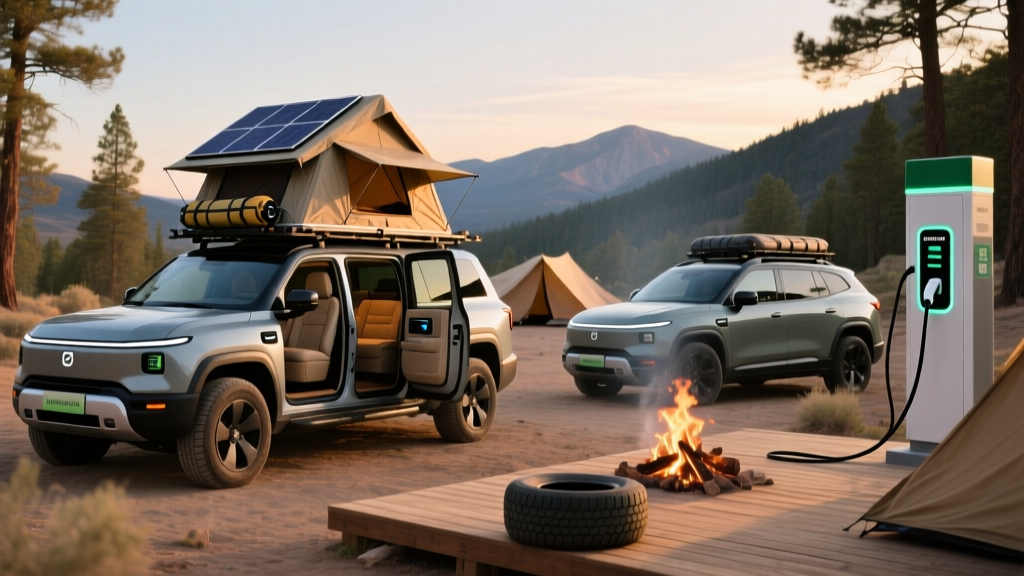
Yes — but with major caveats. The best EV camper platforms in 2026 are the Rivian R1T (EPA 328–420 mi, 109 cu ft gear tunnel), Ford F-150 Lightning Extended Range (EPA 320 mi, Pro Power Onboard for campsite electricity), and the Chevrolet Silverado EV 4WT (EPA 492 mi, 10.2 kW off-board power). Expect real-world highway range to drop 20–35% below EPA estimates when loaded with camping gear, roof-top tents, or trailers. If you tow a camper trailer, cut EPA range by 40–55%. Off-grid camping works well thanks to vehicle-to-load (V2L) power; remote backcountry camping with no charging infrastructure remains the primary limitation.
What Makes a Good EV Camper Platform?
Not every electric vehicle is suited for camping. A capable EV camper rig needs to satisfy five criteria simultaneously — and most mainstream EVs only hit two or three:
- Range under load: At least 250 miles of real-world range with 500–800 lbs of camping gear, passengers, and a roof-top tent (which adds ~150 lbs and significant drag).
- Off-board power (V2L/V2H): The ability to run camp lights, a portable fridge, induction cooktop, or laptop charger from the vehicle's battery — typically 1.5–10.2 kW output.
- Cargo and storage: Enclosed, weatherproof storage for gear. Trucks with gear tunnels or SUVs with flat-folding seats and 60+ cu ft cargo volume are ideal.
- Ground clearance and AWD: Minimum 8.5 inches of ground clearance for forest service roads; dual-motor AWD for traction on gravel and mud.
- Charging access near destinations: DC fast charging (150+ kW) within 30–50 miles of your campsite, or reliable Level 2 at campgrounds.
Top EV Camper Vehicles Compared (2026 Models)
| Spec | Rivian R1T (Dual Max) | Ford F-150 Lightning (Ext. Range) | Chevy Silverado EV (4WT) | Tesla Cybertruck (AWD) | Gas Baseline: Toyota Tacoma TRD |
|---|---|---|---|---|---|
| EPA Range | 420 mi | 320 mi | 492 mi | 340 mi | ~450 mi (18 gal tank) |
| Real-World Loaded Range* | ~310–340 mi | ~230–260 mi | ~370–400 mi | ~250–280 mi | ~350–380 mi |
| Battery (usable kWh) | 149 kWh (NMC) | 131 kWh (NMC) | 200 kWh (NMC) | 123 kWh (NMC) | N/A |
| Peak DC Fast Charge | 220 kW | 150 kW | 350 kW | 250 kW | N/A |
| 10–80% Charge Time | ~34 min | ~41 min | ~27 min | ~28 min | ~5 min (fill-up) |
| Off-Board Power (V2L) | Up to 6.6 kW | Up to 9.6 kW (Pro Power) | Up to 10.2 kW | Up to 11.5 kW (Powershare) | None (need generator) |
| Ground Clearance | 14.9 in (max) | 8.9 in | 10.4 in | 16.0 in (extract mode) | 9.4 in |
| Max Towing | 11,000 lbs | 10,000 lbs | 12,500 lbs | 11,000 lbs | 6,500 lbs |
| Base MSRP | $87,900 | $69,995 | $77,900 | $81,895 | $45,990 |
| §30D Tax Credit Eligible? | Yes (up to $7,500) | Yes (up to $7,500) | Yes (up to $7,500) | No (MSRP over $80K cap for trucks) | No (not a PEV) |
*Real-world loaded range assumes 600+ lbs payload, roof-top tent, 70 mph highway driving, 65°F. Cold weather (below 32°F) reduces these figures an additional 15–25%.
Towing a Camper Trailer With an EV: The Range Reality
This is where EV campers face their biggest limitation. Towing a travel trailer or teardrop camper with an electric truck is possible — but the range penalty is severe and non-negotiable physics.
A 3,000–5,000 lb camper trailer with a flat frontal area increases energy consumption by 50–80% compared to unloaded driving. Here's what that looks like in practice:
- F-150 Lightning towing 4,500 lb trailer: EPA 320 mi drops to ~140–170 mi real-world at highway speed. You'll need a DC fast charger every 100–120 miles on longer trips.
- Rivian R1T towing 4,000 lb trailer: EPA 420 mi drops to ~190–230 mi with the Max Pack battery.
- Silverado EV 4WT towing 5,000 lb trailer: EPA 492 mi drops to ~230–270 mi — the best towing range in the segment thanks to its massive 200 kWh battery.
For comparison, a gas Tacoma towing the same 4,500 lb trailer drops from ~22 MPG to ~12–14 MPG, giving roughly 215–250 miles per tank. The EV advantage here is slim or negative on range — but the EV wins on campsite power, instant torque for hill climbs, and zero tailpipe emissions at the campsite.
Practical rule: If you plan to tow a camper more than 150 miles one-way, verify that DC fast chargers (150+ kW) exist along your route and at or near your destination. Apps like fueleconomy.gov list vehicle efficiency data, but for charging-station routing, A Better Routeplanner (ABRP) and PlugShare are essential pre-trip tools.
Vehicle-to-Load (V2L): The EV Camper's Killer Feature
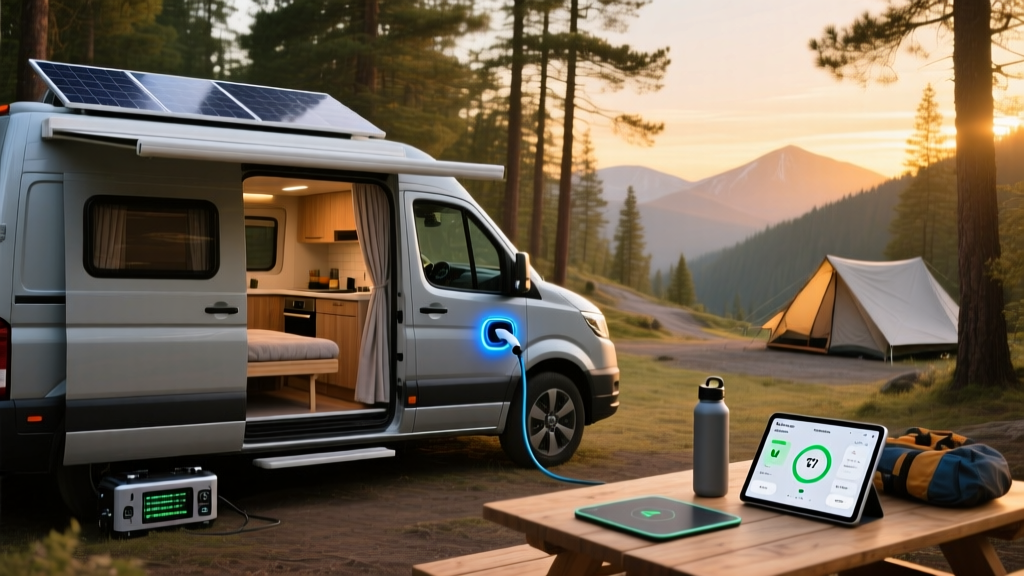
The single biggest advantage of an EV camper over a gas rig is off-board power. Instead of hauling a loud, smelly gasoline generator, you can run your entire campsite from the vehicle's battery pack.
| Factor | EV V2L (e.g., F-150 Lightning 9.6 kW) | Honda EU2200i Generator |
|---|---|---|
| Continuous Output | 9,600W | 1,800W (2,200W peak) |
| Noise Level | Silent | 48–57 dBA |
| Fuel / Energy Cost | ~$0.13/kWh (home charge) = ~$1.25 for 10 kWh campsite use | ~$1.10/hour (gasoline at $3.50/gal, ~0.25 gal/hr) |
| Runtime (typical campsite load ~1 kW) | 130+ hours from 131 kWh battery | 8–10 hours per tank (0.9 gal) |
| Emissions at Campsite | None | CO, NOx, CO2 |
| Upfront Cost | Included with vehicle (adapter may cost $50–200) | $1,100–$1,300 |
With 9.6 kW of output, the F-150 Lightning can simultaneously power a portable induction cooktop (1,800W), a 12V compressor fridge via inverter (80W), LED camp lights (50W), a laptop charger (90W), and an electric blanket (100W) — and still have 80%+ of the battery remaining for the drive home.
Critical caveat: Running V2L accessories drains the traction battery. Budget roughly 2–5 kWh per day for moderate campsite use (lights, fridge, cooking). That translates to 6–15 miles of lost driving range per day — negligible on most trips, but plan for it on extended off-grid stays.
Real Costs: EV Camper vs. Gas Camper Ownership
Let's compare the five-year ownership cost of an EV camper setup (F-150 Lightning Lariat Extended Range) versus a gas equivalent (Toyota Tacoma TRD Off-Road), assuming 15,000 miles/year, 8 camping trips/year, and home Level 2 charging availability.
| Category | F-150 Lightning Ext. Range ($69,995 MSRP) | Toyota Tacoma TRD Off-Road ($45,990 MSRP) |
|---|---|---|
| Purchase Price (after incentives) | ~$62,495 (est. $7,500 §30D credit) | $45,990 |
| Fuel / Electricity (5 yr, 75K mi) | ~$5,400 (home charging at $0.13/kWh, ~2.0 mi/kWh) | ~$10,125 (18 MPG avg at $3.50/gal) |
| Campsite Power Cost (5 yr) | ~$200 (incremental electricity for V2L use) | ~$2,750 (generator fuel, ~$55/trip × 50 trips) |
| Maintenance (5 yr) | ~$1,800 (no oil changes, fewer brake replacements) | ~$3,500 (oil changes, transmission fluid, more brake wear) |
| Insurance (5 yr est.) | ~$12,500 (EV premiums typically 15–25% higher) | ~$9,000 |
| Estimated Depreciation (5 yr) | ~$28,000 (40–45% — EV depreciation remains elevated) | ~$16,000 (35% — Tacoma holds value well) |
| Total 5-Year Cost | ~$110,395 | ~$87,365 |
| Cost Per Mile | ~$1.47/mi | ~$1.16/mi |
The EV camper costs roughly $23,000 more over five years, driven primarily by higher purchase price and steeper depreciation. Fuel and maintenance savings recover about $9,000 of that gap. The EV wins on campsite experience (silent power, no generator), instant torque, and lower daily operating cost — but it does not win on total cost of ownership in 2026.
Per IRS §30D guidelines, the federal tax credit of up to $7,500 requires meeting battery critical-mineral and component sourcing thresholds, income caps ($300K joint / $150K single), and MSRP limits ($80K for trucks). Always verify eligibility with a tax professional before purchase, as these rules are subject to legislative change.
Charging on the Road: The EV Camper's Biggest Planning Challenge
Home charging is straightforward — plug into a Level 2 (240V, 32–48 amp) wall connector overnight, and wake up to a full battery. The Ford F-150 Lightning charges at 11.5 kW on Level 2, adding roughly 30 miles per hour of charging, or a full charge in ~11 hours.
Road-trip camping is where planning becomes mandatory. Here's what charging looks like on a typical camping trip:
| Level | Power (kW) | Miles Added Per Hour | Use Case |
|---|---|---|---|
| Level 1 (120V household) | 1.2–1.6 kW | 3–5 mi/hr | Emergency trickle at a cabin; 5+ days for full charge |
| Level 2 (240V campground) | 7.2–11.5 kW | 20–35 mi/hr | Overnight at equipped campgrounds; full charge in 8–14 hrs |
| DC Fast Charge | 150–350 kW | 500–1,000+ mi/hr (peak) | Road-trip pit stops; 10–80% in 27–41 min |
The charging-curve reality: DC fast charging does not sustain peak speed for the entire session. A Silverado EV hitting 350 kW at 10% State of Charge will taper to ~150 kW by 50% SoC and ~50 kW by 80% SoC. That 10–80% time of ~27 minutes assumes ideal battery preconditioning and a 350 kW-capable station. On a 150 kW Electrify America or EVgo station, expect 10–80% in 45–55 minutes.
Cold-weather charging: Below 32°F, battery chemistry slows ion transfer, and charging speeds can drop 30–50% unless the vehicle actively preconditions the battery. The Rivian R1T and Tesla Cybertruck precondition automatically when you navigate to a charger; always enable this feature before arriving at a DC station in winter.
Common EV Camper Myths — Fact-Checked
| Myth | Fact |
|---|---|
| "You can't camp off-grid with an EV." | You can — V2L provides days of silent campsite power. The limitation is driving range to reach remote sites without charging infrastructure. Plan routes within 100–150 mi of a DC charger, or choose campgrounds with Level 2 hookups. |
| "EV batteries will die if you use them to power your campsite." | Campsite V2L use of 2–5 kWh/day represents 1.5–3.8% of a 131 kWh battery. Battery degradation is driven primarily by charge cycles, heat, and sustained high SoC — not low-power accessory use. Over 5 years, expect ~8–12% total battery degradation per NHTSA-monitored fleet data. |
| "You can't tow with an EV." | EV trucks have higher tow ratings than most gas midsize trucks. The problem isn't capability — it's range. Towing cuts range 40–55%. That's manageable for 80–120 mi trips to a campground, but impractical for 300+ mi hauls without multiple fast-charge stops. |
| "EVs are worse in the cold for camping." | Cold reduces range 15–30% and slows charging. But EVs can run electric heaters and heated seats without idling an engine, producing no CO risk in enclosed spaces (unlike gas generators or idling vehicles). A heat pump-equipped EV (standard on Rivian, available on Lightning) is actually safer for overnight warmth. |
| "The §30D tax credit makes EV campers cheaper than gas." | Even with $7,500 in federal credit, the F-150 Lightning ($69,995) costs ~$16,500 more than a Tacoma TRD ($45,990). The credit narrows the gap but doesn't close it. Factor in 5-year fuel/maintenance savings (~$9,000) and the gap shrinks further — but the EV still costs more overall in 2026. |
Decision Framework: Should Your Next Camper Rig Be Electric?
Choose an EV Camper If:
- You have home Level 2 charging (240V, 40+ amp circuit) and can start every trip with a full battery.
- Your typical camping trips are under 200 miles one-way, or you're willing to plan DC fast-charge stops.
- You value silent, emission-free campsite power and want to eliminate a portable generator.
- You primarily car-camp (gear in the truck bed or SUV cargo area) rather than tow a large travel trailer long distances.
- You're willing to accept a higher purchase price in exchange for lower daily operating costs, better on-trail torque, and a superior campsite power experience.
Stick With Gas (or Consider a PHEV) If:
- You regularly tow a camper trailer over 200 miles one-way through areas with sparse charging infrastructure.
- You camp at remote backcountry sites more than 150 miles from the nearest DC fast charger.
- Your camping budget is under $50,000 and you need a single-vehicle solution.
- You lack access to home charging (no garage, apartment living, no electrical panel capacity for a 240V circuit).
- Depreciation risk concerns you — EV resale values remain more volatile than proven gas trucks like the Tacoma.
Frequently Asked Questions
Can I sleep inside an EV camper with the climate control running overnight?
Yes, and this is a major advantage over gas vehicles. An EV can run its heat pump or A/C compressor all night using roughly 3–8 kWh (depending on outside temperature). That's 9–25 miles of range consumed over 8 hours — with zero carbon monoxide risk. The Rivian R1T and F-150 Lightning both support "camp mode" or equivalent climate-control settings that maintain cabin temperature without the vehicle "idling."
Do campgrounds have EV charging?
A growing but still limited number. As of 2026, some state and national park campgrounds have installed Level 2 (240V) EV charging pedestals — but availability is sparse. KOA has been rolling out EV chargers at select locations. Always check PlugShare or the specific campground's website before booking. Many campgrounds offer 30A or 50A RV electrical hookups; with the right adapter (NEMA 14-50 to J1772), you can charge at up to 7.2–11.5 kW from an RV pedestal — but confirm with the campground first, as not all allow EV use on RV hookups.
How much does it cost to install a Level 2 charger at home for my EV camper?
Expect $800–$2,500 for a quality Level 2 wall connector (48 amp, hardwired) plus professional installation if your electrical panel is near the garage and has capacity. If you need a panel upgrade (200A service), add $1,500–$3,500. A NEMA 14-50 outlet installation is a lower-cost alternative at $500–$1,200, enabling portable charger use. Always hire a licensed electrician and pull a permit — improper EV charger installation is a fire risk and may void home insurance coverage.
What's the best EV camper for boondocking (off-grid camping)?
The Rivian R1T with the Max Pack (420 mi EPA, 14.9 in ground clearance, 6.6 kW V2L) is the most capable off-grid EV camper in 2026 thanks to its combination of range, air-suspension ground clearance, and the 11-cu-ft gear tunnel for enclosed gear storage. The Ford F-150 Lightning is a close second if campsite power output is your priority (9.6 kW Pro Power Onboard). For pure range to reach remote sites, the Silverado EV 4WT's 492-mile EPA rating is unmatched — but its 10.4-inch ground clearance is less suited to rough forest roads.
Will using my EV for camping void the battery warranty?
No. Using V2L off-board power and camping accessories falls within normal vehicle use. Battery warranties (typically 8 years / 100,000 miles for Rivian, Ford, and GM) cover defects and capacity degradation below a threshold (usually 70% of original capacity). Camping use will not trigger a warranty denial. However, aftermarket modifications — such as cutting into the high-voltage system or using non-approved V2L adapters — could void coverage.