The Short Answer: EV + RV Towing in 2026
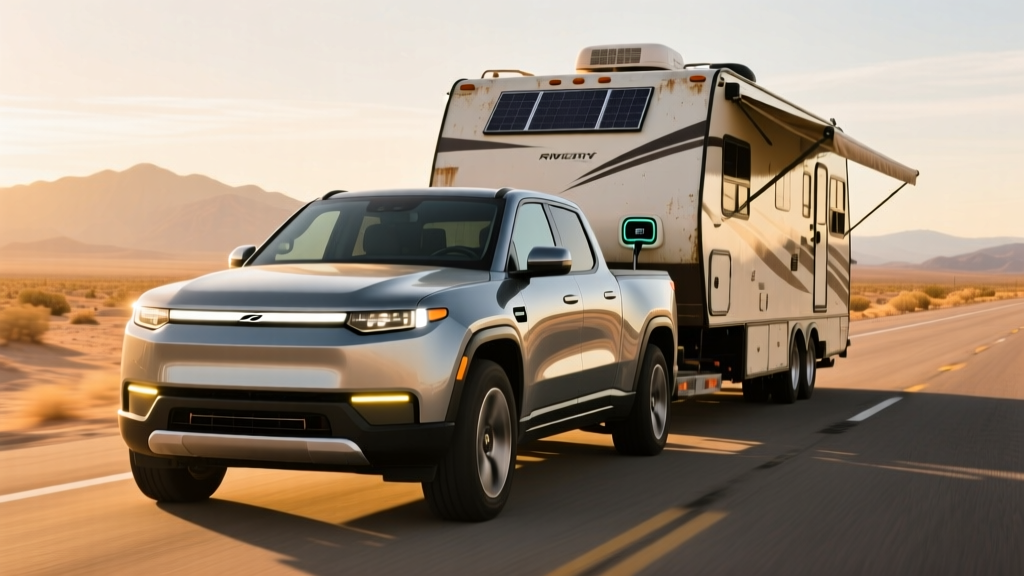
Yes, you can tow an RV with an electric vehicle — but expect your EPA-rated range to drop by 40–55% when pulling a loaded travel trailer. A Ford F-150 Lightning rated at 320 miles unladen will realistically deliver 140–180 miles towing a 5,000-lb camper at highway speeds. That means DC fast-charging stops every 90–120 minutes on long trips. If your camping is mostly within 150 miles of home and you can charge at your campsite or at a Level 2 at the RV park, an EV tow rig works well. For cross-country towing through charging deserts (western Nebraska, rural Nevada), a diesel or gas truck remains the more practical choice in 2026.
Why Towing Crushes EV Range (The Physics)
Electric vehicles are extraordinarily capable tow rigs — instant torque, no transmission hunting, stable low-speed control — but aerodynamics and rolling resistance don't care about your powertrain. At 65 mph, a boxy travel trailer roughly doubles the aerodynamic drag of your truck. Energy consumption that sits at 2.0–2.5 kWh/mile unloaded can spike to 3.8–5.0 kWh/mile under load.
Here's what that looks like with real battery math. Take the 2026 Ford F-150 Lightning Extended Range with its 131 kWh usable lithium-ion NMC pack:
- Unloaded highway (70 mph): ~2.2 kWh/mile → ~295 real-world miles
- Towing 5,000-lb travel trailer (65 mph): ~4.2 kWh/mile → ~155 real-world miles
- Towing 7,500-lb trailer in headwind/hills: ~5.0 kWh/mile → ~130 real-world miles
Cold weather compounds this further. Below 40°F, expect an additional 10–15% range loss on top of the towing penalty, as the battery management system diverts energy to thermal conditioning and cabin heat (though the Lightning's heat pump helps mitigate this compared to resistive heaters).
2026 EV Trucks Ranked for RV Towing
| Vehicle | Max Tow (lbs) | Battery (kWh) | EPA Range | Est. Towing Range* | Peak DC Charge | 10–80% Time | Base MSRP |
|---|---|---|---|---|---|---|---|
| Chevrolet Silverado EV 4WT (Max Tow) | 12,500 | 200+ | 440 mi | 200–240 mi | 350 kW | ~20 min | $72,900 |
| Rivian R1T Dual Max | 11,000 | 141 | 410 mi | 180–220 mi | 220 kW | ~22 min | $87,600 |
| Ford F-150 Lightning Ext. Range | 10,000 | 131 | 320 mi | 140–180 mi | 150 kW | ~38 min | $69,995 |
| GMC Sierra EV Denali Edition 1 | 12,000 | 200+ | 440 mi | 200–240 mi | 350 kW | ~20 min | $99,495 |
| Tesla Cybertruck AWD | 11,000 | 123 | 340 mi | 150–185 mi | 250 kW | ~25 min | $79,990 |
*Estimated towing range assumes a 5,000-lb loaded travel trailer at 65 mph in moderate temperatures. Real results vary with trailer frontal area, terrain, wind, and driving style. Source: fueleconomy.gov EPA ratings; towing estimates from owner-reported data and third-party testing.
The Chevrolet Silverado EV and GMC Sierra EV stand apart in 2026 thanks to GM's massive Ultium battery packs (over 200 kWh) and 350 kW DC fast-charging capability on 800V architecture. That combination means more miles between stops and shorter stops when you do plug in — the single biggest advantage for towing.
The F-150 Lightning, while proven and widely available, is hampered by its 150 kW peak charge rate and 400V architecture. On a road trip towing, you'll spend noticeably more time at chargers. Ford's Pro Power Onboard (up to 9.6 kW of 240V output) is a genuine campsite advantage, however — enough to power a travel trailer's AC, lights, and appliances without a generator.
EV vs Gas Truck: The Real Cost of Towing an RV
| Cost Factor | 2026 F-150 Lightning Ext. Range | 2026 F-150 3.5L EcoBoost (Gas) |
|---|---|---|
| Base MSRP (comparable tow trim) | $69,995 | $58,400 |
| Federal §30D Tax Credit (if eligible) | Up to $7,500 | $0 |
| Effective Purchase Price | ~$62,495 | $58,400 |
| Fuel/Energy Cost per Mile (towing) | $0.16–$0.28/mi | $0.38–$0.52/mi |
| Annual Fuel/Energy (3,000 tow-miles) | $480–$840 | $1,140–$1,560 |
| Annual Maintenance (est.) | $300–$450 | $600–$900 |
| 5-Year Total Fuel + Maintenance (towing use) | $3,900–$6,450 | $8,700–$12,300 |
The energy cost range above reflects the wide spread in DC fast-charging pricing in 2026. Home Level 2 charging at the national average of $0.16/kWh yields the low end; Electrify America and EVgo stations averaging $0.40–$0.55/kWh push costs higher. If you tow exclusively on road trips and rely entirely on public DC fast charging, your per-mile energy cost roughly doubles compared to home charging.
Even at public charging rates, the EV tow rig saves $300–$700 per year in energy costs over gas for 3,000 towing miles. Factor in zero oil changes, no transmission fluid, and fewer brake replacements (regenerative braking saves the friction brakes), and the 5-year operating savings typically reach $4,000–$6,000 — partially offsetting the higher purchase price.
Per IRS §30D rules, the $7,500 federal tax credit for the Lightning requires meeting battery critical-mineral and component sourcing thresholds, buyer income caps ($150K single / $300K joint), and MSRP limits ($80K for trucks). The credit can now be transferred at the point of sale as a down-payment reduction. Always confirm current-year eligibility with your dealer and a tax professional, as sourcing requirements tighten annually.
Charging an EV While Towing: The Logistics Nobody Talks About
This is where most EV-and-RV planning falls apart. The practical challenges go beyond range numbers:
Pull-through charging is rare. Most DC fast-charging stations are designed for passenger cars in pull-in/pull-out spots. Arriving with a 25-foot travel trailer in tow means either unhitching in a parking lot (time-consuming and sometimes unsafe) or finding a station with pull-through truck lanes. As of 2026, Electrify America, Tesla Superchargers, and Love's Travel Stops have begun adding pull-through stalls at select highway locations, but coverage is inconsistent — particularly in the Mountain West and rural South.
Charging time adds up. With the Lightning's ~150 kW peak and a towing-depleted battery, expect 10–80% charges to take 35–40 minutes. On a 600-mile tow day, that's three charging stops totaling roughly two hours of stationary time. The Silverado EV's 350 kW capability cuts each stop to ~20 minutes, a meaningful difference.
Campsite charging is your secret weapon. Many RV parks now offer 50-amp (12 kW) or 30-amp (7.2 kW) NEMA 14-50 or TT-30 outlets. Plugging in your EV overnight at your campsite using a mobile connector delivers 30–50 miles of range per hour of Level 2 charging — easily enough to replenish a full day's towing by morning. Before booking, call the RV park and confirm EV-friendly outlet access; not all parks allow it, and some charge an additional electric fee.
What First-Time EV + RV Buyers Must Know
| Common Misconception | The Reality (with Data) |
|---|---|
| "EVs can't tow heavy trailers." | The Silverado EV tows 12,500 lbs; the Cybertruck tows 11,000 lbs. Torque is not the issue — range is. |
| "You'll be stranded in the middle of nowhere." | True in some corridors (US-50 in Nevada, I-10 through West Texas). Plan routes using A Better Route Planner with trailer parameters. Avoid routes where chargers are 100+ miles apart. |
| "Towing will destroy the battery." | High-discharge towing generates heat, but modern liquid-cooled packs manage this well. Battery degradation from occasional towing is minimal. GM, Ford, and Rivian all warranty their packs for 8 years / 100,000+ miles at 70%+ capacity retention. |
| "All charging networks work with trailers." | Many urban chargers are inaccessible with a trailer. Prioritize networks adding pull-through stalls: Love's, select Tesla Superchargers, and newer Electrify America highway sites. |
| "EVs are heavier, so they'll wear out faster towing." | EV trucks are indeed heavier (the Lightning weighs ~6,500 lbs), which increases tire wear. Budget for tire replacement every 25,000–35,000 miles under towing use. However, regenerative braking dramatically reduces brake pad wear. |
Hitch and Payload Considerations
EV trucks carry heavy battery packs, which reduces available payload capacity compared to a gas truck of the same GVWR. The F-150 Lightning's payload ranges from 1,800 to 2,235 lbs depending on trim. A travel trailer with 800 lbs of tongue weight plus passengers, gear, and a bed cap can approach or exceed that limit. Always weigh your loaded rig at a CAT scale before hitting the road, and ensure tongue weight stays within the hitch rating.
Decision Framework: Should You Tow Your RV with an EV?
Choose an EV Tow Rig If:
- Your typical towing trips are under 200 miles one-way, or you're comfortable with 1–2 DC fast-charge stops on longer trips
- You have home Level 2 charging (240V, 40–80 amp) to leave every trip at 100%
- You camp at RV parks with 50-amp or 30-amp electrical hookups for overnight charging
- You value the silent, vibration-free towing experience and onboard power (Pro Power Onboard, Rivian's camp kitchen features) for off-grid camping
- You tow fewer than 5,000 miles per year, where the per-mile energy savings justify the upfront premium over 5+ years
- You live in a state with low electricity rates (under $0.14/kWh) and access to affordable public DC charging networks
Stick with a Gas/Diesel Truck If:
- You regularly tow over 300 miles through rural areas with sparse charging infrastructure
- You tow over 8,000-lb fifth wheels or large travel trailers where the range penalty becomes untenable (under 120 miles between stops)
- You cannot install a Level 2 home charger (apartment, street parking, older electrical panel without upgrade budget)
- You boondock frequently in remote areas with zero charging infrastructure and need the range security of a 30-gallon fuel tank (350+ towing miles)
- Your towing budget is under $55,000 total — no current EV truck reaches that price point even with the tax credit
The PHEV Middle Ground
If you want some electric benefit without the range anxiety, consider that no heavy-duty PHEV trucks exist in the US market as of 2026. However, if your RV is a small pop-up or teardrop under 3,000 lbs, a PHEV SUV like the Jeep Wrangler 4xe (3,500-lb tow rating, 22 miles electric-only) can handle light towing with a gas safety net for longer hauls.
Real-World Ownership: What 2025–2026 EV Truck Owners Report
Based on aggregated owner reports from F-150 Lightning and Rivian R1T forums and EV towing communities, here's what actual EV-and-RV owners experience:
- Typical towing efficiency: 2.0–2.8 miles/kWh with a mid-size travel trailer (4,000–6,000 lbs) at 60–65 mph
- Real-world towing range satisfaction: Owners who planned routes around 100-mile segments between chargers report high satisfaction; those who attempted 200+ mile stretches without backup plans report stress and near-depletion events
- Winter towing: Expect 25–35% less range than summer towing at temperatures below 30°F. Battery preconditioning (available on all major EV trucks) helps recover some charging speed but doesn't fully offset the cold-weather energy penalty
- Tire costs: Owners report replacing OEM all-terrain tires at 25,000–30,000 miles under regular towing use — budget $1,200–$1,800 for a set of LT-rated replacements
- Campsite charging satisfaction: Universally praised. Owners who charge overnight at RV parks describe it as "the best part of EV towing" — waking up to a full battery with no detours
Frequently Asked Questions
Can I tow a fifth wheel with an EV truck?
The Silverado EV and GMC Sierra EV support fifth-wheel/gooseneck towing with proper equipment, rated up to 12,500 lbs. However, fifth wheels tend to be heavier (7,000–10,000+ lbs loaded), which pushes towing range toward the 120–160 mile range. Plan charging stops accordingly and verify payload capacity — fifth-wheel pin weight can consume 1,500–2,000 lbs of payload.
Will towing void my EV battery warranty?
No. All major manufacturers (Ford, GM, Rivian, Tesla) permit towing within the published ratings and do not exclude towing-related use from battery warranty coverage. The standard warranty is 8 years / 100,000 miles (or 150,000 for some commercial trims) with a minimum 70% capacity retention threshold per Ford's published terms and equivalent manufacturer documentation.
Do I need a special charger at home for towing?
You need a robust Level 2 setup. A 240V / 60-amp circuit with a 48-amp charger (like the Ford Charge Station Pro or Wall Connector) delivers roughly 15–20 miles of range per hour — enough to fully recharge an overnight session after a day of towing. Expect $800–$2,500 for a professional Level 2 installation depending on your electrical panel's capacity. Homes with 100-amp service may need a $2,000–$4,000 panel upgrade to 200 amps to safely support both EV charging and household loads.
Which charging networks are best for towing an RV?
In 2026, the best networks for trailer-towing EV owners are: Tesla Superchargers (via NACS, now open to non-Tesla vehicles — some locations have pull-through stalls), Love's Travel Stops (partnering with Electrify America for truck-friendly layouts), and Pilot/Flying J stations adding DC fast chargers with pull-through access. Always check PlugShare or your vehicle's native navigation for real-time stall availability and pull-through compatibility before committing to a route.
Is a diesel truck still better for heavy RV towing?
For trailers over 8,000 lbs and cross-country trips, yes — in 2026, a diesel Super Duty (Ford F-250/F-350, Ram 2500/3500) still offers 400+ miles of towing range, 15,000–22,000-lb capacity, and fuel availability in every rural town. The EV advantage lies in operating cost, ride quality, campsite power, and zero tailpipe emissions at your campsite. Match the truck to your specific towing profile rather than choosing on ideology.