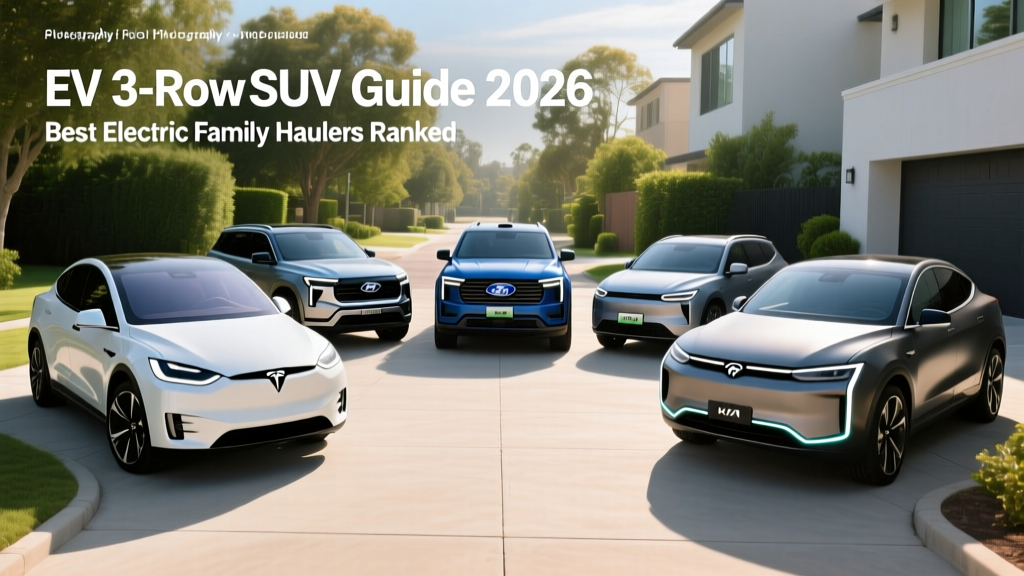
Quick Answer: Best 3-Row EV SUVs in 2026
If you need three rows of seating in an electric SUV, your top choices in 2026 are the Kia EV9 (best value from ~$55,000, 270-mile EPA range), the Rivian R1S (best range and off-road capability, ~$75,000, 340-mile EPA range), and the Tesla Model X (best Supercharger access, ~$80,000, 335-mile EPA range). The Hyundai Ioniq 9 and Cadillac Vistiq round out the competitive set. All seat six or seven, offer DC fast charging above 150 kW, and qualify for varying levels of federal tax credit depending on trim, sourcing, and buyer income.
Why 3-Row EV SUVs Are the Hottest Segment Right Now
Three-row electric SUVs occupy a rare sweet spot: they combine the passenger and cargo utility families need with the operating-cost advantages of battery-electric powertrains. Until recently, buyers wanting three rows had to choose between a minivan, a gas-powered SUV like the Toyota Highlander, or the six-figure Tesla Model X. The 2024–2026 wave of more affordable entries — led by the Kia EV9, Hyundai Ioniq 9, and Cadillac Vistiq — has changed the calculus.
The core appeal is straightforward. Electric motors deliver instant torque for confident highway merging with a full load of passengers and cargo. Regenerative braking simplifies stop-and-go school runs. And fueling cost per mile is typically one-third to one-half that of a comparable gas SUV, depending on local electricity rates. The trade-offs are real too: higher purchase prices (partially offset by incentives), dependence on charging access, and reduced range in cold weather or sustained highway driving.
The 2026 Three-Row EV Contenders: Spec-by-Spec
| Model | Battery (kWh) | EPA Range | Peak DC Charge (kW) | 10–80% Time | 0–60 mph | Starting MSRP |
|---|---|---|---|---|---|---|
| Kia EV9 (LR RWD) | 100.0 (NMC) | 304 mi | 236 kW | ~20 min | 8.2 sec | $54,900 |
| Kia EV9 (LR AWD) | 100.0 (NMC) | 270 mi | 236 kW | ~20 min | 5.0 sec | $59,900 |
| Hyundai Ioniq 9 (LR AWD) | 110.3 (NMC) | ~310 mi | ~240 kW | ~20 min | ~5.5 sec | $56,500 |
| Rivian R1S (Dual Max) | 149.0 (NMC) | 410 mi | ~200 kW | ~30 min | 3.5 sec | $79,900 |
| Cadillac Vistiq (AWD) | 102.0 (NMC) | ~300 mi | ~190 kW | ~25 min | ~5.5 sec | $58,000 |
| Tesla Model X (LR) | 100.0 (NMC) | 335 mi | 250 kW | ~18 min | 3.8 sec | $79,990 |
Sources: EPA fueleconomy.gov, manufacturer press sites. Ioniq 9 and Vistiq figures are preliminary estimates based on announced specifications.
Real-World Range Reality Check
EPA range numbers assume a mix of city and highway driving at moderate temperatures. Expect 10–20% less range on sustained 75+ mph highway trips, and 20–35% less in freezing temperatures (below 32°F), even with heat-pump preconditioning. The Kia EV9 LR RWD's 304-mile EPA sticker realistically translates to 250–270 miles on a summer road trip and 200–230 miles in a Minnesota winter. Plan charging stops accordingly.
EV vs. Gas 3-Row SUV: The Cost Comparison
The most common question from families eyeing an EV 3-row SUV is whether the higher sticker price pays for itself. Let's compare the Kia EV9 LR AWD against the Toyota Grand Highlander Hybrid — one of the most efficient gas-hybrid three-row SUVs on the market.
| Cost Factor | Kia EV9 LR AWD | Toyota Grand Highlander Hybrid |
|---|---|---|
| Base MSRP | $59,900 | $46,620 |
| Federal Tax Credit (§30D, if eligible) | Up to $7,500* | $0 (hybrid, not eligible) |
| Effective Purchase Price | ~$52,400 | $46,620 |
| Fuel/Energy Cost (15,000 mi/yr) | ~$720/yr** | ~$1,875/yr |
| Annual Maintenance | ~$300 | ~$650 |
| 5-Year Fuel + Maintenance | ~$5,100 | ~$12,625 |
| Estimated Insurance (avg/yr) | ~$2,200 | ~$1,700 |
| 5-Year Insurance | ~$11,000 | ~$8,500 |
*§30D eligibility depends on MSRP cap, buyer income, and battery component/critical-mineral sourcing per current IRS rules. Verify before purchasing.
**Based on national average residential electricity rate of ~$0.17/kWh and EV9 efficiency of ~2.8 mi/kWh. Actual costs vary by utility and charging mix.
The EV9 saves roughly $7,500 in fuel and maintenance over five years. However, insurance premiums run about $500/year higher for the EV, eating back ~$2,500 of that. Net five-year operating savings: approximately $5,000. The remaining purchase-price gap (about $5,800 after the tax credit) means you roughly break even at the five-year mark — and pull ahead in years six through ten, when the EV's simpler powertrain continues to require less maintenance.
Real-World Ownership: What First-Time EV Buyers Must Know
Home Charging Is Non-Negotiable for Most Families
For a three-row family hauler used daily, Level 2 home charging is essential. A Level 2 charger (240V, typically 32–48 amps) adds 20–30 miles of range per hour and fully replenishes a 100 kWh battery overnight in 8–10 hours. Without home charging, you'll rely on public DC fast chargers or workplace charging, which adds time, cost, and unpredictability to a family routine.
| Item | Typical Cost Range |
|---|---|
| Level 2 charger (48A hardwired, e.g., ChargePoint Home Flex, Wallbox Pulsar Plus) | $400–$700 |
| Electrician labor (run 240V/60A circuit from panel to garage) | $800–$2,500 |
| Electrical panel upgrade (if needed, 100A → 200A) | $1,500–$4,000 |
| Permits and inspection | $100–$400 |
| Total (no panel upgrade) | $1,300–$3,600 |
| Total (with panel upgrade) | $2,800–$7,600 |
Always hire a licensed electrician for a site assessment before purchasing equipment. Your panel's available amperage determines whether a simple circuit addition suffices or a full upgrade is required.
Cold Weather and Range Loss
Battery chemistry matters in cold climates. All current 3-row EVs use NMC (nickel manganese cobalt) batteries, which lose capacity in freezing temperatures. Expect 20–35% range reduction when temperatures drop below 32°F, with the worst losses occurring on short trips where the cabin and battery must heat from cold each time. Preconditioning while plugged in mitigates this significantly — the car warms the battery using grid power rather than consuming stored energy.
Every EV listed above includes a heat pump (or offers one as standard), which improves cabin heating efficiency by 30–50% compared to resistive heating. If you live north of the 40th parallel, a heat pump is not optional — it's a requirement.
Charging on Road Trips
DC fast charging speeds vary by model and by network. The Kia EV9 and Hyundai Ioniq 9 use 800V architectures that enable peak charge rates above 230 kW, meaning a 10–80% session takes roughly 20 minutes at a capable 350 kW station. The Rivian R1S, with its larger 149 kWh battery, takes longer in absolute time but gains more range per minute of charging due to its higher efficiency.
Network access matters as much as vehicle capability. Tesla Model X owners benefit from the most mature Supercharger network in North America, though the network has opened to NACS-equipped non-Tesla vehicles (Kia, Hyundai, Ford, Rivian with adapter) as of 2025–2026. Check fueleconomy.gov and manufacturer resources for the latest connector and network compatibility.
Federal Tax Credit Eligibility: The §30D Rules for 2026
The federal clean vehicle credit under IRS §30D can reduce your tax burden by up to $7,500 — but eligibility is anything but automatic. Here's the checklist:
- MSRP cap: SUVs/vans/pickups must have an MSRP at or below $80,000. All models in this guide qualify at base trim; some Rivian R1S and Tesla Model X configurations exceed the cap.
- Buyer income limits: Modified AGI must not exceed $150,000 (single), $225,000 (head of household), or $300,000 (joint).
- Battery sourcing: Required percentages of critical minerals and battery components must be sourced from the US or free-trade-agreement countries. These thresholds increase annually. As of 2026, the Kia EV9 (built in Georgia since late 2024) and Hyundai Ioniq 9 (also US-built) meet the full $7,500 threshold for eligible buyers.
- Point-of-sale transfer: You can transfer the credit to the dealer at purchase, reducing the vehicle price upfront rather than waiting for a tax refund.
- FEOC restriction: Vehicles with battery components from a "foreign entity of concern" (primarily Chinese supply chain) are disqualified. Verify current status with your dealer.
Consult a tax professional and the IRS §30D page for your specific situation. Rules and eligible-vehicle lists are updated periodically.
Decision Framework: Which 3-Row EV Is Right for You?
Choose Based on Your Priority
Choose the Kia EV9 if you want the best value, strong DC fast charging (236 kW peak), US-built quality, and full federal tax credit eligibility. The LR RWD trim at $54,900 is the segment's sweet spot for suburban families who charge at home and take occasional road trips.
Choose the Hyundai Ioniq 9 if you prioritize maximum range and the latest Hyundai motor/charging tech, and you want a slightly more refined interior than the EV9. The 110.3 kWh battery gives it an edge in real-world highway range.
Choose the Rivian R1S if you need genuine off-road capability, maximum range (410 miles EPA with Max Pack), and don't mind paying $75,000+. It's the only 3-row EV that can credibly handle a weekend trail and a Monday school run.
Choose the Tesla Model X if Supercharger network reliability is your top priority, you value the fastest acceleration (3.8 sec 0–60 in Long Range), and you can absorb the higher MSRP. Watch the $80,000 MSRP cap carefully on higher trims.
Choose the Cadillac Vistiq if you want a luxury-badged 3-row EV at a near-mainstream price (~$58,000), and you prioritize a quiet, comfortable ride over sporty handling.
Stick with a hybrid (Grand Highlander Hybrid, Mazda CX-90 PHEV) if you cannot install a home charger, regularly drive 400+ miles between charging stops, or live in an area with unreliable public charging infrastructure. Hybrids eliminate range anxiety at the cost of higher fuel bills.
Common Misconceptions About 3-Row EVs
| Myth | Fact |
|---|---|
| "EVs can't tow." | The Rivian R1S tows up to 7,700 lbs; the Kia EV9 tows 5,000 lbs (AWD). Expect 40–50% range reduction while towing — plan charging stops accordingly. |
| "Batteries need replacement every 5 years." | All models here carry 8-year/100,000-mile battery warranties (10 years/100,000 miles for Kia/Hyundai). Real-world data shows modern NMC packs retain 85–92% capacity at 100,000 miles under normal use. |
| "Charging takes too long for family trips." | A 10–80% DC fast charge takes 18–30 minutes at a capable station — roughly a meal-and-restroom stop. Plan 2–3 stops on a 600-mile drive, similar to a gas car. |
| "Third rows in EVs are useless." | The EV9, Ioniq 9, R1S, and Model X all accommodate adults in the third row for short trips. The R1S and EV9 offer the most usable third-row legroom (31–32 inches). Cargo space behind the third row is tight across the segment (12–20 cu ft) — roof boxes help on long trips. |
| "You'll save a fortune on fuel." | Savings are real but modest: roughly $1,100–$1,500/year vs. a comparable gas SUV, depending on local electricity rates and driving patterns. The bigger financial advantage is lower maintenance and the potential $7,500 tax credit. |
Frequently Asked Questions
Can I charge a 3-row EV on a standard 120V outlet?
Yes, but slowly. Level 1 (120V) charging delivers roughly 1.4 kW, adding 3–5 miles of range per hour. For a 100 kWh battery, a full charge from empty takes 60–70 hours. This is fine for overnight top-offs if your daily driving is under 30 miles, but it's not a practical primary charging strategy for a family vehicle.
How long do EV batteries last in a 3-row SUV?
Modern NMC batteries in these vehicles are engineered for 200,000+ miles of use with acceptable degradation (retaining 70–80% of original capacity). All manufacturers warranty the battery for at least 8 years/100,000 miles, with Kia and Hyundai extending to 10 years/100,000 miles. Avoid routinely charging to 100% or letting the battery sit at 0% for extended periods to maximize longevity.
Is a 3-row EV practical without home charging?
It's possible but significantly less convenient. You'll depend on public DC fast chargers or workplace Level 2 stations, adding 30–60 minutes of charging time several times per week. Public charging also costs 2–3× more per kWh than home electricity. If you live in an apartment or lack garage access, consider a PHEV like the Mazda CX-90 PHEV (26 miles electric-only, 25 MPG combined on gas) as a bridge solution.
Which 3-row EV has the lowest total cost of ownership?
Based on current pricing, the Kia EV9 LR RWD at $54,900 with the full $7,500 federal credit (effective price ~$47,400) offers the lowest 5-year total cost of ownership in the segment, factoring in fuel savings, maintenance, and depreciation. Rivian and Tesla carry higher depreciation risk due to premium pricing, though the Model X's Supercharger network access provides intangible value for frequent travelers.
Do 3-row EVs qualify for the full $7,500 tax credit?
It depends on the specific model, trim, manufacturing location, battery sourcing, and your income. As of 2026, the Kia EV9 and Hyundai Ioniq 9 (both built in Georgia) meet the full $7,500 threshold for eligible buyers. The Rivian R1S (built in Illinois) also qualifies at the full amount for eligible trims under the $80,000 MSRP cap. The Tesla Model X qualifies on base trims under the cap. Always verify current eligibility on the IRS clean vehicle credit page before committing to a purchase.