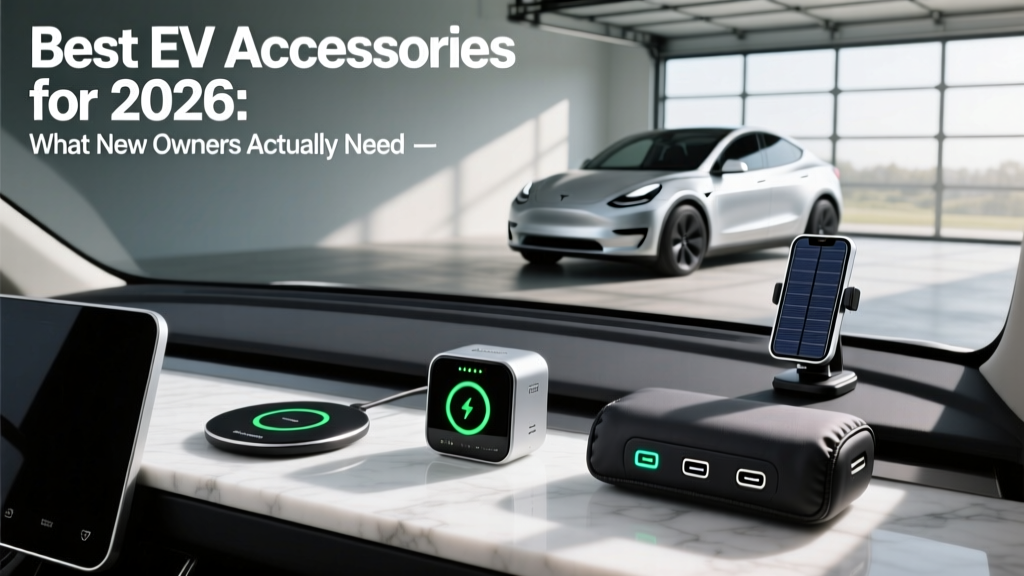
The first 90 days of EV ownership reveal which accessories actually matter. Based on real-world use across multiple BEV platforms, here's the short answer: you need a J1772-to-NACS adapter (if your car uses the Tesla-style port, ~$180-$250), a quality Level 2 home charger ($350-$650), a tire inflator/sealant kit ($40-$80), and an EVSE extension cord rated for your amperage if your outlet is more than 10 feet from your parking spot ($120-$250). Everything else is optional. This guide breaks down the exact EV accessories worth buying, the ones that are overhyped, and how each impacts your ownership costs.
EV Accessories vs. Gas Car Gear: What Changes When You Go Electric
The transition from gas to electric eliminates entire categories of accessories (jumper cables for 12V batteries, fuel cans, oil-filter wrenches) while creating new ones. Understanding this shift prevents wasted spending.
| Category | Gas Car Essential | EV Equivalent | Cost Difference |
|---|---|---|---|
| Roadside emergency | Gas can ($25), jumper cables ($40) | Tire inflator ($50), 12V lithium booster ($80) | +$65 |
| "Refueling" hardware | None (gas stations provide pumps) | Level 2 EVSE ($350-$650), adapters ($180-$250) | +$530-$900 |
| Maintenance tools | Oil drain pan, filter wrench, spark plug socket | Cabin air filter ($20-$40) — minimal tooling | -$80 to -$150 |
| Portable energy | None | V2L adapter for camping/emergency ($200-$400) | +$200-$400 |
| Winter prep | Block heater ($50-$100) | Preconditioning (built-in, $0 extra) | -$50 to -$100 |
The net result: expect to spend $500-$1,200 on EV accessories in your first year, offset partially by eliminating gas-car maintenance tools. The biggest line item is charging hardware — an expense gas car owners never face.
The Must-Have EV Accessories (With Real Costs and Specs)
1. J1772-to-NACS Adapter (or CCS-to-NACS)
As of 2026, the North American Charging Standard (NACS) dominates new vehicles from Ford, GM, Rivian, Hyundai, and others. But public infrastructure still includes thousands of J1772 (Level 2) and CCS1 (DC fast) connectors. Without an adapter, you're locked out of ChargePoint, EVgo, and Electrify America stations that haven't retrofitted NACS cables.
- Cost: $180-$250 for J1772-to-NACS (Level 2); $250-$400 for CCS-to-NACS (DC fast)
- Specs to check: Amperage rating (48A minimum for Level 2), IP67 water resistance, UL listing
- Real-world note: Some adapters reduce peak DC charge rate by 5-10% due to added resistance. On a 250 kW session, expect ~230 kW peak through an adapter.
2. Level 2 Home Charger (EVSE)
The single most impactful accessory. A 48-amp Level 2 charger on a 60-amp circuit delivers 11.5 kW, adding roughly 35-44 miles of range per hour depending on your vehicle's efficiency (measured in kWh/100mi).
Divide your daily driving miles by 35 (conservative miles-per-hour of charge). If you drive 70 miles daily, you need ~2 hours of charging = any 32A+ charger works. For 150+ mile daily commutes or towing, go 48A minimum.
| Charger | Max Amps | Power (kW) | Mi/Hr* | Cable Length | Price |
|---|---|---|---|---|---|
| ChargePoint Home Flex | 50A (adjustable) | 12.0 | ~42 | 23 ft | $550-$650 |
| Emporia Vue | 48A | 11.5 | ~40 | 24 ft | $350-$400 |
| Wallbox Pulsar Plus | 48A | 11.5 | ~40 | 25 ft | $500-$600 |
| Tesla Wall Connector | 48A | 11.5 | ~40 | 24 ft | $425 |
*Miles per hour based on 3.5 mi/kWh average efficiency. Actual varies by vehicle (see fueleconomy.gov for your specific model's kWh/100mi).
3. Tire Inflator and Sealant Kit
Most EVs ship without spare tires to save weight and maximize battery space. A flat 200 miles from home is a $300+ tow without one of these. EVs also wear tires 20-30% faster than gas cars due to higher curb weight (often 5,000+ lbs) and instant torque.
- Cost: $40-$80 for a 12V compressor with sealant
- Key spec: Must reach 42+ PSI (many EVs run 38-45 PSI for efficiency)
- Weight consideration: Choose under 5 lbs — every pound affects range
4. Heavy-Duty EV Extension Cord (If Needed)
If your NEMA 14-50 outlet isn't adjacent to your parking spot, you may need an extension. This is the most dangerous accessory to buy wrong. Standard household extension cords will melt at EV charging currents.
- Required rating: 6 AWG wire for 50A circuits, 8 AWG for 40A, 10 AWG for 30A
- Cost: $120-$250 for a 25-foot, properly rated cord
- Safety rule: Never daisy-chain cords, never use indoor-rated cords outdoors, and have a licensed electrician verify your circuit can handle continuous 80% load (a 50A breaker supports 40A continuous)
Optional EV Accessories Worth Considering
V2L (Vehicle-to-Load) Adapters
If your EV supports V2L (Hyundai Ioniq 5/6, Kia EV6/EV9, Ford F-150 Lightning), a V2L adapter turns your battery into a portable generator. You can power a campsite, run tools, or keep a refrigerator running during an outage.
- Output: Typically 1.9 kW (120V, 15A) — enough for most household appliances
- Cost: $200-$400 depending on OEM vs. third-party
- Practical limit: Drawing 1.5 kW continuously for 8 hours uses ~12 kWh — about 15-20% of a 77 kWh battery
Frunk Cargo Organizers
Front trunks (frunks) are a uniquely EV storage advantage. But they're often oddly shaped. A custom-fit organizer ($30-$60) prevents groceries and charging cables from sliding around.
Portable Solar Trickle Charger (12V Battery)
EVs have a 12V auxiliary battery that powers electronics. If your car sits unused for weeks, this battery can die — and you can't start the car even with a full traction battery. A $40-$60 solar trickle charger on the dashboard prevents this.
Cost Breakdown: EV Accessories vs. Gas Car Ownership
EV accessories represent an upfront investment that gas car owners don't face. But the ongoing savings in fuel and maintenance typically offset this within 12-24 months.
| Item | EV Owner | Gas Car Owner |
|---|---|---|
| Home charging/refueling equipment | $500-$900 (EVSE + install) | $0 (uses gas stations) |
| Adapters/connectors | $180-$400 | $0 |
| Emergency roadside kit | $90-$160 (inflator + 12V booster) | $65-$100 (jumper cables + gas can) |
| Maintenance supplies | $20-$40 (cabin filter) | $80-$150 (oil, filter, plugs) |
| Total first-year accessories | $790-$1,500 | $145-$250 |
| Annual fuel/energy cost (12,000 mi) | $480-$720 (home charging at $0.13/kWh) | $1,560-$2,040 (gas at $3.25-$4.25/gal, 25 MPG) |
| Net position after Year 1 | EV breaks even or saves $300-$900 despite higher accessory costs | |
Data source: U.S. average electricity rate of $0.17/kWh (EIA 2025 data) and home-charging efficiency. Public DC fast charging at $0.30-$0.48/kWh raises EV fuel costs significantly — another reason a home Level 2 charger is the single most important accessory.
Common EV Accessory Misconceptions
| Myth | Fact |
|---|---|
| "I need a Tesla Supercharger adapter for every road trip" | As of 2026, most major networks (Electrify America, EVgo) have added NACS cables. A J1772 adapter covers remaining Level 2 gaps. Check PlugShare before each trip. |
| "Any extension cord works for Level 1 charging" | A 120V Level 1 charger draws 12A continuous. Standard 16 AWG cords overheat. Use 12 AWG minimum, 10 AWG for runs over 25 feet. |
| "EV-specific tires are a marketing gimmick" | EV-rated tires (marked HL for High Load) have reinforced sidewalls for 5,000+ lb vehicles and foam liners to reduce road noise (no engine to mask it). They cost 15-25% more but last longer under EV weight. |
| "I need a battery blanket for winter" | Modern EVs have active thermal management. Preconditioning via the app warms the battery before driving/charging. An external blanket is unnecessary for any 2023+ model. |
| "Solar roof chargers can meaningfully extend range" | Aftermarket solar panels on a car roof generate ~50-100W — roughly 1-3 miles of range per day of full sun. Not worth the $500+ cost and added drag. |
Decision Framework: Which EV Accessories Do You Actually Need?
Start here:
- Do you have a garage or dedicated parking spot with a 240V outlet?
- YES → Buy a 48A Level 2 EVSE ($350-$650). This is your #1 priority.
- NO → You'll rely on public charging. Buy a J1772-to-NACS adapter ($180-$250) and a CCS-to-NACS adapter ($250-$400). Consider a portable Level 2 charger ($400-$600) for 240V outlets at workplaces or RV parks.
- Does your EV have NACS (Tesla-style) port?
- YES → You need a J1772 adapter for older Level 2 stations.
- NO (CCS port) → You need a NACS adapter only if you plan to use Tesla Superchargers (check your automaker's access agreement).
- Do you drive more than 100 miles daily?
- YES → 48A charger minimum. Consider a second EVSE for your workplace if Level 2 is available.
- NO → A 32A charger ($300-$400) is sufficient and cheaper to install.
- Do you take road trips of 300+ miles?
- YES → Carry both J1772 and CCS adapters. Download PlugShare, A Better Routeplanner, and your automaker's charging app.
- NO → One adapter and your built-in navigation's charger routing is sufficient.
- Does your EV support V2L?
- YES and you camp/work outdoors → The V2L adapter ($200-$400) replaces a portable generator.
- YES but you only drive in the city → Skip it; a $50 power bank covers phone/laptop needs.
What First-Time EV Buyers Should Know About Accessories
The EV accessory market is flooded with cheap, non-UL-listed products that pose fire and electrical risks. Follow these rules:
- Only buy UL-listed or ETL-listed EVSEs and adapters. The NEC (National Electrical Code) requires listed equipment for insurance coverage. A $200 unlisted charger that causes a $200,000 house fire won't be covered.
- Check your vehicle's onboard charger limit. If your EV's onboard charger maxes at 11.5 kW (48A), buying a 60A EVSE wastes money — the car can't accept more. Check your owner's manual or fueleconomy.gov for your model's AC charge rate.
- Budget for electrical work. A Level 2 EVSE requires a dedicated 240V circuit. Installation costs range from $300 (simple outlet near panel) to $2,500+ (panel upgrade, long wire runs). Always get a quote from a licensed electrician before buying the charger.
- Federal tax credit opportunity: The Alternative Fuel Vehicle Refueling Property Credit covers 30% of home EVSE installation costs up to $1,000, subject to income and census-tract eligibility. This is separate from the §30D new clean vehicle credit.
Frequently Asked Questions
Do I need a special charger for my EV, or will any Level 2 work?
Any UL-listed Level 2 EVSE with the correct connector (NACS or J1772) will charge your vehicle. The car controls the charge rate, not the charger — a 48A EVSE will safely charge a car limited to 32A. The key variable is the connector type and the circuit amperage your electrician installs.
Are cheap Amazon EV chargers safe?
Many sub-$300 EVSEs on Amazon lack UL or ETL certification. While they may function, they pose overheating risks and may void home insurance claims in the event of a fire. Stick to ChargePoint, Emporia, Wallbox, Tesla, or Grizzl-E — all carry proper safety certifications.
Can I use a regular power strip for Level 1 charging?
No. Level 1 charging draws 12A continuous for 8-20 hours. Standard power strips and surge protectors are rated for intermittent loads, not continuous high-current draw. Plug Level 1 chargers directly into a dedicated 15A or 20A wall outlet on its own circuit breaker.
How much do EV accessories add to total ownership cost?
Expect $800-$1,500 in first-year accessory costs (EVSE, adapters, emergency kit). This is offset by $900-$1,500 in annual fuel savings versus a comparable gas car at 12,000 miles/year. By Year 2, your accessory investment is fully recovered through energy savings alone, before accounting for reduced maintenance.
Do I need winter-specific EV accessories?
For most 2023+ EVs with active thermal management, no. Your car's built-in battery preconditioning handles cold weather. What does help: a set of EV-rated winter tires ($800-$1,200 for a set of four) — they improve traction and reduce the 20-30% cold-weather range loss caused by increased rolling resistance.