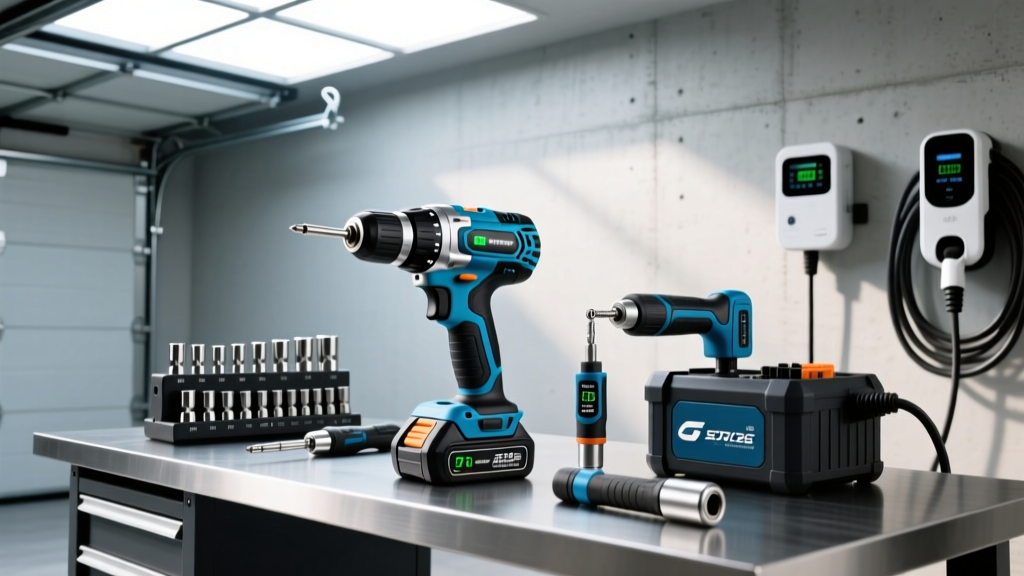
If you're an EV owner building out a home garage, an electric wrench tool (commonly called a cordless impact wrench) is one of the most versatile power tools you can add. Unlike air-powered impact wrenches that require a bulky compressor, modern battery-electric wrenches deliver 300–1,000+ ft-lbs of breakaway torque from a compact, cordless platform — perfect for tire rotations, brake jobs, suspension work, and general fastener removal on any vehicle, electric or gas.
Quick Answer
For most EV owners doing DIY maintenance, a 1/2-inch cordless impact wrench in the 400–700 ft-lbs range covers 95% of tasks. Top 2026 picks run on 18V/20V Max lithium-ion platforms (DeWalt, Milwaukee, Makita) and cost $150–$300 as bare tools. You'll use it most for lug nuts (typically 80–120 ft-lbs spec), caliper bolts, and subframe hardware. Stick with the same battery ecosystem as your other cordless tools to avoid buying duplicate chargers.
Why EV Owners Specifically Need to Think About This Tool
Electric vehicles change the maintenance equation, but not in the way you might expect. An EV like the Tesla Model Y or Hyundai Ioniq 5 still has wheels, brakes, suspension components, and underbody panels that require the same fastener work as any other car. What changes is what you don't do: no oil changes, no spark plugs, no exhaust work, no transmission fluid swaps (on most single-speed reduction gearboxes).
This means your home garage tool needs shift. Instead of a broad mechanic's toolkit optimized for internal-combustion service intervals, EV DIYers concentrate on:
- Tire rotations and changes — EVs are heavy (a Ford F-150 Lightning tips scales at ~6,200 lbs) and eat tires faster due to instant torque. You'll rotate every 5,000–7,500 miles.
- Brake inspections — Regenerative braking saves pad life, but calipers still need service and slide pins need lubrication to avoid seizing.
- Cabin air filter replacement — Often every 15,000–20,000 miles, sometimes requiring panel-clip and fastener removal.
- Underbody panel removal Accessing the 12V auxiliary battery or inspecting the charge port area often means dropping plastic aero shields held by bolts and push-clips.
An electric wrench tool handles the bolted joints in all of these. For push-clips and trim, you'll want a separate nylon pry-tool set ($10–$15).
Electric Wrench vs. Impact Driver vs. Breaker Bar: What's the Difference?
Before you buy, make sure you're selecting the right tool category. These terms get confused:
| Tool Type | Typical Torque | Drive/Bit | Best For |
|---|---|---|---|
| Cordless impact wrench | 300–1,000+ ft-lbs | 1/2", 3/8", or 3/4" square anvil | Lug nuts, suspension bolts, axle nuts |
| Cordless impact driver | 1,500–2,200 in-lbs (~125–180 ft-lbs) | 1/4" hex collet | Screws, small bolts, interior trim fasteners |
| Manual breaker bar | Depends on user (200–400 ft-lbs typical) | Square drive with socket | Stubborn or over-torqued fasteners; no power needed |
| Torque wrench (manual or digital) | Varies by model | Square drive | Final tightening to spec — mandatory for lug nuts |
Critical rule: An impact wrench removes fasteners quickly, but you should never use one for final tightening of lug nuts. Always finish with a calibrated torque wrench set to your vehicle's spec (commonly 90–120 ft-lbs for passenger EVs; check your owner's manual). Over-torqued lugs warp rotors and can snap studs.
What to Look for in a 2026 Electric Wrench Tool
Specs that matter, with real numbers you can compare on the shelf:
- Breakaway torque: The maximum torque the tool can apply to loosen a stuck fastener. For EV passenger cars, 400 ft-lbs is sufficient. For trucks like the Rivian R1T or F-150 Lightning, aim for 600+ ft-lbs to handle larger suspension hardware.
- Fastening torque: Typically 20–30% lower than breakaway. This is the tightening force — still finish with a torque wrench.
- Impacts per minute (IPM): 2,000–3,000 IPM is standard. Higher IPM removes fasteners faster but increases noise and vibration.
- Battery platform voltage: 18V / 20V Max systems dominate. The "20V Max" label is peak voltage; nominal is 18V. Don't read marketing voltage as a performance promise — amp-hours (Ah) of the battery pack determine runtime.
- Weight: Mid-torque 1/2" wrenches weigh 5–7 lbs with battery. Compact models (3/8" drive, ~300 ft-lbs) drop to 3–4 lbs and are easier overhead.
- Brushless motor: Standard in 2026 mid-tier and up. More efficient, longer life, less heat than brushed motors.
Cost Breakdown: Building an EV DIY Garage Around an Electric Wrench
Here's what a realistic first-year EV home-maintenance setup costs, compared to paying a shop:
| Item / Service | DIY Cost (First Year) | Shop Cost (Annual) |
|---|---|---|
| Cordless 1/2" impact wrench (bare tool) | $170–$250 | — |
| 5.0 Ah battery + charger | $130–$180 | — |
| Socket set (SAE + metric, impact-rated) | $60–$120 | — |
| Torque wrench (1/2" drive, 20–150 ft-lbs) | $40–$90 | — |
| Tire rotation (2x/year) | $0 (after tools) | $50–$80 |
| Cabin air filter (annual) | $20–$40 (part) | $60–$120 |
| Brake inspection | $0 (visual, DIY) | $30–$60 |
| Year 1 Total | $420–$680 | $140–$260 |
| Year 2+ Recurring | $20–$40 | $140–$260 |
DIY pays for itself by year 2 or 3, assuming you rotate tires and swap cabin filters yourself. The electric wrench tool is the single biggest line item, but it's a one-time purchase that lasts 5–10 years.
EV-Specific Ownership Considerations That Affect Your Tool Choice
A few things unique to EV ownership shape how and when you'll reach for an impact wrench:
Vehicle Weight and Lug Nut Spec
EVs carry 500–1,500 lbs more mass than equivalent gas cars due to the battery pack. That weight sits low and increases load on wheel bearings and suspension bushings. You'll see larger lug bolts and sometimes higher torque specs. A BMW i4 M50, for example, calls for 103 ft-lbs on its lug bolts — well within a mid-torque wrench's range, but it means you need a tool that can break fasteners that a shop may have over-tightened with an air gun.
High-Voltage System Safety
Your electric wrench tool is safe to use on any 12V-system component, chassis hardware, wheels, and suspension. Never use power tools on or near the orange-sheathed high-voltage cables that run between the traction battery, inverter, and drive motors. Those systems operate at 400V (or 800V on Hyundai/Kia/Genesis E-GMP and Porsche Taycan architectures) and require certified high-voltage training and insulated tools. If a job involves the HV system, it's dealer- or specialist-only.
Cold Climate and Battery Performance
This applies to your tool's battery, not just your car's. Lithium-ion packs in cordless tools lose significant output below 32°F. If you're rotating tires in a Minnesota January, keep your spare tool batteries indoors and swap them warm. A cold 5.0 Ah pack may deliver only 60–70% of rated runtime.
Home Charging Access and Garage Power
If you've already installed a 240V Level 2 home charger (a typical $500–$2,000 install), your garage likely has adequate circuit capacity for tool chargers. Most cordless tool chargers draw 70–100W — trivial compared to a 7.2–11.5 kW EV charger. Plug your tool charger into any standard 120V outlet in the garage without panel concerns.
Common Misconceptions About Electric Wrench Tools for EV Work
| Myth | Fact |
|---|---|
| "EVs don't need any tools — they're maintenance-free." | EVs eliminate fluid changes but still require tire, brake, filter, and suspension service. Tires wear 20–30% faster on EVs due to weight and torque. |
| "I need special insulated tools for my EV." | Only for HV-system work (which you shouldn't DIY). Standard tools are fine for wheels, brakes, cabin, and chassis. |
| "A bigger impact wrench is always better." | A 1,000 ft-lbs high-torque wrench is overkill for a Model 3 and heavy to use overhead. Match tool size to your vehicle class. |
| "I can tighten lug nuts with the impact wrench to save time." | Impact wrenches can't control final torque precisely. Always finish with a torque wrench to spec to avoid warped rotors or snapped studs. |
| "20V tools are more powerful than 18V." | "20V Max" is peak voltage; nominal is 18V. Performance depends on motor design and Ah rating, not the marketing label. |
Decision Framework: Which Electric Wrench Tool Fits Your EV?
Choose a compact 3/8" impact wrench (~250–350 ft-lbs) if:
- You drive a compact or midsize EV (Chevrolet Bolt, Nissan Leaf, Tesla Model 3)
- Your main use is tire rotations and cabin-filter access
- You value one-handed use and lighter weight
Choose a mid-torque 1/2" impact wrench (~400–700 ft-lbs) if:
- You drive a crossover or sedan EV (Tesla Model Y, Hyundai Ioniq 5, Ford Mustang Mach-E)
- You want one tool to cover lugs, caliper bolts, and most suspension fasteners
- This is your only impact wrench — mid-torque is the best all-rounder
Choose a high-torque 1/2" impact wrench (700–1,000+ ft-lbs) if:
- You own an electric truck or large SUV (F-150 Lightning, Rivian R1T, GMC Hummer EV)
- You plan to tackle ball joints, axle nuts, or rusted subframe bolts
- You already have a mid-torque and need a dedicated heavy-duty tool
For most first-time EV buyers adding a single impact wrench to the garage, the mid-torque 1/2" class hits the sweet spot. Pair it with a quality torque wrench, a set of impact-rated sockets (regular chrome sockets can shatter under impact loads), and you're set for years of EV ownership.
Real Costs of EV Ownership vs. Gas: Where DIY Tools Fit In
| Category | EV (e.g., 2026 Model Y LR) | Gas (e.g., 2026 RAV4 AWD) |
|---|---|---|
| EPA efficiency | 117 MPGe combined | 30 MPG combined |
| Energy cost per mile (US avg) | $0.04–$0.06 (home charging) | $0.11–$0.14 ($3.40/gal) |
| Annual fuel/energy (12,000 mi) | $480–$720 | $1,320–$1,680 |
| Annual maintenance (industry avg) | $400–$600 | $900–$1,200 |
| Tire replacement interval | 30,000–40,000 mi | 45,000–60,000 mi |
| DIY tool payback period | ~2 years | ~2 years |
Source: fueleconomy.gov and AAA Your Driving Costs 2025.
EVs save $600–$1,000+ annually on fuel and maintenance. A $200–$300 electric wrench tool accelerates those savings by letting you handle tire rotations and inspections yourself rather than paying a shop. According to IRS §30D rules, qualifying new EVs can also reduce your upfront cost by up to $7,500 via the federal clean vehicle credit (subject to MSRP, income, and battery-sourcing caps), further improving the ownership math.
Frequently Asked Questions
Can I use an electric impact wrench on my EV's lug nuts?
Yes, for removal. For installation, run the lug nuts down with the impact on a low-torque setting, then finish with a calibrated torque wrench to the vehicle's spec (typically 90–120 ft-lbs; check your owner's manual). Never rely on the impact wrench alone for final torque.
Do I need a special socket set for an electric wrench tool?
You need impact-rated sockets, which are made from softer, more ductile steel (usually chrome-molybdenum) that absorbs shock without shattering. Standard chrome vanadium sockets can crack under impact loads and send shrapnel flying. A 15–20 piece metric impact set (10–24mm) costs $40–$80 and covers most EV fasteners.
Will an electric wrench tool damage my EV's battery or electronics?
No. The tool operates independently of the vehicle's electrical system. Just avoid using power tools near the orange high-voltage cables and don't drop metal tools across exposed battery terminals. The 12V system and chassis are safe to work on with standard tools.
What battery Ah rating should I get for my cordless impact wrench?
A 5.0 Ah pack is the practical sweet spot — enough runtime for a full four-wheel tire rotation plus a few other tasks without being excessively heavy. If you already own tools on a platform, use the largest pack you have. Compact 2.0 Ah packs work but will require frequent swaps during bigger jobs.
Is a corded electric wrench tool worth considering over cordless?
Corded electric impact wrenches exist but are rare in 2026 and generally outclassed by modern brushless cordless models. The cord is a hassle under a car, and you need an extension cord rated for the amperage. Cordless 18V/20V platforms offer equivalent or better performance with far more convenience. Stick with cordless.
Bottom line: an electric wrench tool isn't an EV-specific accessory — it's a general-purpose garage tool that happens to pair perfectly with the reduced-maintenance, tire-focused service profile of electric vehicle ownership. Buy into a battery platform you'll use across multiple tools, get a mid-torque 1/2" model, pair it with a torque wrench and impact sockets, and you'll handle the vast majority of DIY EV maintenance safely and efficiently.