The Quick Answer: Is an Electric Work Van Right for Your Business?
An electric work van makes financial sense in 2026 if your daily routes are under 150 miles, you can install Level 2 charging at a depot or home, and you qualify for the up-to-$7,500 federal commercial clean vehicle credit (§45W) or the §30D point-of-sale incentive for small-business buyers. Expect 120–160 miles of real-world range with a full payload, $0.08–$0.14 per mile in electricity versus $0.18–$0.25 for gas, and significantly lower maintenance costs. The trade-off: higher upfront pricing ($45,000–$60,000 base MSRP before incentives), 45–60 minute DC fast-charge sessions at public stations, and reduced range in cold climates or at sustained highway speeds.
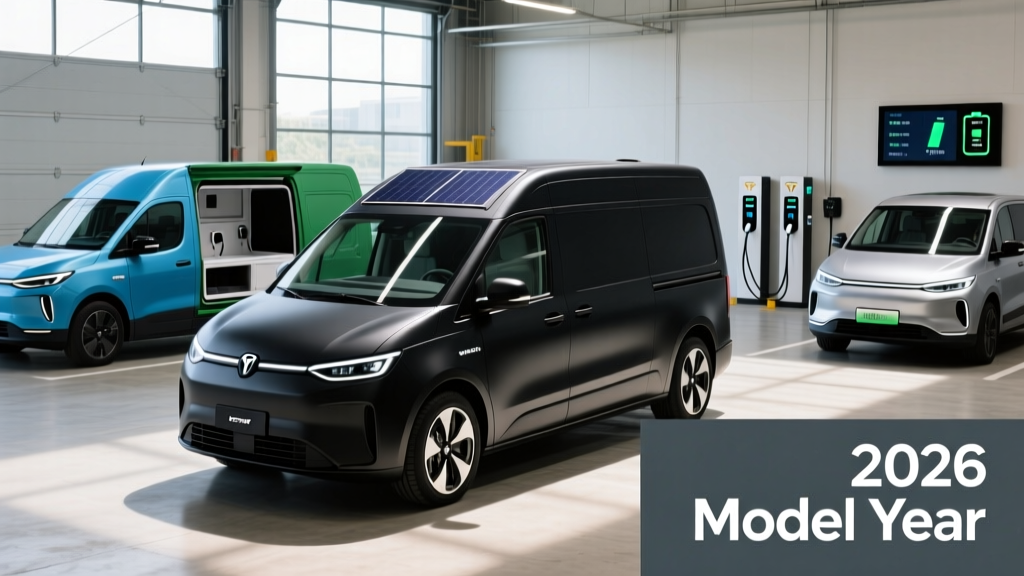
The commercial electric van market has matured considerably. The Ford E-Transit, BrightDrop Zevo 400/600, Mercedes-Benz eSprinter, and Ram ProMaster EV now offer viable alternatives to their diesel and gasoline counterparts — but only for specific duty cycles. Below, we break down exact costs, ranges, charging speeds, and the ownership realities that dealer brochures gloss over.
Top Electric Work Vans: Side-by-Side Specs
| Specification | Ford E-Transit (2026) | BrightDrop Zevo 400 | Mercedes-Benz eSprinter (2026) | Ram ProMaster EV |
|---|---|---|---|---|
| EPA Range (cargo-empty) | 126 mi | ~160 mi (est.) | ~200 mi (est.) | ~162 mi (est.) |
| Battery Capacity | 68 kWh usable (NMC) | ~115 kWh usable (NMC) | ~113 kWh usable (NMC) | ~110 kWh usable (NMC) |
| Peak DC Fast Charge | 115 kW | 120 kW | 115 kW | 150 kW |
| 10–80% DCFC Time | ~45 min | ~50 min | ~42 min | ~40 min |
| Level 2 Charge Rate | 10.5 kW | 11.5 kW | 9.6 kW | 11.5 kW |
| Max Payload | 3,880 lbs | 2,500 lbs | 2,624 lbs | 3,040 lbs |
| Cargo Volume | 246.7 cu ft (LR) | 412 cu ft | 314 cu ft (LR) | 285 cu ft |
| Motor Output | 266 hp / 317 lb-ft | ~240 hp | 201 hp / 332 lb-ft | 266 hp / 302 lb-ft |
| Base MSRP (2026) | ~$46,000 | ~$55,000 (fleet) | ~$55,500 | ~$52,000 |
| Powertrain Warranty | 8 yr / 100,000 mi | 8 yr / 100,000 mi | 8 yr / 100,000 mi | 8 yr / 100,000 mi |
Note: BrightDrop, eSprinter, and ProMaster EV figures marked as estimates are based on preliminary manufacturer disclosures and EPA testing trends. Always verify with the OEM or fueleconomy.gov before purchase. Source for Ford E-Transit confirmed specs: Ford Commercial Vehicles.
Electric Work Van vs. Gas Van: Real Cost Comparison
The sticker price of an electric work van is $10,000–$20,000 higher than an equivalent gas-powered Ford Transit or Ram ProMaster. The question is whether operating savings close that gap within your ownership window. Here's a five-year, 75,000-mile total cost of ownership (TCO) model based on a typical last-mile delivery route (100 miles/day, 250 days/year):
| Cost Category (5-Year / 75k mi) | Ford E-Transit (Electric) | Ford Transit 350 (Gas, 3.5L V6) |
|---|---|---|
| Base MSRP | $46,000 | $43,500 |
| Federal Tax Credit (§45W or §30D) | –$7,500 | $0 |
| Effective Purchase Price | $38,500 | $43,500 |
| Fuel / Energy (75,000 mi) | $7,500 (avg $0.10/mi at depot L2) | $16,875 (avg 15 mpg, $3.375/gal) |
| Maintenance (oil, filters, brakes) | $2,200 | $6,800 |
| Insurance (est.) | $12,500 | $10,500 |
| Estimated Resale Value (Year 5) | –$14,000 | –$16,000 |
| Net 5-Year Cost | $46,700 | $61,675 |
| Cost Per Mile | $0.62 | $0.82 |
Key takeaways from this model:
- Energy savings are massive — roughly $9,000+ over five years if you charge primarily at a depot on Level 2 power at commercial electricity rates ($0.10–$0.14/kWh).
- Maintenance savings add up — no oil changes, no transmission fluid, and regenerative braking extends brake pad life by 2–3×. Expect to spend roughly one-third of what a gas van costs in scheduled maintenance.
- Insurance runs 10–20% higher for electric commercial vehicles due to higher repair costs for battery-adjacent damage and limited collision repair networks.
- The tax credit is critical — without it, the payback period stretches from ~2.5 years to ~4.5 years.
Tax Credits and Incentives: What You Actually Qualify For
Business buyers should understand two distinct federal incentives for electric work vans in 2026:
- §45W Commercial Clean Vehicle Credit: Available to businesses that purchase qualifying EVs for commercial use. The credit is up to $7,500 for vehicles under 14,000 lbs GVWR. The van must meet battery-component and critical-mineral sourcing requirements, which tighten annually. Filed via IRS Form 8936 equivalent for commercial entities. Check current rules at IRS.gov §45W.
- §30D New Clean Vehicle Credit: If you're a sole proprietor or single-vehicle buyer purchasing for personal/small-business use, the §30D point-of-sale transfer may apply. This has MSRP caps ($80,000 for vans), buyer income limits ($300k joint / $150k single), and the same battery-sourcing requirements. Not all vans will qualify every year — critical-mineral rules disqualify some battery supply chains.
§45W / §30D Eligibility Checklist for Electric Work Vans:
- Vehicle GVWR under 14,000 lbs (all vans above qualify)
- MSRP at or below $80,000 cap (all base models qualify; loaded trims may exceed)
- Battery components: required percentage manufactured in North America (increases yearly through 2029)
- Critical minerals: required percentage sourced from US or FTA partners
- Buyer income (for §30D): ≤$300k joint, ≤$225k HOH, ≤$150k single
- Vehicle must be new, not previously titled
- Check VIN eligibility on fueleconomy.gov before purchase
Many states also offer commercial EV rebates — California's HVIP, New York's Truck Voucher Incentive Program, and others can stack on top of federal credits, sometimes covering $10,000–$18,000 additional. Check your state energy office for current availability.
Real-World Range: What the EPA Sticker Doesn't Tell You
EPA Range vs. Reality for Electric Work Vans:
The Ford E-Transit's EPA-rated 126 miles assumes moderate speeds, partial payload, and mild temperatures. In real-world fleet testing:
- Full payload + city stop-and-go: ~110–120 miles (regen braking helps here)
- Full payload + highway (65–75 mph): ~85–100 miles (aerodynamic drag dominates)
- Winter (below 32°F) + payload: ~75–95 miles (battery chemistry slows, cabin heat draws ~3–5 kW)
- Summer A/C + payload: ~105–115 miles (thermal management is more efficient than heating)
This is the single biggest mistake fleet buyers make: spec'ing an electric work van based on EPA range alone. If your route is 110 miles with 2,000 lbs of cargo in January in Chicago, the E-Transit's 126-mile EPA figure won't cut it. You'd need the eSprinter or Zevo 600 with larger battery packs — or you need to plan a mid-day DC fast-charge stop.
Charging-curve reality: When manufacturers quote a "peak" DC fast-charge rate of 115–150 kW, that speed applies only between roughly 15% and 50% state of charge (SoC). Above 80%, the charge rate tapers sharply — often dropping below 30 kW — to protect battery longevity. A "10–80% in 45 minutes" claim doesn't mean 80–100% takes another 10 minutes. Budget 25–35 extra minutes if you need a full battery for a second shift.
Charging Infrastructure: Depot, Home, and Public Options
Your charging strategy determines whether an electric work van is an asset or a liability. Here's a realistic breakdown:
| Charging Level | Power | Miles Added/Hour | Best For | Install Cost |
|---|---|---|---|---|
| Level 1 (120V outlet) | ~1.4 kW | ~3–4 mi/hr | Emergency / overnight top-off only | $0 (existing outlet) |
| Level 2 (240V, depot/home) | 7.2–11.5 kW | ~18–30 mi/hr | Primary daily charging (overnight) | $2,500–$8,000 per stall |
| DC Fast Charge (public) | 50–150 kW | ~100–200 mi/hr (peak) | Mid-day top-up, route extension | N/A (pay per kWh) |
Depot Level 2 installation costs for a commercial fleet setup break down roughly as follows:
| Component | Cost Range (per charger) |
|---|---|
| Level 2 commercial EVSE (e.g., ChargePoint CT4000, EVgo X) | $1,500–$4,000 |
| Electrical panel upgrade (if needed, 200A → 400A) | $3,000–$10,000 |
| Conduit, wiring, trenching (50–100 ft run) | $1,500–$5,000 |
| Permits and inspection | $200–$800 |
| Electrician labor | $1,500–$4,000 |
| Total per stall | $7,700–$23,800 |
For a small fleet of three vans, budget $25,000–$50,000 for depot charging infrastructure. The federal §30C Alternative Fuel Vehicle Refueling Property Credit can cover up to 30% of hardware and installation costs (capped at $100,000 per item for commercial property), but only in eligible census tracts. Confirm eligibility with your tax professional.
Public DC fast charging costs $0.30–$0.55/kWh on networks like Electrify America, EVgo, and ChargePoint — roughly 3–5× more expensive than depot Level 2. Relying on public charging erases most of the per-mile fuel savings versus gas. Plan depot charging as your baseline; public DCFC is your safety net.
Common Misconceptions About Electric Work Vans
| Myth | Fact |
|---|---|
| "Electric vans can't handle real payloads." | The Ford E-Transit tows up to 3,880 lbs payload and 4,290 lbs towing. Performance under load is strong (instant torque), but range drops 15–25% at max payload. |
| "Batteries will need replacing at 100k miles." | NMC batteries in commercial vans are warrantied for 8 years/100,000 miles at 70% capacity retention. Real-world fleet data shows ~85–90% SoH at 100k miles with proper charging habits (avoiding daily 100% SoC). |
| "Charging takes too long for commercial use." | Overnight Level 2 depot charging (8–10 hours) fully replenishes any current electric van. The time problem only exists if you need mid-day top-ups on tight schedules. |
| "All electric vans qualify for the $7,500 tax credit." | Battery-sourcing and critical-mineral requirements tighten annually. Some model-year/vin combinations may qualify for a partial credit ($3,750) or none. Always verify on fueleconomy.gov before purchase. |
| "Electric vans are cheaper in every scenario." | If you drive 250+ miles/day, lack depot charging access, or operate in extreme cold without a heated garage, a gas or diesel van still wins on TCO in 2026. |
Decision Framework: Should You Buy an Electric Work Van?
Choose an electric work van if:
- Your daily route is under 130 miles (or under 100 miles in cold climates)
- You can install Level 2 charging at your depot or home
- You qualify for the §45W or §30D tax credit (verify VIN on fueleconomy.gov)
- Your fleet operates primarily in urban/suburban stop-and-go routes (regen braking maximizes efficiency)
- You plan to own the vehicle 4+ years (to capture the TCO advantage)
- You value reduced noise for early-morning/late-night urban deliveries
Stick with a gas or diesel van if:
- Your daily route exceeds 180 miles or includes sustained highway driving above 70 mph
- You lack access to depot or home charging and would rely on public DCFC
- You operate in extreme cold (below 10°F) without a heated garage
- You need to tow over 5,000 lbs regularly
- You turn over vehicles every 2–3 years (higher upfront cost won't be recaptured)
- Your routes include rural areas with no DC fast-charging infrastructure
First-Time EV Fleet Buyer: What You Need to Know
If this is your first electric commercial vehicle, here are the operational shifts to prepare for:
- Route planning becomes charging planning. Map your routes against available range with payload and climate factored in. Fleet management software like Ford Pro's Charge Genius or Geotab can optimize this.
- Preconditioning matters. Setting the van to warm its battery and cabin while still plugged in (via scheduled departure) preserves 5–10% of range that would otherwise be lost to heating on the road.
- Train drivers on regen braking. One-pedal driving extends range by 8–12% in city conditions and reduces brake wear. Most fleet operators report drivers adapt within a week.
- Budget for electrical upgrades early. Contact a licensed commercial electrician for a site assessment 3–6 months before vehicle delivery. Utility interconnection approvals for multi-stall depots can take 8–12 weeks.
- Monitor State of Health (SoH). Use the OEM telematics dashboard to track battery degradation quarterly. Keeping daily charge limits at 80–90% (not 100%) extends long-term battery life. Reserve 100% charges for days when you need maximum range.
- Insurance quotes first. Get fleet insurance quotes before ordering. Some carriers still surcharge EVs 15–20%, and you need that number in your TCO model.
Frequently Asked Questions
How long do electric work van batteries last before replacement?
All major commercial electric vans carry an 8-year/100,000-mile battery warranty guaranteeing at least 70% capacity retention. Real-world fleet data from early Ford E-Transit and BrightDrop adopters shows approximately 85–92% State of Health at 100,000 miles when vehicles are charged primarily on Level 2 and avoid repeated 100% SoC. Full battery replacement, if needed out of warranty, costs $12,000–$20,000 depending on pack size, though this scenario is rare before 150,000+ miles.
Can I charge an electric work van on a standard household outlet?
Yes, but Level 1 (120V) charging adds only 3–4 miles of range per hour. For a 126-mile-range E-Transit, a full charge from empty would take 35–40 hours. Level 1 is suitable only for emergency top-offs or very low-mileage use. Plan for a 240V Level 2 installation as your primary charging solution.
Do electric work vans lose range in winter?
Yes. Expect 20–35% range reduction in sustained below-freezing temperatures. This comes from both battery chemistry (slower ion movement in cold cells) and cabin/cargo heating (which draws 3–5 kW continuously). A van rated at 126 miles EPA may deliver 80–100 miles in a 20°F winter. Preconditioning while plugged in and using heated seats instead of cabin heat can recover 5–10% of this loss.
Is an electric work van eligible for the $7,500 federal tax credit?
Possibly — but eligibility depends on the specific model year, VIN battery sourcing, and your business structure. The §45W commercial credit and §30D consumer credit have different rules. Battery-component and critical-mineral sourcing requirements tighten annually, and some vans that qualified in 2024 may not in 2026. Always check your specific VIN on fueleconomy.gov and consult a tax professional before finalizing a purchase.
What happens if the van runs out of charge on a route?
Unlike a gas van where a quick fuel stop takes 5 minutes, a depleted electric van requires a tow to a charger or 30–60 minutes at a DC fast-charger to resume. Fleet best practice is to set a 20% SoC buffer alert and plan routes with a 15–20% range margin above expected consumption. Most commercial telematics systems will flag range-risk routes before dispatch.
How does payload affect electric van efficiency vs. a gas van?
Both vehicle types lose efficiency under load, but the impact differs. A gas van's MPG drops 10–15% at full payload. An electric van's range drops 15–25% at full payload (more sensitive because the baseline energy reserve is fixed and smaller). However, electric vans maintain strong acceleration under load due to instant electric motor torque — no downshifting or power-band lag. Regenerative braking also recovers more energy in stop-and-go conditions when the vehicle is heavier.
Always verify current pricing, incentives, and specifications with the manufacturer and IRS.gov before purchasing. Tax credit rules are subject to change annually. Real-world range and efficiency figures are based on fleet testing data and may vary with driving conditions, climate, and vehicle configuration.