If you're considering an electric work truck for job-site duty, fleet use, or heavy hauling, the short answer is that today's best options — the Ford F-150 Lightning, Chevrolet Silverado EV, and Rivian R1T — can handle most light-to-medium commercial tasks with lower per-mile energy costs than gas, provided your daily route stays under ~250 miles and you can charge at a depot or home overnight. For long-haul towing over 300 miles or remote job sites without charging infrastructure, a diesel or hybrid truck still holds an edge.
Quick Verdict: Who Should Buy an Electric Work Truck?
Buy electric if: Your daily driving is under 250 miles, you have Level 2 charging at home or a depot, and you value low running costs, instant torque for hauling, and on-site power output (V2L/V2H).
Stick with gas/diesel if: You regularly tow over 7,000 lbs for 300+ miles in a single day, operate in extreme cold without garage parking, or work in rural charging deserts.
The Current Electric Work Truck Lineup (2026 Models)
Three serious contenders dominate the electric truck space for work use. Each targets a slightly different buyer, from fleet operators to owner-operators on job sites.
| Spec | Ford F-150 Lightning | Chevrolet Silverado EV | Rivian R1T |
|---|---|---|---|
| EPA Range | 240–320 mi | 390–460 mi | 270–420 mi |
| Battery (usable) | 98 kWh (Std) / 131 kWh (Ext) | 200 kWh (Max Range) | 106 kWh (Std) / 149 kWh (Max) |
| Chemistry | NMC | NMC (Ultium) | NMC (Samsung SDI) |
| Max DC Fast Charge | ~210 kW peak | ~350 kW peak | ~220 kW peak |
| 10–80% Charge Time | ~41 min (Ext Range) | ~20 min (Max Range) | ~30 min (Max Pack) |
| Level 2 Rate | 19.2 kW (80A) | 19.2 kW (80A) | 11.5 kW (48A) |
| Max Towing | 10,000 lbs | 12,500 lbs | 11,000 lbs |
| Max Payload | 2,235 lbs | 1,800 lbs | 1,760 lbs |
| Horsepower | 580 hp (Ext Range) | 754 hp (4WT) | 665 hp (Dual) |
| 0–60 mph | ~3.8 sec | ~4.5 sec | ~3.0 sec |
| Base MSRP (2026) | ~$55,000 | ~$57,000 | ~$69,900 |
| Powertrain Warranty | 8 yr / 100,000 mi | 8 yr / 100,000 mi | 8 yr / 175,000 mi |
| Pro Power / V2L | 9.6 kW (Pro Power Onboard) | Up to 10.2 kW (PowerBase) | Vehicle-to-Home capable |
Sources: fueleconomy.gov, Ford F-150 Lightning specs, Chevrolet Silverado EV configurator.
Real-World Range: What the EPA Sticker Doesn't Tell You
EPA vs. Reality for Work Trucks
F-150 Lightning Extended Range (320 mi EPA): Expect ~240–270 mi on mixed highway driving at 70 mph. With a 5,000-lb trailer in tow, that drops to roughly 150–180 mi. In sub-30°F weather without preconditioning, plan for 20–30% range loss.
Silverado EV Max Range (460 mi EPA): Real-world highway driving yields ~360–390 mi unloaded. Towing 8,000 lbs cuts range to approximately 200–240 mi. This is currently the longest-range electric work truck available, giving it a clear advantage for regional routes.
Rivian R1T Max Pack (420 mi EPA): Expect ~330–360 mi on highway. Towing near max capacity reduces range to ~180–220 mi. The R1T's quad-motor efficiency is strong, but its smaller bed limits pure work utility.
The physics are straightforward: towing and hauling add aerodynamic drag and rolling mass, which hit EVs harder than gas trucks because regenerative braking can't recover energy on flat highway cruising. A gas F-150 towing 7,000 lbs loses about 30–40% of its MPG; an F-150 Lightning towing the same load loses 40–50% of its range. Plan routes around this reality.
Electric Work Truck vs. Gas Truck: Total Cost Breakdown
The purchase price of an electric work truck is higher than a comparable gas F-150 or Silverado, but operating costs tell a different story — especially for stop-and-go job-site driving where regenerative braking maximizes efficiency.
| Cost Factor (5-Year / 75,000 mi) | F-150 Lightning (Ext Range) | F-150 Gas (3.5L EcoBoost) |
|---|---|---|
| Base MSRP | $65,000 | $52,000 |
| Federal Tax Credit (§30D) | –$7,500* | $0 |
| Effective Purchase Price | $57,500 | $52,000 |
| Fuel/Energy (75k mi) | $4,800 (home L2 @ $0.14/kWh) | $12,400 (@ $3.50/gal, 18 MPG) |
| Maintenance | $1,200 | $4,500 |
| Insurance (est. avg) | $11,500 | $9,200 |
| Estimated Depreciation | $22,000 | $18,000 |
| 5-Year Total Cost | $97,000 | $86,100 |
*The IRS §30D credit of up to $7,500 requires meeting MSRP caps ($80,000 for trucks/vans), buyer income limits ($300k joint / $150k single), and battery critical-mineral and component sourcing rules. Eligibility varies by trim and model year — confirm at the point of sale and with a tax professional. The credit can now be transferred to the dealer as a point-of-sale discount.
For fleet buyers, commercial tax credits under §45W (up to $7,500 for vehicles under 14,000 lbs GVWR) may apply instead of §30D. Consult your fleet manager and tax advisor.
Charging Infrastructure: Depot, Job Site, and Public Networks
An electric work truck is only as practical as your charging plan. Here's what you need to know about keeping one powered up for daily work.
| Level | Power | Miles Added per Hour | Use Case |
|---|---|---|---|
| Level 1 (120V) | ~1.4 kW | ~3–5 mi/hr | Emergency/top-off only |
| Level 2 (240V, 48A) | ~11.5 kW | ~28–35 mi/hr | Overnight home/depot |
| Level 2 (240V, 80A) | ~19.2 kW | ~48–58 mi/hr | Fleet depot, full overnight |
| DC Fast Charge | 210–350 kW | ~500–900 mi/hr (peak) | Mid-shift top-up, road trips |
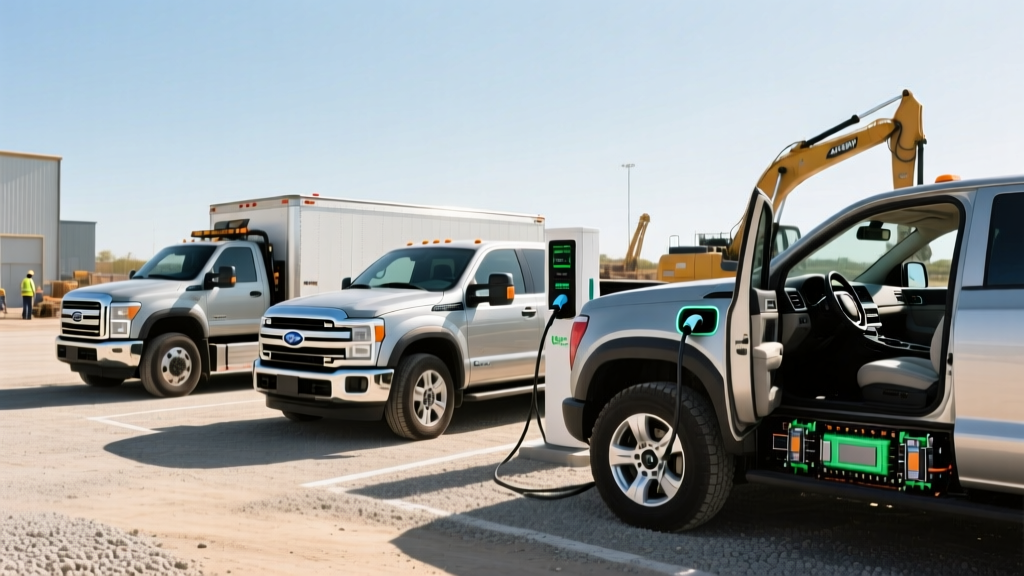
Home/Depot Charging: A Level 2 charger at 80 amps (19.2 kW) will fully replenish an F-150 Lightning Extended Range (~131 kWh usable) in about 7.5 hours — ideal for overnight turnaround. Expect installation costs of $1,500–$3,500 for a hardwired 100-amp circuit, including a panel upgrade if your existing electrical panel is maxed out. Fleet operators installing multiple chargers should budget $5,000–$15,000 per stall with commercial-grade equipment and potential utility demand charges.
Public DC Fast Charging: The Silverado EV's 350 kW peak charge rate on 800-volt architecture is a standout — a 10–80% session takes roughly 20 minutes at a compatible Electrify America or EVgo 350 kW station. The Lightning peaks at ~210 kW on 400-volt architecture, meaning 10–80% takes ~41 minutes. For a crew on a lunch break, the Silverado's faster curve is a meaningful productivity advantage.
Important caveat: Peak charge rates only hold between roughly 10–50% State of Charge (SoC). Above 80%, charging slows dramatically to protect the battery. Plan your DCFC stops around the 10–80% window for maximum efficiency.
Common Misconceptions About Electric Work Trucks
| Myth | Fact |
|---|---|
| "EV trucks can't tow anything." | The F-150 Lightning is rated for 10,000 lbs, the Silverado EV for 12,500 lbs. The real limitation is range while towing, not capability. Plan for 150–240 mi of range under heavy tow. |
| "Batteries need replacing every few years." | Modern NMC packs are warrantied for 8 years / 100,000–175,000 miles at 70%+ capacity retention. Real-world data from high-mileage EVs shows ~10–15% degradation over 150,000 miles with proper thermal management. |
| "You'll be stranded with no charging." | The U.S. now has over 70,000 public charging ports. The real risk is in rural corridors and remote job sites — plan routes with AFDC's station locator and keep a 20% buffer. |
| "Cold weather kills EV trucks." | Sub-20°F temperatures reduce range by 20–30% due to battery chemistry and cabin heating demands. Preconditioning while plugged in and using seat/steering-wheel heaters mitigates most of this. Garage parking helps significantly. |
| "Electric trucks are slow off the line when loaded." | Electric motors deliver peak torque at 0 RPM. The Lightning hits 60 mph in ~3.8 seconds unloaded — faster than any gas F-150. Loaded performance remains strong because electric drivetrains don't need to build revs. |
On-Site Power: The Work Truck as a Mobile Generator
One feature that sets electric work trucks apart from any gas competitor is vehicle-to-load (V2L) and vehicle-to-home (V2H) capability — turning the truck's massive battery into a mobile power source.
The F-150 Lightning's Pro Power Onboard delivers up to 9.6 kW of continuous 120V/240V output through outlets in the bed and cabin. That's enough to run chop saws, air compressors, welders (small), and job-site lighting simultaneously — without the noise, fumes, or fuel cost of a portable gas generator. The Silverado EV offers a similar system called PowerBase with up to 10.2 kW output.
For context, a typical Honda EU7000iS generator produces about 5.5 kW and costs roughly $4,000 plus fuel and maintenance. Your electric work truck's battery holds 131–200 kWh of energy — effectively replacing a week's worth of generator fuel on a single charge.
Decision Framework: Which Electric Work Truck Is Right for You?
Choose Based on Your Work Pattern
Choose the Ford F-150 Lightning if: You want the most proven platform (on sale since 2022), need 9.6 kW Pro Power Onboard for job-site tools, prefer Ford's dealer and service network for fleet maintenance, and your daily routes stay under 250 miles.
Choose the Chevrolet Silverado EV if: Range is your top priority (up to 460 mi EPA), you need the fastest DC charging (350 kW peak, 10–80% in ~20 min), you tow heavier loads regularly (12,500 lbs max), and you can accommodate the larger vehicle footprint and higher starting price on upper trims.
Choose the Rivian R1T if: You want the best on-road performance and adventure capability alongside work use, value the longest powertrain warranty (8 yr / 175,000 mi), and don't need a full-size 8-foot bed. The R1T's ~4.5-foot bed is better suited for tools and materials than long lumber.
Stick with gas/diesel if: You regularly exceed 300 miles per day while towing, operate in areas with sparse DC fast-charging infrastructure, or need to refuel in under 5 minutes between back-to-back job sites without route flexibility.
What First-Time Electric Truck Buyers Must Know
Electrical panel capacity: Before ordering, have a licensed electrician assess your home or depot panel. A 19.2 kW Level 2 charger requires a dedicated 100-amp circuit. If your panel is a 100-amp or 150-amp residential unit, expect a $2,000–$5,000 panel upgrade to 200 amps or higher.
Tax credit complexity: The §30D federal credit has layered requirements — MSRP under $80,000 for trucks, buyer AGI under income caps, and battery component/critical-mineral sourcing thresholds that change annually. Not every trim qualifies every year. Verify eligibility at irs.gov before committing.
Insurance costs: EV trucks typically carry 15–25% higher insurance premiums than gas equivalents due to higher repair costs and battery replacement risk. Get quotes before purchasing — the premium difference can eat into fuel savings.
Depreciation uncertainty: EV depreciation curves are still stabilizing. Early Lightning owners saw steep drops as new inventory caught up with demand. Leasing or buying with the intent to run the truck 5+ years and 100,000+ miles is the safest financial play.
Charge planning is non-negotiable: Unlike gas trucks, you can't wing it on long hauls. Use apps like A Better Routeplanner or the OEM's built-in route planner to map charging stops. On job sites without charging, a Level 1 trickle (120V) adds only ~3–5 miles per hour — not enough for daily work use.
Can an electric work truck handle a full day on a construction site?
Yes, for most light-to-medium duty. An F-150 Lightning with the extended-range battery can idle, drive short distances between sites, and power tools via Pro Power Onboard for a full 8–10 hour day while using 40–60% of its battery. Heavy highway driving between distant sites is where range becomes a constraint.
How much does it cost to charge an electric work truck at home?
At the U.S. average residential rate of ~$0.16/kWh (as of 2025 EIA data), fully charging an F-150 Lightning Extended Range (131 kWh usable) costs roughly $21. That delivers ~240–270 real-world miles — equivalent to about $47 worth of gas at 18 MPG and $3.50/gallon. You save roughly $26 per fill-up equivalent.
Are electric work trucks eligible for the $7,500 federal tax credit?
Potentially, but it depends on the specific trim, model year, your income, and current battery-sourcing rules. The truck must have an MSRP under $80,000 and the buyer must fall under IRS income caps. Commercial buyers may qualify under §45W instead. Always confirm at the dealership and with a tax professional.
What happens if the battery degrades significantly?
All three trucks carry 8-year / 100,000+ mile battery warranties guaranteeing at least 70% capacity retention. Real-world data from Tesla, Hyundai, and Ford fleets suggests NMC batteries lose roughly 8–12% capacity over 100,000 miles with normal use. Full battery replacement out of warranty currently costs $15,000–$25,000 depending on pack size — a real but infrequent expense.
Is an electric work truck practical in cold climates?
It's workable with planning. Expect 20–30% range loss below 20°F. Precondition the battery while plugged in each morning, use heated seats instead of cabin heat when possible, and add 25–30% to your range buffer on cold days. Garage parking and depot charging make a significant difference. Extreme cold combined with heavy towing is the worst-case scenario where gas or diesel still wins.